


Several processes regarding sanctions pressure on Russia and support for Ukraine are unfolding simultaneously in the US. House Democrats are expressing reservations about Senator Graham's bill, while the US Treasury Department has imposed new restrictions on the Russian bank VTB due to its dealings with Iran. US authorities are also handling a case involving the illegal shipment of American aerospace components to Russia.
Jeffries explains why US Democrats are cautious about Graham's sanctions bill
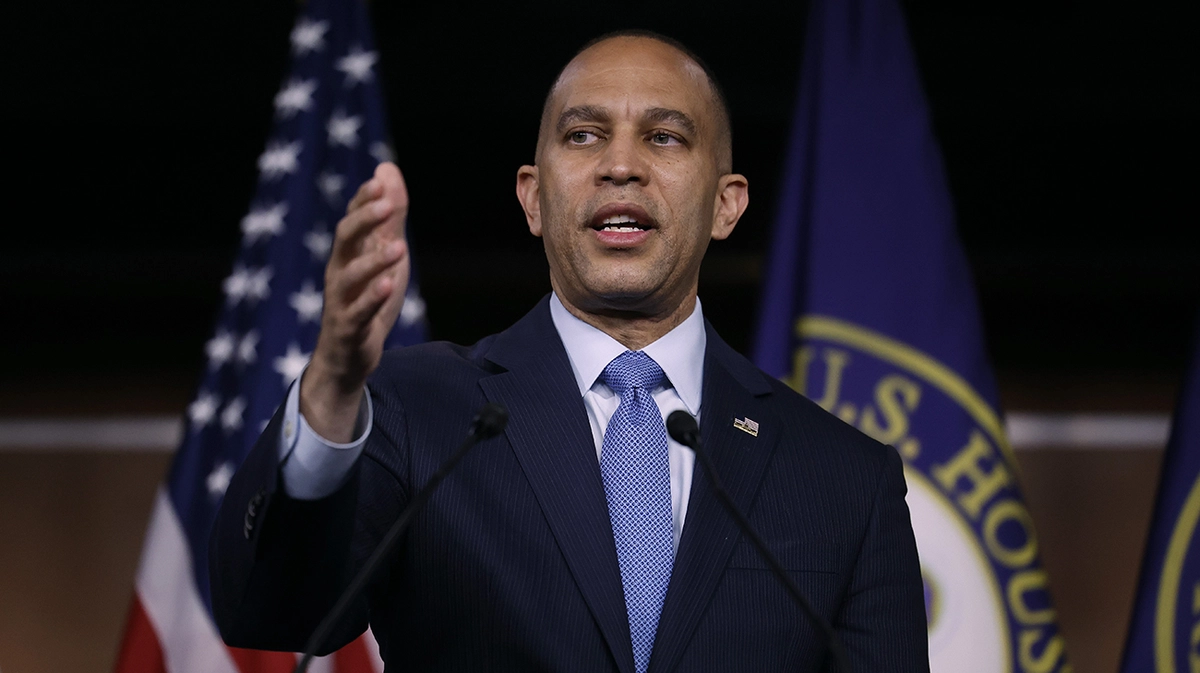
US House Democratic Leader Hakeem Jeffries said, that his party continues to support Ukraine but holds serious reservations regarding the bill on additional sanctions against Russia and Iran, authored by Senator Lindsey Graham. While the document previously garnered broad bipartisan support in the Senate, House Democrats have publicly voiced doubts about its provisions. During a press conference, Jeffries confirmed that Democrats are concerned the bill could grant US President Donald Trump excessively broad powers—a concern he shares.
Jeffries emphasized that House Democrats have supported Ukraine since the start of the full-scale war and have participated in approving aid packages.
"House Democrats, led by (former – Ed.) Speaker Nancy Pelosi, have supported the Ukrainian people from the very beginning." "Every legislative package passed by Congress to support the bravery, courage, and sovereignty of the Ukrainian people was a direct result of the leadership of President Biden, House Democrats, or their joint efforts, and that leadership will continue," Jeffries said.
He urged the Trump administration to abandon the "my way or the highway" approach and to negotiate with Democratic representatives on a potential bipartisan solution.
"It is worth sitting down at the negotiating table to discuss this with incoming Committee Chair Meeks, incoming Committee Chair Neal, as well as Linda Sánchez, Steny Hoyer, and other colleagues who have ideas on how to reach a bipartisan solution," he stated.
The US has imposed sanctions on Russia's VTB
On September 14, the US Department of the Treasury added the Russian bank VTB to its sanctions list due to its activities in Iran's financial sector. The US Office of Foreign Assets Control (OFAC) stated that the bank had helped Iran circumvent sanctions. According to the US agency, over the past three years, VTB established correspondent relationships with sanctioned Iranian banks, utilizing accounts for mutual payments. In January 2025, the bank began expanding its presence in Tehran, notably by opening offices to coordinate with Iranian authorities and foster trade between the two countries.
According to US Treasury, VTB also established a settlement system using national currencies via correspondent accounts denominated in Iranian rials and Russian rubles. The U.S. side alleges that the bank took steps to move billions of dollars in frozen Iranian assets. The sanctions were imposed as part of Operation "Economic Outcast," announced by U.S. Treasury Secretary Scott Bessent on August 24, 2026.
"The Treasury Department will not tolerate any support for the regime and will continue to identify, expose, and isolate those who aid Iran," Bessent said.
The U.S. Treasury warned foreign financial institutions of the high risks associated with doing business with VTB following its designation and stated that such institutions could face restrictions on U.S. correspondent accounts. VTB had previously been subject to U.S. sanctions, notably in February 2022 and January 2025.
Russian national pleads guilty to illegally supplying U.S. aerospace parts to Russia
In the United States, 32-year-old Andrei Samuylovsky—who holds citizenship of Estonia, Switzerland, and Russia—pleaded guilty to the illegal export of U.S. aviation and aerospace components to Russia. This was announced by The U.S. Department of JusticeAccording to court documents, from early 2022 through September 2024, Samuilovskyi and other participants in the scheme supplied aerospace-related components to restricted Russian end-users. They did not obtain the required licenses from the U.S. Department of Commerce’s Bureau of Industry and Security for the export of these goods.
Samuilovskyi was a co-founder of ITC Middle East FZ-LLC, a company officially registered in March 2022—approximately four weeks after the start of Russia’s full-scale invasion of Ukraine. Between the company's inception and September 2024, U.S. businesses made dozens of shipments to ITC, supplying goods of U.S. origin—primarily aerospace items subject to U.S. export controls—valued at nearly $2 million. These goods were subsequently re-exported to Russia. Samuilovskyi is scheduled to be sentenced on January 13, 2027, and faces a maximum penalty of 20 years in prison.
Ukraine seeks new countermeasures against high-speed Russian drones
Ukraine is developing new means to counter Russian jet-powered attack drones, which represent a faster and harder-to-intercept version of the Shahed-type drone. In July, the Ukrainian military invited a large group of manufacturers to test new interceptors; however, the trials revealed control issues when the craft exceeded speeds of 400 kilometers per hour. According to Reuters, sources, some interceptors crashed into fields and forests. The tests highlighted the difficulty of the challenge ahead of the winter season, a time when Ukraine is simultaneously facing a shortage of Western air defense systems capable of countering ballistic missiles.
According to the Ukrainian military, Russia increased its use of jet-powered drones roughly sixfold over the three summer months. In June, Russian forces launched approximately 450 drones with speeds ranging from 240 to 500 kilometers per hour, while in August, that figure rose to around 2,850. Ukrainian intelligence estimates Russia's production of such drones at approximately 3,000 units per month, with the highest volume of attacks targeting Kyiv and the surrounding region, as well as the Odesa area. Maksym Zhorin, Deputy Commander of the 3rd Army Corps, stated:
"We have once again completely ceded the initiative regarding jet-powered drones—that is a fact." He added: "The Russians have established mass production and deployment of jet-powered Shaheds, while we don't even know what to do about them."
Ukrainian manufacturers and the military are working on new interceptors, including jet-powered craft and low-cost guided missiles. According to Yurii Cherevatenko, a representative of the Ukrainian Air Force, some of the new missiles are already undergoing testing, and their cost is expected to be significantly lower than that of the targets they are designed to destroy. Ukraine is also considering a networked approach in which multiple systems simultaneously influence drone navigation and alter their flight paths. Another area of development involves AI systems designed to intercept jet-powered drones on head-on courses, as current interceptors often struggle to catch them. Until these new technologies are deployed at scale, military aircraft continue to intercept a significant number of such targets; however, due to dwindling air-to-air missile stocks, pilots are increasingly forced to use their cannons.
Trump urged Zelenskyy not to attack Russian diesel production infrastructure
US President Donald Trump called on Ukrainian President Volodymyr Zelenskyy to halt strikes on Russian infrastructure linked to diesel fuel production. According to Trump, Ukrainian attacks on Russian oil refineries reduce fuel output and contribute to shortages. In recent months, Ukraine has carried out a series of long-range drone attacks on Russian oil refineries. Kyiv maintains that these facilities are legitimate military targets, while Russia has faced shortages of gasoline and other fuels due to the drop in production.
"Mr. Zelenskyy needs to do one thing: he needs to stop knocking out diesel fuel in Russia," Trump told reporters during a visit to the Irish Open golf tournament.
He added: "We’ve spoken to Mr. Zelenskyy about this. There are plenty of other targets. Don't hit the diesel fuel. It hurts the world."
According to the US President, the global fuel shortage is linked not only to the situation in the Middle East but also to the war between Russia and Ukraine. On Thursday, the average price of diesel fuel in the US exceeded $6 per gallon—reaching that level for the first time, according to GasBuddy. Meanwhile, Russia has lowered its oil production forecast for 2026 to a 17-year low and revised its fuel export projections for 2026 and 2027 due to the consequences of the war.
Photo: pravda.com.ua
Author: Danylo Pievchev