


On the sidelines of the UN General Assembly’s "diplomacy week," Ukraine is discussing sanctions, the strengthening of air defense systems, and potential steps to end the war with the US and European partners. Simultaneously, allies are addressing continued military support for Ukraine and the maintenance of the US presence in Europe. At the regional level, Ukraine has also launched a new cooperation framework with Carpathian region countries covering security, energy, and the economy.
Zelenskyy to Hold About 20 Meetings in New York and Prepare New "Drone Deal"
President of Ukraine Volodymyr Zelensky arrived in New York to attend the 81st session of the UN General Assembly. During his visit, he plans to hold approximately 20 meetings with US President Donald Trump, European leaders, and members of the US Senate and House of Representatives. His schedule also includes talks with heads of international organizations and representatives from leading American companies and think tanks. Additionally, Zelenskyy announced that the Ukrainian side is preparing to sign a new agreement under the "Drone Deal" framework.
According to the President, Ukraine will also present partners with concrete security proposals and de-escalation solutions that, in his assessment, could bring the end of the war closer. Key topics during the negotiations will include bolstering Ukraine's air defense capabilities and securing necessary funding. A summit of the international Crimea Platform will also take place in New York, with high-level state representation expected. Zelenskyy noted that he plans to discuss support for Ukraine and future security steps with his partners during the trip.
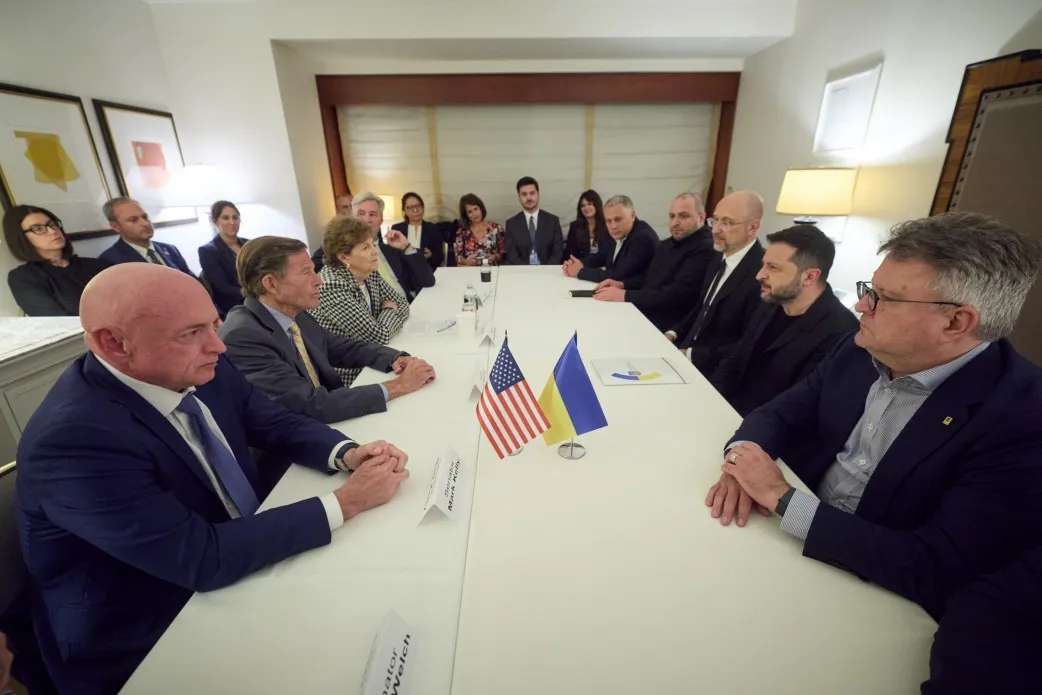
Zelenskyy’s first engagement in New York was a meeting with US senators, during which the parties discussed sanctions against Russia and Ukraine’s need for protection against ballistic missiles.
"I began my visit to New York with a meeting with US senators. I expressed my gratitude for the strong bipartisan support for Ukraine and for the vote in favor of Lindsey Graham’s sanctions bill. It is a very right step. Once fully implemented, peace and guaranteed security will certainly be brought closer," Zelenskyy wrote.
According to him, the Ukrainian and American teams agreed to work more closely on the sanctions front. "We also discussed our needs for ballistic missile interceptors and the challenges facing us this winter. There are things we can do together with America to protect lives. American Patriots are currently irreplaceable; the more anti-ballistic defense Ukraine possesses, the less audacity Russia will have to continue its strikes and prolong the war," the President noted.
Macron and Trump discussed a possible energy truce between Ukraine and Russia
French President Emmanuel Macron met with US President Donald Trump in New York on September 22. During their talks, they discussed the war in Ukraine, the strengthening of Ukrainian air defense, and the idea of a mutual moratorium on strikes against energy infrastructure in both Ukraine and Russia. Following the meeting, Macron described the conversation as "very good" and "very constructive," confirming that both sides agreed on the need to help Ukraine bolster its defenses. "We held an extensive discussion regarding Ukraine and Russia, as well as the need to provide our Ukrainian friends with interception capabilities more quickly and effectively, as this is a key issue from a defense perspective," Macron said.
According to the French president, the meeting also addressed proposals to halt strikes on the energy sector. Macron emphasized that supporting Ukraine's energy sector remains a priority, given the war's impact on the security of all of Europe. He expressed hope that progress on this issue could be achieved during meetings on the sidelines of the UN General Assembly. Macron also planned to discuss this topic with Ukrainian President Volodymyr Zelenskyy. According to Reuters, the French leader views halting strikes on energy infrastructure as one avenue for future negotiations regarding the war.
Polish Foreign Minister Urges US to Strengthen Support for Ukraine
Polish Foreign Minister Radosław Sikorski said, that the United States should step up its support for Ukraine to bring the war to an end. He argued that Russia would agree to negotiations only when Putin realizes he cannot achieve his objectives at a cost acceptable to him. Sikorski made these remarks during a briefing on the sidelines of the UN General Assembly in New York.
"I would prefer the United States to support Ukraine more strongly, because that is the path to peace," Sikorski said.
He also stated that the US should focus on supporting Ukraine rather than merely acting as a mediator, given that previous diplomatic efforts have so far yielded no results.
Sikorski also commented on Trump’s call for Ukraine to halt strikes on Russian oil refineries. "Ukraine is a victim of aggression," the Polish minister said, adding that Russia continues to strike Ukraine with guided aerial bombs and new types of drones.
"So, if Ukraine has found a vulnerable spot for Russia, one must ask what Russia would be willing to do in exchange for such a hypothetical—formal, partial, or otherwise—ceasefire," Sikorski declared.
He also addressed the international consequences of the war, specifically the disruptions to Ukrainian grain exports and fertilizer supplies. "I hope that everyone here at the UN sees that Russian aggression against Ukraine is not a bilateral issue between these two states. It is something that negatively affects the entire world," he said.
Ukraine Launches the "Carpathian Eight"
The first plenary session of the Carpathian Summit took place in the village of Huta, Ivano-Frankivsk region; during the event, Ukraine launched a new regional cooperation format—the Carpathian Integration Initiative, or C8 (the "Carpathian Eight"). The format includes Ukraine, Poland, Romania, Serbia, Slovakia, the Czech Republic, Austria, and Hungary, and also envisages cooperation with the European Union. The summit was attended by Ukrainian President Volodymyr Zelenskyy, Romanian President Nicușor Dan, Serbian President Aleksandar Vučić, Polish Prime Minister Donald Tusk, and high-ranking representatives from Austria, the Czech Republic, and Slovakia. Representatives from Hungary participated in the economic segment of the meeting, although Hungarian Prime Minister Péter Magyar later stated that Budapest had not joined the format.
During the summit, the primary focus was on the development of transport and logistics infrastructure, energy cooperation, military mobility, cross-border trade, and manufacturing. Volodymyr Zelenskyy emphasized the need to modernize roads and railways, increase the number of energy interconnectors, develop renewable energy, extract critical mineral resources, and expand energy storage capabilities.
"We need better transport and logistics. We need greater capacity for transporting large volumes of cargo. We need to modernize our roads and railways faster. We need military mobility that enhances our defense capabilities. We need more storage facilities, more renewable energy, the development of the region's critical mineral resources, stronger trade ties, and closer industrial cooperation. We need to build more interconnectors between our energy systems," the President of Ukraine said.
According to him, the Carpathian region should leverage its location to develop transport routes connecting Europe, the Black Sea, the South Caucasus, and Asia.
The economic segment of the summit involved approximately 550 business representatives and the presentation of around 100 projects from participating countries, with a total value of nearly €40 billion. According to the Ukrainian side, investment and trade agreements worth €1 billion in the energy, logistics, and infrastructure sectors were prepared during the meeting; Reuters reports the signing of over 50 agreements totaling more than €1 billion. During the political segment, Polish Prime Minister Donald Tusk affirmed support for Ukraine and referred to Russian attacks near the Polish border:
"Russian attacks are already reaching infrastructure near the borders of the European Union and NATO. On September 13, the Russians carried out a drone attack in the immediate vicinity of the Polish border—specifically near the Dorohusk-Yahodyn crossing point. We must strive to limit and eliminate such threats while continuing to pressure Russia to end the war. Peace will not come through concessions, but by raising the cost of the war for Moscow," the Polish Prime Minister noted.
New rotation of US troops heading to Lithuania
Lithuanian President Gitanas Nausėda said, that a new rotation of US troops is already en route to the country. The President's office noted that the US military presence remains part of the deterrence and collective defense of Lithuania within NATO.
"Excellent news for Lithuania—US troops will continue to be stationed in our country." "The US military presence in Lithuania is an indispensable part of our deterrence and collective defense, and the allies' resolve to stand with us sends a clear signal that NATO is ready to defend every inch of its territory," stated the Office of the President in a release issued on September 22.
Nausėda also thanked US President Donald Trump and his administration for the decision to extend the US military presence in Lithuania. According to him, this is significant not only for the country's security but also for the entire region. The exact size of the new contingent is not yet known; however, as the Lithuanian president noted, it will not be smaller than the previous one.
"At the same time, this is further concrete proof that a stronger Europe and America’s firm commitment to European security complement each other," the statement reads.
A rotation of over a thousand U.S. troops concluded in Lithuania this summer, and the United States has been regularly deploying units to the country since 2019. Following the start of Russia's full-scale invasion of Ukraine, U.S. forces in Lithuania shifted to a continuous rotational deployment.
Photo: cdn-cabinet.ua.news
Author: Danylo Pievchev