


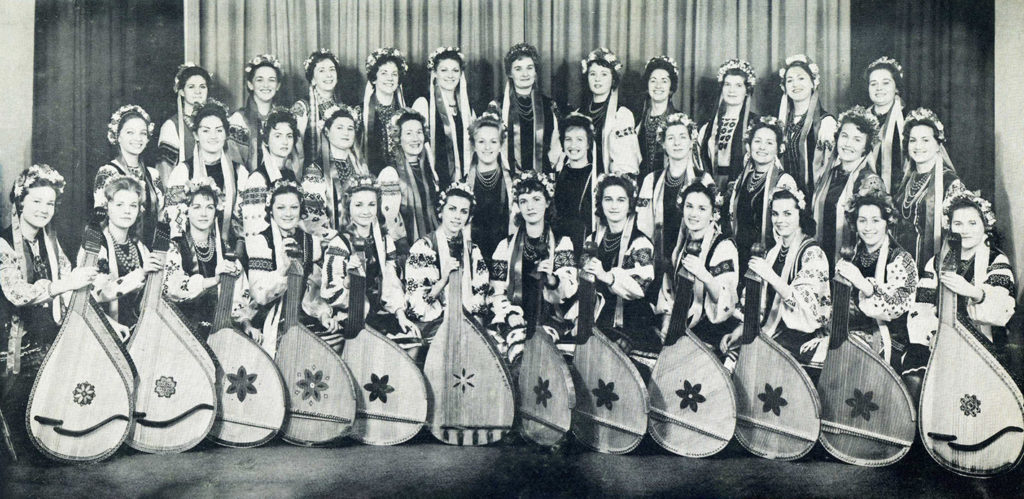
 The Ukrainian illustrated magazine Ekran was published in Chicago from April 1961 until 1990, initially under the patronage of the Ukrainian Teachers’ Association in Chicago. The publication featured materials on the history, culture, religious, civic, political, and sporting life of Ukrainians in different countries around the world. The magazine’s editor-in-chief and publisher was Professor Adam Antonovych, who was also involved in Ukrainian education and community work.
This was reported by Mariia Hrynko for UkrainianPeople.us.
The magazine Ekran was published by a Chicago publishing house of the same name, with a circulation of 3,000 copies. The editorial team launched the publication in order to use photographs and graphic materials to present events of the past and present that had previously been covered by the press mainly in an informational format. One of its goals was to collect illustrative materials on the history of the Ukrainian people and preserve the achievements of Ukrainian emigration.
The publication covered the life of the Ukrainian national community across different continents and countries. The publishing house declared its commitment to Ukrainian unity and political nonpartisanship. Its pages covered church, political, civic, artistic, cultural, academic, and sporting events involving Ukrainians both in the free world and in Ukraine.
Adam Antonovych
The editor-in-chief, publisher, and distribution manager of Ekran was Professor and educator Adam Ivanovych Antonovych. He was born on September 20, 1908, in the town of Skole in the Boyko region. His father came from Dolyna in the Stryi region, while his mother, Kateryna, was from the Horbov family.
Antonovych became involved in community activities while still in school. He received a national Ukrainian upbringing from his parents and was a member of Sokil and Plast. At Lviv University, he studied ancient history and physical education.
Adam Antonovych served as head of the St. Josaphat Institute at the Minor Seminary in Lviv under the patronage of Metropolitan Andrey Sheptytsky and also helped organize the Second Minor Seminary in Rohatyn. He was a member of Sokil-Batko and the Catholic Eagles organization, where he worked in physical education and organized camps.
At the beginning of World War II, Antonovych was mobilized by the Polish authorities and sent to the front. There, he was taken prisoner by the Germans and held in a camp in Luckenwalde near Berlin.
After his release, he taught at a Ukrainian gymnasium in Kholm, supervised young men serving in air-raid defense, and worked as a physical education instructor for the Ukrainian Central Committee among Ukrainians in the General Government. He also organized regional sports competitions in various disciplines in Ukraine during the occupation.
After the war, Antonovych lived in displaced persons camps. Together with his wife Mariia, he taught at a gymnasium in Karlsfeld, Germany, whose principal was V. Radzykevych.
In December 1949, the family moved to Chicago. There, Adam Antonovych continued his community work. He was one of the organizers and supervisors of summer educational camps for children and youth at the Ukrainian Samopomich settlement in Round Lake. At the camps, children were taught the Ukrainian language, songs, and traditions, and took part in sports competitions.
Antonovych participated in founding the Association of Ukrainian Educators in America. He worked with Ukrainian youth, language, and schooling. He also adopted writer T. Kurpita’s idea of creating a permanent Ivan Franko Literary Fund, which operated for 30 years under Antonovych’s leadership.
The Fund organized literary competitions and evenings, lectures, celebrations, and commemorations marking anniversaries of writers in the free world and Ukrainian writers imprisoned in Soviet camps. Adam Antonovych also served for many years as chairman of the Ukrainian Teachers’ Association in Chicago.
The Magazine Ekran
One of the key staff members of the Ekran publishing house in its early years was Professor Vasyl Ivashchuk. For 15 years, from 1961 to 1976, Adam Antonovych’s wife Mariia served as the magazine’s secretary and administrator. She died at the end of 1976.
Mariia Okhrymovych was born on December 1, 1911, in the Lviv region. In 1934, she graduated from Jagiellonian University in Kraków with a degree in psychology and physical education. She taught at gymnasiums in Sambir and Lviv.
In 1939, Mariia Okhrymovych was imprisoned by the Polish authorities. She was held in the Bryhidky prison in Lviv. During the bombing of Lviv, she escaped from prison and made her way to Kraków.
In 1940, an eight-grade gymnasium was established in Kholm, where she taught. There, Mariia Okhrymovych met Adam Antonovych, and the two later married. In December 1949, the couple moved to Chicago.
Until July 1970, Ekran was published under the patronage of the Ukrainian Teachers’ Association in Chicago.
The magazine was published in a large format. Its pages featured materials from various areas of Ukrainian émigré life, the history of the Ukrainian people, and events in Ukraine. Ekran cooperated with churches, political, civic, artistic, youth organizations, and schools in different countries where Ukrainians had settled.
The magazine’s title reflected its format and content: on its pages, as if on a screen, events and people, the present and the past, alternated before the reader.
The publication was intended primarily for young people. The magazine had representatives in New York, Philadelphia, Washington, Detroit, Cleveland, California, as well as in Australia, Argentina, and Canada. Its contributors included Professors R. Zavadovych and M. Semchyshyn, editor T. Kurpita, and others.
Ekran was originally intended to appear once every two months, although this schedule could not always be maintained. Each year, two or three double issues were published with the months indicated. Beginning in 1982, due to financial difficulties, community commitments, and Professor Antonovych’s age, issues were marked only with a sequential number rather than a month.
The publishing house had neither its own printing press nor dedicated editorial offices. Linotype composition was done by Ukrainian printing houses in Chicago, while offset work and printing were carried out by American printers.
Page layout was prepared by the editorial team free of charge. After his wife’s death in 1977, Adam Antonovych handled the editorial work himself: commissioning, selecting, and editing materials, organizing subscriptions, and ensuring that issues were published. The office and administration operated from the kitchen of his private home.
The editorial team had no staff correspondents and cooperated with other Ukrainian émigré publications. Ekran reprinted materials from Ukrainian periodicals including Svoboda, America, Narodna Volia, The Ukrainian Weekly, Nasha Meta, Shliakh Peremohy, Homin Ukrainy, Novyi Shliakh, Visti, Ukrainske Slovo, Khrystyianskyi Holos, Vilna Dumka, and others. It also used materials from American publications, including The New York Times, News World Staff, and the Chicago Tribune, as well as publications from Ukraine, including Literaturna Ukraina.
Beginning in 1963, some texts were published in English. This was done to attract English-speaking readers, including non-Ukrainians, to materials about Ukrainian history and the problems faced by the Ukrainian community outside Ukraine.
In English, the magazine reported, among other topics, on the Holodomor of 1932–1933, campaigns in defense of Ukrainian dissidents M. Rudenko, V. Stus, O. Meshko, I. Senyk, V. Romaniuk, and others, as well as the Second Congress of the People’s Movement of Ukraine and the student hunger strike on Independence Square in Kyiv.
Publication Topics
Throughout its existence, Ekran faced financial difficulties. The publication continued largely thanks to the work of its founder, publisher, and editor Adam Antonovych. The editorial team repeatedly appealed to readers for financial support.
The publishing house received no assistance from financial institutions and survived on donations from private individuals, whose names were published in the magazine.
The editorial team published photographs and reports about events in the Ukrainian émigré community, including the activities of religious, political, student, educational, sporting, and professional organizations.
In 1963, the magazine reported on the Fifth Session of the Ukrainian National Council and the composition of its new executive body, as well as on the lives of Ukrainians in Brazil, Argentina, and Paraguay and on the Ukrainian youth organization Plast.
In 1964, it published photo reports on the consecration of the site for the Taras Shevchenko monument in Washington and materials on a gathering of former residents of the Stryi region held on August 17–18, 1963, in Pine Hill, New York.
Later issues covered the Second World Congress of Free Ukrainians in Toronto on November 1–4, 1973, the Third World Congress of Ukrainian Women in Toronto on May 26–29, 1977, and the Third World Congress of Free Ukrainians in New York on November 23–26, 1978.
In 1980, the magazine published materials about the Third World Congress of Free Ukrainians, and in 1988 it covered the Fifth Congress of the World Congress of Free Ukrainians, held in Toronto on November 23–27.
Special attention was given to the younger generation of Ukrainians born in emigration. In 1987, Ekran published Professor I. Bodnaruk’s article “Ukrainian Children — Our Future,” devoted to the need to raise Ukrainian children in national traditions, teach them the Ukrainian language, culture, and history, conduct services in Ukrainian churches in the Ukrainian language, and preserve national solidarity.
The opening pages of each issue featured portraits of prominent figures in Ukrainian culture, history, and the Church. Among them were Petro Konashevych-Sahaidachnyi, Markiian Shashkevych, Hryhorii Skovoroda, Ivan Kotliarevskyi, Taras Shevchenko, Ivan Franko, Lesia Ukrainka, Metropolitan Josyf Slipyj, Yevhen Konovalets, Symon Petliura, Stepan Bandera, Roman Shukhevych, Alla Horska, and others.
Alongside the portraits, the magazine published materials about the lives and work of these figures.
A significant portion of the magazine was devoted to religious topics. It reported on anniversaries of Ukrainian church leaders and important dates in the history of the Ukrainian Church. These included the 80th birthday of Metropolitan Ilarion, the 70th birthday of Metropolitan Josyf Slipyj, the Golden Jubilee of the Providence Association of Ukrainian Catholics, as well as the 50th anniversary of the martyrdom by the NKVD of Metropolitan Vasyl Lypkivskyi of Kyiv and All Ukraine.
A particularly important event for the Ukrainian diaspora was the commemoration of the 1,000th anniversary of the Baptism of Rus-Ukraine, preparations for which lasted ten years.
Materials About Events in Ukraine
During the 1960s–1980s, the magazine regularly published materials about resistance to the totalitarian regime in Soviet-ruled Ukraine and campaigns in defense of Ukrainian political prisoners, including P. Zalyvakha, S. Karavanskyi, V. Chornovil, and others.
It also published materials opposing the Russification of Ukraine, reports on the observance of the 20th anniversary of human rights in 1968, a student demonstration in Chicago in defense of V. Moroz in 1971, and a protest hunger strike in Canberra on January 22, 1979, against Ukraine’s subjugation by Russian imperialism and marking the 60th anniversary of Ukrainian unity.
A 1982 issue reported that on November 9, 1982, then-U.S. President Ronald Reagan proclaimed Ukrainian Helsinki Group Day in honor of the sixth anniversary of the group’s founding in Kyiv on November 9, 1976.
In 1984, the editorial team reported the deaths of Ukrainian prisoners of conscience Valerii Marchenko and Oleksa Tykhyi in Soviet camps. In 1985, the magazine informed Western audiences about the death of Ukrainian poet Vasyl Stus in a camp on September 4, 1985.
In the late 1980s and early 1990s, with the beginning of democratic changes in the USSR, Ekran published photo materials about events in Ukraine. These included the Second Congress of the People’s Movement of Ukraine on October 28, 1990, the commemoration of the 500th anniversary of the Zaporizhian Sich on Khortytsia in September 1990, and the student hunger strike on Independence Square in Kyiv in October 1990.
The final issue published during Adam Antonovych’s lifetime, No. 148–149, appeared belatedly in 1991 but was dated 1990 because of the editor and publisher’s prolonged illness. Antonovych was preparing the jubilee 150th issue but did not live to publish it.
In 1997, the final commemorative issue of Ekran was published in Chicago under the editorship of Orysia Antonovych, Adam Antonovych’s daughter-in-law. It included materials he had prepared for the 150th issue, as well as memoirs about him, including Myroslav Antonovych’s “Remembering My Brother Adam,” Osyp Panchyshyn’s “My Memories of Prof. A. Antonovych,” Yurii Saievych’s “About a Dear Educator,” and other materials.
The cover of the issue featured a portrait of Adam Antonovych (1908–1992) by artist Volodymyr Nemyra, created in 1996.
Photo: Mariia Hrynko
Author: Danylo Pievchev