


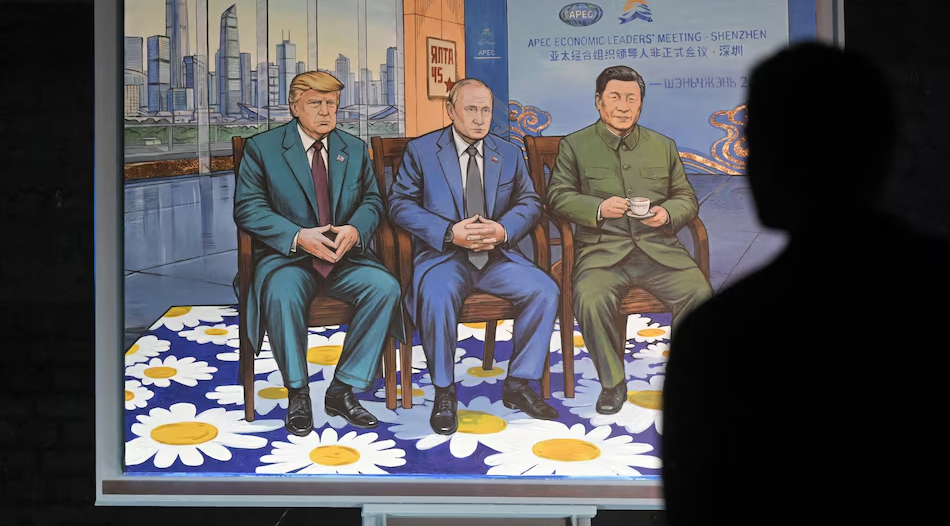
The US is revising plans to reduce its military presence in Europe, while American senators are criticizing Moscow’s demands for the withdrawal of NATO forces. Meanwhile, discussions regarding an end to the war are addressing Ukraine’s potential accession to the alliance, security guarantees, and territorial concessions. Particular attention has been drawn to restrictions on the "Starshield" system in temporarily occupied territories, as well as the possibility of a meeting in China between Trump, Xi Jinping, and Putin.
US to Reduce Military Presence in Europe by Less Than Allies Expected
The US Department of Defense plans to reduce the number of American troops in Europe by a smaller margin than European allies had previously feared. According to Bloomberg, sources, the administration of President Donald Trump is considering a reduction of approximately 5,000 personnel. Previously, European nations had speculated that the number of US troops might be cut down to 25,000. Instead, the total contingent is now expected to remain at around 80,000 troops.
One reason for this revision is the US’s positive view of increased defense spending by NATO member states. Furthermore, the Pentagon has come to recognize the extent to which the US military relies on forces stationed in Europe for operations in the Middle East—particularly in the context of a potential conflict with Iran. According to sources, the most significant reductions could affect Germany, which hosts the largest American military contingent in Europe. At the same time, there are plans to strengthen NATO’s eastern flank, provided that the countries bordering Russia cover the costs of maintaining American troops. The final decision rests with Donald Trump, and Elbridge Colby, the U.S. Deputy Secretary of Defense for Policy, has yet to present an official report on the proposed changes to Pete Hegseth.
U.S. Senate: Russia’s Demand for NATO Troop Withdrawal to 1997 Borders Is Absurd
Senator Tom Cotton (R-AR), a member of the U.S. Senate Intelligence Committee, has labeled Russia’s demand that NATO nations withdraw their forces to the alliance’s 1997 borders as "absurd." The senator also stated that further negotiations with Moscow at this stage are pointless.
"Russia’s demand that NATO countries retreat from 'their own borders' is absurd. Putin has once again proven that he has no intention of achieving peace through negotiations. Further talks at this point are a farce," Cotton wrote on X.
According to Cotton, Putin will only agree to end the war once he realizes he cannot win it. To ensure this, the senator emphasized, the U.S. must help Ukraine demonstrate this reality to Russia.
Cotton’s statement came in response to a The New York Times report regarding a document outlining Moscow’s demands, which Russian officials circulated during negotiations in Abu Dhabi. In it, Russia demands that NATO renounce any further expansion and cease all military activity in Ukraine, Eastern Europe, the South Caucasus, and Central Asia. Moscow also insists on an end to the supply of Western weapons to Ukraine and demands that France and Great Britain rule out the use of their nuclear arsenals to defend other European countries. Russia is prepared to accept Ukraine’s accession to the European Union only on the condition that Kyiv does not participate in the bloc’s common defense policy. According to the report, American representatives Jared Kushner and Steve Witkoff reminded the Russian side that the situation in Europe has changed since December 2021, and urged them to consider new proposals that would include concrete steps to de-escalate tensions.
Zelenskyy warns of dangerous Starshield restrictions in temporarily occupied territories
President Volodymyr Zelenskyy reported, that speed restrictions on the Starshield system in the temporarily occupied territories of Ukraine have been in effect for five days. The maximum speed is limited to 161 km/h. According to the head of state, the fact that there are no such restrictions in Ukrainian-controlled territory, while they remain in place in occupied areas, suggests a potential political motive.
"If they have reverted to a policy where there are no restrictions within Ukrainian territory, but restrictions remain in the temporarily occupied territories, then this decision is highly dangerous—because it carries a political implication. If you are imposing restrictions there, it suggests you no longer fully recognize the temporarily occupied territories as ours," the President stated.
He added that the Ministry of Defence of Ukraine had communicated with SpaceX, where they denied the existence of any restrictions.
Zelenskyy noted that the Ukrainian side monitors the system's performance daily across various sectors and has documented restrictions; therefore, they do not view these as isolated technical glitches. The President also recalled that during previous operational issues with Starshield, he spoke with U.S. Secretary of State Marco Rubio. Following that conversation, he stated, there were no further issues regarding early warnings of ballistic missile strikes, intelligence sharing, or restrictions on Starlink and Starshield. At the time, Rubio remarked that "Starshield is under the control of the U.S. government, rather than SpaceX." According to Zelenskyy, the Ukrainian team attributes the current restrictions to the actions of SpaceX, so the circumstances remain to be clarified. The President emphasized that, as a result, Ukrainian interceptor drones are unable to shoot down jet-powered "Shahed" drones near the front line in the temporarily occupied territories, forcing them to attempt interceptions elsewhere.
Trump, Xi, and Putin May Meet in China to Discuss Global Issues
Next week, U.S. President Donald Trump, Chinese President Xi Jinping, and Russian President Vladimir Putin may hold a trilateral meeting in Shenzhen, China, on the sidelines of the Asia-Pacific Economic Cooperation (APEC) summit. According to Reuters citing two sources familiar with the preparations, discussions regarding the format and agenda are ongoing, though no final agreements have been reached. Potential topics include the war in Ukraine, the situation involving Iran, nuclear arms, and artificial intelligence. At the same time, the prospects for reaching major agreements during the meeting are considered low. Putin hopes to use the negotiations to secure a deal ending the war in Ukraine on Moscow’s terms, while Trump may seek agreements regarding nuclear arms control.
For Xi Jinping, such a meeting carries political risks, as China has no interest in negotiating nuclear disarmament on equal footing with the United States and Russia. According to Reuters, Moscow sought to include the war in Ukraine on the agenda, but Beijing opposed this. A U.S. official also stated that Trump is unlikely to raise the issue of the war in Ukraine during the trilateral talks. The potential meeting is already being compared to the 1945 Yalta Conference, where major powers defined the post-war order and spheres of influence. This prospect has sparked concern in Ukraine and other nations, which fear that major powers might strike deals without their participation.
"We certainly do not want this to turn into a 'Yalta 2, 3, or 4' scenario involving a redistribution of influence," Volodymyr Zelenskyy stated last month.
Meanwhile, China is attempting to position itself as a nation that advocates for taking the interests of smaller countries into account.
Zelenskyy stated that the U.S. proposed that Ukraine discuss joining NATO in exchange for relinquishing the Donbas
President Volodymyr Zelenskyy reported, that American negotiators raised the possibility of withdrawing Ukrainian troops from the Donbas in exchange for Ukraine’s accession to NATO. According to him, this topic was first discussed during negotiations with Russia in Abu Dhabi.
"The Americans raised the question: 'What if Ukraine joins NATO? Will Ukraine withdraw from the Donbas?'" Zelenskyy said.
He noted that this proposal brought the issue of Ukraine's NATO membership back onto the agenda; however, negotiations on this matter would be difficult, given Putin's stance. Zelenskyy emphasized that Ukraine is not prepared to surrender its territories. At the same time, he stated that if a comprehensive package of agreements were reached—including security guarantees, Ukraine's right to maintain a strong and properly funded army, and funds for reconstruction—he would put the issue to a nationwide referendum.
The Head of State also rejected Moscow's proposal to first negotiate a broad European security architecture, and only then determine the terms for ending the war.
"We cannot turn everything upside down by starting with discussions about changing the global or continental security system, and only then talking about ending this war. First, this war must be brought to an end," he declared.
Two-day negotiations between Ukraine and Russia, mediated by the United States in Abu Dhabi, concluded without a major breakthrough; however, the parties did agree on a prisoner exchange involving over a thousand people. The final number of individuals to be included in the exchange is still being determined. Zelenskyy also stated that American representatives Steve Witkoff and Jared Kushner were expected to raise the issue of an "energy truce" during their meeting with Putin; however, no information regarding any progress emerged following the talks in Moscow. According to the President, Putin himself does not support a ceasefire. At the same time, the American negotiators informed Zelenskyy that all parties had agreed to include Europe at the table for future negotiations.
Photo: REUTERS/Andrei Bok
Author: Danylo Pievchev