


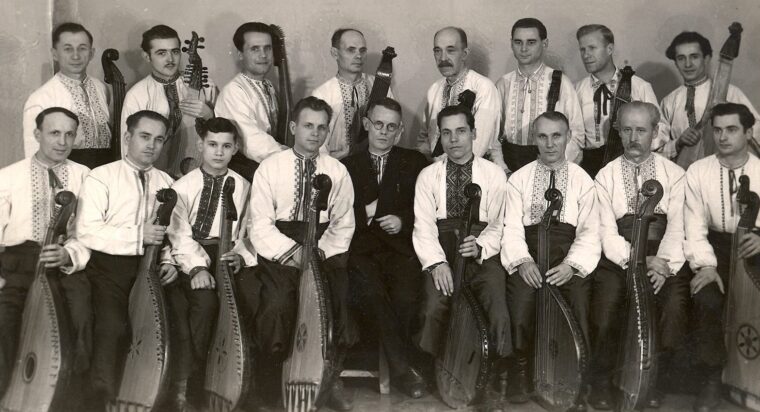
The Taras Shevchenko Ukrainian Bandurist Chorus was founded in Kyiv in 1941. During the Second World War, its members ended up in forced labor in Germany, where they performed for Ukrainian Ostarbeiters (forced laborers). Following a tour in Galicia, the Chorus left Ukraine in 1944; since 1949, its headquarters has been located in Detroit.
This was reported by Ukrainian People.
The history of the Chorus is intertwined with the development of the Ukrainian art of the bandura and the work of several generations of musicians. Among the artists who worked in Chicago were choreographer Vasyl Avramenko, conductor Yuriy Benetsky, and bandurist and composer Hryhoriy Kytasty.
One of Vasyl Avramenko’s achievements in Chicago was the organization of a "Ukrainian Festival," which took place on November 8, 1932, at the Opera House. Two hundred Ukrainian dancers participated in the event.
In 1974, the Ukrainian Canadian Congress honored Avramenko with its highest award—the Shevchenko Medal. In 1976, he received a tribute from Myron Kuropas, an advisor to the U.S. President on ethnic affairs:
"Your efforts on behalf of Ukrainian dance in America are legendary. You have done more to preserve our Ukrainian culture than any other man I know. The Ukrainian-American community owes you a great debt for your tireless energy, sensitivity, and accomplishments."
The "Ukrainian Choir," under the direction of Yuriy Benetsky, also gained widespread popularity in Chicago. The ensemble took first place three times at the Chicago Music Festival. It performed at Soldier Field, as well as at the Studebaker Theater and Kimball Hall. American newspapers published favorable reviews of its performances. In particular, music critic Herman Devries wrote:
"One can only offer praise when writing about the Ukrainian Choir, directed by the exceptionally talented Yuriy Benetsky... Listening to them yesterday, our faith in the future of music was restored; for with such talent... we need neither beg for nor demand a place within the centers of culture. It belongs to us."
In 1935, the bandura player, conductor, and composer Hryhoriy Kytasty served as the concertmaster of the State Exemplary Bandurist Capella. Later, in German-occupied Kyiv, he became the director of the Taras Shevchenko Ukrainian Bandurist Capella.
In 1964, Kytasty settled in Chicago, where he directed the first bandurist ensemble of the Association of Democratic Ukrainian Youth (ODUM). At the end of 1967, he moved to Cleveland, from where he would travel by car to Detroit for the Capella’s rehearsals.
In 2008, Hryhoriy Kytasty—the ensemble’s long-time artistic director and conductor—was posthumously awarded the title of "Hero of Ukraine," along with an order recognizing his contributions to Ukraine and Ukrainian culture.
From Early Kobzar Ensembles to the Capella in Kyiv
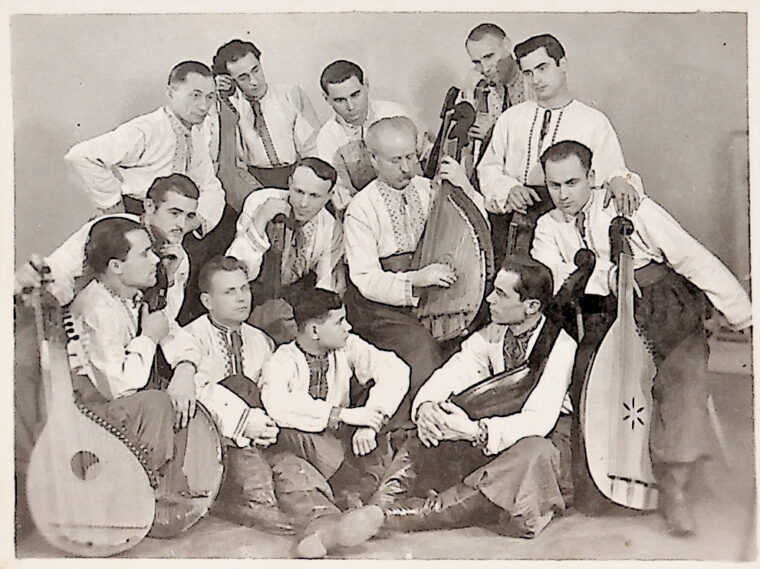
The emergence of the capella (ensemble) is linked to the work of Hnat Khotkevych, who, in 1902, established the first group of bandura players at the 12th Archaeological Congress in Kharkiv.
In August 1918, an artistic ensemble known as the "Kobzar Choir" (Kobzarskyi Khor) was founded in Kyiv under the leadership of bandura player Vasyl Yemets. It remained active until March 1919. Many of its members suffered during the revolutionary upheavals, while others emigrated to the West.
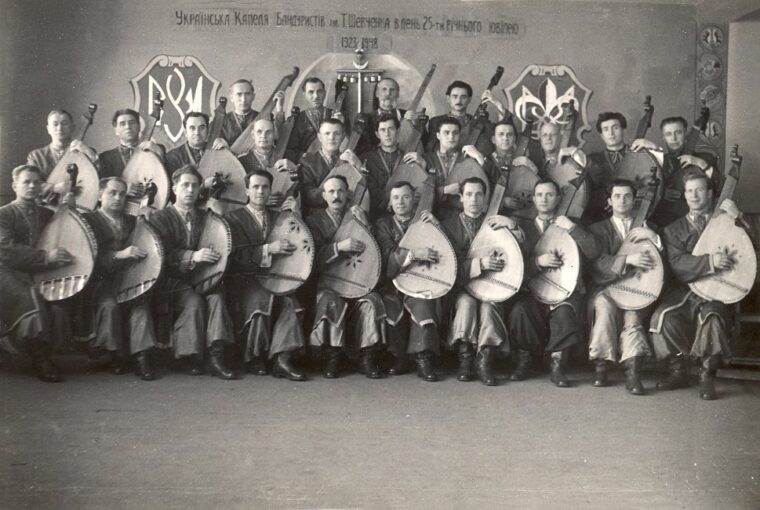
In 1923, the Kyiv Bandurist Capella was founded. Only two members from the former "Kobzar Choir"—Fedir Doroshko and Heorhiy Kopan—joined the new group. Both were killed during the Stalinist terror in 1938.
The Poltava Capella, led by Volodymyr Kabachok, began its activities in January 1925. In 1928, Hnat Khotkevych took charge, and under his leadership, the ensemble reached a higher level of professional proficiency. From January 1930, it was known as the "First Exemplary Capella of the People's Commissariat for Education of the Ukrainian SSR."
In the 1930s, the authorities' attitude toward the art of the bandura shifted. Funding was cut off, Volodymyr Kabachok was arrested in January 1934, and in October of that same year, both capellas were disbanded.
October 1935, the "Model Bandurist Capella" was formed from the remnants of the Poltava and Kyiv capellas, under the direction of M. Mykhailov.
Performances in Western Ukraine and the Revival of the Ensemble
The capella traveled abroad for the first time alongside the Red Army. On September 20, 1941, the musicians performed in Ternopil, and on September 30, in Lviv.
The bandurists were struck by the standard of living outside of Soviet Ukraine. They observed that the local peasants were better dressed than the performers themselves. The ensemble’s director had to take them to a shop so they could purchase decent clothing.
In Ternopil, the musicians were met with a wary silence. The situation shifted, however, when they performed the song "Dumy moyi, dumy moyi" ("My Thoughts, My Thoughts"). While the audience did not trust the Soviet performers, they trusted Shevchenko. Following the performance, the hall erupted in applause.
In Lviv, the theater was packed. The major concert featured the bandurists alongside prominent Ukrainian singers—including Patorzhynsky, Lytvynenko-Volhemut, and Ivan Kozlovsky, who performed two Ukrainian songs.
Western Ukraine impressed the artists with its high level of national consciousness. An independent Ukrainian administration, a school system, cooperatives, and a press were active there, as were educational organizations—most notably Plast and Prosvita—along with various women’s and youth associations.
At the outbreak of the Second World War, the bandurists of the State Exemplary Capella were mobilized, and the ensemble was disbanded once again. The younger performers were conscripted into the army, while the older ones were assigned to dig anti-tank ditches. Some of the musicians returned to their family homes in the provinces.
By the time the Germans captured Kyiv in September 1941, only four artists from the pre-war ensemble remained in the city. Shortly after the change in power, one of them, Dmytro Chernenko, placed an advertisement in the newly established newspaper Ukrainske Slovo ("Ukrainian Word"), calling on members of the Capella to return to Kyiv and resume their work.
Musicians from various towns and villages responded to the call—including some who had managed to escape from captivity. Two members, D. Pika and O. Buldovskyi, perished at the front. Others made their way back to Kyiv on foot, enduring both cold and hunger.
In November 1941, 13 bandurists gathered in Kyiv with plans to perform small-scale concerts. Shortly thereafter, Hryhoriy Kytasty escaped from a prisoner-of-war camp in Romny and was subsequently entrusted with the artistic direction of the ensemble.
At the request of the members, the new administration’s Municipal Department of Culture and Education—headed by sculptor and film director Ivan Kavaleridze—officially approved the ensemble under the name "Taras Shevchenko Ukrainian Bandurist Capella." The musicians were granted space at the Bergonier Theater for their rehearsals.
Their first major performance took place in Bila Tserkva and was a significant success. Following this, the Capella toured the Kyiv region.
Later, at the initiative of Stepan Skrypnyk, director of the "Volyn" publishing house, the ensemble was invited to the Volyn region, where they held several concerts in Rivne and Lutsk.
On July 26, the Capella performed near the town of Zhydachiv during the construction of a memorial mound for the "Fighters for the Freedom of Ukraine"—men who had been killed by NKVD bullets during the Soviet retreat. The march "Hej, numo, chloptsi do zbroyi!" was performed at the event. Thousands of people gathered for the occasion, displaying blue-and-yellow flags and tryzub (trident) emblems. The event concluded with the song "Shche ne vmerla Ukraina"
The following day, as the Capella was returning to Lutsk in three horse-drawn carts, they were intercepted by German military personnel, who ordered them to return to Kyiv immediately.
Upon arrival in the capital, the ensemble’s administrator was summoned to the General Commissariat and ordered to travel to the Reich to perform in camps for Ostarbeiters (forced laborers). They were given only one day to prepare.
Performances in Ostarbeiter Camps
On the morning of August 5, 1942, 16 bandura players, accompanied by their administrator Ivan Maistrenko, arrived at Kyiv’s main railway station. From there, people were being dispatched to Germany for forced labor via freight trains. The musicians were also placed into a freight wagon.
They arrived in Hamburg on August 13. Their banduras were confiscated, and they were issued shovels and axes instead. Thus began a period of forced labor for the artists as Ostarbeiter (Eastern workers).
The conditions of their confinement in the camps were documented in the diary of bandura player Havrylo Makhynia. It records the daily life of the musicians: grueling labor, poor nutrition, cold, air raids, hand injuries, swollen legs, and illnesses left untreated.
On November 15, 1942, the ensemble was taken to another camp for the first time, where they performed for the prisoners during their lunch break. Everyone went to the concert—even the sick and exhausted artists. In exchange for the performance, they received an extra portion of food.
On November 30, the musicians were ordered to hand over their work tools and prepare for departure.
From that point on, the 17-member ensemble began performing concerts in Ostarbeiter camps. The group was assigned to the "Kraft durch Freude" (Strength Through Joy) cultural department. They performed for Ukrainians who had been taken to Germany for forced labor in factories and industrial plants.
Between October 1943 and the end of the period, the artists gave 370 concerts across 168 cities.
Return to Ukraine and Performances in Galicia
During the Allied offensive and the bombing of Germany, cities suffered extensive destruction. Following an air raid in Düsseldorf, the bandurists emerged from a bomb shelter to find that their hotel was gone. Similar incidents occurred in Cologne and Nuremberg. The musicians themselves, as well as their instruments, remained unharmed.
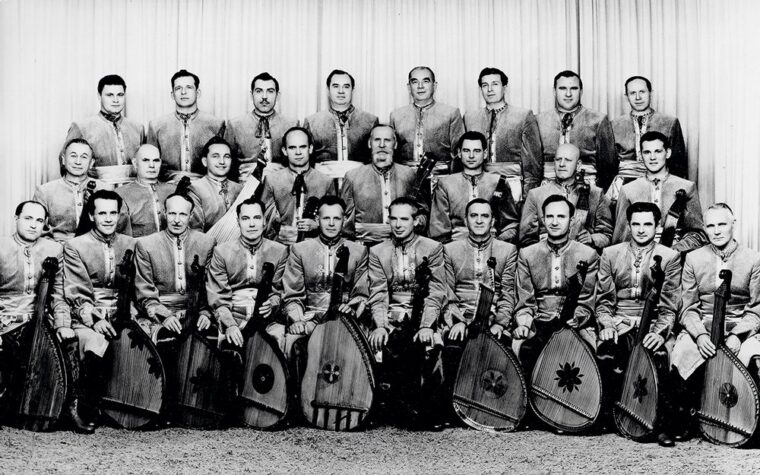
On October 6, 1943, the Capella was granted leave to travel to Ukraine to visit their families. The musicians reached Rivne, but the roads leading further east were impassable. Hryhoriy Kytasty organized a search to locate the families of the ensemble members.
On October 22, the bandurists traveled by train to Lviv. The musicians’ families gathered there, and the group’s first performance took place at the residence of Metropolitan Andrey Sheptytsky.
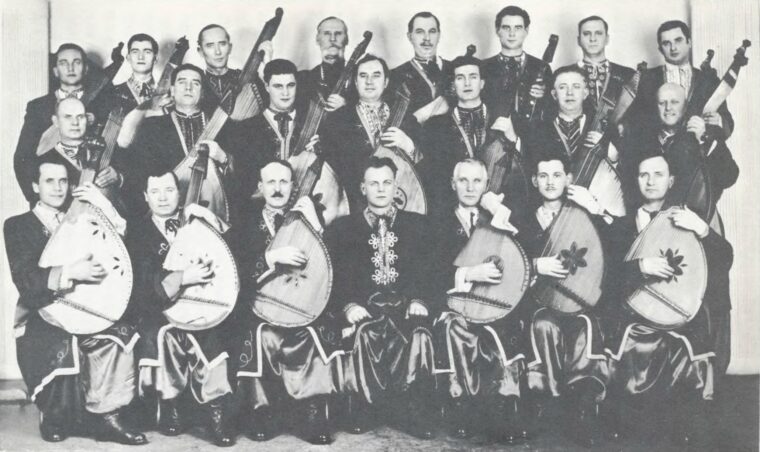
After the concert, the Metropolitan—who moved about in a wheelchair—wrote the following in the Capella’s guestbook:
"The Taras Shevchenko Bandurist Capella teaches us how to perceive and feel the tragedy of our situation, while simultaneously uplifting our spirits with cheerful songs and instilling hope for the future. May God Almighty bless you on your path ahead."
In Galicia, the bandurists gave 210 concerts in various towns and villages. In the town of Turka, where the musicians had settled with their families, they met with an old friend—the poet Ivan Bahrianyi.
Using lyrics by Bahrianyi set to music by Hryhoriy Kytasty, they created the "Ukraine March." The piece gained popularity within the UPA (Ukrainian Insurgent Army) and was performed at every one of the Capella’s concerts.
The members of the ensemble spent the New Year of 1944, Christmas Eve, and Christmas Day within the territory of the "Galicia" Division. The five months the Capella spent with their families in Turka marked the final period of their time on Ukrainian soil.
On July 25, 1944, the ensemble left the town and set off for Hungary, planning to reach the Czech lands or Austria.
Photo: Ukrainian People
Author: Danylo Pievchev