


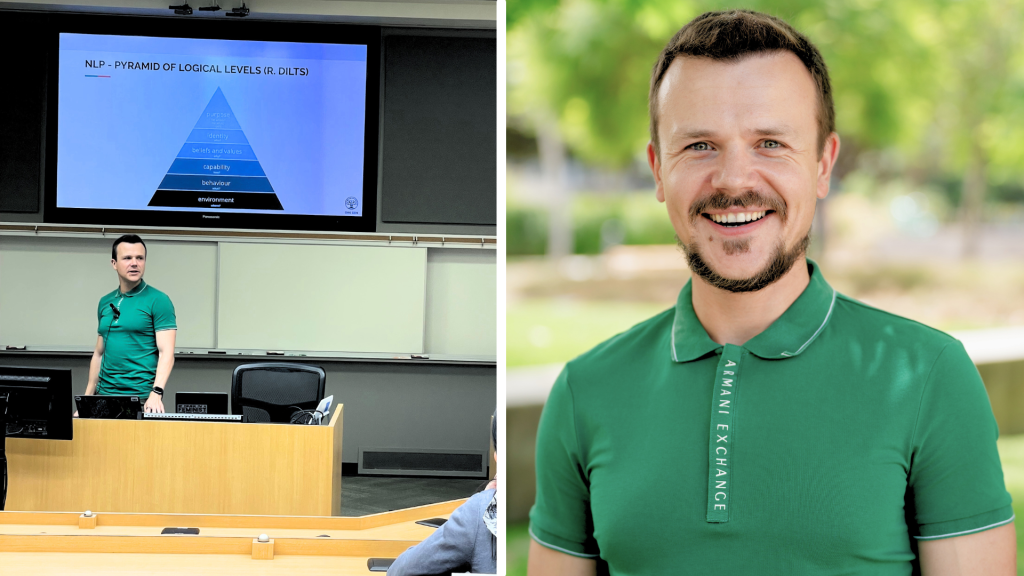
He impressed me with his life story. Anyone who goes through so many stages of personal evolution carries a lot of depth in their eyes. Just a glance shows that this slim, cheerful, and energetic man has a lot of experience behind him. Serious challenges forced Vasyl to reconsider his priorities, and after overcoming personal pain and struggles, he transformed them into motivation for others. He is more than an entrepreneur; he is invited to lecture and mentor at Stanford. Vasyl serves as a guide for many Ukrainian entrepreneurs and startups in Silicon Valley, helping them find themselves, develop their potential, and integrate into a global and highly competitive environment.
Vasyl Dub's work spans teaching, mentoring, and coaching, but his main mission is to inspire. Through his example, he shows that even the most challenging circumstances can be transformed into a driving force for new achievements. He supports the Ukrainian community abroad, helping them find themselves in a world of new opportunities and challenges, adapt, and thrive. With deep knowledge of human nature, love for his work, and dedication to Ukraine, he has become an invaluable figure for Ukrainian IT professionals and startups seeking a path to success in one of the world's most dynamic innovation communities.
Trials and Rebirth
Lukian Selskyi (LS): Vasyl, you managed to overcome a serious illness, but what interests me is not the illness itself, but the path you took to overcome it. It wasn't exactly linear, was it?
Vasyl Dub (VD): It was a kind of challenge to myself. I literally sold myself on the idea that became my reality. When I moved from Kyiv to my hometown Drohobych, I chose a path of strict fasting, which was met with a lot of misunderstanding from those close to me. Every day my father would ask if I had eaten anything, and every day I would say "no" and ask him to stop bringing it up. I was irritable, but eventually, I understood that he simply couldn't stay silent because of parental worry. Every day of fasting meant losing a kilogram, day by day. In 2016, there were over 100 such days.
LS:Did none of your friends know what was happening?
VD: I forbade my parents and wife from even mentioning my illness. It was crucial for me to fully focus on my journey. Occasionally, I heard jokes from acquaintances, and sometimes I was even bullied, but for me, it was a challenge that changed everything. It was a process that demanded not only physical effort but also spiritual transformation.
LS:: How did you maintain resilience in such a difficult situation?
VD: During this time, I learned to wake up with gratitude for every opportunity to become stronger. I believed that this journey would lead me to my dream life. This belief gave me the strength to keep moving forward. I envisioned my future in a new light, imagining how strong I would become. Doubts arose, but faith in success helped me overcome any obstacles.

Dreams That Become Reality
LS:You now live in Silicon Valley and collaborate with Stanford—one of the world's most prestigious educational institutions. How has this impacted you, and what do you do there?
VD: Stanford has always been a dream for me. Back in Ukraine, I wasn't the best student. I chose technical sciences, even though my heart leaned towards psychology, philosophy, and sociology. But I knew this university had a unique atmosphere—a place of power where knowledge is combined with practice and quiet confidence. Now I mentor in several venture programs and give lectures to entrepreneurs from around the world. I was invited to integrate my experience and knowledge into the Stanford Technology Ventures Program and the Department of Management Science and Engineering.
LS:What attracts Stanford to you?
VD: My story of overcoming challenges in a rather unconventional way has proven to be very motivational. Students are interested in how I managed to combine different roles in my life—entrepreneur, father, lecturer, triathlete—and how I do it with such energy. Being a tech startup entrepreneur and taking it from zero to a billion-dollar company is also a very challenging path. To traverse it, you need to be a highly motivated person who knows the answer to the key question "Why?" My lecture on Motivation in the course "Entrepreneurship Without Borders" helps students gain practical insights on finding and maintaining this motivation. It is important to help them feel that they, too, can achieve more, especially by changing their mindset and realizing that their potential is limitless.
LS:How is your interaction with the local community? Have you been able to integrate?
VD: Silicon Valley is a multinational environment where it is important not only to share knowledge but also to adapt to cultural differences. Entrepreneurs, students, and professors here are very diverse but united by a common goal—to develop humanity and change the world. I have interests that go beyond business—from conducting research to writing books, participating in sports competitions, and building networks with various groups of entrepreneurs. This place allows for connections with people who share similar interests and are seeking challenges and new horizons.

Five Keys to Success
LS:You often talk about mindset, motivation, and life principles. What is your formula for success, if you can formulate one?
VD: The formula starts with self-understanding. We often think we possess more knowledge and skills, but without a deep understanding of our mission and values, this knowledge is powerless. My life is an example of how motivation can change everything if it comes from deep convictions. We become disciplined only when motivated, when our "why" is so strong that it becomes impossible to stop. The journey starts from the point where you understand yourself and can ask the right questions.
LS:What specific steps would you recommend to people who want to succeed, for example, in Silicon Valley?
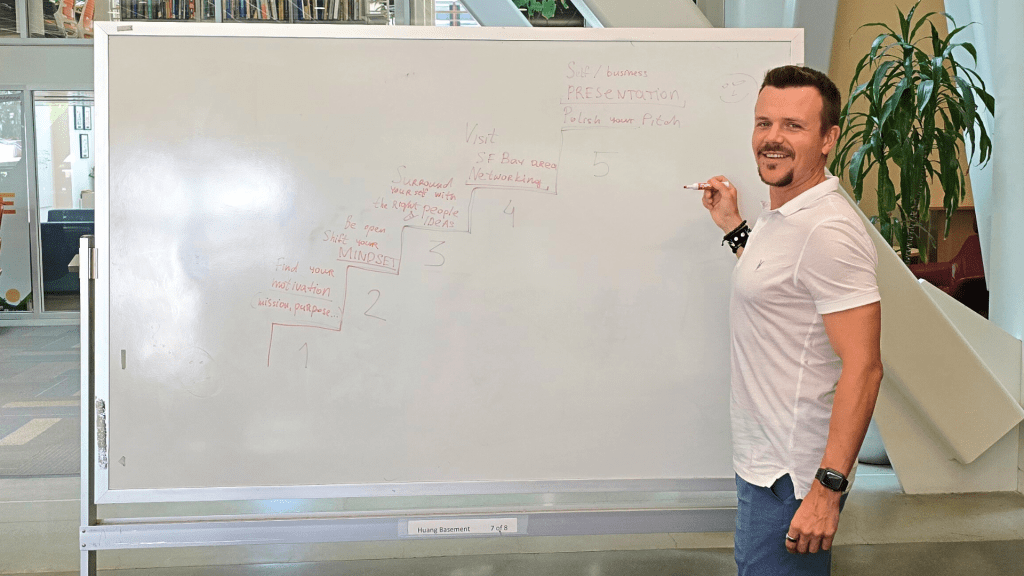
VD: There are several key points. Let's call it the top 5 tips for those who want to become part of this environment:
- Find your motivation. Understand yourself, find the reason that drives you. This may not be an easy process, but once you clearly know what inspires you, all subsequent steps become clear.
- Shift your mindset. Be open to new knowledge, even if it means admitting your incompetence in something. It is important to adapt and learn from others. Silicon Valley taught me that maintaining an open mind and the ability to change perspectives is critical to success.
- Surround yourself with the right people. Success depends on the people around you, those who can inspire, support, or share their experience. Your journey will be easier if you find your people and create a supportive community.
- Physical presence. I always say, "Come here." Personal contact creates a completely different level of trust and opens up new opportunities. Being physically present is the key to many doors.
- Maintain your Identity and interests. Be yourself, find people with similar interests who share your energy and vision. Business is built on people and their interactions, and your genuine interests can become a bridge to great collaboration.
LS:You emphasize the importance of not just business aspects but personal development as well. That’s interesting…
VD: Yes, because business is people. If you don’t know who you are and what motivates you, it will be very difficult to move forward. You must always start with yourself and then learn to interact with others.
Supporting the Ukrainian Community in Silicon Valley
LS:How would you assess the presence of Ukrainians in Silicon Valley? Is there a "Ukrainian influence" here?
VD: Yes, the Ukrainian community here is strong, but there is still work to be done. I often communicate with Ukrainian entrepreneurs and founders, and we have unique experiences, but at the same time, our resilience, which has helped us survive, can sometimes be a hindrance. We are used to difficult paths and often overcomplicate processes instead of adopting already working models. This is very noticeable in Silicon Valley. For example, when crises arise, Ukrainians show endurance, and instead of learning from others' experiences, we often choose difficult roads. In venture business, it is especially important to quickly acknowledge mistakes and change direction. We are still learning to accept such changes.
LS:How do you interact with such an environment?
VD: It is important for me to stay connected with our people here. We often unite in small communities, help each other, share experiences, and contacts. In this process, I see myself as a mentor. By the way, I recently became a certified coach, which allows me to work more deeply with people. Now it is not just about sharing knowledge but also about helping them find themselves, their strengths, and form a clear mission. Coaching helps me better understand my own motivation and how to use it to achieve more.
LS:What attracts you most about coaching, and how is it different from mentoring?
VD: During mentoring, experts share their successful experiences on already established tasks. But to find motivation and set relevant tasks, a person first needs to look inside themselves. This is what coaching is for. It is a process that changes thinking and allows for new ideas that resonate with a person's individuality. I see this as one of the key skills for development, especially in such a dynamic environment as Silicon Valley. Everything changes very quickly here, and the ability to adapt is critically important.

Author: Lukian Selskyi