


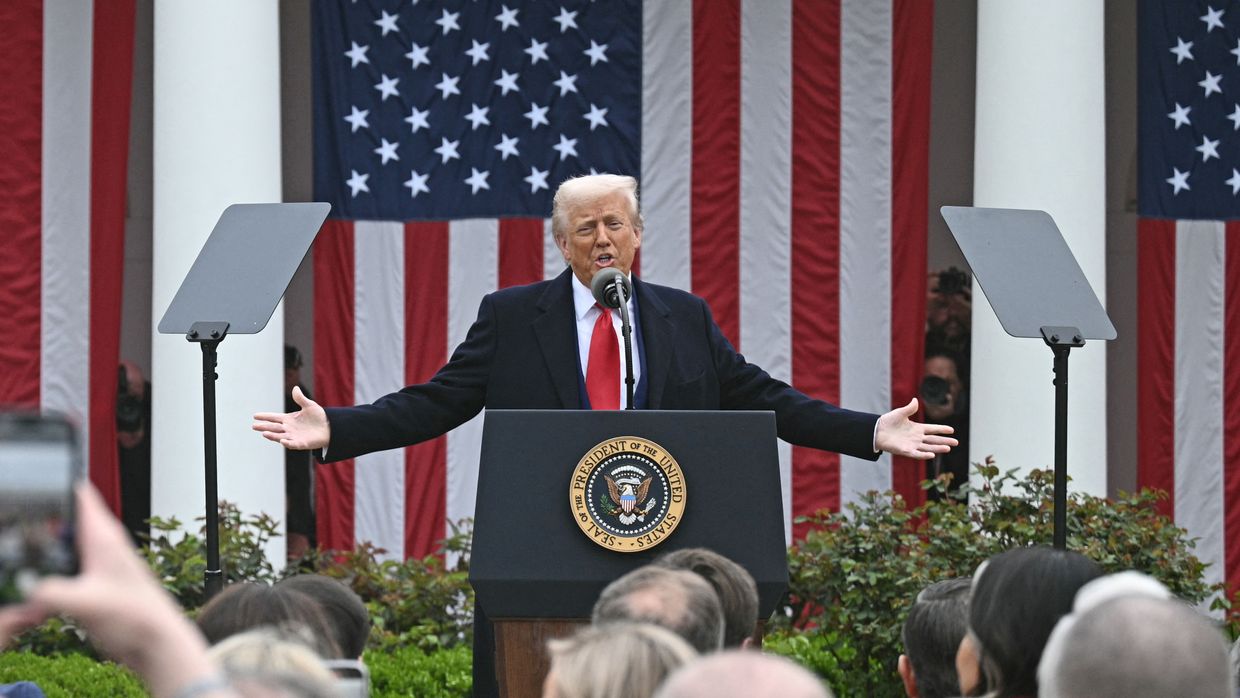
The Trump administration continues to negotiate with Russia behind Ukraine’s back, while simultaneously removing Moscow from its list of trade adversaries and threatening Kyiv with economic restrictions. Despite this, NATO reaffirms its long-term support for Ukraine, and allies have delivered the first F-16s. Meanwhile, the Kremlin is preparing for a new offensive, prompting Kyiv to reject any de-escalation proposals on Moscow’s terms. At the same time, Ukraine is facing cultural losses—most notably, the termination of funding for Ukrainian literature translations at Harvard.
New Trump Tariffs
The Trump administration is introducing large-scale tariffs against key U.S. economic partners—yet Russia is not on that list. Instead, Ukraine risks losing trade preferences, particularly in the agricultural and metallurgical sectors. This imbalance is perceived in Kyiv as politically motivated.
U.S.–Russia Talks
The Russian president’s special envoy, Kirill Dmitriev, held several meetings in Washington. According to him, “significant progress” was made in shaping a potential ceasefire framework. For the first time, the Kremlin officially stated it is willing to offer Ukraine “security guarantees”—albeit in vague terms. However, Kyiv was not involved in these consultations. Media compared the talks to a "Yalta 2.0" format—where Ukraine’s fate is discussed without Ukraine at the table.
U.S. Secretary of State Marco Rubio saidthat the United States will be able to assess the seriousness of Putin’s intentions for peace in Ukraine in the coming weeks.
European leaders, including the foreign ministers of the UK and France, called for clear deadlines for Moscow to accept ceasefire terms. They accused Putin of stalling negotiations, emphasizing that Ukraine had already agreed to the proposed conditions while Russia continues military aggression.
Moreover, a number of Trump’s senior advisors oppose direct contact with Putin, arguing that doing so would strengthen the Kremlin and undermine the U.S. image as a neutral mediator.
Ukraine and NATO: A Course for Long-Term Support
NATO and Ukraine the largest their joint course toward sustained security cooperation. The Alliance’s Secretary General emphasized that Ukraine will receive support as long as the threat from Russia persists. New aid packages, military training programs, and strategic integration of defense infrastructure have been confirmed. NATO remains firm in its stance, despite the U.S. engaging in a new round of “peace diplomacy.”
Russia Prepares for Offensive
Ukrainian military command is watched signs of Russian preparations for intensified combat across several fronts. Russia plans to increase its troop presence by 150,000 soldiers, which could significantly shift battlefield dynamics. Russian forces are concentrating in the south and east, preparing for a new phase of the war.
President Volodymyr Zelensky has saidthat he will not allow the downsizing of Ukraine’s armed forces under pressure from U.S.–Russia talks. This is in response to proposals from Trump’s circle for “de-escalation gestures” that would involve reducing Ukrainian troop numbers in line with Moscow’s conditions.
New F-16s Set for Deployment in Ukraine
The Netherlands and Belgium have completed the transfer of the first F-16 fighter jets to Ukraine. Pilots are in the final phase of training in Romania, and deployment to Ukrainian bases is expected in April. The jets are intended to strengthen defense against missile and drone attacks, and open possibilities for counteroffensives.
“Putin Cannot End the War”
Ukrainian and Western analysts believesthat even if Putin wanted to end the war, he no longer has the power or internal support to do so. The Russian military and intelligence agencies have independent agendas that hinder any peace efforts. Key power players in Russia—such as the FSB, GRU, and the Union of Regions—are not interested in ending hostilities.
Ukrainian Literature Translation Program at Harvard Loses Funding
The Ukrainian Research Institute at Harvard University has lost funding for its long-running Ukrainian literature translation program. Active since 2012, the program served as a vital cultural bridge between Ukraine and Western audiences. The funding cut was explained by the foundation as a "reallocation of financial resources to support the president’s new agenda."
Tactical Gains by the Ukrainian Armed Forces
Ukrainian forces continue active operations in the east. The Armed Forces of Ukraine (AFU) confirmed the liberation of a settlement previously held by Russian troops. Fighting continues along the Bakhmut–Kreminna–Siversk line, where Ukraine seeks to shift momentum in its favor ahead of Russia’s anticipated spring offensive.
Author: Inna Mikhno