


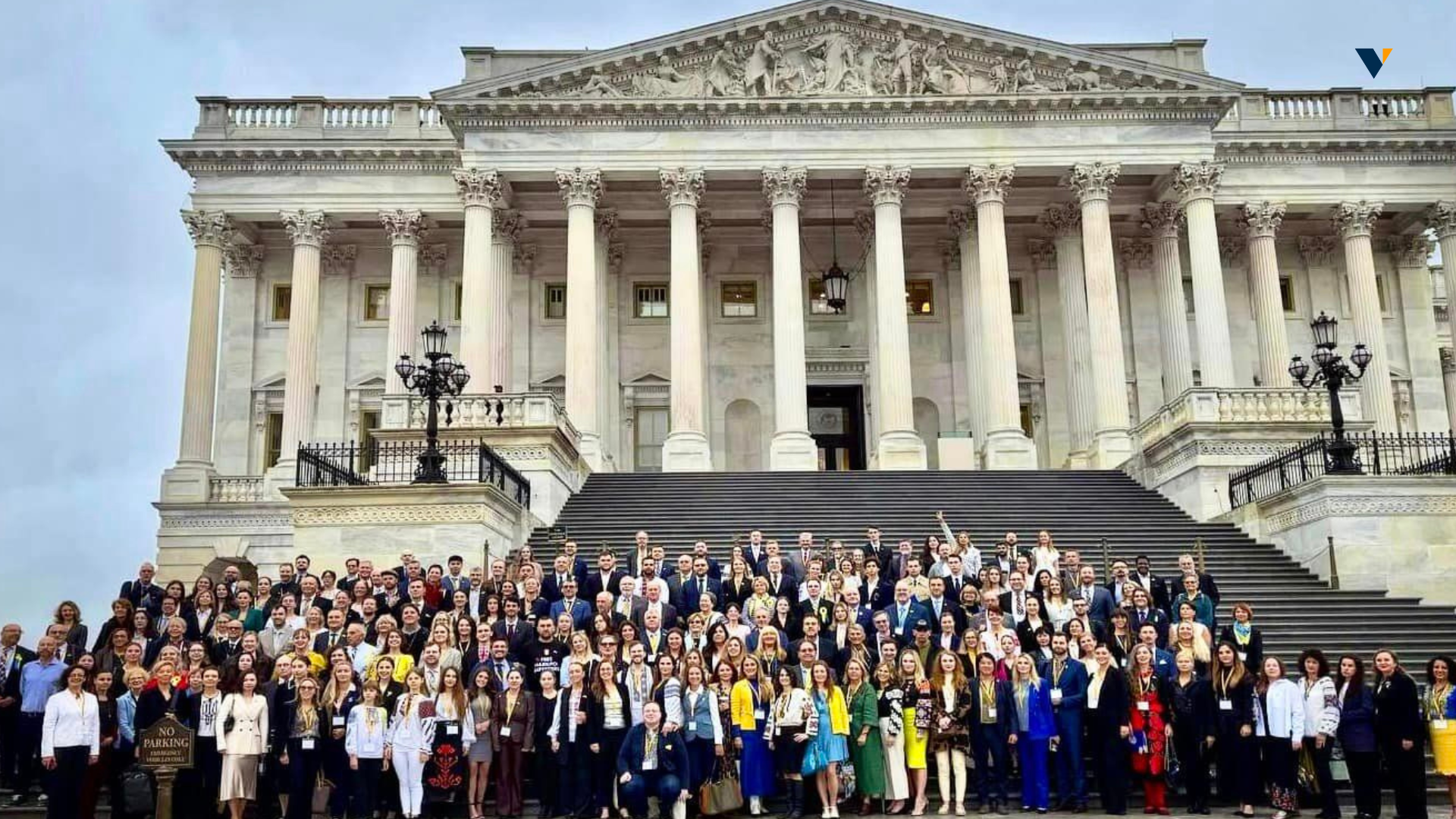
As Ukraine is now in its fourth year of fighting off Russia’s full-scale invasion, American advocates are preparing to make their voices heard in Washington. From April 6 to 9, 2025, hundreds of Ukraine’s supporters from across the United States will attend the Ukraine Action Summit. Their mission: to keep Ukraine’s struggle front and center in Washington—and to remind those in power that Americans stand with Ukraine in its fight to exist and remain free.
Held twice a year and organized by the American Coalition for Ukraine (ACU), the summit offers citizens a rare opportunity to engage directly with members of Congress. In September 2024, the summit brought together delegates from over 40 states for more than hundreds of meetings on Capitol Hill. Often such events are significant—after the spring one, a large US aid package was announced for Ukraine.
“It was just days after our 2024 spring summit that the $62 billion aid package was passed,” says Jacqueline Colgan of New Jersey. “I like to think that we were the straw that broke the camel’s back.”
Power in Numbers
The summit's strength lies in its diversity of people’s background, their motivation to support Ukraine and the scale. “Having 500 Ukraine supporters descending on DC simultaneously can make a difference,” says Stephanie Dowbusz, a Texas-based organizer and four-time attendee. “Phone calls are important, but talking to your representative face-to-face has a bigger impact.”
Dowbusz points to the power of a united front. “ACU is a coalition. Instead of all the organizations working separately with different messages, we all work together with a united front and message.”
Rachel Smith, a state lead from Louisiana, agrees. “It’s very cool to hear words and ideas that you shared in a meeting spoken by your member of Congress.”
These are not career lobbyists or political insiders. They are teachers, veterans, language tutors, and small-town activists who believe that Ukraine’s fate matters not just for Eastern Europe, but for the values the U.S. claims to uphold.
“Ukraine is willing to defeat one of our enemies and all they ask for is help with equipment,” says Smith. “I believe it’s both helping Ukraine achieve a just peace and protecting American national security.”
Moral Clarity
For many, this is personal. Some, like Arkansas-based Sam Linton, found connection through language. “While recovering from a car wreck, I started studying Ukrainian,” he says. He now tutors English learners in Ukraine through a nonprofit. “My ‘buddies’ are now family to me.”
Others, like Colgan, were drawn in by indignation. Her group, Nantucket Cares, brought a bullet-ridden children’s slide from Irpin to Capitol Hill to demonstrate the brutality of the war. “There is absolutely no way that Russia can ever defend its actions in Ukraine,” she says.
“I cannot recall any conflict between nations in which there has been such blatantly obvious moral clarity as to which side is right and which side is wrong,” she adds. “To quote Senator Cory Booker, ‘It is not about left or right, it is about right or wrong.’ Russia is clearly wrong.”
It’s also a great deal for American national security. “Ukraine is willing to defeat one of our enemies and all they ask for is help with equipment to achieve victory,” said Smith.
 What’s Different This Year
The tone of this year’s summit is different. Many attendees worry about declining political will in Washington, especially under the new administration. “It’s not clear if we can rely on any support from the administration or Congress,” says Dowbusz. “I think Ukraine continues to be supported by many Americans. What’s on the line is whether Ukraine will have a just peace with security guarantees… or be thrown under the bus.”
This concern is echoed by Nodira Uhlanova, an activist from New Hampshire and Massachusetts. “What’s at stake is not just supporting an ally, but defending democratic values on a global scale,” she says.
Attendees are calling for more than just continued aid. They want security guarantees, sanctions enforcement, the release of frozen Russian assets, and recognition of Ukraine’s full territorial sovereignty.
Colgan adds a focus on accountability: “Russia must pay. And we must address the abduction of Ukrainian children—many have been adopted into Russian families or forced into indoctrination camps.”
From Advocacy to Action
ACU’s mission is not only to influence policy but to empower ordinary Americans. “We’re not lobbyists,” says Linton. “We’re just people who care.”
This is civic diplomacy at its most grassroots—fueled by outrage, hope, and a deep belief in justice for what is happening to Ukraine. “I believe that I am standing up for my American values by supporting Ukraine,” Colgan says. “To turn my back on this just cause would make me feel like a deserter.”
In the coming week, members of Congress will be greeted by motivated volunteers, with a message that Ukraine’s survival, and America’s credibility, are on the line.
“When we go back home to our states and districts, we’re also able to more effectively encourage others to make calls to Congress, and help increase and broaden support for Ukraine,” said Linton.
Author: David Kirichenko