


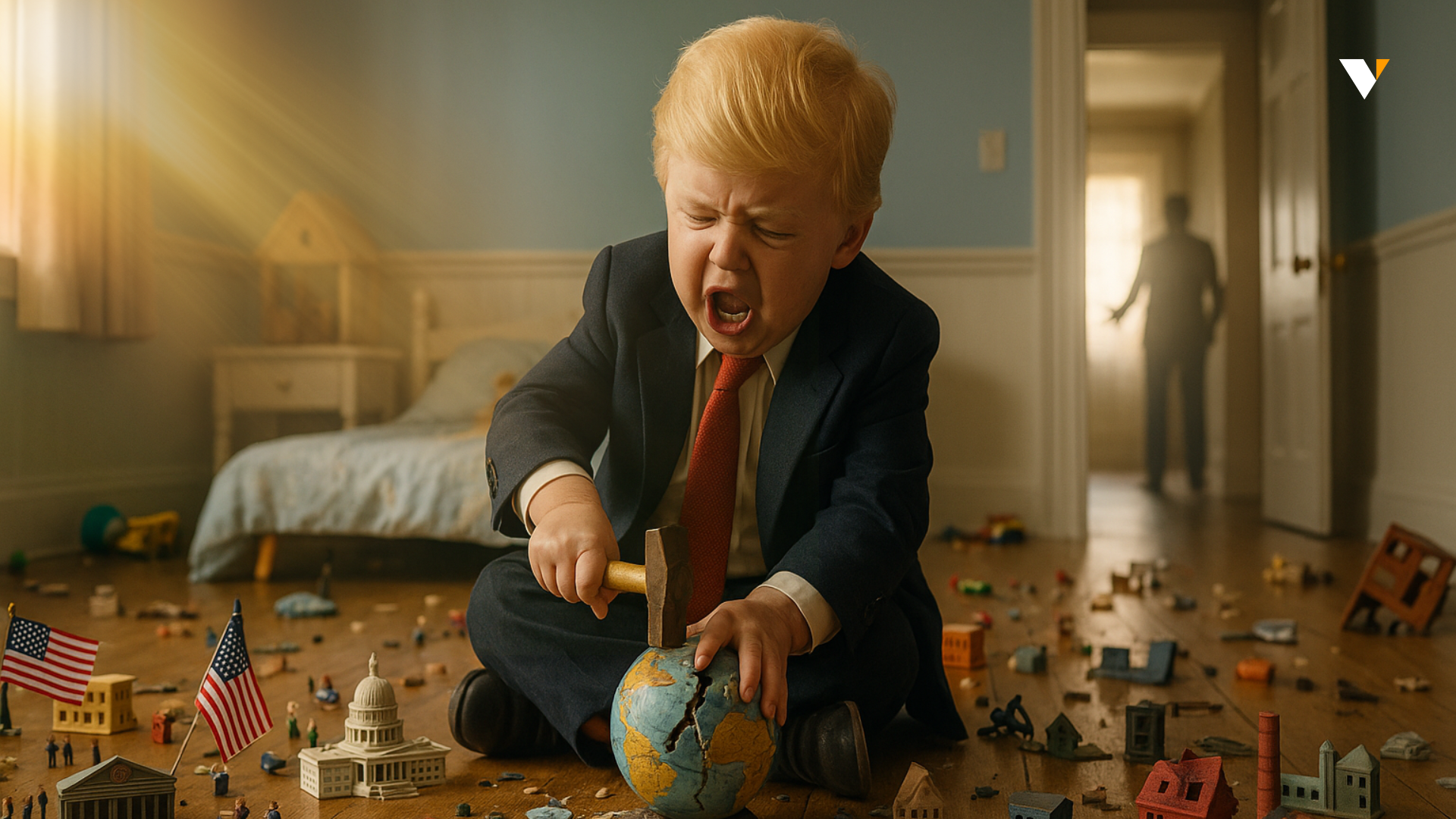
The further we march into the “Golden Age” proclaimed by U.S. President Donald Trump, the darker and more tangled the path becomes.
Draconian tariffs that sent shock waves through the U.S. and global economies—like an earthquake—are announced, then postponed. Raids targeting supposedly illegal migrants accused of serious crimes are carried out, yet more and more law-abiding, fully documented, and productive immigrants are swept up in them. Government shutdowns and mass layoffs grind on without pause (even the IRS was hit—right in the middle of tax-filing season). Elite, world-class universities face attacks and threats to strip their funding—powers that lie beyond the president’s constitutional remit.
Hundreds of lawsuits have been filed, followed by chilling maneuvers to sidestep court rulings, including those of the Supreme Court. Some experts say the nation is teetering on the brink of a constitutional crisis.
The “Golden Age” resembles a children’s playroom after mischief-makers have flung toys everywhere and even broken some open to see what’s inside. “Put everything back right now!”—but there are no adults left in the room.
For those “rowdies,” Ukraine—fighting desperately against a far stronger enemy for its very survival—is just another toy to toss around like a ball...
In truth, this “playroom” is a global battlefield where the fates of nations and peoples will soon be decided.
A “Declaration of Independence”… from the laws of economics?
On 2 April, the declaration of a worldwide trade war was staged with pomp: President Trump proclaimed not merely an “economic emergency,” but a U.S. “Liberation Day.”
“This is our declaration of economic independence. For years, hardworking American citizens have had to stand by while other countries grew rich and powerful—largely at our expense. But now it’s our turn to prosper,” he announced.
A large board was presented to him listing 110 countries on which the White House was imposing a 10 percent base tariff—on all imports, regardless of each country’s size or share of global trade (the list even included the uninhabited McDonald Islands near Antarctica, home only to penguins, prompting a storm of satire on social media). Noticeably absent were Russia, Belarus, Iran, and Cuba.
On top of that base tariff came extra, more differentiated duties: 24 percent for China, 20 percent for the EU, and the same 20 percent for “the most ruthless exploiters”—Canada and Mexico, the United States’ closest trading partners with intensive cross-border commerce and tourism.
But the markets did not share in the jubilation. The New York Stock Exchange suffered its steepest drop since the COVID-19 pandemic. A global economic crisis loomed; experts warned of rising inflation and a broad U.S. downturn approaching the scale of the 2007-08 Great Recession.
What rattled markets most was the sweeping approach of Trump and his chief adviser on the issue, Peter Navarro, to the intricate web of international trade. Yes, the U.S. national debt exceeds $30 trillion, but not because other nations have willfully “exploited” America (China’s currency manipulation aside). Rather, it stems chiefly from a decades-long global division of markets and production based on each country’s economic strengths.
For roughly thirty years, the U.S. and EU have shifted manufacturing to China, Vietnam, and Cambodia (and the U.S. also to Canada and Mexico), focusing instead on services and high-tech. China and several other Asian states, in turn, have “flooded” Western markets with cheap consumer goods and critical microelectronics. Supply chains painstakingly built over decades were abruptly severed by these one-size-fits-all tariffs.
Economists warned Americans to brace for sharp price hikes on everyday goods, medicines, food, durable items, and cars. Tariffs would raise import costs, and “reshoring” factories to the U.S. would spike the production costs of “import-substituted” goods, because American labor is far pricier than labor in China or the Global South. Domestic manufacturing capacity has also withered since offshoring began. Bringing industry back would effectively drag the country into a bygone industrial era it had already transcended through rapid scientific and technological progress.
Moves to rein in Trump’s sledge-hammer blows to the U.S. and world economies quickly emerged. NBC News noted at least three congressional billsto limit presidential authority over tariffs. Two libertarian groups — New Civil Liberties Alliance and Liberty Justice Center (on behalf of five small-business owners) — sued to block the duties, arguing that even an economic emergency gives no president the power to levy what are effectively taxes on American consumers.
Infighting also erupted inside the administration—most notably between Elon Musk (whose companies took a beating from the tariffs and public outrage) and Navarro.
Under pressure, Trump hastily announced on 9 April a 90-day delay for the harshest tariffs on the EU, Canada, and Mexico—though the base 10 percent still took effect immediately.
China, however, saw no reprieve: a genuine trade war was under way, with both sides escalating duties. The U.S. now slaps Chinese goods with tariffs up to 245 percent (electronics are temporarily exempt), and China responds in kind.
Markets partially rebounded after the postponement (savvy players, CNBC’s Robert Frank notes , pocketed instant windfalls—Business Insider’s Brian Metzger reports a finger at Congresswoman Marjorie Taylor Greene).
Yet indices never returned to pre-tariff levels. Postponement is no substitute for a coherent strategy: the U.S. has squandered its reputation as a reliable trade and business partner, undermining the global economic order that rested on that trust—and even tarnishing confidence in the dollar itself. Economists are at a loss to predict the fallout.
IMF Managing Director Kristalina Georgieva warned that the world economy’s resilience is being tested by this “reset of the global trading system,” stated turbulence on financial markets.
Are all immigrants criminals?
Trump endlessly repeats in various forms that “Democrats opened the borders, letting in millions of criminal aliens sent from the world’s prisons and asylums,” lumping everyone who ever entered the U.S. with procedural lapses together with violent offenders. Apparently no one has explained that such lapses often stem not from criminal intent but from refugees fleeing political persecution who cannot navigate the legal immigration maze; many genuinely escape jail—or death—for non-criminal reasons. As with trade, immigration is treated through a simplistic, mass-campaign lens. Raids occur even in churches, hospitals, and schools; immigration police, given quotas, ignore individuals’ circumstances.
The most high-profile case is that of Kilmar Abrego García (see, e.g., Daniela Silva, NBC News), a Salvadoran who reached the U.S. at 16 in 2012, married an American citizen, and fathered three U.S.-born children. Swept up in a mass deportation of over 200 Salvadorans all labeled MS-13 gang members, he was flown overnight—without trial—to El Salvador’s harshest prison, infamous for torture. Yet the U.S. Justice Department itself had admitted error: in 2019 (during Trump’s first term) a court ruled he could not be deported because he faced death “from local gangs” if returned.
García’s case reached the Supreme Court (where three of nine justices are Trump’s own appointees), which unanimously ordered the White House to bring him home. The administration resists, branding him a terrorist—without evidence.
Such cases have pushed the nation toward constitutional crisis as the president overreaches and seeks to erode judicial authority, still politically independent.
Trump has even mused about sending U.S. citizens convicted of serious crimes to that Salvadoran prison—an idea said she.
Mass-deportation policy faces mounting litigation, yet Trump doggedly vows to expel “every criminal alien.” By executive order he cut federal funding for lawyers who represented unaccompanied minor migrants—26,000 children—leaving them to navigate U.S. courts alone ( Rebecca Santana, AP). A basic remedy would be arranging adoption by American families, given that parents who knowingly dispatched children on such a journey should lose custody—even in absentia.
Is the U.S. heading for a hybrid system?
More and more experts discern in Trump’s actions a deliberate attempt to dismantle America’s institutional foundations—checks and balances, separation of powers, university autonomy—and to thrust the country swiftly toward authoritarianism or, more likely, a hybrid regime.
Zak Beauchamp, writing for Vox, argues that Trump’s tariff policy signals the decay of U.S. democracy and a shift toward “a strange hybrid system that combines elements of democracy and autocracy”:
“On the one hand, the electorate that chose Trump is getting his policies. Sometimes, demagogues win elections in democracies—Plato lamented this problem in The Republic. On the other hand, democracies rely on legal norms that limit executive power, preventing any demagogue from becoming a dictator. In the U.S. system, Congress alone has the power to tax. Instead of seeking legislative approval for higher tariffs, Trump uses a broadly worded emergency statute to bypass the legislative branch,” Beauchamp explains, noting that tariffs are effectively taxes on imported goods.
But, he continues, this is only a symptom: America’s democratic machinery stopped functioning properly long ago.
He sees the decline chiefly in Congress’s diminished capacity to wield its constitutional powers—the main brake on executive overreach:
“The chief culprit is Congress, which—through a mix of political cowardice and hyper-partisanship—has become both unable and unwilling to act as the supreme lawmaking body. Instead, it has delegated vast chunks of its own authority to the executive branch.”
Sometimes this was deliberate—empowering presidents to craft policy through executive agencies and thus creating the much-criticized “administrative state.” Sometimes it was inadvertent: Congress granted the president vague emergency powers meant for narrow contexts, which in practice allow unilateral action in normal political disputes. And sometimes Congress simply did nothing on crucial issues, forcing presidents to act through dubiously broad interpretations of their own authority.
The judiciary is to blame as well: “though the Supreme Court occasionally steps in to police presidential abuses, it does so haphazardly and inconsistently. Worse, it has long indulged the president on key issues such as immigration, trade, and war,” Beauchamp writes.
He adds that internal executive-branch guardrails—advisory councils, unwritten norms, the personal restraint of previous presidents—were always voluntary:
“Trump neutralized internal checks within the executive branch and clearly lacks the self-restraint we expect of people in high office.”
Tariffs are one of the clearest examples of why this matters: without democracy, the quality of our policy deteriorates to dangerous levels.”
Another expert, Trevor Potter (founder of the Campaign Legal Center and former adviser to Senator John McCain’s presidential campaigns), analyzes in Newsweek how Trump has stretched his authority through a torrent of executive orders:
“Executive orders do not create new laws—only Congress can do that,” Potter emphasizes.
“Some of President Trump’s executive orders are within the law, including those rescinding President Biden’s orders. Many others, however, are unconstitutional and illegal,” he writes, citing in particular an order on elections.
That order instructs several independent federal agencies to change federal-election rules, imposing needless hurdles for voter registration. “If these powers take effect, they could disenfranchise millions,” Potter warns. Yet “the president has no authority to enforce this order. The Constitution explicitly gives states power over federal elections, and Congress—not the president—may create nationwide voting standards.”
Finally, immigration lawyer Yuliya Nikolaieva writes on Facebook:
“The most outrageous measures are now being introduced only through emergency powers that exist solely for exceptional situations. … ‘Emergency’ is a legal concept, not political, economic, or philosophical, so all talk of an economic crisis, woke excesses, or an immigrant invasion is irrelevant—none of the conditions present when the new administration took office meet the legal definition of an emergency. Using emergency powers under these circumstances is nothing but a legally untenable veil for pushing through dubious decisions quickly. … Declaring an emergency dangerously expands presidential authority while eliminating procedural safeguards, minimizing the role of other branches, and depriving society of influence over what is happening.”
Thus, the United States now stands at a crossroads between preserving its democratic system and sliding toward a hybrid regime that still holds elections but loses the mechanisms restraining a president from exceeding the powers defined by the Constitution and laws. To this end, presidential candidates exploit existing problems, offering in fiery speeches simplistic, campaign-style, mass-appeal methods that inflame voters but most often yield loud yet superficial measures and decisions—measures that not only fail to solve problems but actually complicate them, sometimes triggering crises of national and even global scale “out of thin air.”
The clearest sign of a drift from democracy to hybridity is the inability of different branches of government, political forces, and parties to cooperate—an erosion of centrist compromise. In today’s United States, bipartisanship is giving way to mutual hostility, reciprocal accusations (sometimes justified, more often exaggerated) used to justify power grabs, and disregard for the losing minority—nearly half the electorate.
Under such conditions that minority resorts to counter-measures, which are often radical as well. There is a danger that, riding the wave of Trump’s failed policies, the Democratic Party will swing sharply left—a trend we may already see in next year’s mid-term elections.
Foreign policy: from alliances to deals?
Trump’s domestic trajectory is accompanied by attempts to reshape U.S. foreign policy. Instead of relying on the integrity of the Euro-Atlantic civilization and its values, he proposes a disjointed, chaotic agenda based on carrots-and-sticks extortion to secure bilateral deals weighted toward U.S. interests rather than mutual benefit.
Such an approach makes no principled distinction between aggressor and victim, between “good” and “evil”—most clearly seen in Trump’s treatment of the Russian-Ukrainian war. Having assumed the role of mediator, Trump effectively appeases the aggressor and repeatedly ducks direct support for Ukraine, even accusing Kyiv of allegedly having started the war. This policy reaches absurdity in voting records: on a UN General Assembly resolution marking the third anniversary of Russia’s invasion, the United States voted with Russia against the measure; Washington also torpedoed a G7 resolution condemning Russia’s latest war crime—the Palm Sunday strike on Sumy.
Democracy or hybridity—the West's defining question
The characteristics now evident in the United States are gradually taking hold in Europe as well. For now, EU countries and the United Kingdom staunchly defend democratic values, standing as democracy’s last bastion. But with every parliamentary or presidential election, radical forces resembling Trumpism attract more adherents, steadily advancing toward positions that shape domestic and foreign policy.
Whether democratic forces in European countries can hold the center, preserve compromise, and enable voters to evaluate political programs critically—resisting the lure of quick fixes—will determine whether any remnant of the post-World-War-II international order that ensured Western peace and prosperity survives.
Europe, too, is tempted by simple solutions. Unlike the United States, insulated by oceans, Europe—especially its east—has felt Russia’s aggression firsthand. After years of attempts by France (including early-term Macron), Germany (under Merkel and early Scholz), and other states to pursue trade-and-politics deals with Putin’s regime, today’s European leaders—with the exception of Hungary and Slovakia—see the futility of that path.
For now, Europe demonstrates not only the ability to unite independently in defense of the democratic order’s remnants but also to restrain U.S. impulses to abandon the continent.
Nowhere is this clearer than in the new policies of France, Britain, Italy, and EU leadership toward the Russian-Ukrainian war. Since Trump entered the White House, Europe has mobilized all its capabilities—both to avoid an outright break with the United States and to increase support for Ukraine far beyond previous levels.
Yet Europe, too, teeters on the brink of sliding into a Trump-style world. Here lies the frontline of battles decisive for the Euro-Atlantic civilization’s future—and Ukraine stands at their epicenter.
About Author:
