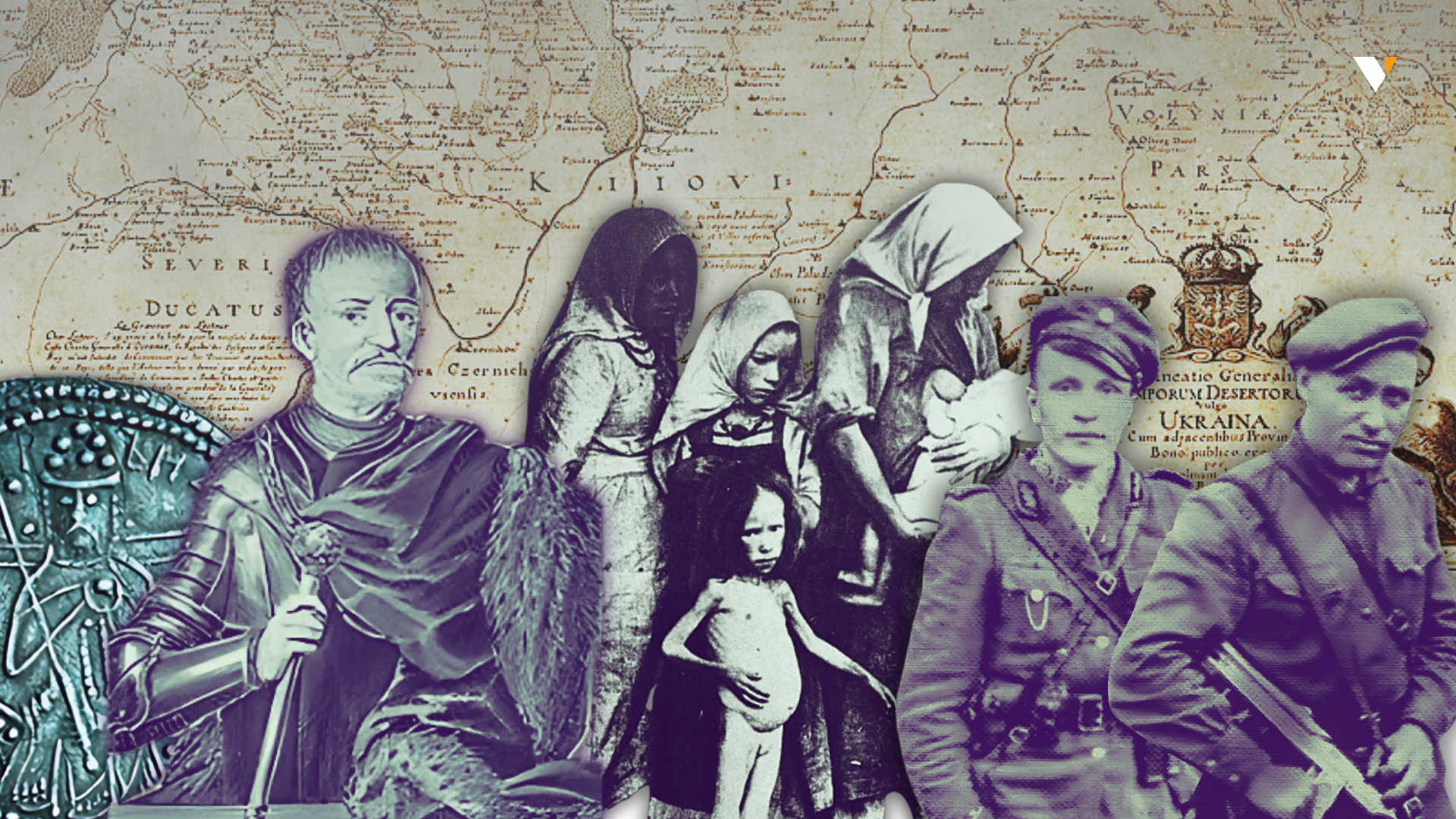
In the Russian-Ukrainian war unfolding before our eyes, the weapons are not only shells. Today, ideas kill. It is not only cities that are being destroyed—memory is being erased, the past is being distorted, archives are being burned, language is being wiped out. In this war, the history of Ukraine is not a school subject and not the pages of a textbook. It is another front—unseen but decisive. Because history is precisely what shapes a nation’s identity, consciousness, and future choices.
As everyone in the world already knows, in February 2022 the world shuddered at russia’s full-scale invasion of Ukraine (as opposed to the hybrid attack on Ukrainian sovereignty in 2014). But for anyone who knows even a little about the history of Eastern Europe, this did not come as a surprise. russia had been preparing for this war for decades—and not only with its army. It prepared the ground through propaganda, the falsification of historical facts, and the mass production of myths that legitimize aggression. It systematically persuaded its own population that Ukraine is “not a real state,” that Ukrainians are “part of the great russian people,” and that Kyiv is “the cradle of russian statehood.”
These narratives are not just propaganda slogans. They are elements of a weapon. Historical myths have become instruments of war. Because if you can convince the world that Ukrainian identity does not exist, then the annexation of its territories will look not like a crime but like “taking back what is yours.”
That is why today Ukrainian historians, educators, journalists, and all conscious citizens are waging another struggle: for the truth. For the right to be heard. For our voice—emotional, yes, but also reasoned—to finally be heard in Washington, Brussels, Ottawa, London, Berlin, Paris, Rome, Buenos Aires, Ankara, and everywhere the Ukrainian diaspora lives or where the West and its democratic partner states still perceive russian interpretations as an “alternative view.”
We live in a time when meanings weigh more than facts. Because a fact can be twisted, torn out of context, manipulated. Meaning is a coordinate system. And that is precisely where today’s struggle lies: between truth and lies, between freedom and empire, between future and past.
So let us look at what has become an obvious axiom: the history of Ukraine has long ceased to be about memorizing dates and canonical biographies. It is about dignity. It is about freedom. It is about the right to be oneself. And on understanding this depends not only Ukraine’s fate but also the future of the entire democratic world.
Part One
The Past as a Weapon: How russia Rewrites a “Common History”
russia’s war against Ukraine is not only a war for territory or political influence. It is a war for memory. For control over what is considered “historically correct.” For the right to define who we Ukrainians were, who we are now—and who we must be tomorrow. In this war, tanks and missiles are supplemented by textbooks, television, and fake “historical documents.” The past has become a weapon. And the official kremlin has long since learned to fire this weapon no less painfully than its “Kalibrs.”
At the center of this propaganda campaign is the idea of a “common history,” in which Ukraine supposedly was never an independent subject but merely the “younger brother” of a great russian civilization. This myth rests on the deliberate distortion of facts, the wrenching of events from context, and the systematic destruction of everything that does not fit into the “great russian history.”
The clearest example is the attempt to appropriate the legacy of Kyivan Rus. Imperial ideology, starting in the eighteenth century, deliberately built the narrative that “russia is the direct heir of Rus.” This historical fake did not arise from antiquity but from the decisions of moscow’s tsars and the synod of the russian orthodox church, who—under the influence of Greek scholars—invented the name “russia” for muscovy only in the second half of the seventeenth century. Moreover, Rus was geographically, culturally, and politically a completely different entity whose center was Kyiv, not the swamps around moscow, which at that time were only beginning to be settled by Ugro-Finnic tribes.
The empire needed legitimacy—and it decided to steal it from Kyiv. russia actively exports this myth to this day: “president” putin personally wrote a column calling Ukrainians and Russians “one people”; russian textbooks claim that Ukraine arose only as a result of “fraternal assistance,” and state television regularly says that “Ukrainians are an invention of the Austrian General Staff.”
Another component of this “history war” is the distortion of twentieth-century events, especially the Holodomor, World War II, and Soviet repressions. The Holodomor of 1932–1933, which Ukrainians and most of the civilized world recognize as genocide, russia still denies, calling it a “shared tragedy of the peoples of the USSR”—despite the obvious facts of centrally imposed grain requisitions specifically in Ukraine and the blocking of any aid. This is not merely falsification—it is an attempt to erase the memory of the millions of Ukrainians killed by starvation.
In the russian version of history, World War II is the “Great Patriotic War,” where the USSR is the hero and liberator, and all others are traitors or “Nazis.” There is no mention of the Molotov–Ribbentrop Pact. Nor of the murder of Polish officers at Katyn. Nor of the deportation of the Crimean Tatars, the destruction of the Ukrainian intelligentsia, or the NKVD’s mass executions. Everything that contradicts the image of the “great victory” and the heroic USSR is simply cut out.
This is no accident. It is a systematic policy. And in the twenty-first century it turned into the ideological basis for invasion: devaluing Ukraine’s history became preparation for devaluing its statehood. If Ukraine never existed as a subject, then it has no right to independence. If there was no separate culture, then everything Ukrainian can be banned. If there was no language, then it is superfluous. And this mechanism of literally destroying meanings has been working for more than a century.
But the truth is on our side. The history of Ukraine does not begin in 1991, nor in Soviet offices, nor on the pages of imperial textbooks. It begins with the unique Trypillian archaeological culture, with the ancient cities on the Black Sea, with Scythian burial mounds, with medieval Kyiv, with the Cossack state, with the struggle of the Ukrainian People’s Republic, with the heroes of Kruty, with the underground of the Ukrainian Insurgent Army, with the Sixtiers, with the Maidan. It is not “younger” than russia’s—if anything, quite the opposite. And it is different. Our own.
And that is precisely why those who are used to living by lies fear it so much. Because truth is not only memory. It is a weapon. And we have learned to use it. Those who have not yet learned will do so, because there is no going back.
Ukraine as a Different Model of the Future: Why Freedom So Irritates the Empire
When we speak of russia’s war against Ukraine, we cannot view it only as a conflict over territory or resources. It is a war of worldviews. A war between two radically different visions of what the future should be. In this confrontation, Ukraine appears not as a fragment of the russian empire but as its alternative. An alternative that irritates, frightens, and demoralizes the empire precisely because it shows that one can live differently—building a state not on lies, fear, and brute force, but on dignity, freedom, and respect for the human being.
And that, perhaps, is the main reason for the kremlin’s hatred of Ukraine. russia, which for decades (indeed, for centuries) has built its narrative around the idea of a “special civilization,” where some inhuman order matters more than human freedom, where the state dominates the citizen and “truth” is whatever is convenient for the authorities, perceives a mortal threat in the very fact of Ukrainian freedom.
Because Ukrainian identity, despite centuries of attempts to destroy it, survived. And not only survived—it has been able to offer a model of statehood where society matters more than the bureaucrat; where the army is supported not out of fear but out of trust; where the real language rings out in the streets, not a ritual substitute.
Ukraine is the country of the Maidan. And not just one. It is a state where citizens can say “no” to a government that betrays their values. A state where, even in wartime, people continue to discuss reforms, debate morality, and refuse to bow to a tsar. And in this lies the main difference between Ukrainians and the representatives of the putin regime.
As is well known, empires always fear an example that destroys their monopoly over the definition of normality. In the eighteenth century, for instance, the French Revolution terrified Europe’s monarchies more than any army; in the twentieth, the fall of the Berlin Wall caused mortal panic in communist regimes; and in the twenty-first, Ukraine has become such an example for russia.
Because if Ukraine can be free, democratic, European, and open—what then becomes of russia? That question is the most frightening for the putin regime. It calls into question the very legitimacy of russian authoritarianism. If Ukrainians can live without a strongman, why are russians being forced to submit to a dictator?
Therefore, Ukraine must either be destroyed or broken. Its path must be shown to be a failure. Freedom must be “proven” to be chaos, democracy to be weakness, language, culture, and national dignity to be “Nazism.” And the future, they insist, exists only where there is a “strong hand” and an “eternal president.”
Ukraine as such refutes all of this lying—by its very existence. And that is why the modern russian empire tries to convince the world that Ukrainians do not exist, that they are “the same people,” that all the difference is merely a “wrong interpretation of history” or “Western interference.”
But tens of millions of Ukrainians who fight, volunteer, work, teach children, pay taxes, and tell the truth prove otherwise. They prove that the future is possible. That freedom is not a privilege but a value worth fighting for. That history is not only about the past but about choice—about who we want to be tomorrow.
And this choice is not only Ukrainian. It is a challenge to the entire world—to the West, to the United States of America. Because if freedom can be killed with rockets, then what is it worth? If truth is defenseless before lies, then what is truth?
That is why Ukraine is not merely a victim of aggression. It is a forward outpost. It is a test for all who believe in freedom. And how we answer that test will determine what the twenty-first century will be: a century of empires and dictatorships, or a century of dignity, rights, and humanity.
Stolen Meanings: From Rus to the Soviet Era
As is already known, russia’s war against Ukraine is not only a struggle over territories or resources. It is a war over meanings, over memory, over who has the right to tell the story. For decades—indeed, for centuries—russia has stolen from Ukraine not only people and lands but also historical subjectivity. It appropriated the past, erased names, silenced tragedies, twisted facts—and passed it off as a “shared heritage.” As a result, millions in the West still believe myths about “one people,” “one history,” “one language,” or “brotherly nations.”
But the truth is different. The history of Ukraine is a distinct, self-sufficient, extraordinarily deep, and tragic road. It has its own origins, its own turns, its own heroes, and its own wounds. And that road the russian empire—first tsarist, then Soviet, and now putinist—has constantly tried either to block or to seize.
So let us walk through several points that moscow has systematically distorted—from the time of Kyivan Rus to World War II. We will see why these historical events were (and remain) dangerous for the last russian empire, and how restoring them to a truthful reading changes not only Ukraine’s past but also our shared future.
We will speak not only about facts but also about meanings. Because they, ultimately, are today’s most crucial battlefield.
Kyivan Rus: Why “Common Roots” Is a Myth
One of the main myths that russian propaganda has exported to the West for at least decades is the claim of “common roots” of the Ukrainian and russian peoples in Kyivan Rus. Allegedly, russia is the “successor” of this powerful medieval state, and thus Kyiv is the spiritual cradle not only of Ukraine but of “all Slavic peoples.” This myth is very convenient, because it is precisely what allows moscow to claim historical legitimacy in controlling Ukraine. But the truth is otherwise: Kyivan Rus is not the “cradle of three fraternal peoples” but an independent East European state that arose long before moscow itself—on the territory of present-day Ukraine.
Kyivan Rus emerged in the ninth century with its center in Kyiv—the present capital of Ukraine. It was here that Volodymyr the Great baptized Rus in 988; here that the legal and administrative traditions were formed which became the foundations of statehood. moscow appeared on the historical map only centuries later, first as one of numerous vassal appanages and then as a vassal of the Mongol Chinggisids. There was never any direct political or administrative succession between Kyiv and moscow.
russia appropriated the legacy of Rus much later—when moscow’s tsars began to seek legitimacy for their rule. In the sixteenth century, for instance, moscow proclaimed itself the “Third Rome” and declared Kyivan Rus to be “its” past. After part of the Ukrainian lands were incorporated into the russian empire, the myth of a “single Rus’ history” became official ideology, later adopted by the Soviet union as well. In textbooks, museums, and films, Rus was transformed into the “prehistory of Russia,” erasing Ukraine’s belonging to this heritage.
In reality, however, the cultural, linguistic, and political legacy of Rus is much closer to modern Ukraine than to russia. The language of Rus had more in common with Ukrainian; the Kyiv chronicles, customary law, and architecture—all this continued and developed on Ukrainian lands, while moscow built a different model: despotic, isolationist, authoritarian.
The point of this myth is not truth but control. By appropriating Rus, russia tries to erase historical boundaries between itself and Ukraine, to replace history with geopolitics, and identity with imperial loyalty. Yet the truth still breaks through. And every smashed plaque that reads “one people” is another step toward liberation from historical captivity.
So, as an axiom, let us state: Kyiv is the heart of Ukraine. And Rus is Ukraine as well. Not Moscow. And it never was.
Hetman Mazepa: From Treason to Heroism
For a Western reader, the name of Hetman Ivan Mazepa most often evokes the myth of “betraying Tsar Peter” or images from Byron’s poetry and Liszt’s music. Yet behind this story lies something much deeper—the struggle of the Ukrainian people for freedom, dignity, and their own state. To understand the role of Hetman Mazepa himself, we should take several steps back—to an era when, after centuries of division and foreign rule, Ukrainians again asserted themselves as a distinct and politically active people.
After the decline of Kyivan Rus due to multiple internal and external pressures, and the fall of the last Rus state—the Ruthenian Kingdom (the Galician-Volhynian state) in the fourteenth century—Ukrainian lands gradually came under the rule of neighboring states: Poland, Hungary, Lithuania, Moldavia, the Crimean Khanate, and later Muscovy. Yet the memory of statehood, language, faith, and rights lived on among Ukrainians for centuries. In the fifteenth and sixteenth centuries, a new and unique phenomenon emerged in the south of Ukrainian lands—the Zaporozhian Cossacks: a self-governing, armed, militarily organized brotherhood that gradually became not only a military force but also an embodiment of the national idea of freedom.
By the mid-seventeenth century, the Cossacks, as the elite of society, led a grand uprising against Polish rule. In 1648, the democratically elected Hetman Bohdan Khmelnytsky launched the Ukrainian people’s war of national liberation, which resulted in the formation of the Hetmanate—the Ukrainian Cossack state under the official name the Zaporozhian Host. For the first time in centuries, Ukrainians restored their statehood, founded on elected leadership, legal tradition, and their own army.
This nationwide drive for independence, in many respects, resembled the American War of Independence that would occur over a century later. Both Bohdan Khmelnytsky and George Washington led struggles for their nations’ freedom against colonial oppression and for the right to determine their own destinies. Both wars arose from the need to protect citizens’ rights, religious freedom, and land from imperial exploitation—Polish in Ukraine’s case and British in America’s. In both cases, national leaders had to seek foreign allies, with mixed success, and fight not only enemy regular armies but also internal divisions and betrayals. This parallel historical experience should make Ukraine’s struggle for independence more comprehensible to Western readers and creates a moral bridge between the two nations.
Practically immediately after Hetman Khmelnytsky’s death in 1657, however, began a long period of political instability and power struggles known as the Ruin. moscow, initially only a military ally, increasingly interfered in the Hetmanate’s internal affairs. Ukrainian statehood was steadily narrowed, and its leaders were ever more often replaced or murdered at the tsar’s order. It was in this difficult time, in 1687, that Ivan Mazepa—a highly educated, ambitious, and politically seasoned statesman—became head of the Hetmanate.
Hetman Mazepa tried to balance the interests of muscovy, Poland, the Crimean Khanate, and the Ottoman Empire, seeking to preserve Ukraine’s autonomy. He built infrastructure, supported the Orthodox Church, and founded schools, academies, and printing houses. His rule was an era of baroque flourishing in Ukrainian culture. Yet moscow’s authorities increasingly ignored Cossack rights and interfered in every sphere of life—especially under the despotic Tsar Peter I, who sought to centralize and russify all territories under his control.
Understanding the fatality of remaining under such tyranny, in 1708, during the Great Northern War between muscovy and Sweden, Ivan Mazepa made a fateful decision—to side with Swedish King Charles XII. This was not a sudden betrayal, as moscow’s propaganda claimed, but a considered attempt to gain real independence for Ukraine through alliance with a European state. Mazepa realized that a victory by Peter in this war would mean the end of Ukrainian autonomy. His decision was supported by part of the Cossack elite and clergy, but due to treachery Peter learned of Mazepa’s plans and dealt a crushing blow to Ukraine—not only a military one. In 1709, the joint Ukrainian-Swedish forces suffered a catastrophic defeat at Poltava, and Mazepa was forced to flee to Moldavia, where he later died.
Mazepa’s story is that of a leader ahead of his time. He understood that the Ukrainian people could survive only with freedom and European integration. His decisions, although they did not bring immediate independence, became a symbol of indomitability. It is no accident that russia anathematized the Ukrainian church for Mazepa’s sake and that his name was long banned. Modern Ukraine is restoring Mazepa to his rightful place in history—as a statesman who dared to challenge the empire.
Thus, today Mazepa’s image is not that of a traitor but of a nation-builder who, like America’s Founding Fathers, chose the path of independence despite great risks. In this lies the essence of his heroism.
The Holodomor: A Genocide moscow Denies
The term “Holodomor” is composed of two words—“holod” (hunger) and “mor” (mass death).
To understand the tragedy of the Holodomor of 1932–1933, we must look at the preceding events. It was not the first famine to sweep Ukrainian lands in the twentieth century. Already in 1921–1923, the Bolshevik authorities, having by then established control over Ukraine, confiscated grain, livestock, and food from peasants to supply the Red Army and russian cities. As a result, more than a million Ukrainians died of hunger, even as aid was organized for the starving in northern russia but not in Ukraine. moscow already treated Ukrainian grain as a resource for the empire and Ukrainian peasants as subjugated and dangerous.
In the 1930s, the Stalinist regime launched a sweeping policy of forced collectivization. Peasants were forbidden to own land, livestock, or tools—everything was transferred to kolkhozes controlled by the state. Those who resisted were labeled “kulaks” (prosperous peasants) and were mass-arrested, deported, imprisoned, or shot. All forms of resistance—even burning property or slaughtering livestock—were treated as “counterrevolutionary activity.” This collectivization campaign was part of Stalin’s broader plan for industrialization: Ukrainian grain was to feed workers in moscow and Leningrad and provide exports to pay for Western machinery.
By 1932, the situation in Ukrainian lands had become catastrophic. moscow imposed impossible grain procurement quotas—seizing not only surpluses but the last grain, potatoes, beans, cows, and chickens. For hiding food or gleaning stalks in the fields, people were executed or imprisoned for ten years. “Blacklists” were created in Ukraine—rosters of villages whose residents were banned from trading, traveling, or receiving any assistance. The USSR leadership deliberately isolated Ukraine, shutting down transport, railways, and interregional borders. People died by families, by villages, by districts. According to Ukrainian historians, the Holodomor’s death toll exceeds 4 million (from 3 to 7 million Ukrainians). It was a man-made, deliberately organized famine.
Historians and human-rights defenders stress: this was not merely a tragedy; it was an act of genocide. The Stalinist regime aimed to break the back of the Ukrainian nation—to destroy the village as the bearer of Ukrainian identity, culture, and language. The regime feared Ukraine’s national revival—the intelligentsia that was building national literature, theaters, and schools; peasants who wanted to farm on their own; patriotic students, writers, teachers, priests. At the same time began the “Executed Renaissance”—the annihilation of the flower of Ukrainian culture.
In the West, few knew the truth then. The Soviet union denied the famine, refused aid from foreign organizations, and some Western journalists consciously repeated Soviet propaganda—for which they were later sharply criticized. Today, over thirty countries have recognized the Holodomor as an act of genocide. moscow still denies it. Modern russia not only fails to repent but repeats imperial methods: the blockade of grain in Ukrainian ports, the destruction of grain elevators, the ruin of agriculture in occupied territories—these are not only war crimes; they are the continuation of the same imperial logic.
The Holodomor is not only a story of horror. It is a story of how much Ukrainians are willing to pay for the right to be free, to speak their own language, to live on their land, and to decide their own future. A story the entire world must know.
Section: The UPA and World War II—A War for Survival
The history of Ukraine’s liberation movement during World War II is one of the most distorted, demonized, and at the same time heroic chapters of the past—one that moscow sought to destroy not only physically but symbolically. The Ukrainian Insurgent Army (UPA), which arose as the military-political continuation of the struggle for independence, waged a partisan war under conditions of double—and often triple—occupation; in this respect its experience can be compared to other European liberation movements.
The UPA’s similarity to European resistance movements is seen first of all in its motivation: the struggle for national freedom and resistance to totalitarian regimes. The French maquis, Yugoslav Chetniks and Tito’s partisans, Poland’s Home Army, Italy’s communist partisans—all fought against Nazi Germany for the liberation of their lands. The UPA, alongside its fight against Nazi occupation, simultaneously waged war against Soviet imperialism, which was re-establishing its power in Ukraine after 1943, and against Polish armed formations seeking to restore control over Western Ukrainian lands.
This three-dimensional battlefield—against Nazis, Bolsheviks, and Polish underground forces—made the situation of Ukraine’s liberation movement far more difficult than in most other countries. In France, for example, after liberation, the partisans were automatically recognized as heroes; in Yugoslavia, they became the foundation of the new government. In Ukraine, by contrast, those who fought for independence were declared “traitors,” “bandits,” and “fascist collaborators”—kremlin narratives that still fuel moscow’s disinformation campaigns in Europe.
Like the Home Army, the UPA sought not merely to expel occupiers but to create its own state. Unlike Poland, however, which had the support of Western allies, the Ukrainian movement was isolated, doomed to fight alone against two totalitarian giants. Moreover, in Western perception the UPA often fell into the ideological trap of the Cold War, where it was either equated with “anti-communist nationalists” (a label convenient for American analysts) or demonized as “Nazi collaborators” (as Soviet propaganda insisted). These simplifications obscured the UPA’s true essence—as a war for the survival of the Ukrainian people, their language, culture, faith, and right to a future.
The UPA also stood out for its organization, discipline, ideological program, and scale of operations. In 1944–1946 it effectively controlled much of Western Ukraine, with its own intelligence service, medical corps, schools, underground administration, courts, and even its own money. It mobilized tens of thousands of fighters and maintained a broad networked rear among the civilian population. No other partisan structure in Europe possessed such organization.
Equally unique was the nature of its struggle—prolonged, fierce, and without any external support. Battles against the NKVD, Chekist special groups, and punitive divisions continued for many years after the war ended. The last documented UPA battle took place in 1960, and the last commander, Vasyl Kuk, lived to see independence and died in 2007. This was not merely a war; it was a spiritual relay: a fight for statehood that the UPA passed on to later generations.
To understand the UPA is to understand what the Ukrainian struggle is. It is not merely resistance. It is a struggle for the very right to exist. At a time when the entire world was fighting for freedom from Hitler, Ukrainians tried to free themselves from Stalin as well. And though official textbooks were long silent about this feat, today we have the chance to tell it—honestly, with dignity, and without censorship.
Like other European resistance movements, the UPA was part of the great drama of the twentieth century—the drama of nations discovering themselves. But the Ukrainian experience is the most dramatic, the most solitary, and at the same time the most prophetic. Because what the UPA’s young men and women fought for in the 1940s—Ukraine’s independence—came true only half a century later. And their shadow is not the shadow of the past, but a light that leads us still today.
About Author: