


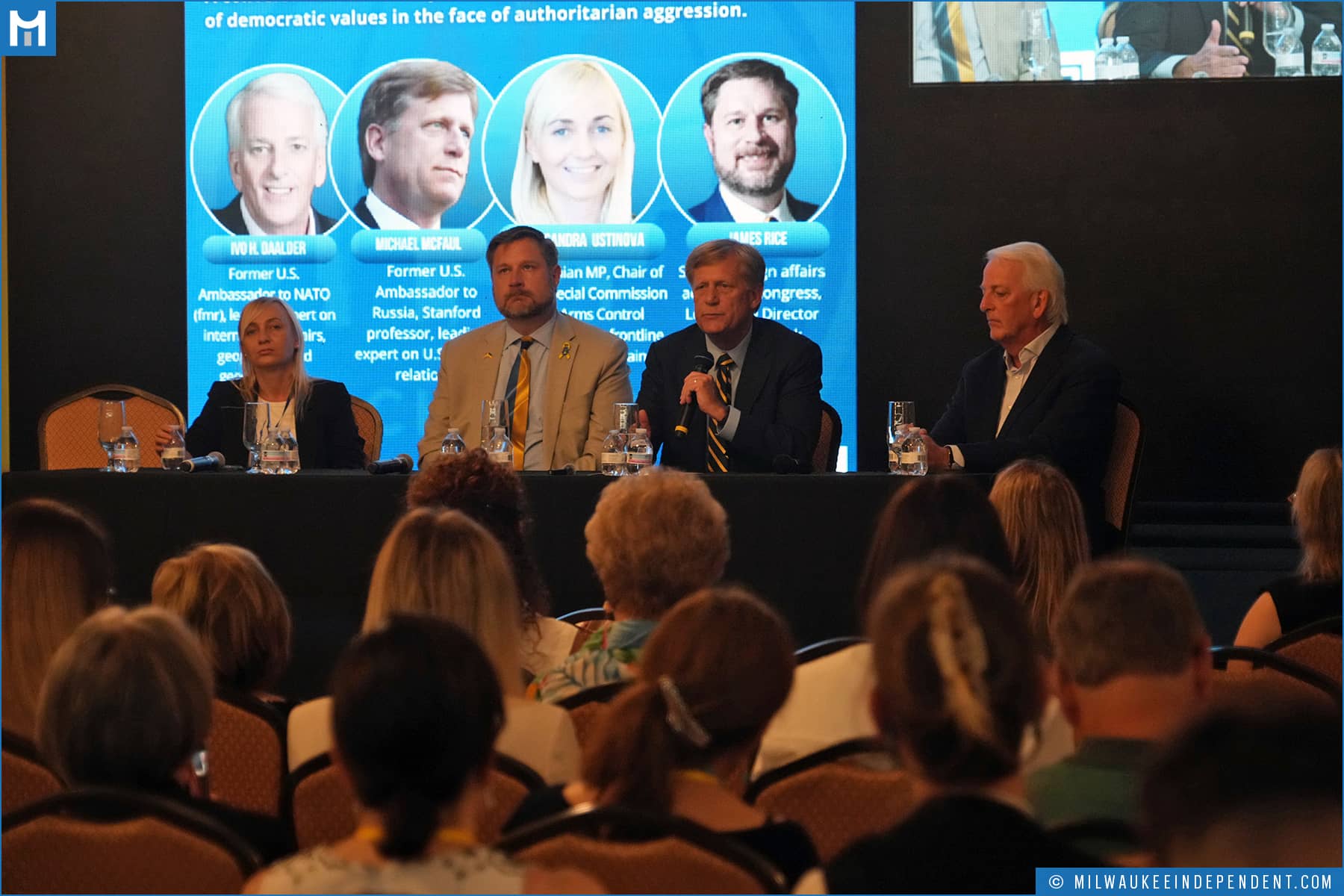
A high-level international forum “Ukraine and the World: Global Insights Forum” dedicated to the 34th anniversary of Ukraine’s Independence was held at the Ukrainian Cultural Center in Chicago. Leading foreign policy experts, former diplomats, American officials, and Ukrainian leaders discussed the future of Ukraine and global security. The event was organized by the Illinois chapter of the Ukrainian Congressional Committee of America in cooperation with the Ukrainian community of Chicago. Here are the key messages from the forum in Chicago.
This was reported by the Milwaukee Independent and one of the moderators of the event, the president of the Kyiv Mohyla Foundation of America, Marta Farion.
“Wars are started by dictators and criminals, but peace is won by people who love freedom – through sacrifice, unions, and alliances. We are extremely grateful to the American people for their continued support and believe in a just and lasting peace worthy of the enormous sacrifices that Ukraine is making,” said Maria Dmytriv-Kopenyak, President of the Illinois Chapter of the Ukrainian Congressional Committee of America (UCCA, Illinois), who opened the conference.
The program also included an opening prayer by Bishop Benedict of the Ukrainian Catholic Church in Chicago, and a speech by Consul General Serhiy Kolyada.
The event also featured presentations from Ukrainian servicemen undergoing rehabilitation in the United States. In particular, David Pyasetsky moved the audience with a message of hope, peace, and ultimate victory, and retired U.S. Army Colonel Alexander Vindman, who served as Director for European Affairs at the U.S. National Security Council (NSC), congratulated the attendees on Ukraine’s Independence Day. Representatives from Wisconsin Ukrainians Inc. and the local Ukrainian community were also among the participants.
Panel discussions became the intellectual core of the forum, covering five key topics. The first was dedicated to global security and the concept of “peace through strength,” where the strategic implications of supporting Ukraine for the entire international system were discussed. The second focused on countering disinformation and exposing the “axis of evil” that undermines support for Ukraine in the United States and Europe. The third panel was devoted to the environmental consequences of war, including the destruction of infrastructure and global risks to food security. The fourth panel considered the issues of achieving justice: war crimes, religious persecution and the need to preserve historical memory, as well as the creation of an international tribunal. The fifth panel focused on building a global community, emphasizing Ukraine’s role in consolidating the world’s democratic nations and shaping a new security architecture.
“The discussions covered a wide range of pressing topics: global security and peace through strength; countering disinformation and exposing the ‘axis of evil’; the ecological cost of war; justice for victims of war crimes and religious persecution; and building a global community through local action and international cooperation,” said Marta Farion.
The audience listened to frank assessments from former diplomats, politicians, and representatives of Ukraine. In particular, former US Ambassador to NATO Ivo Daalder sharply criticized the Alliance.
“Ukraine should and must become a member of NATO. Article 10 clearly states: any European state can be invited if it shares the principles and contributes to the security of the North Atlantic region. Over the past three and a half years, Ukraine has done more for this security than any other country in the world,” Daalder noted.
In turn, the foreign affairs adviser to Congress, James Rice, recalled the doctrine of “peace through strength”: “There is nothing more American than supporting a nation that is fighting for freedom and independence against empire. Russia understands only strength.”
Ukrainian MP Oleksandra Ustinova, on the other hand, called for a change in approach and emphasized that delays in military supplies have cost Ukraine lives and territories.
“We must start talking about Ukraine as a success. Because we know how to fight the Russians, how to produce drones and how to use weapons to win,” says Ustinova.
Newly elected Congressman from Virginia, Yevgeny Widman, emphasized the importance of legislative support for Ukraine, and forum participants called for the creation of a special tribunal for the crime of aggression. Considerable attention was paid to the topic of disinformation that undermines support for Ukraine in the United States and Europe.
In addition, panelists included: Ambassador Michael McFaul, DisinfoWatch founder and director Marcus Kolga, political analyst Yevhen Hlibovytskyi, journalist Joe Lindsley, cybersecurity journalist David Kyrychenko, public health experts Daniel Hryhorchuk and Timothy Erickson, democratic transition expert and author Adrian Karatnytskyi, historian and MP Volodymyr Viatrovych, Nobel Peace Prize laureate Oleksandra Matviychuk, journalist Elina Beketova, international peace and security expert Sergio Jaramillo, Israeli-Arab conflict analyst Steven Dishler, and Syrian-American humanitarian activist and politician Suzanne Akhras Sahloul.
The forum concluded with a common conclusion: Ukraine’s struggle is not only a matter of its national survival, but also a test for a rules-based world order.
“We have proven that we can win. "We have proven that we are not a black hole. We have proven that we are a success story. The only question is: when will we be allowed to win?", concluded Oleksandra Ustinova.
Photo: Lee Matz
Author: Inna Mikhno