


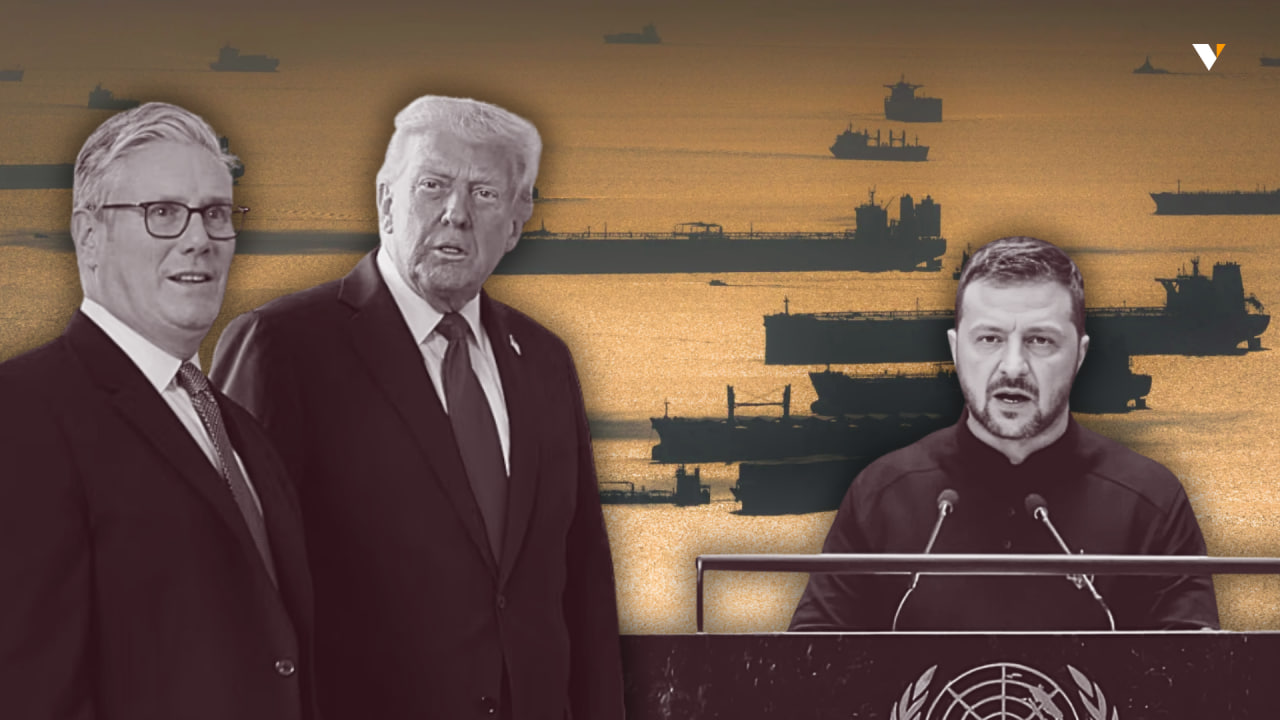
 Russia’s war against Ukraine increasingly reveals that this is not a “regional conflict” but a focal point around which the entire international order is being reshaped. Recent events show that the West is seeking ways to both intensify pressure on the Kremlin and find a formula for cooperation with the new administration in Washington. Europe and NATO face dangerous challenges directly on their borders, while Kyiv strives to keep global leaders’ attention on Ukraine’s needs. Russia, for its part, responds with a combined strategy—from open provocations to the use of a “shadow fleet”—in an effort to preserve the channels that finance its war.
Starmer and Trump: Different Accents, but a Shared Vector
British Prime Minister Keir Starmer and U.S. President Donald Trump, during a joint press conference in London, demonstrated a contrast in rhetoric but also a common thread—the necessity of maintaining pressure on Russia. Starmer urged allies not to slow down and to seek new mechanisms of economic and political influence on the Kremlin, stressing that the war in Ukraine is not a “frozen” conflict but continues in its most acute phase. He pointed out directly that Western solidarity will be tested not only on the battlefield but also in the sustainability of long-term sanctions regimes.
President Trump, for his part, expressed dissatisfaction that Putin had “let him down” by failing to honor certain understandings regarding possible peace talks. The former U.S. president once again emphasized his critical stance toward the EU, saying that the purchase of Russian oil was a “stab in the back” to collective efforts. At the same time, he refrained from making commitments regarding military assistance to Ukraine, leaving room for political maneuver. This shows that the new Anglo-American tandem may prove less unanimous than in previous years, yet it remains oriented toward maintaining pressure on Moscow.
King Charles and the West’s “Moral Front”
The state dinner with the U.S. president became for King Charles III not just a protocol event but an opportunity to underscore the moral stance of the British monarchy. In his saidhe declared that “tyranny once again threatens Europe” and that in historic moments such as this, allies must demonstrate resilience. His words resonated as an appeal to the collective conscience of the West: the war in Ukraine is not abstract geopolitics but a struggle for the values of freedom and democracy.
Trump’s presence in the hall lent additional weight to Charles’s words. Despite the American president’s well-known skepticism about U.S. involvement in global wars, the British monarch embodies a tradition of historical memory and moral continuity. For London, this was a way of making the war in Ukraine not only a matter for government cabinets but also a cause for broader Western society, which can influence its leaders.
The Ukrainian Visit to the U.S.: A New Attempt to Hold Global Attention
President Volodymyr Zelensky will lead the Ukrainian delegation next week at the 80th session of the United Nations General Assembly. For Kyiv, this visit is an opportunity to continue keeping the war in Ukraine at the center of the global agenda. A series of bilateral meetings is expected, including a potential encounter with Donald Trump, which could become the political highlight of the visit.
Ukraine will use this platform to promote the idea of security guarantees and to secure new aid packages. The key task will be to demonstrate that the war is not entering a phase of “normalization” but remains a challenge to global security as a whole. The success or failure of these talks will affect not only Kyiv’s financial resources but also the future of allies’ trust.
NATO and the Baltics: Russian Provocations on a New Level
The incident with three Russian MiG-31 was that violated Estonian airspace served as a serious reminder that the Baltics are the most vulnerable region in the NATO–Moscow confrontation. The aircraft, flying without transponders, remained in Estonian skies for more than ten minutes—longer than any previous violation. This was no accident but a demonstration of the Kremlin’s readiness to test the Alliance’s reaction.
In Brussels, immediate statements condemned the act as a “dangerous provocation.” Kaja Kallas and NATO representatives emphasized that such actions could lead to unpredictable escalation. The scenario of consultations under Article 4 of the NATO Treaty is increasingly being discussed as a precautionary mechanism. The incident confirmed that the war in Ukraine directly affects the security of other European states and that the Alliance could be drawn into a more open confrontation.
The U.S. Congress vs. the “Shadow Fleet”
A group of U.S. senators has introduced a new bill aimed at dismantling Russia’s “shadow fleet”—hundreds of vessels transporting oil and gas while evading sanctions. According to its authors, the legislation is intended to strengthen control over ships that change flags, disable transponders, or belong to offshore companies. It also provides for sanctions against LNG projects and Russia’s defense-industrial complex.
This step is significant for Washington for two reasons. First, it is aimed at depriving Moscow of key sources of foreign currency revenues that finance the war. Second, it demonstrates that the U.S. can exert influence over global logistics networks—from insurance companies to third-country ports. Thus, the bill will be a test of the West’s ability to restrict not only official but also “gray” channels of Kremlin financing.
Russia’s Response: Infrastructure Strikes and Reliance on Shadow Mechanisms
Ukrainian strikes on the port of Primorsk, one of Russia’s largest oil export hubs, have become a new challenge for Moscow. According to experts, the damage to this facility disrupted transportation and created additional costs for Russian traders. Insurance costs are rising, routes must be altered, and the risk of further attacks remains high. This directly affects Russia’s budget revenues, which are already suffering losses from sanctions.
In response, Russia increasingly relies on its “shadow fleet”—vessels with unknown owners, flying the flags of third countries, and attempting to remain beyond international oversight. This practice allows exports to continue but creates serious ecological and economic risks. For global markets, it means added instability, and for Moscow, it signals deeper dependence on illicit or semi-legal schemes. Thus, even if the Kremlin tries to project resilience, in reality it acknowledges its vulnerability to sanctions pressure and attacks on critical infrastructure.