In Charlotte, North Carolina, the Ukrainian community is only beginning to form. After the start of the full-scale war, thousands of Ukrainians came here, seeking not only a safe place but also a way to maintain their connection with their homeland. Among them are many talented and inspired people who are creating new centers of the Ukrainian diaspora — including the heroines of this story.

Anna Bondar and Yuliia Mikhachova, together with their families, arrived in North Carolina in 2022. Each came with her own story, experience, and wealth of knowledge. One of the greatest challenges for parents abroad is to preserve their children’s connection with their roots. Children quickly adapt to a new environment, adopt the language and customs, and gradually forget their native ones. That is why, for many Ukrainian families, it becomes essential to have a place where a child can hear and speak Ukrainian, remember their songs, holidays, and stories.
Facing this challenge, Anna and Yuliia tried to find a center in Charlotte that could help their children preserve their identity. It turned out that there was nothing like that nearby. So, they decided to create their own school and cultural center — Ukrainian House.
“We founded the school on April 17, 2024 — we registered it as a non-profit organization. We started holding the first meetings, gathering people in libraries, and organizing classes. They were either free or at a symbolic fee. We were simply observing whether there would be interest. We received quite a positive response, so we began looking for like-minded people — teachers or just individuals who wanted to support us.
It all started with a GoFundMecampaign, which is still open. It didn’t raise much money — only $2,450. So, through our own efforts, we found a space, rented it, and opened the school in August 2024,” says Anna, who, in addition to managing the Saturday school, works as a 4th–5th grade teacher at Marvin Elementary School (Waxhaw, North Carolina).She speaks Chinese, English, and Ukrainian. Previously, she lived and worked in Shanghai, where she gained significant teaching experience. Before the war, she lived in Henichesk, Kherson region, where she ran her own educational center — Discovery Learning Center — for studying different languages.
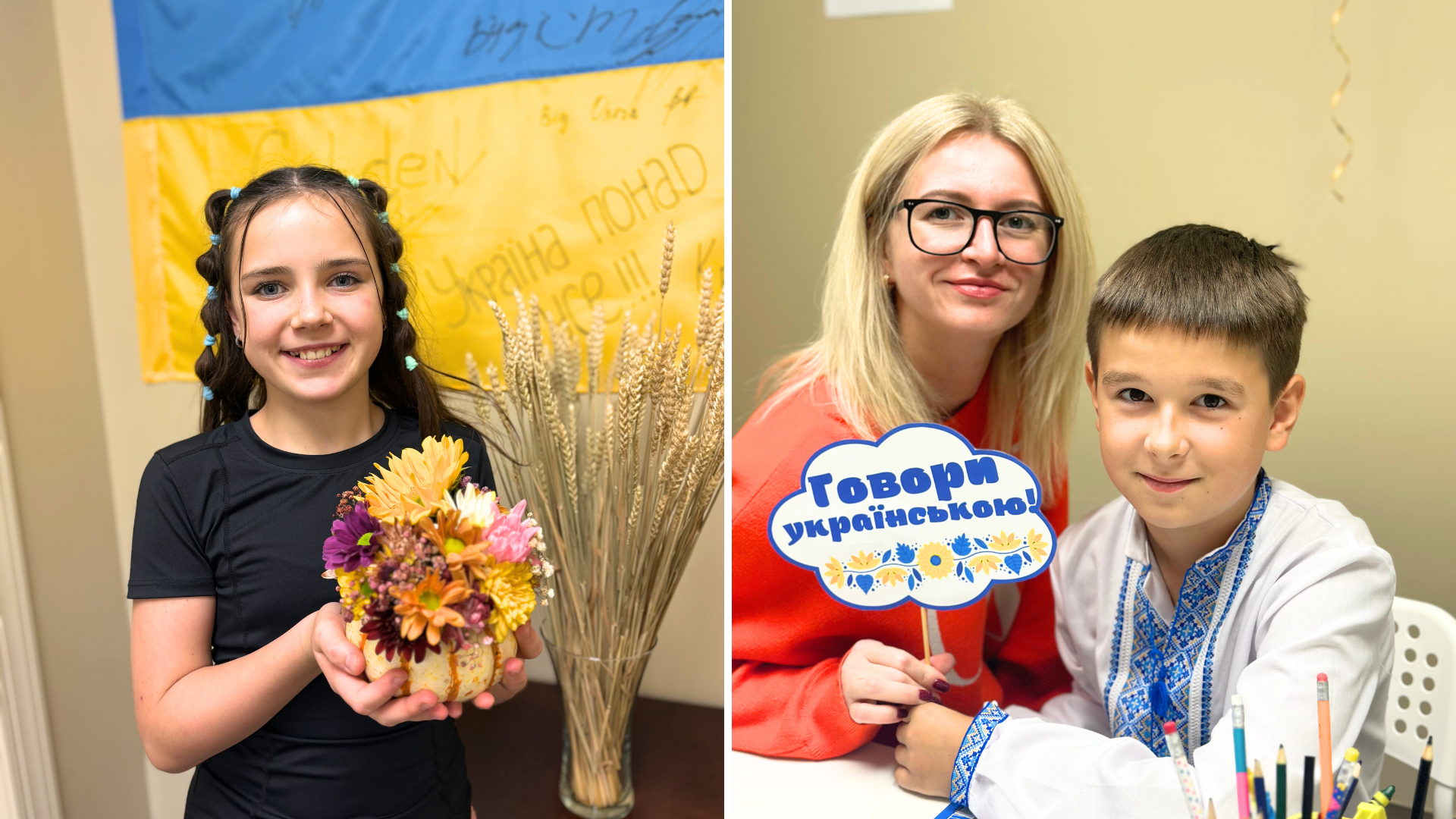
Until 2014, Anna and her family spoke Russian, but while living in China, after being asked “Where are you from?” and “What language do you speak?”, she realized the importance of nurturing her identity — just as other nations do. That is when she switched to speaking Ukrainian.
When Anna arrived in the United States, she was looking for someone who could teach Ukrainian to her older daughter. That’s how she met Yuliia — and together, they decided to create Ukrainian House.
Yuliia’s love for her native language began back in high school. In Donetsk, it was her Ukrainian language and literature teacher who made her fall in love with everything Ukrainian. In Ukraine, Yuliia worked as a teacher, served as a deputy principal for student development, supervised student research for the Junior Academy of Sciences, participated in the New Ukrainian School reform, and co-authored an English-language textbook for 6th grade. In the U.S., in addition to the Saturday school, she works at Refugee Support Services, where she coordinates educational and adult learning programs.
The school began operating on Saturdays. Gradually, the number of students grew — there are now 40 of them, about 50% of whom are preschoolers. Most of the children came to the United States because of the war, but there are also those who were born in America or in other countries. Therefore, the teachers adapt the curriculum to each student individually.

“Our program is based on recommendations from the Ministry of Education of Ukraine, as well as on various approaches and experiences we have studied — for example, from Ukrainian international schools and heritage schools in different countries. And, of course, on the individual needs of our students,” shares Yuliia.
Anna and Yuliia explain that, at first, there were many difficulties with adapting to learning in Ukrainian. Many students were shy to speak their native language out of fear of making mistakes. Thanks to the teachers’ encouragement, the children now feel much more confident.
The students also study the poetry of Lesia Ukrainka and Taras Shevchenko. Some do better, some struggle a bit, but the main goal is to introduce children to Ukrainian poets and writers.
Anna emphasizes: “Our classes are built on the belief that language is not just a skill — it is a bridge to self-identity, to one’s community. It is also a form of healing for us. Every Saturday feels like returning to Ukraine for one day, because this is a place where everyone is your own, where everyone feels like family.”
The school has its own motivation system: students can earn “hryvnyky” — a fictional currency they can spend in the school store. They earn them by doing homework and studying well. Children can buy Ukrainian candies, stationery, or various accessories. Some save up for a whole month to buy a children’s tablet, while others purchase sweets for their parents. Teachers note that this is indeed an effective method, as it motivates students to learn while also introducing them to financial responsibility.
The school is also active in creativity: children make crafts, paint embroidery patterns from different regions of Ukraine, and organize performances.
“Ukrainian House is very proud of its team,” says Anna. “All our teachers are refugees. Many of them have been affected by the war more than once. They are all educators with many years of experience who worked in Ukrainian educational institutions before the war and had their own programs and projects.”
When asked about their future plans, Anna and Yuliia said they hope to open summer camps next year and turn Ukrainian House into a true center and hub that would bring together different kinds of creativity. However, there are still many obstacles on the way — the school needs a larger space and financial support. The teachers have many ideas they unfortunately cannot yet realize due to a lack of technical equipment. In addition, the school is actively supporting Arina, a girl who was recently diagnosed with aplastic anemia. Students and teachers have united to help the girl and her mother.
Ukrainian House is truly a small piece of home for those who miss it. During my entire conversation with the founders, I saw how full of dreams and determination they are to do everything possible to support Ukrainian culture wherever they are.
And how wonderful it is to have “...such a small piece of Ukraine in Charlotte, where together we are raising a free, conscious, and strong generation of Ukrainians — even far from home,” as Yuliia said.
About Author: