


A meeting between the Ukrainian-American community and local humanitarian organizations with the Save Ukraine delegation, led by the organization’s founder and director Mykola Kuleba, took place on November 21 in Dallas. The event was organized by Tamara Velsher (Ukrainian Chamber of Commerce in Dallas/Fort Worth), Leonid Regeta, pastor of River of Life Church (Dallas), and Tetiana Bezsmertna of Ochi Media. Former U.S. Ambassador Gregory Slayton, an active advocate for Ukraine, also spoke at the event.
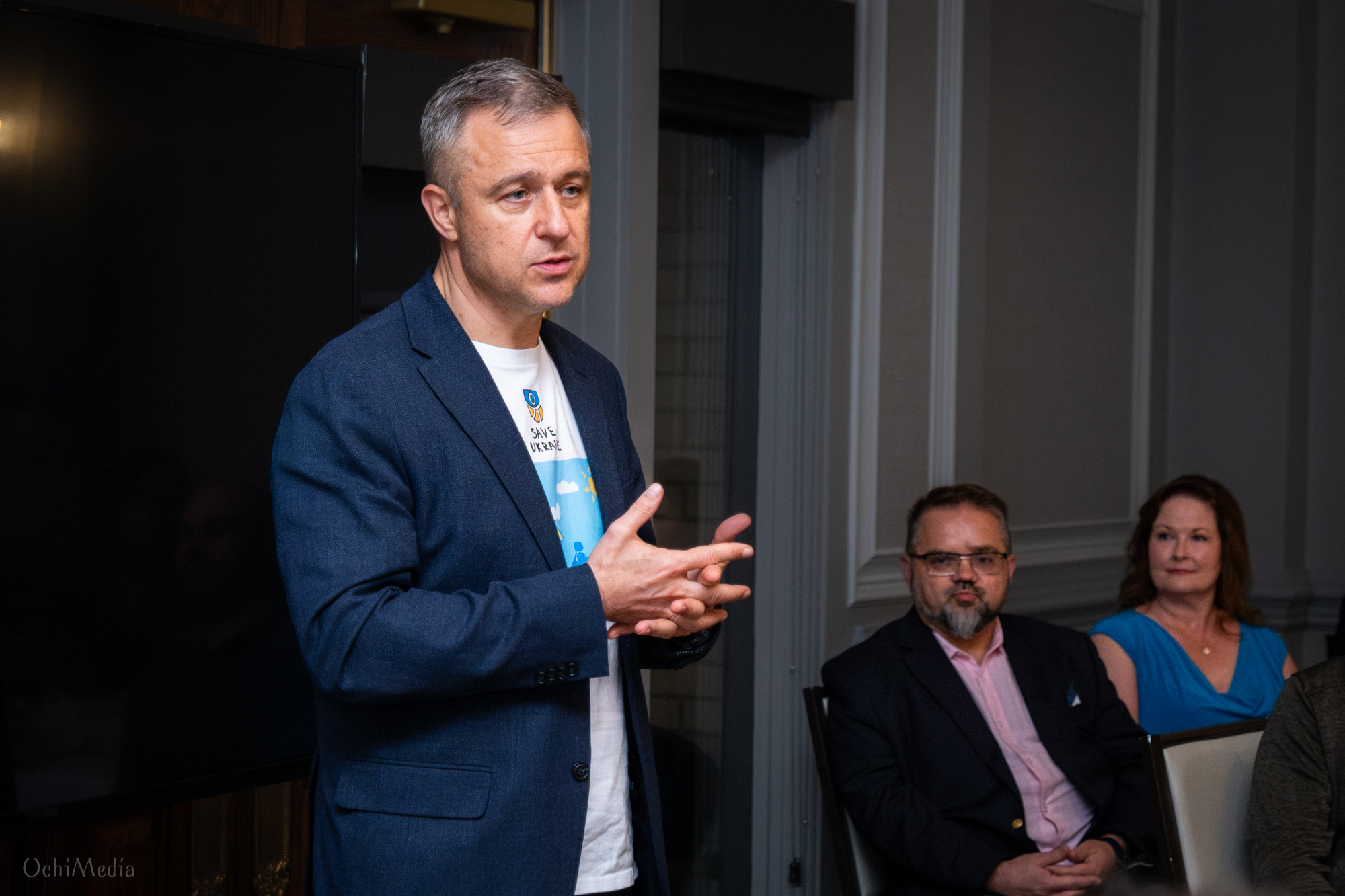
The main goal was to draw attention to the tragedy of Ukrainian children abducted by Russia. This issue has become extremely important on the American policy agenda. In the U.S. Senate, a draft resolution is already being prepared calling for the return of abducted Ukrainian children before any peace agreement aimed at ending Russia’s war against Ukraine is reached. During the Ukrainian Action Summit in November, more than 700 delegates appealed to their legislators in Congress to vote for the resolution. Mykola Kuleba, founder of Save Ukraine, emphasized that the influence of American government leaders, churches, and communities is crucial in demanding the release of abducted Ukrainian children and ensuring their safe return. According to him, the Ukrainian community must continue to advocate and speak the truth about Russia’s crimes against Ukrainian children, doing so at different levels: at the governmental level — with representatives of the executive branch and members of Congress — as well as within society — with churches and representatives of nongovernmental organizations.
The facts are shocking: 19,546 abducted children, of whom only 1,851 have been returned. In total, 1.6 million children remain in the temporarily occupied territories, where they are forced to accept Russian citizenship, and upon reaching adulthood they are drafted into the army. Mykola Kuleba explains what this looks like: “When soldiers with rifles come to your home, you have no choice. When they take you to the military enlistment office, hand you a military ID, dress you in military uniform, you have no choice. Ukrainian children end up in the Russian army not because they wanted to — but because they were forced.”
Behind every statistic is the tragedy of a specific child. In the U.S., Kuleba recounts these stories. He brought a mother and her 13-year-old son. The boy says that the occupiers forced him to sing the Russian anthem and Russian songs every day. Speaking Ukrainian was forbidden. The founder of Save Ukraine says: “They told him that Ukraine didn’t need him, that his family didn’t need him, that only in Russia could he have a future by becoming a Russian soldier. They told him that if — God forbid — he returned to Ukraine, the Nazis would eat him. I asked him again, and it turned out that every day the Russians told him that Nazis eat children.”
Save Ukraine helped the mother retrieve her child. Kuleba recalls that the frightened boy’s first question was: ‘Mom, they told me that Nazis in Ukraine would eat me.’
The process of freeing the child was difficult at every step. The woman traveled to Russia. There she was given an ultimatum — to appear on television with a prepared text saying her child had been happy in Russia. Otherwise they threatened not to return the boy.
Russia systematically forces Ukrainian children into the Russian army. A 16-year-old Ukrainian orphan, who lived with a foster family, was deceitfully sent to a military camp in Siberia, Kuleba reports:
“They simply told her she was going on vacation, but they brought her to a warehouse of military uniforms, dressed her in children’s military clothing, and sent her for a month to a Russian military camp. She told me that Russian soldiers forced her to learn how to operate drones, dig trenches, destroy tanks. She showed me how to set tripwire mines to kill the ‘enemy,’ and the enemies, as they taught her, were Ukrainian Nazis and NATO troops — they taught her how to fight Americans.”
One of the arguments of isolationists in the U.S. is that the war in Ukraine does not concern them. At the same time, Kuleba cites Ukrainian children who were in Russian schools and military camps, explaining that Moscow openly names the United States as an enemy: “Imagine a 15-year-old boy telling you that Russian soldiers come to the school and ask: ‘Are you ready to kill Nazis? Are you ready to kill Americans? How are you ready to do this?’ And try not to answer. This is what our Ukrainian children are being taught. They say that every day in schools they are told how to fight Nazis.”
The founder gives an example from Russian textbooks:
“You can take the Russian 11th-grade history textbook and read who Americans are. They are enemies. Enemies who must be killed, with whom one must wage war. According to these textbooks, America wants to capture Russia. It is not Russia that invaded Ukraine and kills civilians — it is America, as they claim. This is what they teach children. They teach them to hate Ukraine, to hate the entire world: America, NATO, European countries.”
Save Ukraine has returned Ukrainian children who, after turning 18, were drafted into the Russian army: “Boys aged 18–19 received draft notices to the Russian army and were forcibly taken. Many children were sent to Russian military academies and military camps. We even have cases when we rescued children directly from the Russian army,” Kuleba notes.
The greatest threat to Ukrainian children is separation from their parents, the founder of Save Ukraine emphasizes:
“For any disobedience, Russians can kill or arrest Ukrainians. Many arrests happened after occupiers found messages on adults’ phones that they didn’t like. The parents were arrested, and the children were taken to a Russian orphanage or placed into a Russian family.”
Kuleba says his organization saved almost 200 orphaned children, some of whom had already been in foster families. Overall, Save Ukraine has saved more than a thousand children. These cases are documented. Each one is essentially a special rescue operation.
“One story is about a child who became an orphan already in Russia. The Russians took her and her mother out of Ukraine. Then the mother died under unknown circumstances. The grandmother came for the child, but she was not given to her because the girl had been forcibly placed in a Russian military family. And that family refused to return her to the grandmother. We managed to save this child as well,” Kuleba recounts.
Tens of thousands of Ukrainian children have been separated from their families and taken to Russia. It is currently unknown where they are being held. “There is no access to them. We still do not know where these children are. Ukraine needs information,” Kuleba states. Moscow blocks the search for Ukrainian children, especially after the International Criminal Court in The Hague issued arrest warrants for Putin and Russia’s commissioner for children’s rights, Maria Lvova-Belova.
“They immediately began hiding all information. They started hiding. At first, the same Lvova-Belova openly said on television: ‘I brought 30 Ukrainian children to Moscow, adopt them.’ On various social service websites in Russia, children were offered for adoption. And as soon as the arrest warrant was issued, everything was erased, everything disappeared.
Searching for children became extremely difficult because the Russians — Putin and everyone else — understood that they won’t get away with this, that they will be at the tribunal and will be prosecuted,” Kuleba explains. Therefore, Ukraine cooperates with the Bring Kids Back initiative, which includes 44 countries seeking any opportunities to find and return the children. Save Ukraine has partners — governmental agencies and NGOs — that provide information about the children’s whereabouts. However, even if a child is located, that does not guarantee their return.

According to Kuleba, U.S. support is critically needed.
“We started this trip in Washington. We met with Senate offices and government representatives. We met with large organizations that support us. Our biggest partner supporting us is the Jewish Federation of North America. They don’t need to be told what genocide is, or what it means when children are abducted en masse. As soon as they learned that we are rescuing children abducted by Russia, they came to help, and today they are helping us build the Underground Railroad — our system for rescuing Ukrainian children.” (“Underground Railroad” — often non-public and high-risk operations to search for and rescue Ukrainian children — editor)
After children return, an extremely important stage of rehabilitation begins, as all of them have suffered psychological trauma, Kuleba explains:
“Imagine a child who lived in fear for more than four years: fear of going outside because Russian soldiers were there, fear of being taken away from parents, fear of being forcibly sent to a camp. And for those separated from parents — fear of never seeing their loved ones again. Children aged 9–10 cannot read or write because they had no schooling. Children who cannot communicate with others because they are afraid of everything. So our main work is restoring their childhood. It is restoring their sense of safety, because all the children we return have not felt safe. We need to bring them into a safe environment. We call our services the services of care and love. We must show them care, love, and show them that they are wanted in Ukraine, that Ukraine is waiting for them.”
Kuleba calls on Americans:
“You can help us today in rescuing children and restoring their childhood. We ask you to share these stories. We ask you to pray for our rescue missions. Continue supporting us and tell the truth to your friends on social media. And of course, provide donations so that we can rescue as many children as possible and restore their lives in Ukraine.”
The event in Dallas was attended by Tom Frey, a board member of the Christian humanitarian nonprofit organization New Hope Compassion. “I came because of my interest in Ukrainian children. Every Sunday I lead a Bible class for a rehabilitation center for children in Chernihiv. It’s a small thing, but it’s a way to bring hope to children, to let them know that someone on the other side of the world — an American — cares enough to wake up early on Sunday morning to teach them about the heroes of the Bible and how they can apply this in their lives. I wanted to hear about abducted Ukrainian children, about how they are being brainwashed and turned into Russians and Russian soldiers who are supposed to fight against their own people. So I wanted to hear this. And perhaps this will be another way I can help the people and children of Ukraine.”
Great appreciation to the co-author of the article, Tetiana Bezsmertna (Dallas), for providing the photos and conducting the interview with Mykola Kuleba.
About Author:
