


The Program on Georgian Studies at the Davis Center and the Temerty Contemporary Ukraine Program at the Harvard Ukrainian Research Institute (HURI) came together to host their first joint seminar on April 9, 2025. The panel discussion, titled “Journalism in Times of War and Uncertainty,” brought together journalists that report on Georgia and Ukraine to discuss the current media landscape.
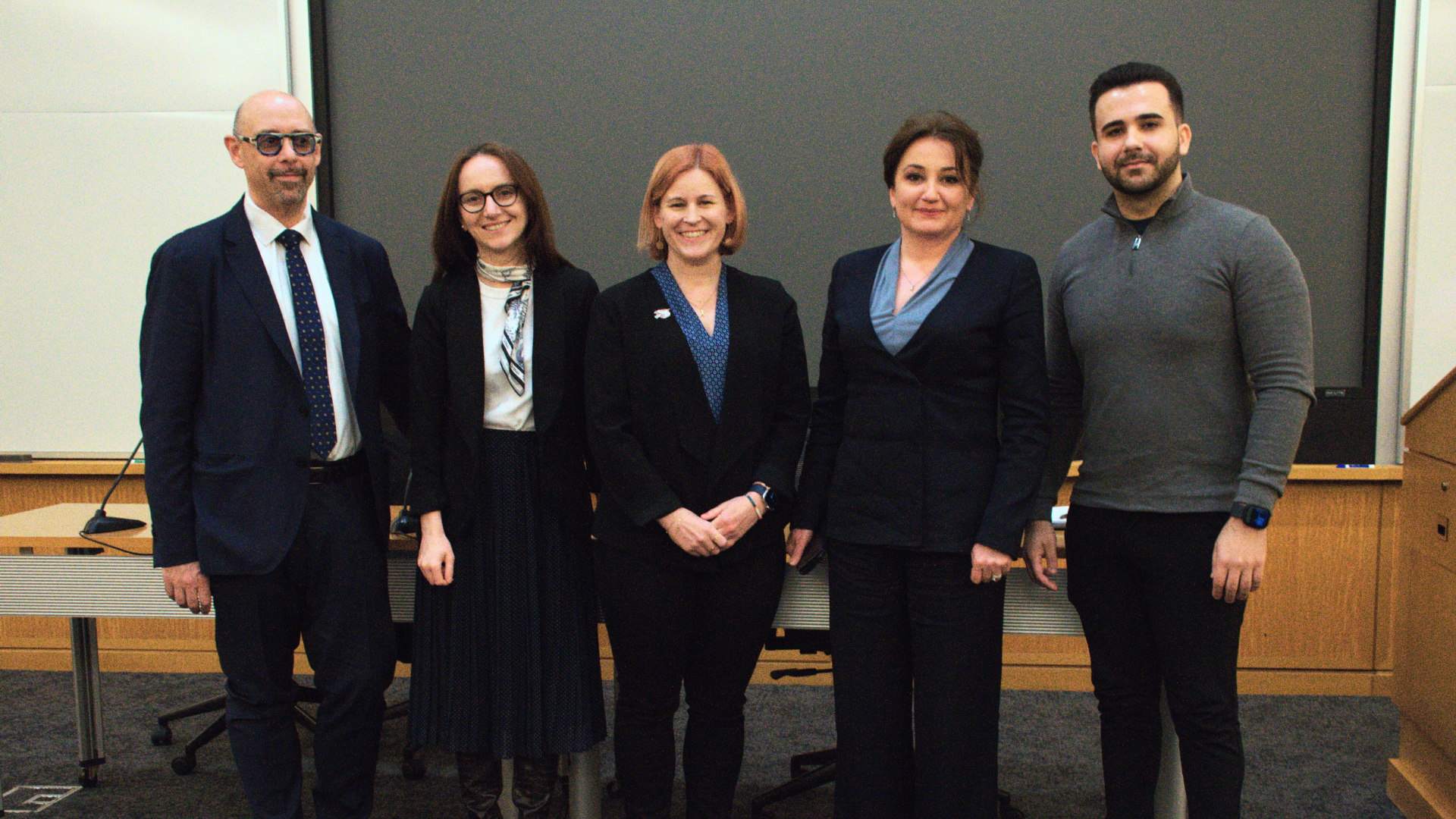
From left to right, David M. Herszenhorn, Natia Chankvetadze, Emily Channell-Justice, Ia Meurmishvili, David Kirichenko. Photo: Avanti Nambiar
The event was a joint effort between Natia Chankvetadze, Director of the Program on Georgian Studies at the Davis Center, and Emily Channell-Justice, Director of the Temerty Contemporary Ukraine Program at the Ukrainian Research Institute.
The panel featured Ia Meurmishvili, Chief International Correspondent and Host of The World Deciphered, and David Kirichenko, a Ukrainian-American journalist.
The discussion was moderated by David M. Herszenhorn, a 2025 Nieman Fellow in Journalism at Harvard and former Russia, Ukraine, and East Europe editor at The Washington Post.
Channell-Justice explained that she and Chankvetadze were motivated to organize the seminar in order to spotlight their relatively new programs at Harvard and to create space for dialogue that extends beyond traditional academic formats. Their goal was to emphasize practical insights and promote solidarity between Ukraine and Georgia, two nations confronting the long shadows of Russian and Soviet imperialism.
The discussion also touched on the importance of fostering shared post-colonial reflection, particularly as both countries continue to face pressure from an increasingly aggressive Russia.

Ia Meurmishvili addresses the audience at the seminar. Photo: Avanti Nambiar
“With the full-scale war continuing so long, it’s sometimes easy to get laser focused on the details of what’s happening every day in Ukraine,” said Channell-Justice. “But we have to keep thinking bigger, because we know that Putin won’t stop at Ukraine’s borders, and we know the democracy Ukraine is fighting for sets an example for others around the world. Having this conversation was a really helpful way to bring some of these issues to light.”
Sophia Yushchenko, a Master’s student at Stanford University and co-founder of Code for Ukraine, commented on the importance of Ukrainian studies programs and holding events to educate people in the West about Ukraine. “The understanding of Ukraine and its people in the West has undoubtedly improved in recent years, particularly since the beginning of the full-scale Russian invasion in 2022,” she said.
“Before this, many Westerners admittedly had limited knowledge about Ukraine, even struggling to locate it on a map. However, the extensive media coverage of the war and the grassroots cultural and humanitarian movements have significantly increased awareness and understanding of Ukraine's history, culture, and current situation.”
Treston Wheat, chief geopolitical officer at Insight Forward, a geopolitical risks consultancy, and an adjunct professor at Georgetown University, pointed out that authoritarian regimes count on short public attention spans. When focus fades, so does accountability and deterrence. Wheat added that Georgia and Ukraine aren’t just defending sovereignty – they’re shaping the future world order. Abandoning them signals that aggression and disinformation can prevail. Dr. Wheat pointed out that events like the Georgia-Ukraine seminar help sustain attention and connect these struggles to shared democratic values.
Lasha Kveseladze, a Georgian journalist and current Nieman Fellow at Harvard University, emphasized the deep parallels between Georgia and Ukraine’s struggles. "Georgia and Ukraine are facing very similar struggles. Both countries are still grappling with post-Soviet identity, constant Russian pressure, and ongoing fights to protect democracy," he said.
Kveseladze stressed that the conflict is not just about territory, but about the larger fight for democratic values. "It’s not just about territory, it’s about whether people can live in free, open societies. The same tactics – violence, disinformation, political manipulation – are being used against us, and it’s part of a much bigger global trend where democracies are being tested."
Kveseladze pointed out the critical role journalists play in resisting authoritarian narratives. "That’s why the work of Georgian and Ukrainian journalists is so important for people in the West. We help the world understand the real issues happening in our countries – the political struggles, the human rights violations, and the growing pressure on free speech. We also help counter disinformation, which is being used as a weapon."
Douglas Davis, Assistant Professor of Radiology at the Medical College of Wisconsin in Milwaukee, reflected on the event, after attending virtually. “Hearing from someone like David Kirichenko, who had no formal background in journalism or humanitarian work before the war, was profoundly moving,” he said. “He chose to throw himself into harm’s way because of a deep moral conviction and personal loss. He has lost members of his own family in this war, and yet he continues to report from the front lines, often within sight of Russian occupiers who would kill him without hesitation if given the chance. That kind of courage is rare.”
Davis explained that Kirichenko’s story struck a deeply personal chord. “His story resonated deeply with me because of my own family’s experience. We’ve lost family and friends in combat, and to brutal, indiscriminate attacks on civilian areas,” he said. “In Lviv – far from the front – missile strikes have killed people we knew just minutes from my wife’s family home. The pain of this war is personal.”
“To see someone like David respond to that same pain not with despair but with resolve and purpose is both humbling and inspiring,” he said. “I admire and deeply respect his courage.”
Davis also reflected on the broader geopolitical context discussed during the seminar. “I learned a great deal about both the parallels and the distinctions between Putin’s influence over Ukraine and Georgia,” he said.
“In Ukraine, that influence has become overtly violent, with full-scale invasion and occupation. In Georgia, while the violence was acute during the events in South Ossetia, Russia’s strategy has since shifted toward more subversive methods – using political interference, disinformation, and economic leverage to exert control and undermine democratic development.”
He noted that this contrast highlights the range of tools authoritarian regimes use to destabilize neighboring states and highlighted the importance of understanding not only military aggression but also the quieter, more insidious forms of influence.
Maria Marini, a pro-Ukrainian activist from Houston said,
“Georgia and Ukraine teach us everything about how important it is to fight for our freedoms.”
Marini added that “the citizens of countries under Soviet rule saw America as a model and chose to pursue democracy because of the opportunities it afforded.”
“Both Georgia and Ukraine are nascent in their independence and have been struggling to get out from under Russia's thumb and build a representative government since 1991,” said Marini.
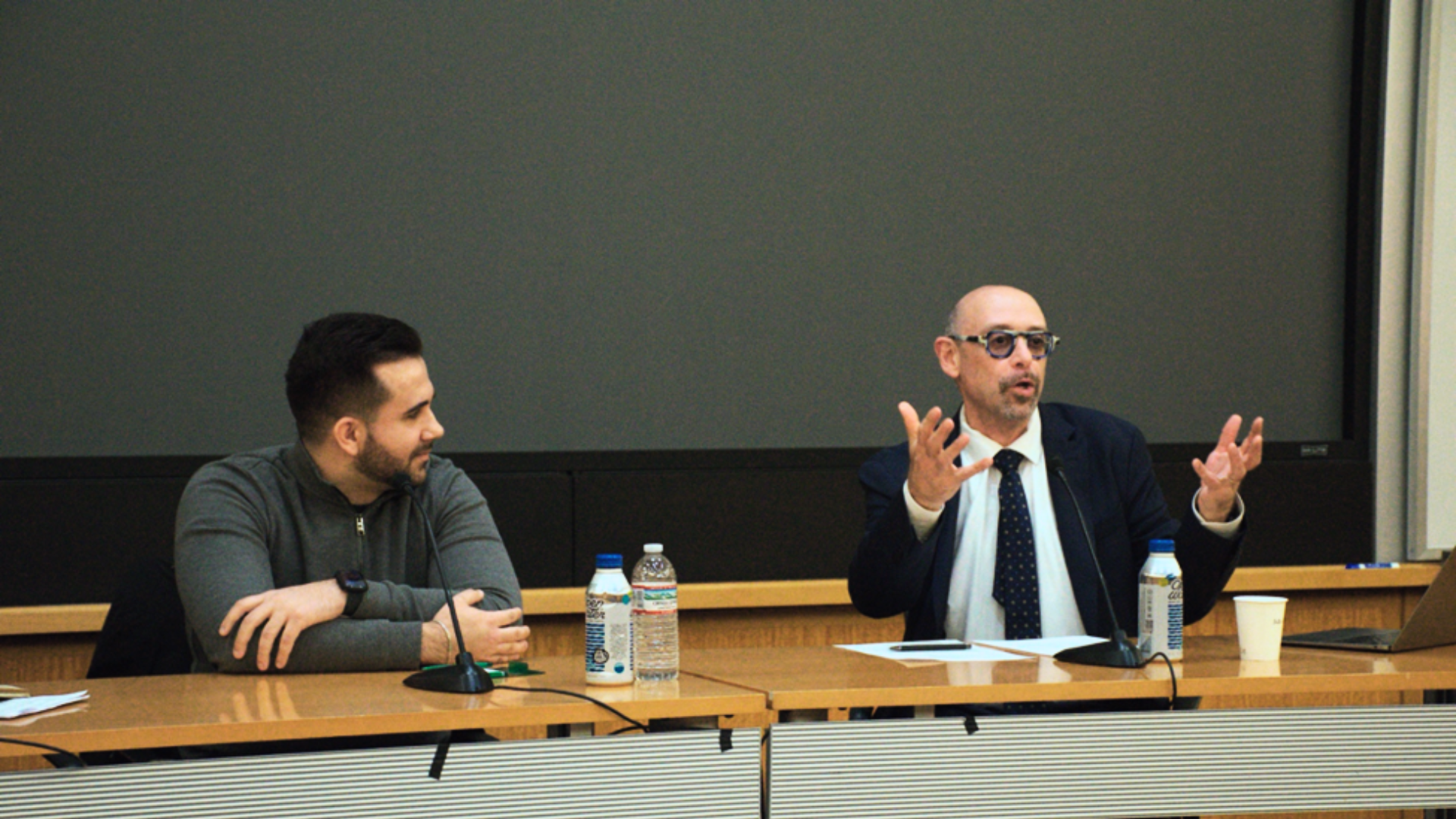
Mr. Herszenhorn speaking while moderating the panel. Photo: Avanti Nambiar
Mykola Kuzmin, a Ukrainian political scientist based in London voiced similar concerns about how Cold War-era thinking still shapes Western understanding of Georgia and Ukraine. He warned that “forgetting has a very serious geopolitical cost. Georgia and Ukraine are part of the larger framework that keeps the free world together, therefore they are not merely countries fighting for themselves.”
He added, “Small nations are unable to protect themselves on their own. They become vulnerable in the absence of partnerships and consistent assistance. As they say, a fish surrounded by sharks.”
According to Kuzmin, “Aggression becomes a precedent when it is not reacted to. There was more to what transpired in Georgia in 2008. We have been paying the price for our complacency ever since this warning was mostly ignored.”
Kuzmin also highlighted the threat posed by the global erosion of democratic values.
“The decline of democratic values worldwide poses a threat to democracy worldwide,” he said. “If authoritarian governments can redraw borders, jail journalists, and suppress civil society without consequence, what hope is there for those who are watching – fighting to protect their own fragile liberties?”
He noted that “in addition to being territorial rivalries, Georgia and Ukraine are also battlegrounds for principles. If these ideals are allowed to decline abroad, don’t be surprised if they begin to decline at home. Democracy doesn’t fall apart all at once; it erodes gradually, often out of sight.”
He highlighted how these conflicts have global consequences that extend far beyond their borders. “We live in a deeply interconnected world. What happens in Tbilisi or Kyiv does not stay there. Wars displace people, disrupt trade, unsettle markets, and shift political landscapes,” he said. “Russia’s war against Ukraine has sent shockwaves across Europe and beyond – through energy prices, food security, and supply chains. The idea that instability in Eastern Europe doesn’t touch the rest of the world is not only naïve, but also dangerous. In this century, no country is truly distant.”
Kuzmin concluded with a warning about the broader stakes for the democratic world: “Ukraine and Georgia are not only someone else's problems. They serve as early warning indicators.”
He added, “Additionally, they serve as a test to see if democracies are still prepared to defend one another or if we will put expediency and temporary silence before the more difficult task of solidarity.”

David M. Herszenhorn, Emily Channell-Justice and Natia Chankvetadze engaging in discussion. Photo: Avanti Nambiar
Kost Elisevich, an activist and author of The Ukraine Essays, highlighted the moral and historical significance of this collective resistance and the need for these types of seminars. “Ever since Man adopted the notion of Society and then Nation, the need to sustain a memory of its traditions, culture, and generational history was born. And from there the need to defend against those who seek to erase it,” he said.
“This is a universally shared sentiment among those nations and peoples which have retained a sense of a global community, so much so that they are willing to unite in part or as a whole to stand up against those intent on destroying it. This is the thing – it’s the universality of this sentiment that must continue to unite all these same nations to the common goal to preserve something sacred for humanity’s sake.”
He continued: “So, we have Georgian, Chechen, Belarusian and even Russian combatants joining with Ukrainians to deny Putin what he wants. Although Georgia is led by a pro-Russian regime, its people are solidly for something different that brings them closer to democratic governance and the EU. Something similar will come about throughout the Caucasus region also in time.”
Some audience members found the discussion personally meaningful.
Mariia Kudina, a student at Tufts University who attended the event, shared how the discussion resonated with her future ambitions. “I have been writing about the war in Ukraine for a student-run newspaper, The Tufts Daily, for three years,” she said. “Thinking about my career upon graduation, I am considering covering the war full time, therefore I was very curious to hear about the frontline reporting from a journalist who works directly at the zero line.”
She added that the panel deepened her understanding of war reporting: “I expanded the knowledge I already had about the process of reporting the war, specifically the risks that come with the use of modern technology like drones and the lack of equipment to counter it.”

Ia Meurmishvili and David Kirichenko speaking with a member of the audience after the panel discussion. Photo: Avanti Nambiar
Kudina also noted how the panel shed light on the personal toll of being a war correspondent and the complexities of communication between journalists, brigades, and the government. “Additionally, it was also interesting to hear about Georgia’s media landscape in the current political climate. I have a few friends in Georgia who have been protesting, and hearing someone speak about this through a professional lens was informative.”
The seminar, Kudina added, “reminded me of the need to write about the war even if it is mentally challenging and at certain moments dangerous.”
About Author:
