


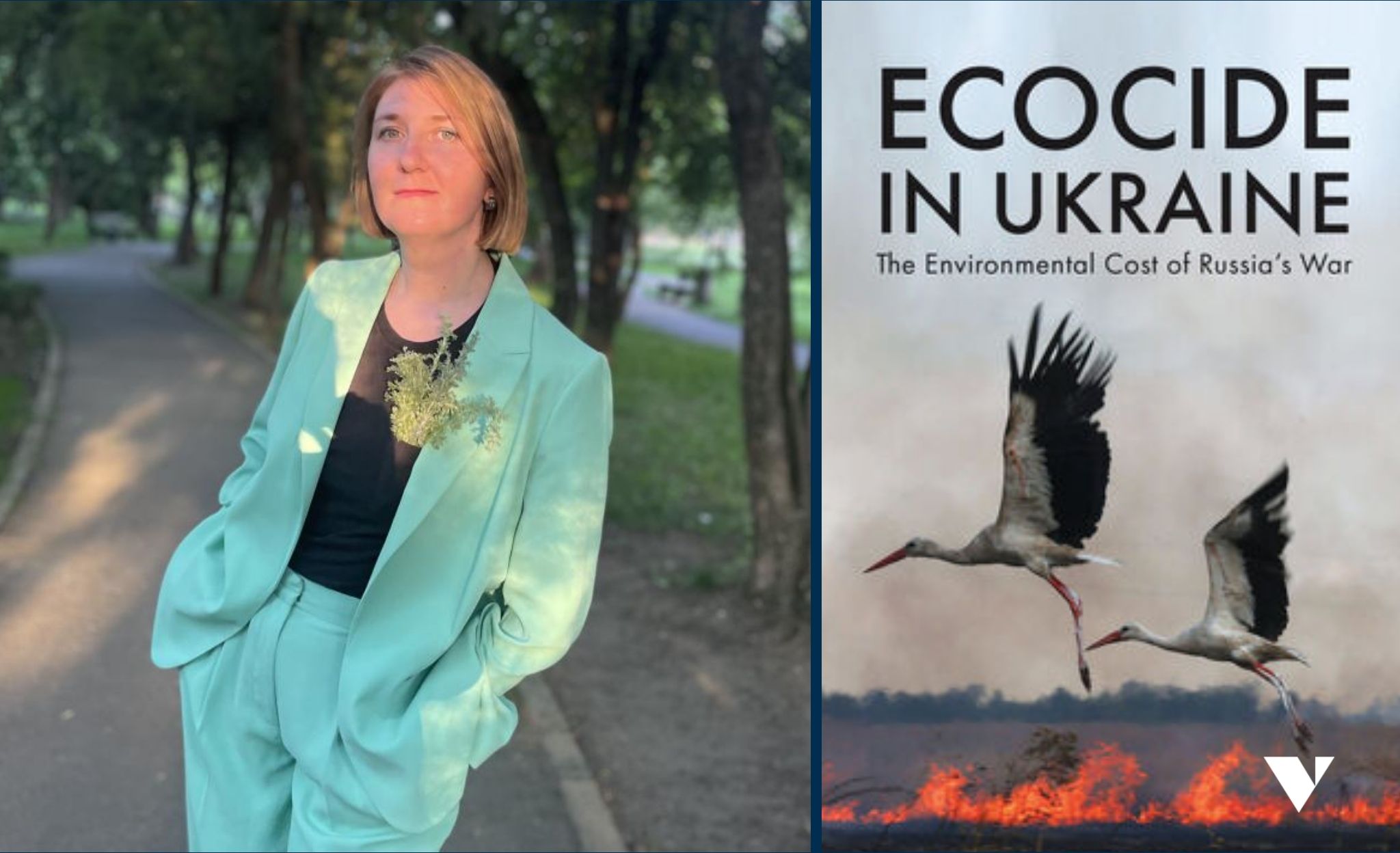
In February, the Ukrainian National Women's League of America (UNWLA), together with an expert jury, announced the winner of its annual competition, the “Petro and Lesia Kovalev Foundation Award” — the 2026 prize in the Nonfiction/History category. The award was presented to Daria Tsymbalyuk for her book Ecocide in Ukraine: The Environmental Cost of Russia’s War, which examines the environmental consequences of Russia’s war against Ukraine.
This was reported by UNWLA.
The jury reportedly included Oleg Kotsyuba, director of print and digital publications at the Ukrainian Research Institute at Harvard University; Tamara Hundorova, Ukrainian literary and cultural scholar; Maria Mayerchyk, Ukrainian scholar, historian, and translator; and Serhiy Bilenky, historian.
As noted, the 2026 prize was awarded to Daria Tsymbalyuk for her groundbreaking book “Ecocide in Ukraine: The Environmental Cost of Russia’s War” (Polity, 2025).
It is noted that the researcher, scholar, writer, and assistant professor at the University of Chicago combines environmental humanities, cultural analysis, and literary scholarship to study the devastating environmental consequences of Russia’s war against Ukraine.
Combining academic analysis, essayism, and environmental testimony, the author explores the scale of the environmental destruction caused by Russia’s war against Ukraine, as well as how war transforms ecosystems and the very ways we know about them.
In turn, the head of the jury, Oleg Kotsiuba, emphasized that the book is “a powerful meditation on the fragility of life – human and non-human – in the face of ecological and epistemological environmental destruction,” and is also extremely relevant to a broader societal understanding of loss and resilience.
“Moving between scientific analysis, narrative, and ecological testimony, Tsymbalyuk shows how war alters both ecosystems themselves and the ways we know about them. At a time when the academic community is struggling to make sense of the mutual vulnerability of nature, culture, and knowledge, her work makes a poignant and urgent appeal to a broader public awareness of ecological loss and resilience. We could not imagine a more worthy winner of this year’s Kovaliv Prize in the Nonfiction/History category,” the jury chair noted.
Jury member Maria Majerchyk emphasized that the work reveals the horrific ecological consequences of war through key themes—water, land, air, plants, bodies, and energy. The poetic style is combined with the ruthless facts that testify to the toxicity and destructiveness of war for all forms of life.
“The poetic nature of her style and the captivating stories about the natural world of Ukraine (did you know, for example, that the steppe can contain even more biodiversity than tropical forests?) are intertwined with the ruthless reality of facts. These facts testify to the toxicity and destructiveness of war for countless life forms – those that live in the soil, on the ground, in the air and in the water – as well as for local knowledge and a war-changed semiosis, where the sky becomes a threat, burying oneself in the ground is a way of protection, and a happy future is imagined as an opportunity to harvest a new crop of ripe, fragrant tomatoes under the gentle sun in one’s own garden,” says Majerczyk.
And Tamara Gundorova noted that the book opens up eco-studies as an interdisciplinary space that combines scholarship, essay writing, diary, autobiography, law and even a “biological herbarium.”
“Daria Tsymbalyuk’s book is a kind of discovery of eco-studies as an interdisciplinary field that combines scientific research and essay writing, diary and autobiography, law and biological herbarium. This non-hierarchical way of writing is itself part of ecology, as it demonstrates how polymorphic and multi-stylistic ecological thinking is. The text itself – like everything that Tsymbalyuk says about living and non-living nature, about the environment and about people as its integral part – becomes a document and testimony of war,” Gundorova notes.
According to the organizers, through the Kovaliv Fund, UNWLA continues its almost sixty-year tradition of supporting Ukrainian authors and scholars around the world.
“The award is designed to celebrate the best examples of Ukrainian intellectual thought and promote their international visibility,” the organization summarized.
Background
Established in 1967 under the auspices of the Ukrainian National Women's League of America (UNWLA), the Lesia and Petro Kovalev Foundation has been recognizing significant achievements in Ukrainian literature for nearly six decades.
Lesia and Petro Kovalev, originally from central Ukraine, emigrated to Switzerland in the early 20th century. Their legacy lives on through the Kovaliv Fund, which is dedicated to supporting and promoting Ukrainian poetry, prose, and nonfiction. Each year, a distinguished jury composed of prominent Ukrainian writers and scholars selects laureates whose works contribute to the development of Ukraine’s intellectual and literary life.
Through the Kovalev Award, the Ukrainian National Women's League of America (UNWLA) reaffirms its enduring commitment to the development of Ukrainian literature and intellectual life. By honoring works that reflect on war, ecology, memory, and identity, the 2025 laureates demonstrate the power of literature — to document, to interpret, and to sustain a nation in times of profound transformation.
Collage by VM
Author: Inna Mikhno