


We all live in a world of symbols and logos. Look around–you’ll see that every device, every everyday item carries some kind of brand mark. An apple on a phone, “H&M” on clothes, “logi” on a computer stereo system, a “W” in a circle on a car… The list goes on endlessly. And each of them conveys certain information about the product. That apple on a phone may signal that you spent well over a thousand dollars on it–and that in a year, when a newer version comes out, the older one will suddenly start working much worse, despite showing no visible or understandable damage. Any item from “4ocean” carries meaning, as the brand recycles ocean plastic into jewelry. And, frankly, it may look much cooler than overpriced, non-eco brands that used child labor to produce their goods. But that’s just lyrical digression.
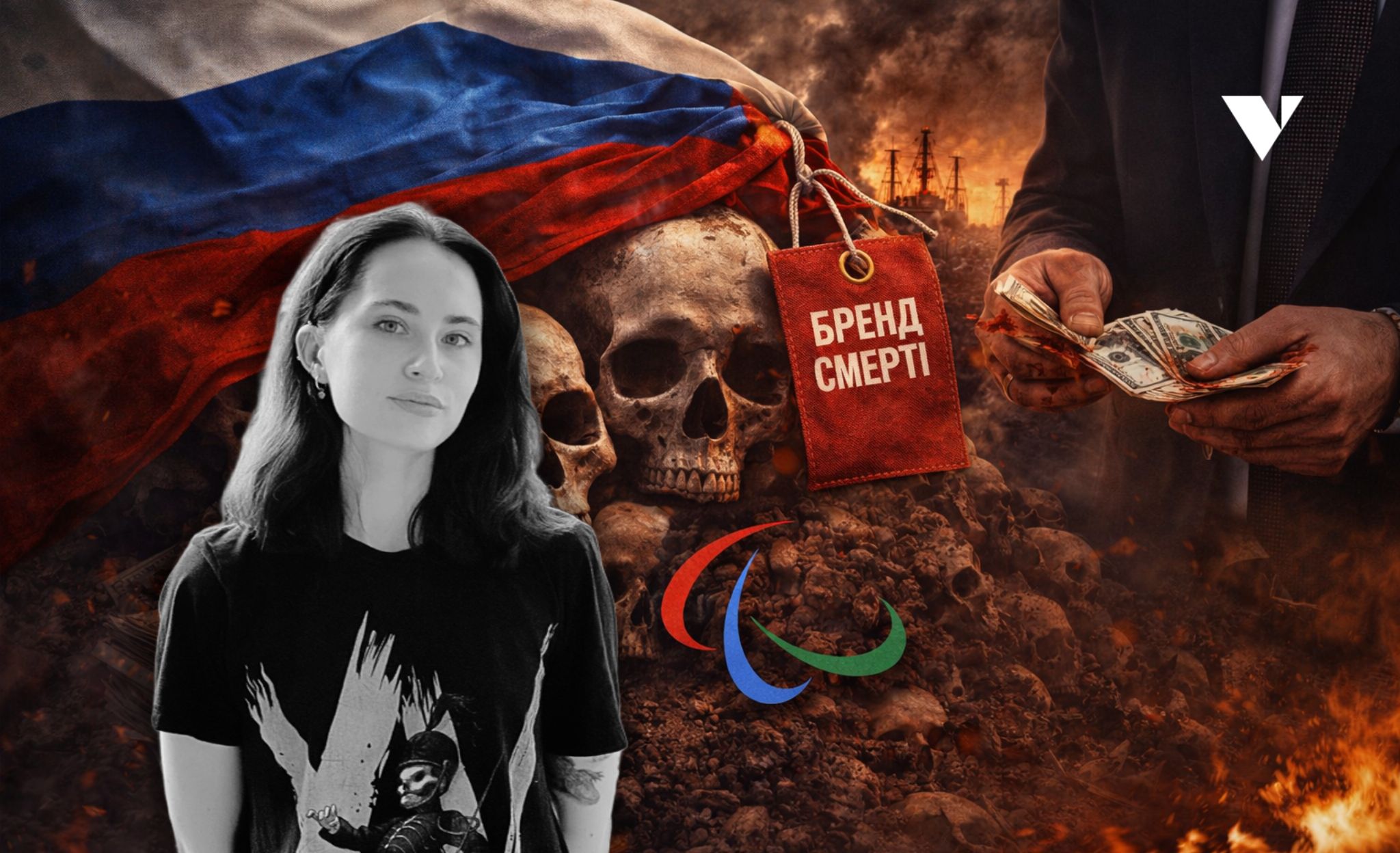
Could we go on forever describing objects, their brands, and the meanings they communicate? Of course–if only we had the time. I could talk about the environmental impact of countless companies, their policies, and their influence on the planet–but that’s not the point here. This is just an introduction to a story about the main symbol. And this time, it is none other than the Russian flag (I know orthography demands capitalization, but perhaps we can make a small exception?). In 2026, after a long stay in a dusty closet with red stains on its handle, it reappeared–not over occupied Ukrainian territories as a symbol of death and pain, not as a doormat at the entrance to a shed labeled “Wipe your feet!”, but at the Paralympic Games. “A perfect place to advertise your brand. We don’t care about your reputation–just call us, and we’ll discuss the price and conditions.” Perhaps that’s what the vacancy announcement looked like for a tricolor flag?
But of course not. In our so-called civilized and modern world, such decisions are made behind closed doors in dull office rooms. Where a handful of people (commonly called a committee) decide who gets in and under what conditions, whom to pressure and whom to greenlight, whom to trip up and whom to throw under the train. That’s where flags, symbols, and signs are discussed. Sitting in comfortable chairs, committee members weigh the “pros” and “cons,” ignoring the fact that, at that very moment, hundreds of Ukrainians are held captive in the territory of the so-called Russian Federation. An hour earlier, civilian cities were under air attack. Thousands have already died, and dozens more are waiting in line for a ticket on the last train into oblivion. Meanwhile, committees sip coffee, eyeing pastries on the table, wondering whether to choose chocolate or cherry, while terrorists carry out orders and kill. These checkered blazers feel deeply sorry for athletes from Russia and Belarus–after all, sport should be, you know, “outside politics.” Why should athletes suffer because some Putin started a war? Besides, it’s still not entirely clear whether he’s really that bad…
I think you get my point. They are tired of sanctions, saddened that the Russian flag no longer flies at the Olympics–it’s so innocent, after all, and carries absolutely no history of torture or death. Then why, excuse me, don’t we fly the flag of the Third Reich? Is it only because that country no longer exists? What’s the difference? Although I know the answer myself. It’s all about marketing. Yes, marketing. The swastika has, let’s say, a bad international image–it’s not very popular and has terrible reviews on Google (by the way, I’ve reported them many times myself–very unethical and cruel office). But with Russia, things are still “unclear.” You know, we need to investigate, to figure out who’s right and who’s wrong. So for now–let it stay. Athletes shouldn’t pay for the actions of dictators. Just don’t forget to check Ukrainian uniforms–they might, God forbid (and how tired we are of their war!), remind us of something uncomfortable. Like that word starting with “w.”
I would have liked to remain neutral, to avoid эмоції, like a “real journalist.” But if hiding absurdity is what it takes to be one, then take away my pen and sell it to the Olympic and Paralympic committees. Set the price yourselves. But honestly, after the helmet story I wrote about last time, something like this was to be expected. Russians are actively keeping their finger on the pulse, trying to find any way to remind the world of themselves. And as we see, many are more than willing to support them–guaranteeing participation and even ironing their flag by hand. But there’s one small detail. When someone supports, let’s say, a not-so-ethical brand, they often face a flood of criticism. So, having received money for promoting terrorists, don’t expect people to understand or accept such a step. It damages reputation–and the reputation of the Olympic and Paralympic committees has long smelled like waste. Especially this year.
We truly live in a world of symbols, brands, and logos. Each carries certain values, meanings, a story–something that makes it unique. We ourselves create and shape them. Perhaps my own “brand” will suffer every time I speak about absurdity and inhumanity, every time I criticize bureaucratic cacophony based on justified doubts. But my hands will remain forever clean–from blood and dirty money. And honestly? I wish others would think about that too–when shaping and supporting a brand of death. I cannot say exactly why terrorists were able to raise their flag where it had recently been banned. Let’s just say–I wasn’t sitting at that table with cherry and chocolate pastries (and honestly, I wouldn’t have wanted to–I don’t even like pastries), I didn’t hear all the fabricated “pros” and the very real “cons.” But the world wasn’t created yesterday–and we all know how it works.
So what else can be said about this situation? “Go to hell…”, “I’m so tired of this…”, “What’s next…”–all classics of the genre. Nothing new. It won’t help much, and of course, the Ukrainian side responded quickly, highlighting everything in the media. But from myself–from my not very famous “brand”–I would personally like to wish that everyone who allows even the slightest tolerance toward terrorists, murderers, and dictators keeps their head down more often. Because life’s boomerang usually comes back right there. Justice, as they say, is “outside politics.” And that is a good thing.
Author: Viktoriia Hridina