


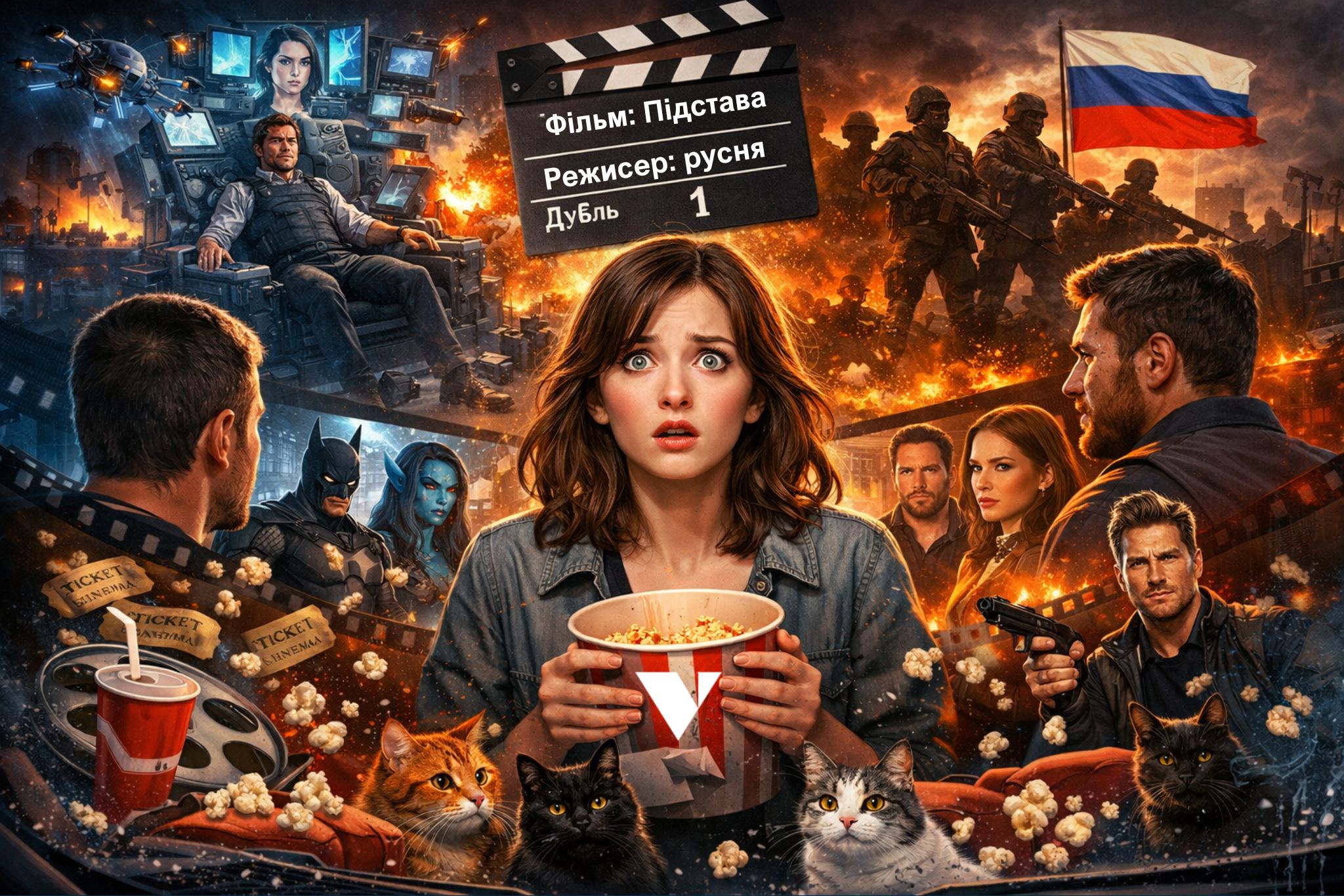
“Hi everyone, my name is Viktoriia, and I… love movies.” That’s roughly how I’d start my first meeting of Movie Lovers Anonymous—if my family ever decided to sign me up after seeing how much money I spend on films. Of course, they’d probably be curious about a few other transactions too, but thankfully they don’t have access to my savings anymore, and I’m no longer sixteen. Still, some things haven’t changed since my teenage years—I truly love movies. That also includes TV shows, sometimes even music videos for favorite songs, cartoons, and commercials, but those are much harder to spend serious money on. Movies, though, still hold that special, cozy place scented with cheesy popcorn, where like-minded lunatics spend their free time. Obviously, not everyone feels this kind of obsessive dependence on big screens, sticky seats, and the fear of getting shot during a screening of Primate, but something still unites us all—we share, as my mom would say, a common denominator.
And probably the most obvious point of connection is the desire to watch a movie. But is it really that simple? Is everyone just curious to see something new, a handsome Richard Gere or a cheerful Keira Knightley? Maybe… but I tend to think movies are actually about something else—something much deeper and more conscious. First of all, they’re a perfect way to escape reality. What could be simpler? You’re riding a bus or driving to the cinema, scrolling through work emails and Telegram, hoping that the news, like your job, ends at 6 p.m. And forty minutes later you’re flying dragons with the Na’vi on Pandora, skydiving with Tom Cruise, cruising the Batmobile with Christian Bale (or Robert Pattinson—whichever universe you prefer), dancing with Natalie Portman, and hugging James Franco. Urgent problems fade, anxiety pauses, and life fills with a strange sense of non-being… Weightless stories that touch us through their unreality, sending millions of goosebumps straight to the heart. That’s how I’d describe the first reason for my movie fanaticism.
Of course, I could go on dissecting every reason (and believe me, I have plenty), but my talent for dragging out introductions and ruining endings should give everyone a break—at least this once. In the end, the main message is clear: I love movies; they’re a place to rest, to escape, to find something personally resonant. But everyone knows not every film becomes “the one.” There are far more mediocre movies than special ones, and to find yours, you have to sit through tons of lousy stories that don’t just fail to touch you, but sometimes push you away forever. Still, I’m the type who gives every film a chance—unless it’s trash like Terrifier. No, sorry, that crap doesn’t deserve to exist.
How do I choose my next movie? Simple—I watch the ads before the screening. You know, the thirty minutes during which you manage to eat all your popcorn, want to use the bathroom, fall asleep, wake up, graduate college, get married, and have three kids. I’m one of those people who watches those short previews as if hypnotized. Honestly, thanks to them I’ve seen dozens of great films! And hundreds of terrible ones—but who’s counting?
And now we finally approach the inciting incident. One day, while watching Avatar 3 for the third time, the ads included a trailer for a movie called Mercy. The premise looked intriguing: in some future world, a program powered by artificial intelligence investigates crimes, finds the guilty, and delivers judgment on its own—no juries, no spectators, just cold facts. The defendant is given a chance to prove their innocence using all available data (it’s a super-advanced world where you can know literally everything). But if the AI deems the evidence insufficient—the person is killed. Creepy, right? Then it turns out the detective who supports this program is himself accused of murdering his wife. Now he has to uncover the truth under a time limit, drowning in useless AI graphics. In just a couple of minutes, we saw explosions, Chris Pratt, a beautiful woman representing the AI, and a trillion mysteries. Well… that’s all I need. A decent idea and a trailer, and I know I’ll see it on the big screen.
So without wasting time, once tickets went on sale, I got to work. Center seats, but not the last rows; a nice theater with adjustable chairs; perfect timing (Saturday evening)—booked, paid for, and added to my phone wallet. Even my perpetually busy husband found a few free hours to dive into the movie world with me. Miraculously, the weather was nice, the roads were clear, and we didn’t even argue about doing the dishes. In short, everything went smoothly. We chose popcorn, which I didn’t eat because I didn’t want to; candy, which I can’t eat because I’m vegan and they all contain gelatin or milk; and, of course, soda, which I also didn’t drink because of caffeine and sugar. And so our classic progressive young couple entered the theater.
The ads didn’t last long because we were experienced and deliberately arrived late, slightly ruining my future planning but I didn’t care—I was too excited. The lights went out, the AC kicked into full blast, and, as you guessed—showtime, baby. At first, everything was slow: a barely sober detective strapped into a fashionable chair where metal heals your limbs tried to wake up and grasp the situation. Just like the trailer—he was arrested for killing his wife. The AI woman stared straight into my eyes as if I, too, were guilty of something (though I don’t consider asking ChatGPT to write work emails a crime). They mumbled about the case, everything felt standard, until suddenly—boom—the screens changed, facts poured in, bam-bang, and the plot accelerated in a strange way. Not very Hollywood-like. I couldn’t quite explain why I sensed a set-up, but eventually it clicked. Ha! Didn’t expect that? I’ve got my own inner detective.
Then the action really kicked in. Explosions, flying police bikes, data found at light speed, crucial clues hidden in barely noticeable Instagram stories, a detective solving everything in ninety minutes, trucks racing alongside drones broadcasting events live. I’m a skeptic, sure, but every movie has its own universe rules. My favorite show, The Umbrella Academy, allows far more inconsistencies, but there they’re explained by the nature of that world—time travelers, gorilla-making elixirs, aliens becoming millionaires on Earth, and a rock musician as the creator. Still, the viewer is immersed deeply enough not to question each scene. Here, though, it felt different. Everything followed the rules, yet I—the main critic, cinematic genius—felt something off. Still, that didn’t stop me from getting a bit emotional, reflecting on the intended meanings, and stealing some popcorn from my husband, who had sworn not to share.
Two hours later, the lights came on, and we were back in the real world. Without delay, our expert duo rushed to the restroom, where I, of course, got stuck longer. I swear, one day I’ll just use whichever bathroom is free. Coming out, I noticed my husband smiling at his phone. I expected a dancing cat video or something similar, but he looked serious and asked:
“Did you know who directed this movie?”
He knew perfectly well that I don’t check such things. Sure, I know who made The Dark Knight or Avatar, but I prefer giving chances to younger or lesser-known artists without bias. This time, though, I should’ve done otherwise…
“Well, congratulations,” my partner in crime said. “We supported a Russian director. It’s a film by Timur Bekmambetov. The guy who made Yolki.”
Good thing I already felt something was off with the film; otherwise, I’d have had to accept not only that I supported a Russian, but also that I kind of liked the movie without sensing the problem… But I did sense it, right? It always felt wrong—too convoluted, raising doubts. And I’d be lying if I said this only happened with Russian films I knew from YouTube reviews. Western movies can be just as infuriating when poorly written. But back then my family in Kyiv wasn’t sitting without electricity for days because of shelling. That was before the full-scale invasion—though the war was already on.
Now it was more critical—I’d given money to a Russian director.
At that moment, the camera should’ve slowly zoomed in on my face, capturing shock, fear, and disgust. But there was no camera—we just stood there by the restrooms, staring at each other in disbelief. We should’ve gone to the car, headed home, but somehow we lingered. Minutes later, we were almost at the car, and I was still thinking about that damn movie and the fifty dollars we spent. Honestly, if it had been the dumbest plot imaginable by an American director, my conscience wouldn’t torment me this much. But this… well, you get it. Me—the smart one who argued with Ukrainians online over Russian language use or attending Loboda and Meladze concerts—went to see a film by a Russian director…
But is he really that bad? Maybe he’s against the war? (Turns out, he is.) But what does that change? Was I supposed to feel better?
I firmly believe you shouldn’t judge a person solely by birthplace or even a controversial past—we’re all flawed. Later I learned he has no business in Russia, doesn’t live there, and condemned Mordor’s actions. But SO WHAT? I still broke my principles by going to that movie! Maybe none of that money funds death, maybe it doesn’t affect Ukraine at all, but it didn’t make me feel better. Sure, we should think broadly, give people chances, blah blah blah—but that works only when your family and homeland aren’t under attack by a neighboring state whose citizens, one way or another, hate you. Those rules belong to another world—not mine.
We reached the car and chose silence. I felt more guilt—I bought the tickets and chose the movie. No one blamed me; honestly, who checks every director before watching a movie? I didn’t think it was necessary in America. I thought seeing a Russian artist here would be rare… though I also never thought Putin would be welcomed with a red carpet. Why did I assume that? This is a land of dreams, and dreams differ. Not everyone is a monster, and not everyone should answer for their country—but those personal “buts” haunted me.
The drive home felt gloomy; it even started raining, adding drama. We passed shops and empty streets, and it felt like an AC/DC song. Too melodramatic, I know. It was accidental—who knew? Dozens of Ukrainians still buy Russian products in Europe because they “need buckwheat urgently,” and I doubt they agonize over it. Hundreds listen to Russian music, consume content, read literature—and live on. They have the right. Who am I to judge? Now I’m a traitor too…
Jokes aside, I really felt uneasy. Nothing terrible happened; the director wasn’t that questionable; the movie wasn’t even that good; I watched it in Florida, not Moscow. My family’s in Ukraine, we donate, help, do what we can—and here I made a small mistake. That doesn’t make me enemy number one. Maybe number five…
Approaching our apartment, I heard our three cats waiting at the door. For them, nothing changed—there’s mom and dad, the girl who feeds us when parents leave, and a favorite scratching couch. But for me, something shifted. I wanted to fix things—but how? Start a revolution over a Russian director? Burn posters? Rob the box office? My initial ideas weren’t very conscious. I just needed time to process and find the right solution.
While feeding the cats—who stared at me with something like contempt—it hit me! I could do what I do best! No, not eat cherry varenyky and read Stephen King, but write about my experience! (I like to think I’m decent at it.) As the bowls emptied, my plan took shape. I couldn’t change the day, choose another movie, warn my past self, or even take my own popcorn instead of stealing my husband’s. But I have a future—and there I can make it right. After chores, I did what anyone would—I went to bed. This isn’t a movie; real life works differently. Don’t worry—it’s part of the process! A week later, I had the strength and inspiration to write about this cinematic catastrophe. So here’s the message:
The film Mercy, currently screening in U.S. theaters, was created by Russian director Timur Bekmambetov. Googling him won’t reveal anything extremely critical (though I didn’t dig deep—check yourselves!). He opposed the war, doesn’t live in Russia, has no business there, and focuses on Western audiences. So, theoretically, he shouldn’t be a scapegoat, and many may even like his work. But! If you’re as sensitive and justice-driven as I am, think twice before seeing this movie in theaters.
I won’t list pros and cons—this is a gray zone, especially for immigrants. We lack the same context as people in Ukraine—not because we’re bad or live better, but because we’re here, in the U.S., Canada, or Europe, where reality is different. People mix, nations blur, you can become anyone anytime. Good or bad—that’s for everyone to decide, but it’s real. I won’t tell you what to watch, drive, or buy—that’s not my responsibility. I just wanted to share my strange experience and maybe warn, scare, or annoy someone. All feelings are valid, and I’m glad I evoked any.
So choose your screening, book tickets, watch movies—and I’ll return to my world, where there’s still no place for Russian artists, even those playing by the rules of good. I won’t call for boycotts or support—that’s not my story anymore. But it was part of that Saturday night, after watching a decent film, surrounded by my three sweet cats who have no idea what these strange bald creatures without tails and whiskers are thinking.
Author: Viktoriia Hridina