


It so happened that Ukraine operates on the principle of a secular state, under which the church is separated from the system of governance and no religion is mandatory. Yet, despite written laws, people still try to find something beyond dry facts and the theories of scientists, delving into various beliefs. Christians, of course, predominate, and that is due to history, but still, about 120 other religious movements have found their place on the territory of Ukraine and in the hearts of our citizens. Islam, Judaism, Buddhism, Hinduism, and others are open to new believers! And how wonderful it is that the state does not impose one correct path on us while denying all the rest. After all, freedom is important in everything, and where, if not in faith, should we seek it?
Do not worry, we are not going to analyze every branch of faith, trying to convince anyone of the theory of evolution or one of the biblical versions. As I said earlier, everyone has the right to choose what is true for them. And yet, despite differences in certain aspects of various religions, there is an unwritten rule about basic respect for historical heritage and cultural features. We do not try to enter a mosque wearing shoes, we cover our arms and legs before entering sacred places, we do not touch a statue of Buddha unnecessarily, we do not enter the altar area without permission, and in general we behave respectfully and quietly wherever we are. And this is done somehow intuitively; no one teaches us to be especially cautious when entering a place of power for those who profess one religion or another. After all, faith is something weightless, delicate, and personal. We have lived to see space travel and a chat that will answer all questions, so elementary respect seems like something universally understood.
But is that really the case? Somehow it has turned out that, despite general tolerance, we are still constantly being told that some religion is not quite as “correct” or is “more radical” than another. Here, someone interprets the Bible badly, while someone else looks at everything from a completely different angle. It is also worth remembering that this was used as manipulation for decades, forcing some believers to take up arms against others. And, as is tradition, the russians have not moved far from our ancient ancestors, once again reminding Ukrainians here and there who we are dealing with.
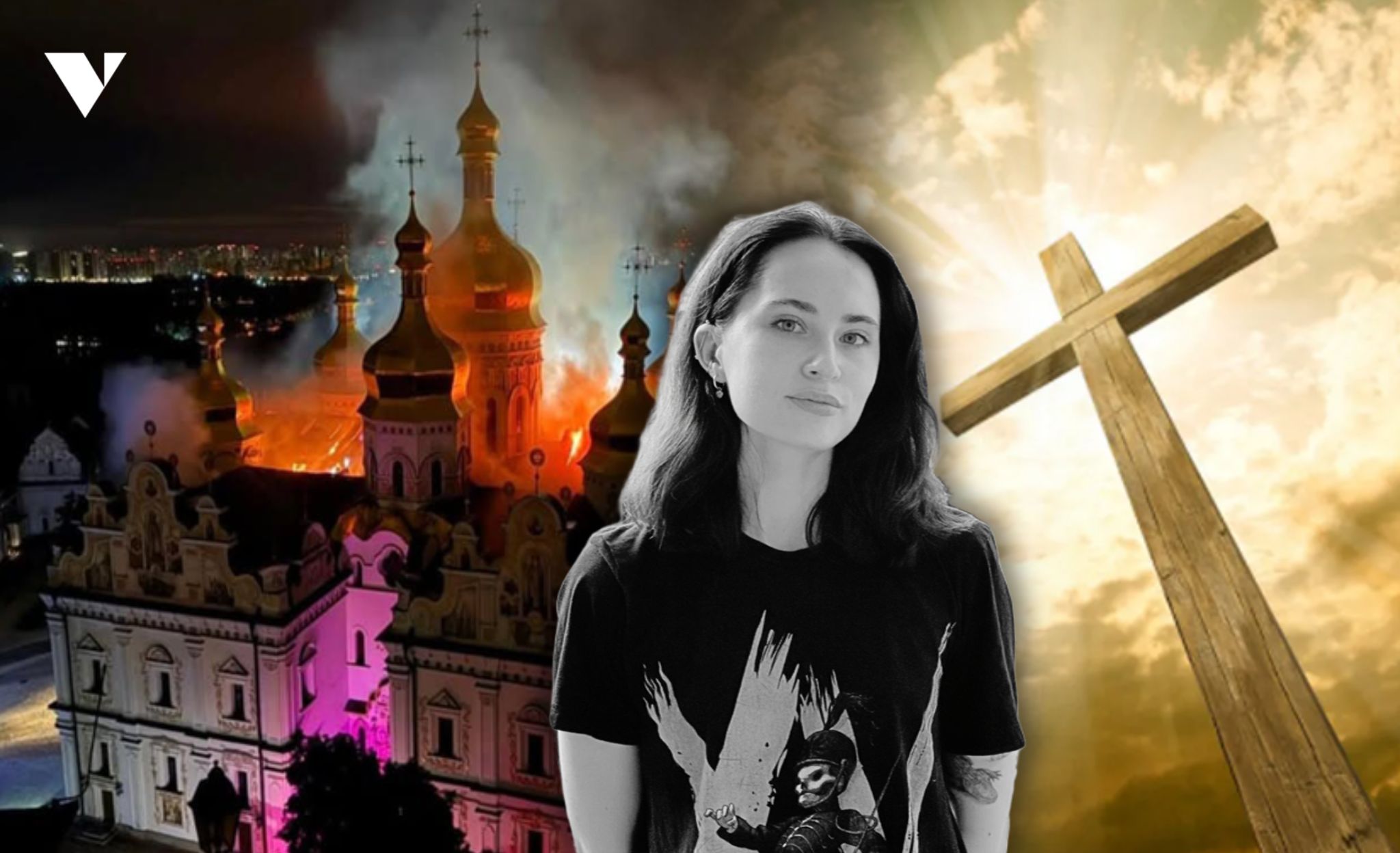
On the night of June 15, 2026, the Kyiv-Pechersk Lavra was damaged as a result of a massive russian attack: a fire broke out on the roof of the Dormition Cathedral, covering an area of about 800 square meters. The head of the Kyiv City Military Administration, Tymur Tkachenko, reported that the fire on the territory of the Lavra occurred as a result of a direct hit. The Treasury of the National Museum of the History of Ukraine, the Museum of Books and Printing of Ukraine, the National Historical Library of Ukraine, the National Academy of Culture and Arts Management, and the storage facility of the National Museum of Folk Architecture and Life of Ukraine were also damaged. Of course, the fire was extinguished, and restoration will begin in the near future, costing approximately 500 million hryvnias, but, as they say, the overall mood had already been spoiled. And some things cannot be restored. For example, faith in a better future, faith in humanity, and faith in love.
Many people abroad do not fully understand this special attitude toward the Kyiv-Pechersk Lavra, reminding us that russians shell countless sites across Ukraine every day, including civilian ones. It is difficult to argue with such truth, and of course it makes sense. Only this time, the russians decided to take away not only concrete, nerves, and, painful and difficult as it is to realize, human lives, but also to try to tear down a center of faith even for those who have never chosen religious paths for themselves. The Kyiv-Pechersk Lavra is not an ordinary little chapel in a basement, although it is not exactly right to devalue such monuments either. No, it is an ancient relic and an important spiritual, educational, and cultural center of Kyivan Rus. Yes, yes, the very Kyivan Rus that putin is trying to appropriate for himself. It was founded in 1051 by the monks Anthony and Theodosius, and received the name “Pechersk” because of the caves where monks once lived. By the way, a large number of Orthodox shrines are kept there. And the Dormition Cathedral is considered its center — a cathedral that every Kyiv resident has seen about a million times, admiring its colors and the spirit of the past. In 1990, the Kyiv-Pechersk Lavra was included on the UNESCO World Heritage List, which, as it turned out, russian henchmen care about just as little as any international norms.
So why so much noise? Where does all this surprise come from? Russia has already violated every norm and every moral principle, crossing the fine lines that we as a society had actively built after the Second World War, spitting on the rules and writing its own. And that is true. This country is guilty of hundreds and thousands of deaths in Ukraine and in other neighboring countries, and despite all attempts to stop it, it still continues to carry out its deranged plans. Only this time, they wanted something new! Now old cathedrals were in their sights — cathedrals that even Hitler’s rabble tried not to touch. And knowing Russia and their clown at the top, one can say that this attack carries far more symbolism than the rather straight folds of their gray matter are capable of grasping. Putin is trying to destroy history, to show everyone that he is the God his corrupt church keeps babbling about. He seems to think that by taking away a few old icons, he can rewrite the events of the past, convince people that truth exists only in his eyes, and that faith should be placed only in him.
They — and by “they” we mean the elite of russian propaganda — have been moving toward this for a very long time. Having taken control of their own church, these damned souls are trying to convince their own believers of the necessity of war, the omnipotence of mere mortals at the helm, and one single truth — the one born in the dictator’s head. And to us, people who are not part of such obscurantism, it seems so easy to see propaganda and lies in it, the absence of morality and the soullessness. But when you are there, when you are part of that faith, it is very hard. And somewhere deep inside, it pains me bitterly that the state controls what should have saved not only the physical body, but also something weightless and higher. But that is how it is. russia has once again shown its true self, and the issue is not only the attack on the Lavra. They have exceeded all the limits of what is permissible for a living soul, while remaining just as proud and vain.
Perhaps one does not need to wear a cross down to the navel or go to church every week in order to be a good person, or even to call oneself someone who believes in higher powers. russia is a perfect example of how actions and words can carry anything but Christian values. There, they bless cities against the coronavirus, and when there is time left, they sprinkle missiles with holy water, asking God for a more accurate strike on a civilian home somewhere in Kharkiv. Their believers do not get tattoos and consider them a sin, but send their loved ones one way to a war that began for no reason. They sacredly adore their own churches while destroying neighboring places of power. This is a game of some wretched gods, and unfortunately, it will never end.
I would like to hope that such displays of hypocrisy will not shake anyone’s faith. Perhaps not all of us see the same path toward understanding life and its continuation after death, but may we, despite all our differences, remain better, more decent, and more humane versions of what is described in all the holy books on planet Earth.
Author: Viktoriia Hridina
