This year’s FIFA World Cup in the United States, Canada, and Mexico is attracting the attention of millions of fans, television viewers, interested observers, and even those who do not follow football. This is natural, since football is the most widespread sport in the world. It should also be added that this championship is being organized by three countries at once.
The geopolitical situation before the start of the tournament and during its course is far from the calmest in the world. Tensions between the United States and Iran have added unpredictable moments around the football battles. Numerous FIFA innovations, the climate, the weather, attendance, and more — all of this is modern professional football.
It is a pity that Ukraine’s national team was unable to earn the right to compete among the best. However, Ukrainian football players have repeatedly visited the United States to take part in various tournaments. For example, the early 1990s were extremely rich in trips by football players from Ukraine to America.
The press has recorded several interesting matches for us: 1991 — the youth team of Dynamo Kyiv; 1992 — the national team of Ukraine; 1992 — the student team of the National University of Physical Education and Sport of Ukraine.
I have already written about the match of Ukraine’s national team in the United States, so this time I will tell you about no less unique Ukrainian football competitions in America.
Dynamo Kyiv or Dynamo-Skif Kyiv?
Thus, Metodii Boretskyi, in the newspaper Narodna Volia, in the article “Successful Performances of the Youth Players of Dynamo Kyiv in the United States,” reported the following: “According to previous reports, the youth players of Football Club Dynamo Kyiv arrived in the United States on March 12 to take part in a major international football tournament in Dallas, Texas. After the conclusion of the aforementioned tournament, at the initiative of Dynamo’s leadership, the Kyiv youths were guests of the Ukrainian Sports Association Tryzub in Philadelphia.”
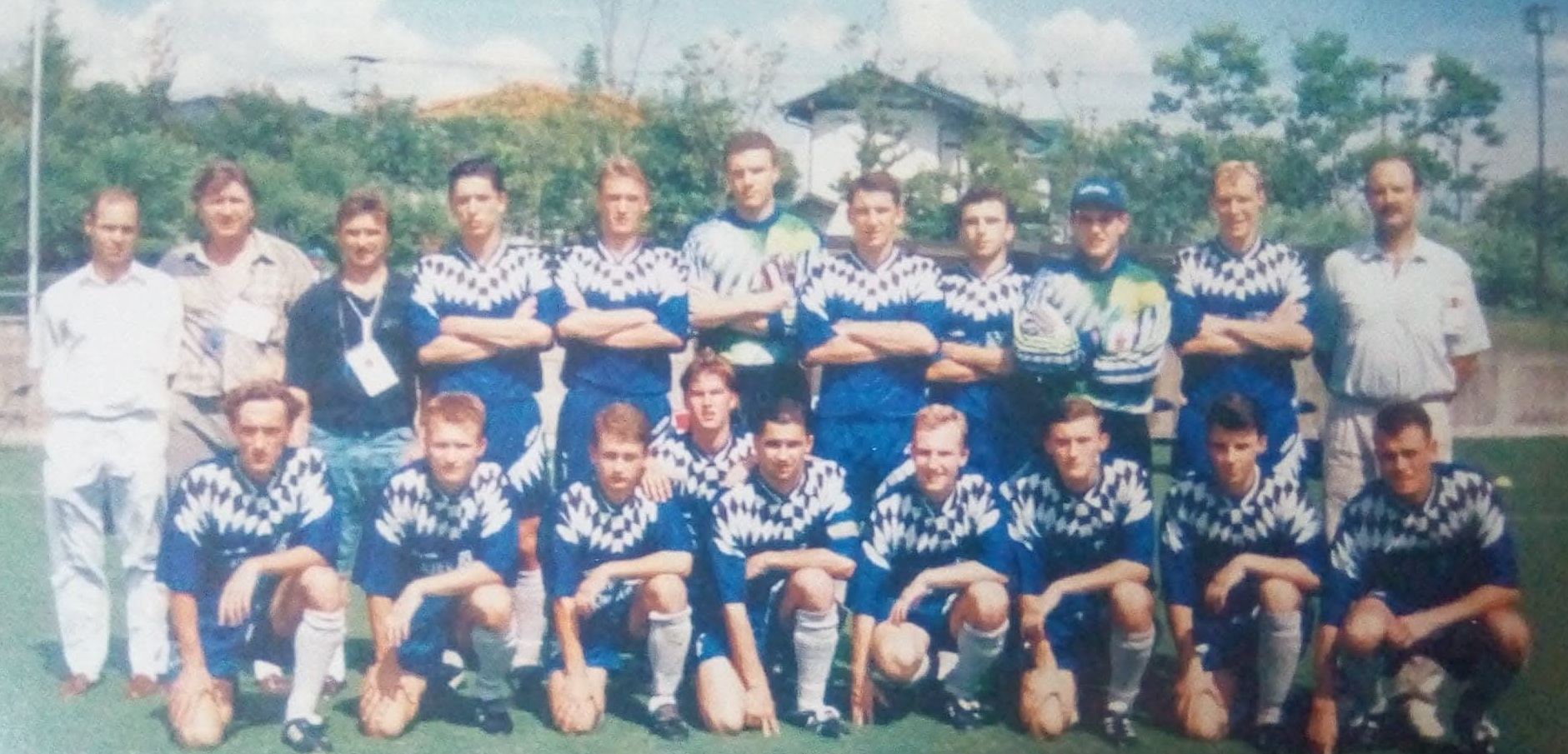
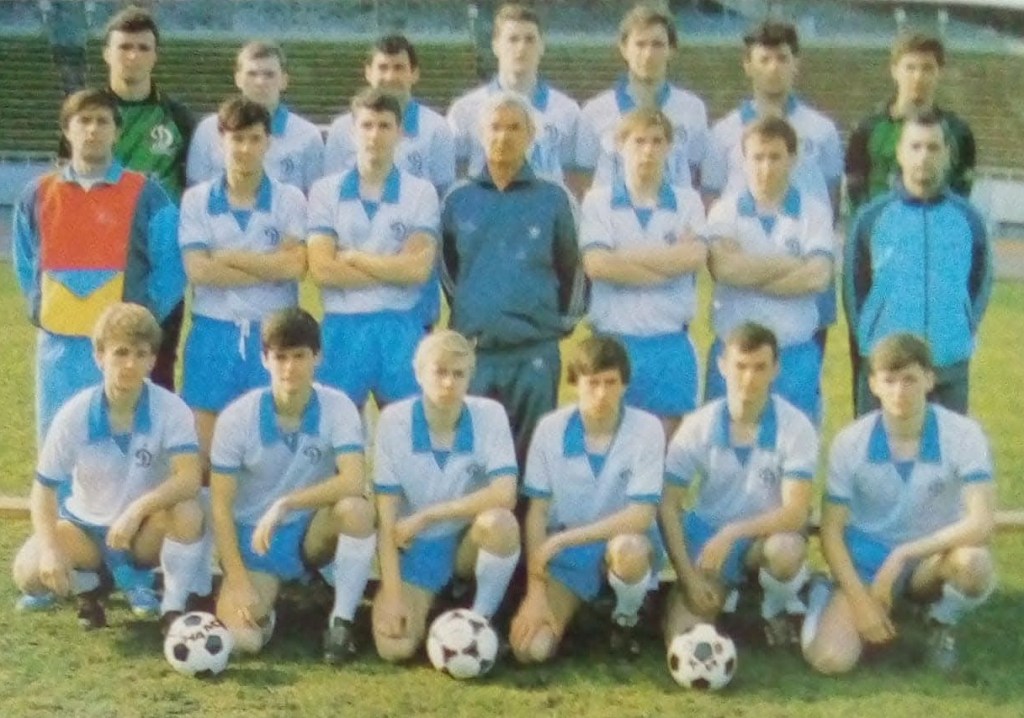
It is truly an interesting story. After all, we learn that the youth of Dynamo Kyiv played in the United States in 1991. However, there is a small but interesting fact here regarding what the team should be called — Dynamo, Dynamo-Skif, or Skif. In the photo, we can see that the players’ shirts say specifically “Dynamo-Skif”! Why exactly this name?
On the Internet, one can find a great deal of information about football and futsal teams called Skif from Kyiv, Brovary, and so on. But these are all not the same teams. So what is the secret of the Dynamo-Skif football team? Is this, in fact, the famous Dynamo Kyiv, or is it some other team? Although the diaspora press in the United States identifies them as Dynamo Kyiv. Is there a mistake here? I will explain it this way — there both is and is not. After all, the Dynamo-Skif football team is not quite the same as Dynamo Kyiv.
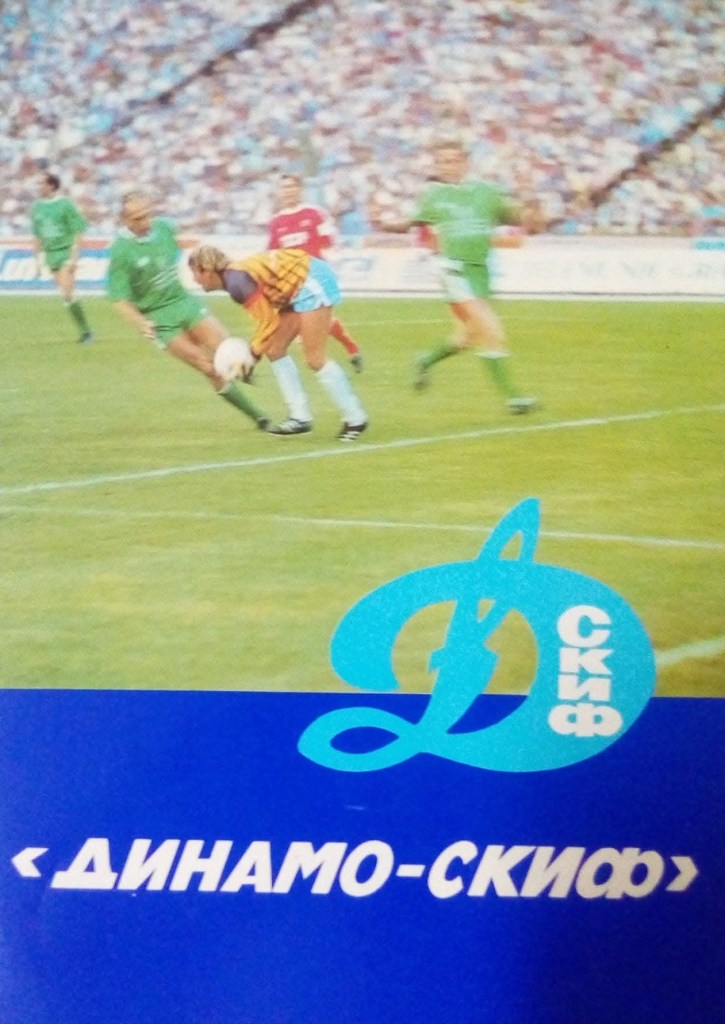
I will now explain what kind of team Dynamo-Skif was. Here is information from the team’s special presentation booklet: “The Dynamo-Skif team represents the Football Department of the Kyiv State Institute of Physical Culture and FC Dynamo Kyiv.” This is quite a striking point in this story. It turns out that this was something departmental and independent, while at the same time connected to Dynamo Kyiv Football Club. So the Ukrainian press in the United States was probably not mistaken.
How did this union of two separate sports institutions arise under an almost identical, symbolic, and well-known name — Dynamo? This is what was written about it: “Dynamo Kyiv Football Club is one of the oldest and most popular in the country, a participant in all USSR championships and Soviet Union Cup tournaments, a twelve-time champion of the USSR, an eight-time winner of the country’s Cup, a two-time winner of the European Cup Winners’ Cup, and holder of the Super Cup. A whole galaxy of Dynamo players received higher education at the Football Department: O. Blokhin, A. Byshovets, V. Muntian, V. Kolotov, Ye. Rudakov, V. Troshkin, A. Puzach, V. Veremieiev, V. Matviienko, V. Onyshchenko, L. Buriak, V. Bezsonov, A. Demianenko, O. Mykhailychenko, I. Bielanov, O. Kuznetsov, P. Yakovenko, I. Yaremchuk, and others. The Dynamo-Skif team includes the most promising athletes — students of the Football Department, the younger colleagues of the Dynamo masters. Despite their young age, many of them represent Kyiv football well not only in our country, but also abroad.”
Thus, we have established that Dynamo-Skif was a separate team that had a direct connection with Dynamo Kyiv Football Club.
Thus, Metodii Boretskyi was indeed right that these were Dynamo youth players. But at that particular moment, they were probably representing Dynamo-Skif. At the same time, during the ceremonies, the team represented Ukraine: “Because the youth players of Dynamo Kyiv formally represented Ukraine — they had been invited in that capacity — at the opening ceremony, among the flags of 27 states, the Ukrainian flag also officially flew.” This is gratifying and worthy of respect!
The results of the matches were as follows: Dynamo-Skif — North Huntington Beach — 1:1; Dynamo-Skif — Baton Rouge — 3:0; Dynamo-Skif — Gjoa — 2:0. Two victories and one draw allowed the Ukrainians to take first place in their group. Unfortunately, in the final match, the Dynamo players lost to the Wexford team from Canada by a score of 0:1.
After the tournament, the Kyiv football players met with the Ukrainian diaspora in the United States. This is how it happened: “On Monday, April 1, Dynamo players and their leadership were met and welcomed at the airport in Newark by representatives of the Ukrainian Sports Association Tryzub. Six cars were waiting for the guests to take the players and their leadership to the premises of the Ukrainian National Association in Jersey City, which had invited all the athletes, their leadership, and their drivers for lunch.”
This was true Ukrainian hospitality. Guests from Ukraine were met and welcomed by leading figures of the Ukrainian community in the United States. U. Diachuk informed them about the activities of the UNA. Z. Snylyk wished them success in competing at the Olympic Games while representing a free Ukraine.
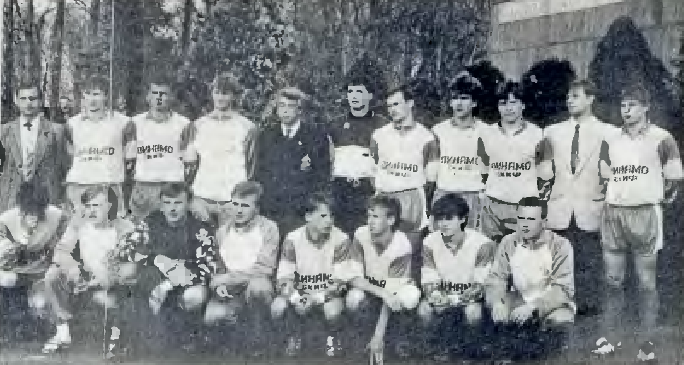
After that, the Ukrainian football players traveled to Philadelphia to learn about the experience and achievements of the Ukrainian Sports Association Tryzub. There, in addition to various ceremonies, the Kyiv team played a match against the local Ukrainian club Tryzub. The press wrote the following about this match between the two Ukrainian teams: “The opening of the competition began with the raising of the Ukrainian and American national flags to the sounds of the national anthems, the exchange of club flags, and greetings. The game began at a fairly fast pace and ended with a score of 6:1 in favor of FC Dynamo. The match was good and fast. The spectators present were clearly satisfied because… our boys played well and won. The Dynamo players wore blue-and-yellow uniforms, while the Tryzub players wore red-and-black uniforms.”
A fine game, a wonderful atmosphere, and brilliant Ukrainian state attributes and symbols.
From press reports, we can also learn the lineups of both Ukrainian teams. Dynamo-Skif: Kostiantyn Kuzhelnykov, Ihor Denysiuk, Ihor Taran (captain), Viacheslav Lytvynenko, Oleh Lyzohub, Valerii Zolotukhin, Andrii Nikitin, Serhii Dihtiar, Andrii Chechuha, Oleksandr Ihnatieiev, Hennadii Prydebailo, Viacheslav Ostroushko, Oleksandr Martsun, Serhii Vovdenko, Yurii Zhabinskyi, Oleksandr Filipchenko. Team officials: Andrii Holovash, Oleksandr Lysenko (coach), Anatolii Suhkov, Anatolii Fedunov.
Tryzub: David Hirber, Jerry D’Alterio, Andrii Barret, Brian Hrabovych, Louis Steins, Christian Paladino, Andrii Kohut, Walter Bilecki, Robert Boyer, Stefan Nimchuk (captain), Tom Brohen, Scott Licat, Mykhailo Koval, Denys Maheryt, Greg Dickerson.
The main referee of the match was Mykola Kasiyan, a well-known and renowned referee in the United States. He was assisted on the lines by Roman Darmohrai and Mike Gallagher. The selection of such qualified referees testifies to the seriousness and high level of the match, even despite its friendly nature.
The post-match gathering testified to the friendly — one might even say familial — Ukrainian roots of the event. This is how it happened: “After the competition, a reception for the guests was held in the main hall of Tryzubivka. The meeting was opened by the master of ceremonies for the evening, engineer I. Skira. Engineer I. Chyzovych welcomed the guests on behalf of the Board of the Ukrainian Sports Association Tryzub, and Ya. Kozak spoke as chairman of USCAK-East. Greetings from FC Dynamo were delivered by coach O. Lysenko and A. Holovash. The keynote address was given by engineer B. Siryi, and Anna Koval presented the guests with packages that included History of Ukraine by M. Hrushevsky and History of Ukrainian Culture by I. Krypiakevych, which were donated to the guests by the local branch of the UCCA.”
It is truly symbolic and fantastic, because only Ukrainians can combine sport with the preservation of national traditions, history, and culture in such a way.
The Team of the Kyiv State Institute of Physical Culture in the United States
On April 14, 1992, the football team of the Kyiv State Institute of Physical Education and Sport arrived in Philadelphia, United States, for a two-week tour — this is how it was stated in the press, although the correct name was the Kyiv State Institute of Physical Culture. Later, it would become a national university. I assume that this was a continuation of the previous year’s visit. Back then, the team was referred to either as Dynamo Kyiv or as Dynamo-Skif of the Institute’s Football Department.
The delegation consisted of 25 people, including the representative of the Institute, head of the Football Department Anatolii Volodymyrovych Popov; coach and lecturer of the same department Andrii Holovash; and head of the Department of Sports Facilities of the State Committee for Sports of Ukraine Borys Mykhailovych Voskresenskyi. The trip was initiated and sponsored by the Football Department, the Ukrainian Sports Association Tryzub in Philadelphia, and other diaspora organizations.
According to Anatolii Popov’s recollections, this project originated back in 1991, when he was in the United States. There, together with representatives of the Ukrainian diaspora, it was decided to hold a tournament the following year with the participation of the Football Department’s team. It should be noted that the core of the Kyiv team consisted of players from the Dynamo-Skif team.
The tour program included matches against football clubs of American universities from various states and against the team of the Ukrainian Sports Association Tryzub. The busy schedule looked as follows: April 16 — Rutgers University, New Brunswick, New Jersey; April 19 — Ukrainian Sports Association Tryzub; April 21 — University of Richmond, Richmond, Virginia; April 22 — University of North Carolina, North Carolina; April 24 — Lenoir-Rhyne University, Hickory, North Carolina; April 25 — Wake Forest University, Winston-Salem, North Carolina; April 27 — University of Virginia, Richmond, Virginia.
On Thursday, April 16, a meeting was held with professors and students of Montclair College. The meeting was led by Professor Leonid Lutsenko. That same day, the Kyiv players played a match against the student team of Rutgers University, winning 3:1. Strong support from the stands was provided by numerous Ukrainian youth from Newark and New York.
On Sunday, April 19, the football players of the Kyiv Institute of Physical Culture played at Tryzubivka against the team of the Ukrainian Sports Association Tryzub. This time, the Ukrainian community supported both teams. Interestingly, students from the Lviv State Institute of Physical Culture played for Tryzub — Viktor Sydorenko, Petro Boretskyi, Oleksandr Hrabar, Pavlo Popovych, as well as coach Yaroslav Dmytrasevych. The game was intense, but the Kyiv team defeated Tryzub 2:1.
On April 21, the Kyiv football players traveled through the southern states and played another five matches in six days! Thus, the overall results were as follows: seven games in thirteen days, 5 wins, 1 loss, and 1 draw. Excellent sporting results and extremely vivid matches under the national flag and anthem of Ukraine.
On April 27, the Kyiv players returned to Tryzubivka, and the following day they flew back to Kyiv. During the Institute team’s stay in the United States, they were accompanied by Tryzub president Ihor Chyzovych and board member Vasyl Baran. Financial support for this project was provided by the UNA, Providence, and ZUADK.
Thus, during 1991 and 1992, football players and students of what is now the National University of Ukraine on Physical Education and Sport traveled to the United States and took part in international tournaments, as well as met with Ukrainian football teams and the community.
We have people and achievements to be proud of! Know your history — and you win Victory!
Author: Oleksii Lyakh-Porodko