 In 2026, the FIFA World Cup will be held in three countries: the United States, Canada, and Mexico. The United States will host the majority of matches in 11 cities: New York, Dallas, Kansas City, Houston, Atlanta, Los Angeles, Seattle, San Francisco, Philadelphia, Miami, and Boston. We believe that the national team of Ukraine will overcome all challenges of the qualification cycle and will be among the participants in the final stage of the World Cup. At the same time, it is worth recalling the significant role Ukrainians have played in the formation and development of football—particularly the European school of football—in the United States.
Representatives of the Ukrainian diaspora were directly involved in shaping and advancing this sport. Ukrainians coached national teams (Yevhen Chyzhovych, Volodymyr Chyzhovych, Ihor Chyzhovych), were leading players of the U.S. national team (Zenon Snylyk, Mykola Krat, Walter Barr, Volodymyr Shmotolokha, Myron Krasii, and other notable figures), and Ukrainian clubs have for decades been leaders of football in the U.S. (USVT “Chornomorska Sich,” USO “Tryzub,” USC New York, and many other worthy representatives).
Football is the king of sports. The most popular game of millions also unites Ukrainians around the world. Ukrainian diaspora football teams have been established in the United States, Canada, Australia, Estonia, the Czech Republic, Spain, Poland, Romania, as well as Hungary, Moldova, Israel, Austria, Germany, the Baltics, Bulgaria, the UAE, Greece, Denmark, France, Sweden, and beyond.
The Ukrainian Americans’ national team (it should be noted that the U.S. team is in fact the team of USCAK—the Ukrainian Sports Federation of America and Canada, as over the years it has included Ukrainians from both the U.S. and Canada; this was also emphasized by USCAK President Myron Byts) has a long and illustrious history. For decades, the team has proudly and successfully represented Ukrainian Americans on the world stage. In addition to matches in the United States, the team has played abroad—in France, Ukraine, Canada, Australia, and England.
Returning to Native Shores
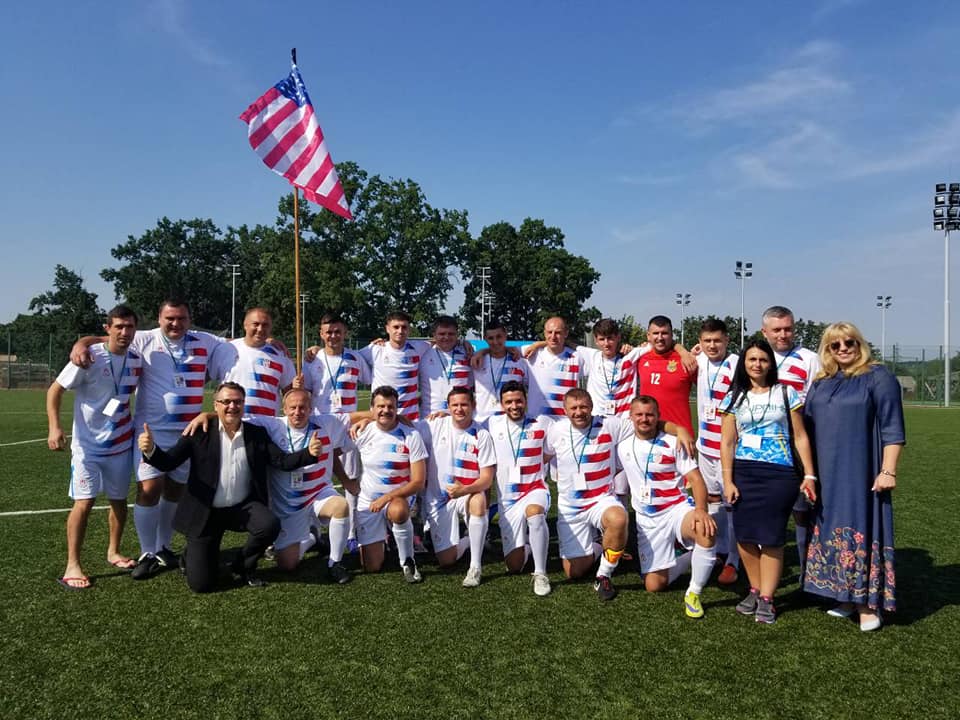
The dream of every Ukrainian forced to leave their homeland for various reasons is, above all, to return home—to their native land. Therefore, whenever the opportunity arises, Ukrainians unite and joyfully travel back to Ukraine, to the ancestral home of their grandparents. In 2018, the VII World Championship in football among Ukrainian diaspora teams took place in Irpin. I had the pleasure of interview the U.S. national team coach Taras Huyda.
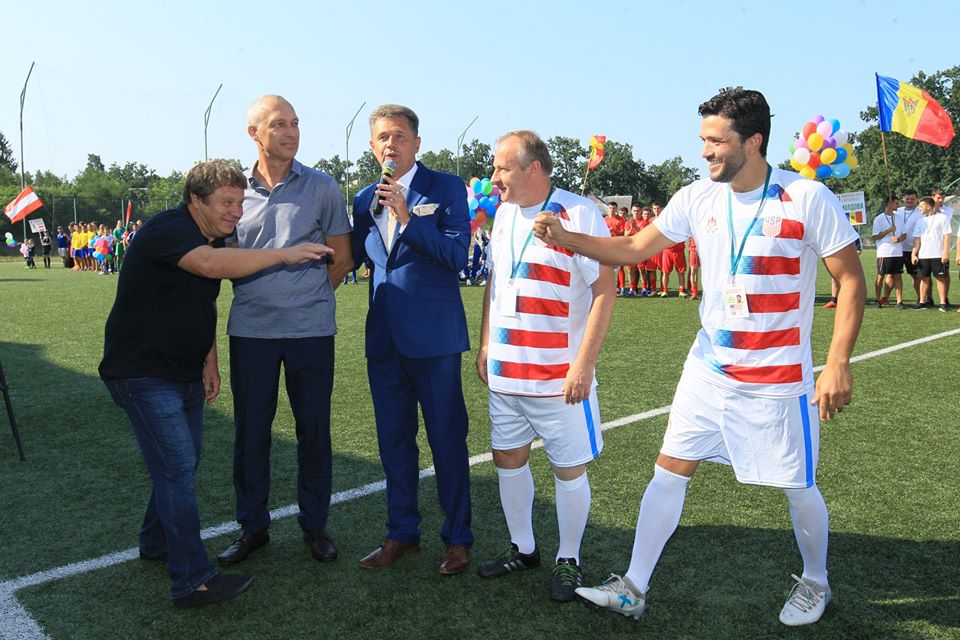
The press wrote the following about the team and its coach: “On the bench of the U.S. team, which is making its debut at the championship, will sit Taras Huyda, a native of Mykulyntsi in the Terebovlia district. In 2001, an opportunity arose to move to America, and the 20-year-old decided to cross the ocean. There he tried to break into the main squad of the MLS team Chicago Fire, which also featured another Ukrainian—Dmytro Kovalenko, a graduate of Dynamo Kyiv. Unfortunately, Taras’s professional career in American football did not materialize—his leg was broken during a training session. Still, he never forgot football. He plays for the veteran team Chicago United. Last year he became state champion and cup winner.” Thus, the team was led by a qualified specialist with solid professional football experience. This was important, as the squad included world football stars Edmar and Ivan Yaremchuk. Media highlighted this unique fact: “Taras Huyda met Ivan Yaremchuk, the legendary Dynamo Kyiv player, at the Legends Cup charity tournament in 2016. Ivan Ivanovych immediately agreed to strengthen the team. There were no major issues with another famous footballer—though from a slightly different era—Edmar. The former Dnipro and Metalist player now lives in Miami. Serhii Nahorniak, who once played for both Dnipro and Shakhtar, helped invite him. Edmar did not hesitate and agreed to visit Ukraine. Unfortunately, at the last moment, Dmytro Kovalenko could not make the trip.” Can you imagine a U.S. team featuring such football stars?
The following year, 2019, Ukraine hosted the First World Unity Cup in football for the Ukrainian diaspora. The U.S. team (USCAK) also took part in that tournament.
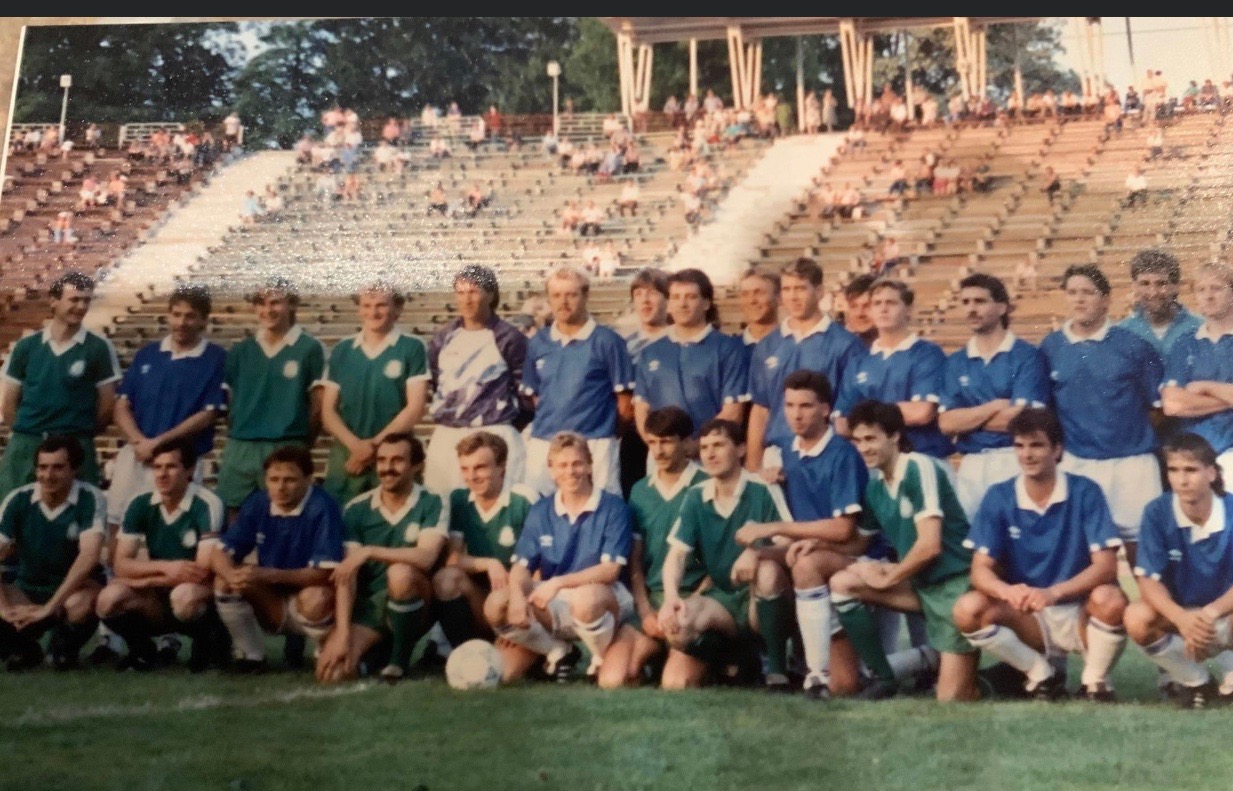
In 1991, the USCAK team undertook a unique tour to Ukraine—still under Soviet occupation at the time. Can you imagine that? Until then, communist terror in occupied Ukraine and anti-Ukrainian policies toward the diaspora had prevented free visits to the homeland. And then such a resonant and historic visit by a large delegation from the U.S. and Canada. The USCAK football team was particularly renowned. In Lviv, at the Ukraina Stadium, they played a match against the local team Karpaty.
The European Tour of the USCAK Team
In 1999, three landmark football matches involving Ukrainians took place in France. The main reason for the arrival of Ukrainian footballers and numerous fans was the match between the national teams of Ukraine and France (the reigning 1998 World Cup champions) for qualification to the final stage of Euro 2000. On March 26, the day before the main match, the youth teams of Ukraine and France played for a place in the final tournament, later held at the 2000 Olympic Games in Sydney. Unfortunately, Ukraine’s youth team lost 0–4, while the senior national team managed a 0–0 draw.
Ukrainians from the U.S. and Canada traveled to France not only to support the national and youth teams of Ukraine, but also to play a unique match between Ukrainian diaspora teams of North America and Europe. The American Ukrainian team featured players from clubs such as Chornomorska Sich (Newark), UST “Lviv” (Cleveland), SK SUM “Kryla” (Chicago), SK SUM “Krylati” (Yonkers), and USO “Tryzub” (Philadelphia). Notably, the team included a single female footballer—Motria Oryshkevych (UST “Lviv,” Cleveland).

The Ukrainian newspaper Svoboda in the U.S. wrote about the historic match: “The competition took place at the Jules Noël Stadium. The game was played in a friendly atmosphere. Footballers born in America, France, England, Belgium, Switzerland, and Germany came to Paris to meet and support the football team of independent Ukraine. After the match, the deputy head of USCAK I. Isaiv congratulated the players and presented them with USCAK medals. Afterwards, the entire ‘Cossack’ brotherhood moved to the hall of St. Volodymyr Church, where a reception organized by the local SUM chapter took place.” The friendly match ended with a 4–2 victory for the European team.
Sharing his memories of the unique match in France in an interview with me was Marko Hovanskyi, a well-known athlete in the United States. Here is what he said: “In 1999, there were fans here who always traveled to support the Ukrainian national team, as well as supporters from the European diaspora. After the 1998 World Cup—France had just won the championship—Ukraine was set to play against France, and that was a huge event. So we decided we had to go. There were quite a lot of us from all over America: from New York, Chicago, and other cities. And we went. The guys from Europe suggested that we play a match the day before the official national team game. We played in Paris—diaspora teams from America, Canada, and Europe. It was essentially a friendly match, since we organized it ourselves. It was a historic event. I remember that during the match I scored a goal, even though I’m a defender, so I don’t score very often. But we lost 4–2, because the Europeans were stronger. I also remember one guy wearing green cleats—he just kept running all over the field, and I couldn’t keep up with him… The next day, before the game, we were all in Paris near the stadium, in great spirits, ready to cheer for Ukraine. Before that, we were at a restaurant, preparing, singing, and outside we stopped cars and danced like Cossacks. We showed that Ukrainians were in Paris. It was fun, and the French were very kind to us. We were all dressed in embroidered shirts and Cossack sharovary.”

Fond memories of the match in Paris are also shared by Taras Yavorskyi, a well-known athlete, coach, manager, and civic activist in the United States. I also had the opportunity to record an interviewTaras recalls that match with nothing but joy. Here is what he says: “We organized it at the very last moment together with my friend Levko Holubets from Cleveland. We really wanted to go to Paris in 1999. There were about seventy-five of us there. Guys from the United Kingdom, Belgium, and Germany wanted to play against us—and it was great! We arrived a bit late for the match because we didn’t know the city well and didn’t have navigation like we do now. But everything turned out fine, and the match took place in a great atmosphere. Even though we lost, we got tremendous enjoyment from the camaraderie.” Thus, football brought together Ukrainians from all over the world!
Matches of the USCAK Team in the Past
The USCAK team played many memorable and powerful matches over the years. In 1980 and 1984, the team took part in large-scale sports competitions of the Ukrainian diaspora—the First and Second Free Olympics—where Ukrainians competed alongside Lithuanians, Latvians, Estonians, and Armenians. The Ukrainian team achieved confident victories in football tournaments.

In 1967, the USCAK team had the unique experience of playing against professional players from the Scottish team Dundee. The match took place on May 10 at John F. Kennedy Stadium in Harrison, New Jersey. The Ukrainians put up a real fight, but the Scots won 4–1.
In 1966, the Ukrainian team of the U.S. and Canada (USCAK) played a friendly match against a Lithuanian team, winning convincingly 5–0. This victory demonstrated the team’s strength—unsurprising given the long and powerful traditions of Ukrainian football in the United States. According to many U.S. football experts, Ukrainians made a significant contribution to the popularization of European football in the country.

The dynamic development of football in the United States today owes much to the tireless and fruitful work of Ukrainian specialists. It is no coincidence that the World Cup will be held in the U.S. for the second time in 2026—the first was in 1994. Indeed, the Ukrainian footprint in the history of American football deserves attention and respect. We truly have much to be proud of.
Author: Oleksii Lyakh-Porodko