


The Ukrainian military continues to demonstrate to its allies its experience in modern warfare, including the use of drones. At the same time, Ukraine is facing a shortage of missiles for Patriot systems ahead of the expected increase in Russian attacks. Against this background, Western countries are also recording new attempts by Russia to act against Ukrainians and their supporters in Europe.
Poland announced the disruption of a Russian assassination attempt on a US citizen of Ukrainian origin
Polish law enforcement officers prevented an attempt by Russian special services to organize the murder of a US citizen of Ukrainian origin in Warsaw. This was said by Polish Prime Minister Donald Tusk, reporting that the suspected Russian citizen was detained on August 7. According to Polish police, the man, who was allegedly recruited by Russian special services, was taken into custody for three months. Tusk said it was the first known case of “someone on Russian orders” attempting to attack a US citizen on the territory of another NATO country. The US citizen, the Polish prime minister said, was “inconvenient for Putin’s regime,” but gave no further details about his identity or the motives for the possible attack.
The operation was carried out in cooperation with US intelligence services, said Poland’s minister responsible for intelligence, Tomasz Siemoniak. He said the target was a US citizen of “Ukrainian origin,” but Polish authorities have not yet provided any further information about him. The US State Department confirmed it was aware of the report but declined to comment further, while the Russian Foreign Ministry did not respond to a request for comment. Polish and Western officials have linked the incident to a broader Russian campaign against opponents and supporters of Ukraine in Europe. According to the AP, since the start of the full-scale war, European countries have linked Russia to about 200 cases of sabotage, arson and other actions aimed at destabilization.
Ukrainian drone operators defeated American forces at military exercises in Germany
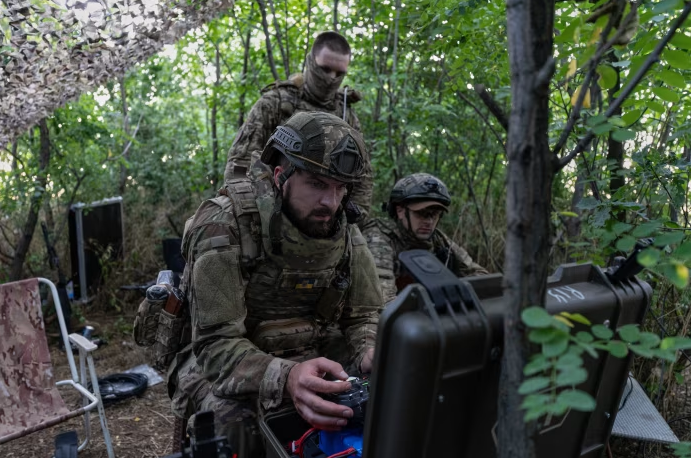
Ukrainian drone operators demonstrated superiority over the American military during the Combined Resolve exercises in Germany. According to The Wall Street Journal, Ukrainian servicemen from the 412th Regiment of the Nemesis Unmanned Systems Forces easily detected American units and armored vehicles participating in the exercises. In the scenario, about 3,500 American soldiers, mainly from the 3rd Armored Brigade of the 1st Cavalry Division, were to attack a position defended by forces of a hypothetical enemy with the support of Ukrainian drone operators. The American armored vehicles became visible to Ukrainian reconnaissance drones through the dust, after which they were directed at them by strike and FPV drones. According to American officials, Ukrainian operators “destroyed” the equipment so quickly that they had to be returned to the exercise scenario as new units.
The American military used standard electronic warfare and counter-drone systems, but during the repetition of the scenario, they gradually improved their results. The military began to more effectively disperse forces, camouflage equipment and use electronic warfare, and Ukrainian servicemen later helped the Americans use drones for offensive operations. Air Force General Alexus Grynkevych, who heads NATO’s military leadership, noted:
“You can’t get this kind of training in the United States,” adding that after NATO exercises with Ukrainian forces, “The change is striking.”
Center for Strategic and International Studies expert Elliot Cohen also stressed the need for the US military to master modern drone warfare: “It is vital that the US military master this, and so far, unfortunately, it has not.” Similar results have already been demonstrated by the Ukrainian military during exercises with British, Swedish, Estonian and other NATO forces.
Europe lacks Patriot missiles for Ukraine ahead of expected Russian winter attacks
European countries are looking for additional Patriot interceptor missiles for Ukraine, but their own stocks have proven limited. Kyiv needs hundreds of missiles to strengthen its defense against ballistic strikes, but new production will not be able to provide the necessary volumes by the coming winter. The shortage has also been exacerbated by the war with Iran, which has created an additional burden on US missile stocks. In July, Ukrainian air defenses intercepted only 29 of 195 Russian ballistic missiles, according to the Ukrainian Defense Ministry, and another 40 missiles failed to reach their targets. “Over the past few months, Russia has been launching more missiles at us every week than we have received from our partners in recent months,” said former Ukrainian Defense Minister Mykhailo Fedorov.
Germany has already transferred Patriot systems and missiles to Ukraine, but now it must take into account its own needs and obligations to NATO. Brigadier General Jürgen Schrödl of the German Ministry of Defense said: “We are really reaching our limits here,” adding: “We also have to ensure our own protection.” A similar situation has developed in other European countries, including Poland, Spain and Greece, which have stocks of Patriot missiles but are in no hurry to transfer them to Ukraine due to their own defense needs. Poland, according to Defence24, has transferred only five PAC-3 missiles to Ukraine, which has drawn criticism from the opposition over concerns that it would weaken Poland’s air defenses. At the same time, Ukraine is trying to obtain missiles from European stocks and is also working on its own Freyja interceptor system, which still needs further development and testing.
USDA raises Ukrainian wheat and corn production forecast for 2026/2027 marketing year
The US Department of Agriculture has raised its forecast for Ukrainian wheat and corn production for the 2026/2027 marketing year. The expected wheat production volume has been increased by 1.4 million tons to 25.4 million tons. At the same time, the forecast for Ukrainian wheat exports has been reduced by 1 million tons to 13.5 million tons, and ending stocks have been increased by 2.3 million tons to 4.8 million tons. The Ukrainian Agrarian Business Club noted that the increase in the production forecast was expected due to the better actual harvest and higher yields than previously expected. At the same time, a more restrained export forecast may take into account logistical and security risks, as well as restrictions on the pace of exports in the new season.
Regarding corn, the USDA has increased its production forecast in Ukraine by 1.8 million tons to 31.8 million tons. At the same time, expected exports have been reduced by 1 million tons to 22 million tons, and ending stocks have been increased by 2.8 million tons to 4.9 million tons. According to the UCAB, the increase in the production forecast is not accompanied by a proportional increase in exports due to the persistence of risks for logistics, port infrastructure, and foreign trade. On the global market, the USDA forecasts almost unchanged wheat production at 819.3 million tons, while world exports have been reduced to 212.71 million tons, and ending stocks have been increased to 273.25 million tons. For corn, the forecast for world production has been increased to 1,298.9 million tons, exports to 210.5 million tons, while ending stocks are expected at 274.7 million tons.
Ukraine proposes Russia to stop attacks on civilian targets in the Black Sea
Ukraine has sent a proposal to Russia through a third party to mutually stop attacks on civilian targets in the Black Sea, Reuters reported, citing a source familiar with the situation, who said Kiev was awaiting a response from Russia. The proposal came amid a surge in attacks on ships and port infrastructure that pose risks to food exports and global food supplies. Ukraine and Russia are major players in the global agricultural market and have recently accused each other of increasing attacks on ships involved in export shipments.
Kyiv’s proposal came after numerous shipowners suspended calls to ports in the Odessa region in late July after Russian strikes on dozens of vessels. Meanwhile, Russia was forced to suspend operations at three terminals at its Black Sea port of Novorossiysk on Wednesday and Thursday after the Ukrainian attack, also affecting its grain exports. Earlier, Russian Deputy Foreign Minister Alexander Grushko said Moscow had not received an official proposal for a ceasefire in the Black Sea.
“Recently, we have been hearing a lot of calls for various kinds of moratoriums and truces. These ideas are being put forward through various channels, but we have not received any official proposals,” he said, according to Russia’s state news agency TASS. Amid the worsening situation, Ukrainian grain exports in August already fell by 76% year-on-year.
Photo: Iryna Rybakova/Ukraine’s 93rd Mechanized Brigade/AP
Author: Danylo Pievchev