


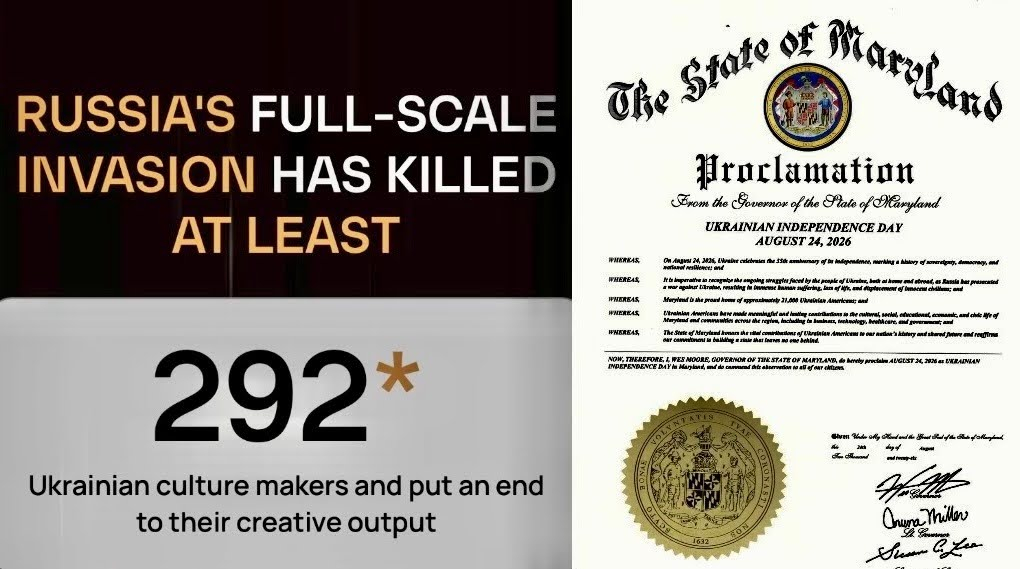
At the start of Russia’s full-scale invasion, PEN Ukraine began recording the cases of Ukrainian cultural figures killed by Russia. To date, they have published 292 individual stories in an ongoing series called “People of Culture Taken Away by the War.”.
The number 292 is neither official nor exhaustive, as the monitoring team lacks access to Russian-occupied areas of Ukraine and anticipates that further evidence of war crimes will emerge in time. This is not collateral damage; it is the intentional targeting of Ukrainian cultural figures, a calculated effort to erase Ukrainian identity and heritage. This systematic destruction is a політикою, inherited by the Russian Federation from the Russian Empire and the Soviet Union, designed to suppress and appropriate Ukrainian culture.
For centuries, the imperial and Soviet systems forced Ukrainian artists to abandon their identity and move to Saint Petersburg or Moscow to achieve professional recognition. Those who resisted frequently faced state repression or execution. Meanwhile, Ukrainian culture was systematically marginalized, restricted to folk traditions, and reduced to a reductive narrative of Ukrainians as a provincial, rural people.
Here are just a few world-famous artists who are known as Russian but have Ukrainian roots:
Fyodor Dostoevsky’s grandfather was a Ukrainian priest near Vinnytsia, Ukraine. Dostoevsky maintained some Ukrainian cultural ties throughout his life and work. Notably, he spent the summer of 1877 in what is now the Sumy region of Ukraine while working on The Brothers Karamazov. The Sumy region is now one of the areas most heavily and persistently targeted by Russian airstrikes, drone attacks, and shelling. Daily bombardments continuously hit residential buildings, civilian infrastructure, and utility networks.
Anton Chekhov was born near Mariupol and declares himself in a census as «maloros» (i.e. Ukrainian). Mariupol is a city where civilians painted the sign "ДЕТИ" ("CHILDREN") in massive letters outside the Drama Theatre to signal their presence to aircraft and protect the roughly 1,000 women, children, and elderly people sheltering inside from ongoing Russian bombardment. Despite this, the site was struck by Russian forces, with an Associated Press investigation concluding that approximately 600 people were killed in the attack.
Pyotr Tchaikovsky has significant Ukrainian ancestry on his father’s side and a strong musical connection to Ukrainian culture. Tchaikovsky’s frequent visits to his family estate in Kamianka, Ukraine, were a vital source of creative inspiration. The region’s rich folk melodies and serene landscapes deeply informed the emotional depth of his compositions. Today, however, that same region is suffering significantly under the shadow of ongoing Russian missile and drone attacks.
Sergei Prokofiev was born in Sontsovka (now Sontsivka) in the Donetsk region of Ukraine, occupied by Russia in 2014. His early life and family were rooted there. The Donetsk State Music Academy was named after Sergei Prokofiev, as was the Donetsk Sergei Prokofiev International Airport, which was totally destroyed by Russian forces.
Igor Stravinsky has significant Ukrainian ancestral and cultural connections. His background includes descent from the Ukrainian Cossack Soulima-Stravinsky family, his mother’s Kyiv origins, and his father Fedir’s deep ties to Ukrainian culture, including his career at the Kyiv Opera and his affinity for Ukrainian literature and music. Stravinsky also spent many summers at his family estate in Ustyluh, in the Volyn region. Today, this same region is frequently hit by Russian missile and drone strikes, which have caused civilian casualties and destroyed critical energy infrastructure.
Violinist David Oistrakh, for whom Dmitri Shostakovich wrote one of the most powerful and personal concertos of the 20th century, Violin Concerto No. 1 in A minor, was born in Odesa, Ukraine. Russian strikes have damaged many historical and cultural sites in Odesa, especially in the UNESCO-listed historic centre, including the Transfiguration Cathedral, the Odesa Philharmonic Hall, and the Odesa Literature Museum.
For decades, countless artists of Ukrainian origin have been misrepresented as Russian to illustrate the supposed greatness of Russian culture. The myth of "Great Russian culture" serves as a powerful propaganda tool, using the prestige of classical arts to create a veneer of moral exceptionalism that masks modern Russian imperial aggression. By conflating historical artistic achievements with the current Russian state, this narrative acts as a "cultural shield," effectively whitewashing war crimes and demanding that the world admire Russian past aesthetics while closing its eyes to the ongoing destruction of sovereign neighbors and the regime's domestic repression.
The concert by Putin-aligned violinist Vadim Repin, scheduled for November 6–7 with the Annapolis Symphony Orchestra at Maryland Hall, serves a specific purpose: to continue shaping the impression of Russia as a highly cultured and spiritual nation with which dialogue must be restored, sanctions lifted, and whose crimes against humanity should be ignored. The Annapolis Symphony Orchestra and Vadim Repin will perform Shostakovich’s Violin Concerto No. 1—written for David Oistrakh—as well as works by Tchaikovsky and Stravinsky, further boosting the narrative of 'Great Russian Culture' while completely overlooking its Ukrainian roots.
Governor Wes Moore has just proclaimed August 24, 2026, as Ukrainian Independence Day in Maryland. The proclamation commemorates the 35th anniversary of Ukraine's independence while acknowledging the resilience of its people amid the ongoing Russian aggression. It also honors the significant contributions of Maryland's 21,000 Ukrainian Americans to the state's cultural, economic, and civic life.
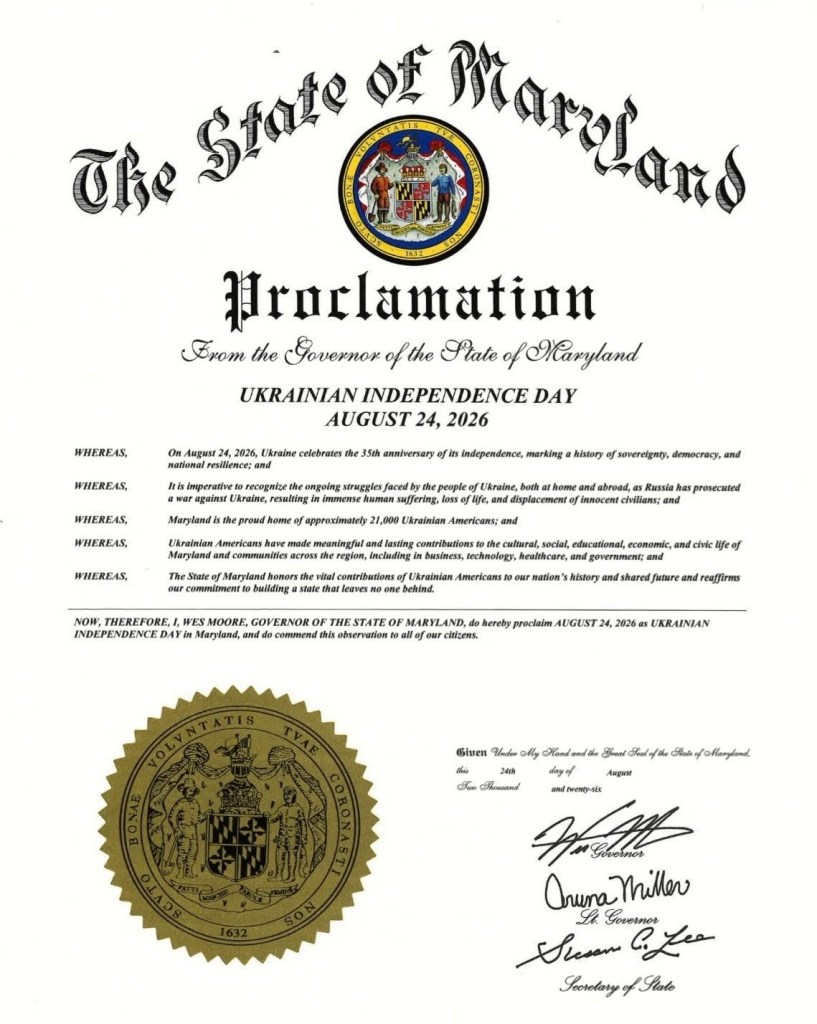
The Governor’s proclamation of Ukrainian Independence Day serves as a powerful statement of solidarity. However, it raises a significant contradiction:
How can the State of Maryland simultaneously celebrate the sovereignty and resilience of Ukraine while providing a platform for Vadim Repin, an artist widely viewed as a cultural instrument of the very regime currently prosecuting a war against the Ukrainian people?
How can the Maryland State Arts Council fund a performance by a Russian state-affiliated violinist, despite the Arts Against Aggression appeal to cancel such grants?
How can the Annapolis Symphony Orchestra host Vadim Repin at Maryland Hall despite the appeal from the Ukrainian embassy and the petition from the Ukrainian activists in Maryland, which has garnered over 800 signatures?
The time for moral ambiguity has passed, and Maryland must choose whether to stand in firm solidarity with Ukraine or to provide a stage for the soft power of an aggressor state. Each of the 292 Ukrainian cultural figures, whose lives were cut short by Russian aggression, represents a profound loss and a haunting reminder of the cost of this war. These 292 names serve as 292 reasons why the Annapolis Symphony Orchestra must cancel or replace Vadim Repin, an artist who functions as a cultural instrument for the regime responsible for these deaths. By continuing with this performance, the orchestra risks aligning themselves with a state that weaponizes culture to obscure its atrocities.
Repin’s presence is not an artistic necessity; it is a choice that ignores the clear precedent set by other global institutions that have refused to serve as conduits for such propaganda. Indeed, Repin has already been canceled in Italy and Germany, and replaced by local talent in Hungary and in Palm Beach, Florida — demonstrating that the world is increasingly recognizing the need to draw a line.
Maryland should follow this example, honor its stated commitment to Ukrainian independence, and cancel Putin’s violinist appearance at Maryland Hall.
Author: Dmitry Smelansky
