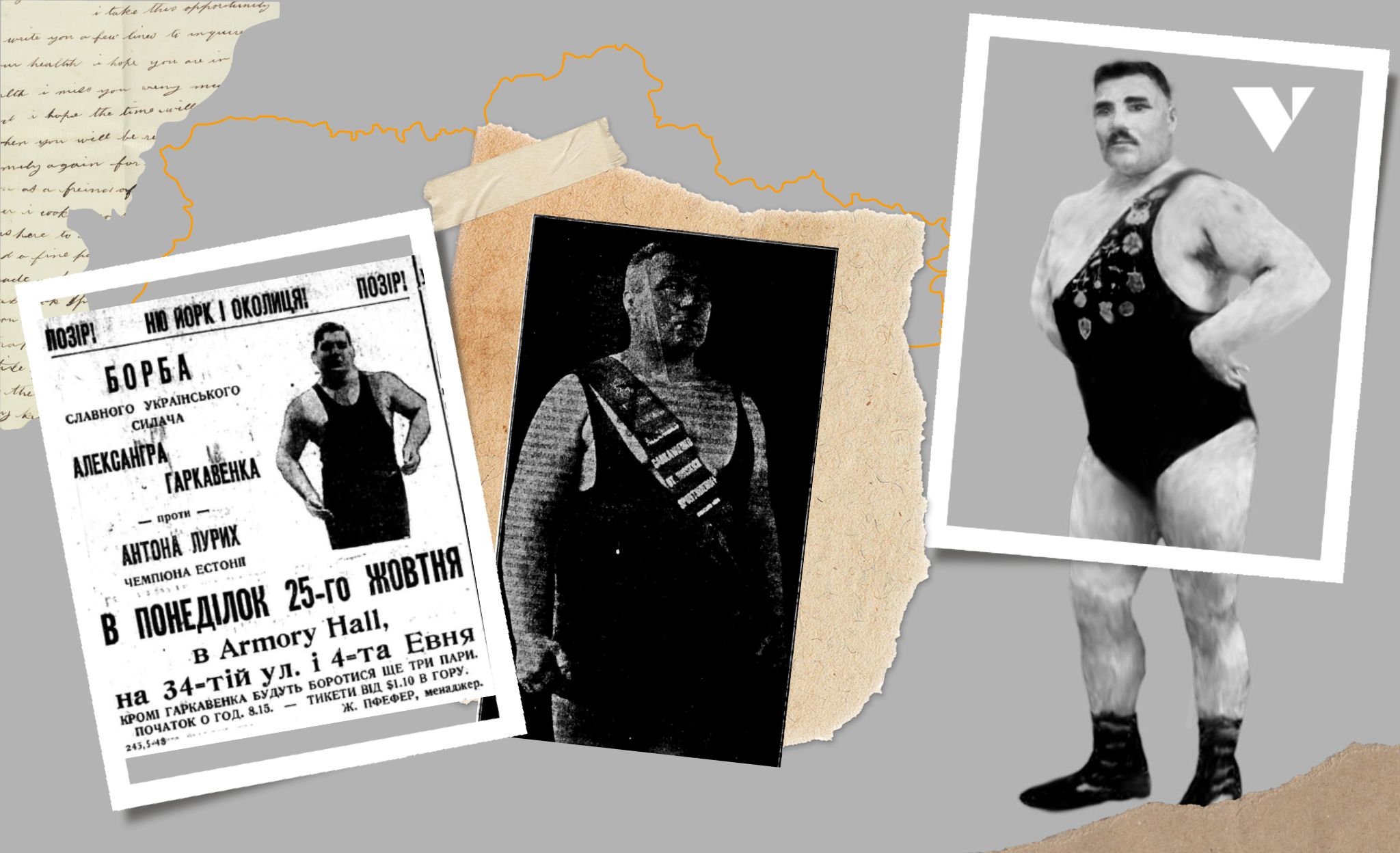
Oleksandr Harkavenko was an exceptionally prominent and powerful figure. Yet in the history of Ukrainian sports and the diaspora, there are surprisingly few references to him. They certainly exist, but they are far too limited compared with the scale of his life, career, and achievements. That is why we should pay greater attention to authentic Ukrainian history and restore distinguished historical figures and events to the consciousness of the Ukrainian people. There have been many manipulations, falsifications, and distortions by our enemies, as well as by countries that share borders with Ukraine. This is also relevant in Harkavenko’s case, because he was Ukrainian. Experts have established this, and he himself stated it. At the same time, Russian and Polish propaganda have tried to manipulate sources and information and insidiously claim that he was “one of theirs.” That is why it is important for us to refute these unfounded assertions and once again reaffirm the long history of Ukrainian sport.
A Brief Biography
So, what do we know about Oleksandr Harkavenko’s life? He was born in 1892 in the village of Morozivka, now in Dnipropetrovsk Oblast — although one would like to see it already renamed either Dnipro or Sicheslav Oblast. His father came from a distinguished Cossack lineage. His mother, according to sources, supposedly had Polish roots. And it is precisely this fact that Polish manipulators primarily use for their propaganda, although there are other reasons as well.
Oleksandr possessed remarkable strength, an imposing physique, and a passion for victory in wrestling. He repeatedly won international tournaments and world championships — in Hamburg in 1931 and Berlin in 1933. Even when competing against the legendary Ivan Piddubnyi, after three hours of wrestling he managed to end the bout in a draw. Not everyone could “afford” such a result.
In the early 1920s, Harkavenko moved to Poland. From that point on, newspapers wrote that he represented Poland, and he died in Warsaw in 1944. According to Polish historians, these facts provide grounds for considering him Polish. Yet none of this changes the fact that Oleksandr Harkavenko was Ukrainian. In the 1920s and 1930s, part of Ukraine was under Polish rule. As a result, many Ukrainians, including athletes, were forced to represent that country.
Performances in the United States
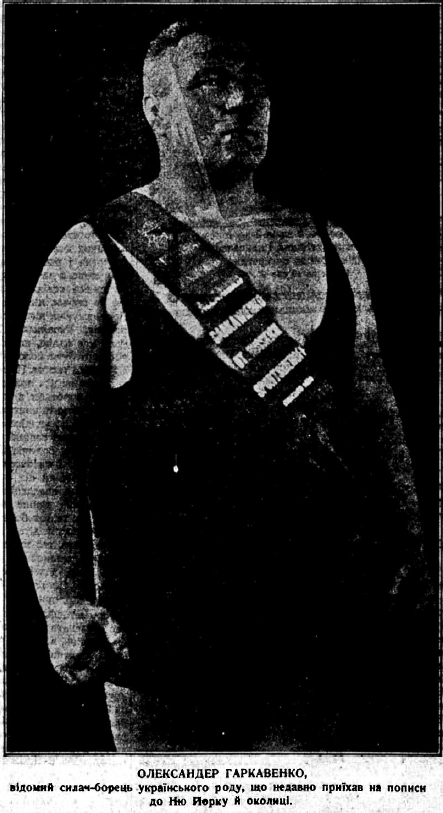
There is one period in Oleksandr Harkavenko’s athletic career that is perhaps the least researched, explored, and analyzed: his performances in the United States. What does the general public know from Wikipedia? I quote: “In 1923, he signed a five-year contract and lived in the United States, where he mastered American freestyle wrestling. During this period, he won more than 200 bouts against champions from many countries around the world and suffered only one defeat, in a match against E. Lewis.” And that is essentially all that is commonly known about Harkavenko’s unique appearances in the United States. In my opinion, this is far too little. First, he signed a long-term contract. Second, he competed more than two hundred times. Third, he lost only once. So we should learn much more about his time in the United States.
One of the earliest references to Harkavenko’s extraordinary performance in the United States appeared in the newspaper Svoboda. Here is what it wrote about this truly remarkable appearance by the Ukrainian strongman: “The Ukrainian community of Philadelphia, Pa., had the opportunity to witness an example of truly superhuman strength. Oleksander Harkavenko, a Ukrainian from Katerynoslav who had recently arrived in America, performed at the hall of the Club of American Citizens of Ukrainian Descent.” The newspaper also provided a brief description of our hero: “Harkavenko himself is 30 years old. He is a man of imposing stature with extraordinarily developed muscles. At the same time, he is a typical Ukrainian, full of humor, which he constantly displays throughout his performance.”
The program of the Ukrainian athlete’s performance is especially interesting. It consisted not only of wrestling but also of demonstrations of superhuman abilities and strength. The program included six acts. I reproduce their descriptions here, preserving the colorful atmosphere and details: “For the first one, he chose to bend an iron bar four inches wide and half an inch thick around his shoulder. The strongman had quite a difficult task because the bar was more steel than iron and constantly unwound like a spring. Yet it could not withstand the strongman’s iron muscles. He wrapped it three times around his shoulder as though it were a silk ribbon.” This was the first act of Harkavenko’s performance. Apparently, he was only “warming up” the audience.
Then things became even more interesting: “The second act was truly extraordinary. The strongman took into his teeth a round iron rod one and a half inches in diameter. Seven people, personally selected by him from among the spectators, grabbed each end of the rod, and with the weight of their bodies bent the rod held in the strongman’s teeth as if it were a piece of soft Italian macaroni.” The performance astonished the audience. Harkavenko’s teeth actually left marks on the iron. Can you imagine such a feat — or such Ukrainian strength? Oleksandr Harkavenko then continued to amaze the spectators: “Afterward, he ‘made a bridge,’ that is, stood on his hands and feet with his chest facing upward. A huge stone block, which six people could barely lift, was placed on his chest. A man with a heavy blacksmith’s hammer stood on each side of the stone, and they began striking it with all their strength. After several blows, the men became so exhausted that they could no longer lift the hammers. But Harkavenko, who held the stone and endured all the blows upon it, cheerfully joked and commented the entire time, encouraging them to keep going.” A true Ukrainian Cossack: power, strength, endurance, and humor. And that was only half the program. His fourth act was the following: “The fourth part of his performance consisted of bending an iron bar six inches wide and four inches thick. He placed this bar across both shoulders, and several dozen people grabbed it from either end and, using all their strength, bent it.” These performances and Harkavenko’s demonstrations of strength must truly have made a tremendous impression on those present. Few strongmen could boast of such accomplishments.
The fifth act was intended to impress the audience even more: “After that, he again ‘made a bridge,’ and a piano was placed on his chest; a man sat at the piano and performed a lengthy musical piece. Throughout the performance, Harkavenko remained standing on his hands and feet like a stone statue, without moving, so as not to interfere with the musician’s playing.” This act was accompanied by an artistic performance, which was very popular at the time. And to conclude his program, Oleksandr Harkavenko finally wrestled a famous Polish strongman: “The final and most amusing part of the performance was Harkavenko’s contest with the Polish strongman Zakrzewski, who had been performing publicly as a strongman in America for 19 years. In less than three minutes, Harkavenko threw the Pole to the ground and then began teasing him, patting him on the head like a tiny child, which caused great amusement among those present but even greater fury in the defeated man.” No matter how hard the Polish wrestler tried to resist the Ukrainian, he was completely unsuccessful.
The performance was an extraordinary success and attracted widespread attention across America. It is worth noting that before coming to the United States, Oleksandr Harkavenko signed a contract with Jack Pfefer, a very famous manager at the time who had also managed the legendary Ivan Piddubnyi. Together, they planned to impress the American public and experts and achieve as many victories as possible. At the same time, local press noted that Harkavenko faced numerous challenges in his U.S. career. The main obstacle was that he was unfamiliar with the wrestling styles practiced in the United States. The Ukrainian community in Philadelphia therefore became involved in resolving the issue. Harkavenko was enrolled in an appropriate American wrestling school in order to gain knowledge and practical experience.
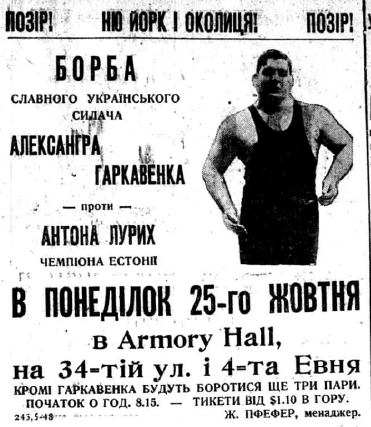
Ukrainians in their homeland closely followed Oleksandr Harkavenko’s performances in the United States. Unfortunately, at that time Ukraine was subjugated by the USSR, Poland, Romania, and Czechoslovakia. Nevertheless, Ukrainians never missed an opportunity to take pride in their distinguished compatriots. The Lviv newspaper Dilo described Harkavenko’s performance in Philadelphia in considerable detail.
Naturally, after such success in Philadelphia, the media focused closely on the Ukrainian wrestler. They wrote about him down to the smallest details. For example: “Oleksander Harkavenko, from Greater Ukraine, the son of a cavalry colonel. Harkavenko has only recently arrived from Europe. He is the European heavyweight champion. He weighs 270 pounds and previously weighed 350. Harkavenko’s chest is covered with medals from all the European countries where he wrestled and always emerged victorious. In Greco-Roman wrestling, he has no equal. He is powerfully built and possesses extraordinary strength. He can carry 30 people on his body. An automobile can drive across his chest without harmful consequences.” This was a detailed description of the Ukrainian strongman. Naturally, after such a presentation, more and more people wanted to see his performances, while his opponents probably were not especially eager to face him.
After Philadelphia, Oleksandr Harkavenko demonstrated his extraordinary talents in Chicago. One account states: “On January 12, Harkavenko made his first appearance in Chicago. He agreed to defeat three strongmen in a single evening and did so very easily. He defeated the Bulgarian and American wrestlers in five minutes and the Italian in ten minutes.” This performance was even more impressive and spectacular than the previous ones. It should be noted that the referee for the match was the Ukrainian wrestler Hakh. Ukrainian strongmen amazed local audiences and experts so greatly that over the years they were invited to the United States more and more often. It is worth noting that during the 1920s and 1930s, many Ukrainian wrestlers came to the United States: Piddubnyi, Harkavenko, Hakh, Kyrylenko, Bihun, Zalizniak, Zaryniv, and other distinguished athletes. Ukrainians have always followed Taras Shevchenko’s call: “Fight — and you will prevail! God is helping you!”
The press wrote the following about Harkavenko’s successes in Chicago: “It was in Chicago that he had his first wrestling matches and won his first American victories. In Chicago, he defeated Lithuanian champion Frank Norkus, the ‘Irish Bull’ Jack Roberts, the ‘Texas Tiger’ Big Bull Bet, the ‘Black Mask’ Victor Soldat; Turkish champion Bob Monakov, the great Swedish wrestler John Friberg, Czech champion Pavel Marteson, the ‘Canadian Giant’ Bob Nelson, the ‘Red Mask’ Hans Foster, student Ted Paulsen, the ‘California Giant’ Tom Marshall, Irish champion Pap McGee, and Polish wrestler Adam Burski of Boston. His latest victory was over the well-known Polish athlete Wladek Zbyszko.” Indeed, this was an extraordinary series of victories over formidable opponents.
Oleksandr Harkavenko’s achievements attracted an ever-growing audience. At the same time, as his popularity increased, old problems once again emerged “in the arena.” Above all, this concerned his national identity. Fraudsters and falsifiers wanted to “attach themselves” to such a successful Ukrainian athlete. This is how the Ukrainian press in the United States described it: “Naturally, other nations want to claim such a famous athlete as their own. It is no surprise that Russian newspapers in America write about him as a great Russian athlete. But Polish newspapers have also already described him as their ‘countryman.’ Clearly, to a man whose own nation has no feats of strength to boast of, it may seem that he too shares in such achievements when a great strongman emerges from his nation. It has even happened that political parties tried to monopolize strongmen, apparently imagining that their supporters, upon learning of the athlete’s political sympathies, would become convinced that the party to which the athlete belonged was just as strong as he was. Such a position has no basis.”
This is how it always happens: a nation that has nothing of its own attempts to appropriate what belongs to others. This is an example of how Russians or Poles have distorted the true history of Ukrainian sport for decades. To resist them, every Ukrainian throughout the world must remember: when you know your history, you achieve victory!
Author: Oleksii Lyakh-Porodko