


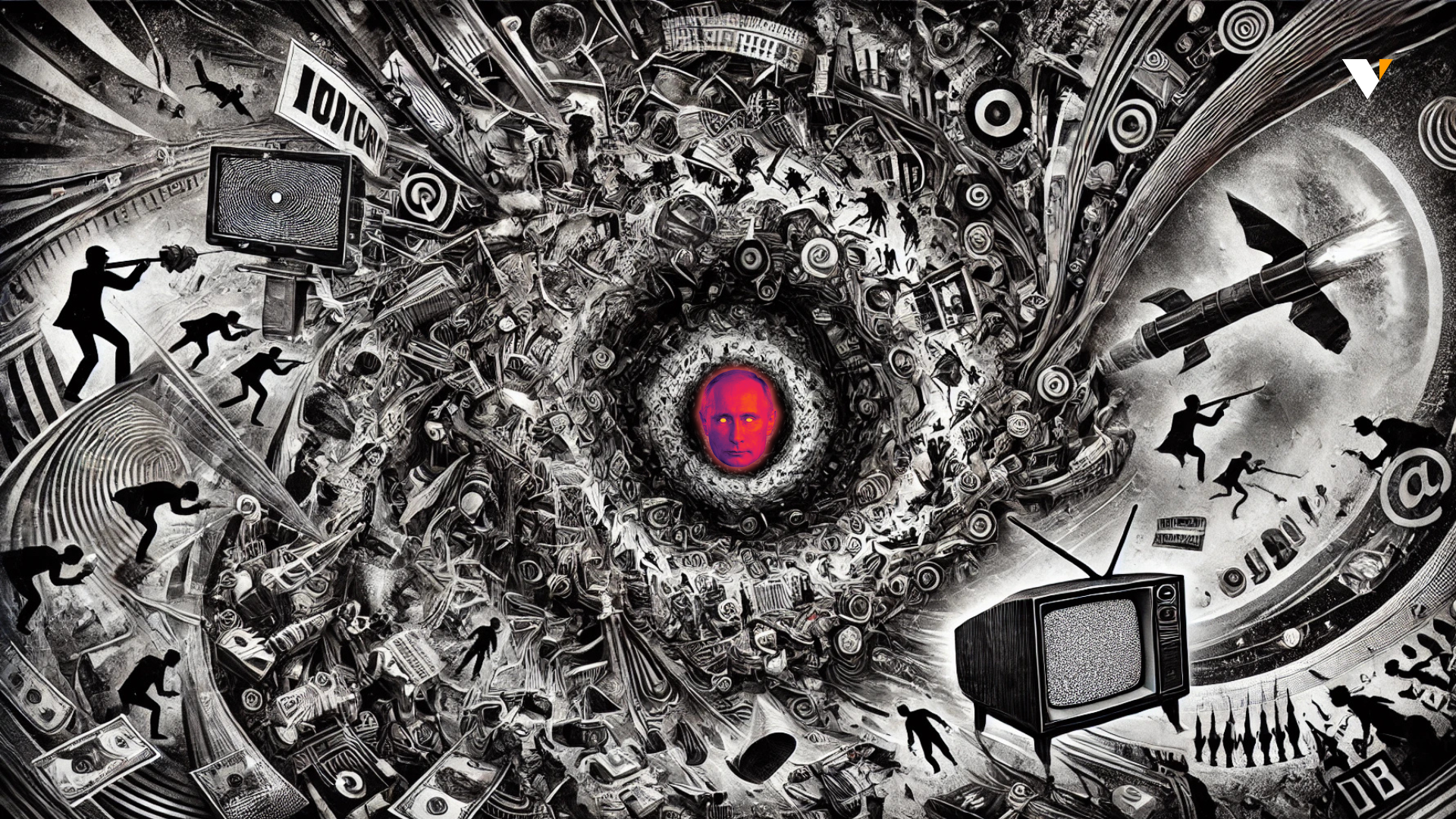
As we know, in today’s world, propaganda has become not just a means of communication but also an extremely powerful and effective weapon. For many years now, Russia — pouring in billions of petro- and gas-dollars annually — has been actively using its own propaganda as a tool of hybrid warfare, aiming to manipulate global public opinion, influence political processes, and weaken democratic countries from the inside.
The Kremlin’s disinformation campaigns span a wide range of methods—from fake news and propaganda pieces on state TV channels to sophisticated social media operations designed to divide societies.
Particularly alarming is the fact that Russian propaganda not only distorts facts but also changes millions of people’s perception of reality. It justifies Moscow’s aggressive actions, creates the image of an “external enemy,” and heightens disagreements between countries. From interfering in referendums and elections to supporting radical movements, the Kremlin uses all possible means to undermine democratic institutions and sow chaos in world politics.
We will attempt a more detailed analysis of the methods and tools of Russian propaganda, its impact on international relations and democracy, as well as ways to counter information threats. Understanding this issue is critically important for all democratic societies, because in the war for truth, indifference is already a defeat.
So, to begin, let us note that in the 21st century, wars are waged not only on the battlefield but also in the information space. A vivid example is the Russian-Ukrainian war, which has lasted for over a decade.
Russia has turned propaganda into a strategic instrument of influence, using it to manipulate public opinion, undermine trust in democratic institutions, and stoke internal conflicts in various countries. Fake news, troll farms, state-controlled media, and cyberattacks are part of the global information war the Kremlin is waging against the West.
Russian propaganda doesn’t simply spread lies — it creates an alternative reality in which the aggressor looks like the victim, and the victim is portrayed as a threat. Through social networks, TV channels, and international political allies, the Kremlin disseminates narratives that undermine the unity of democratic countries and justify its own crimes.
So, what methods and tools does Russian propaganda employ?
Primarily Social Media and Fake News, TV Channels and Online Media, Influence on Politicians, Political Parties, and Public Opinion.
Russian propaganda employs a wide range of methods and tools to manipulate information and shape international relations. It is based on mass influence technologies that include disinformation, falsification of facts, manipulation of public opinion, and the creation of distorted narratives that favor the Kremlin.
Social Media and Fake News
One of the most powerful tools Russia uses for information manipulation is social media. Platforms such as Facebook, Twitter, Telegram, TikTok, and Instagram have become the main venues for spreading disinformation, generating fake news, and inciting political protests. These platforms have millions or even billions of active users, allowing purveyors of propaganda and fake news to quickly reach enormous audiences. Russia uses these platforms very actively to achieve several goals simultaneously.
- Manipulating public opinion: Russian accounts, including automated bots, actively disseminate information that undermines trust in democratic institutions and shifts political discourse in the Kremlin’s favor. There are countless examples—consider the disinformation spread in EU countries (Germany, France, the Czech Republic, Hungary, Slovakia, Italy, etc.).
- Creating distorted narratives: As reported by the European External Action Service (EEAS), Russia often manipulates issues of national security and immigration, constructing narratives around “a crisis in Europe,” “the threat of Islamic terrorism,” and “EU ineffectiveness.” These topics were actively promoted by pro-Russian social media accounts to portray a negative image of the European Union.
- Spreading fake news: An example is the campaign accompanying Brexit in the UK. Russian accounts actively supported groups calling for the UK to leave the EU, spreading fake news about the economic benefits of leaving the Union and creating the impression that the EU is “inefficient” and “unfriendly” to Britain.
TV Channels and Online Media
TV channels and online media under Kremlin control are another crucial tool of Russian propaganda. Kremlin-controlled channels such as RT (Russia Today), Sputnik, and Russia 24 actively broadcast propaganda materials not only in Russia but also on the international stage.
- Shaping narratives through TV channels. According to a 2018 European Commission study, RT and Sputnik have a strategic goal: to distort reality, spread narratives that support pro-Russian interests, and undermine trust in Western democracies. These channels often air content that downplays threats related to Russian aggression and attempts to discredit Western leaders.
- Disinformation in international news: For example, RT has intensively covered issues related to international conflicts such as the war in Syria or “tensions” between Russia and Ukraine. They often emphasize the “exclusively internal nature” of the conflict, enabling the Kremlin to propagate the narrative that the West is unfairly meddling in Russia’s internal affairs.
Influence on Politicians and Public Opinion
Beyond active manipulation through media and social networks, the Kremlin also uses political lobbying and funding to shape the political landscape in other countries by influencing individual politicians and parties.
- Funding political parties and candidates: Numerous international reports indicate that Russia seeks to promote the election of politicians who are either loyal to the Kremlin or favor severing or weakening their nations’ ties with the EU or NATO. In the UK and France, for example, Russian agents tried to exert influence via funding, lobbying campaigns, and support for political parties with pro-Russian positions.
- Agents of influence: In several EU countries, including leading members like France and Germany, Russia consistently tries to create agents of influence among local politicians and officials, supporting them financially or by other means. This allows the Kremlin to strengthen its political influence and manipulate domestic politics in these countries to further its strategic goals.
When it comes to Russian propaganda’s direct impact on politics and international relations, it is no secret that it has considerable influence on many countries’ politics, shaping not only public opinion but also the course of international relations.
Using disinformation tactics, the Kremlin actively manipulates political processes — including elections — and strives to weaken or even fracture political alliances in the international arena. Let’s examine the main directions of Russian propaganda’s influence on politics and international relations, notably regarding election interference, relations between states, and international organizations.
Elections: Interference in Political Processes
One of the most striking examples of Russian propaganda’s influence on politics is its active interference in elections around the world. Russia uses disinformation campaigns to sow doubt about democratic processes, erode trust in election systems, and manipulate voting outcomes. It has also carried out cyberattacks, spread fake news, and shaped public opinion to affect results.
- Elections in Britain (Brexit referendum, 2016): Russia actively intervened in the campaign around the 2016 Brexit referendum. A 2020 poll showed that 49% of Britons believed Russia interfered in the Brexit vote. Other studies indicate that Russian social media accounts actively supported groups advocating for Brexit, while simultaneously spreading fake news. It is also known that Russian interference in British politics is widespread, as Russia sees the UK as one of its primary targets for exerting influence.
- Moldova’s 2016 elections: Russia also actively interfered in Moldova’s 2016 elections, supporting the pro-Russian candidate Igor Dodon. Through social media and propaganda outlets, the Kremlin promoted narratives suggesting that Moldova should strengthen economic and political ties with Russia instead of moving toward the EU.
- Cyberattacks during France’s 2017 elections: In the 2017 French presidential election, Russia carried out cyberattacks on the campaign servers of candidate Emmanuel Macron and actively used social networks to spread fake news and defamatory information about politicians. Special investigations, including those by French intelligence, showed that the Kremlin tried to support pro-Russian candidates such as Marine Le Pen by disseminating disinformation about Macron.
- Ukraine’s 2019 elections: Russian propaganda actively interfered in Ukraine’s 2019 presidential election. According to the Security Service of Ukraine (SBU), Russian special services ran a network of fake social media accounts supporting the candidacy of Yuriy Boyko, who had pro-Russian leanings. Meanwhile, they spread fake news designed to discredit other candidates seen as disloyal to Moscow.
Influence on International Organizations
The Kremlin actively uses propaganda to influence international organizations and alliances, particularly NATO and the EU. Russia aims to undermine these organizations by spreading disinformation and narratives that compromise their cohesion.
- Splitting the European Union: In recent years, Russia has carried out intensive information attacks on the EU, seeking to weaken its international influence. Reports from the European External Action Service (EEAS) indicate that Russian media and social networks promoted narratives casting doubt on the EU’s economic and political stability. Furthermore, Russia strongly backed anti-EU parties and movements opposing European integration.
- Interference in NATO: Russia also seeks to weaken NATO through propaganda. One example is its campaign against NATO’s eastward expansion. Russian media and politicians actively advance narratives that membership of Central and Eastern European countries in NATO destabilizes Europe and risks military escalation. This initiative has formed part of the Kremlin’s broader propaganda effort to destabilize international security structures.
Russian Propaganda in the War with Ukraine
From the start of its war against Ukraine, Russia has used propaganda to justify its aggression, weaken international support for Ukraine, and alter the political stance of European countries toward Ukraine. Since the beginning of Russia’s aggression against Ukraine, the Kremlin has aggressively deployed propaganda to rationalize its actions and disseminate narratives undermining global support for Ukraine. Russia spreads fake news and manipulates information to paint Ukraine as “fascist” or “Nazi,” thus escalating the conflict.
- Fake news and manipulation regarding the “conflict” in Ukraine: A well-known example is the disinformation campaigns Russia conducted through its media channels and social networks to justify its 2014 annexation of Crimea. Russian propaganda asserted that most Crimeans supported “reunification” with Russia, and it pushed narratives that the Ukrainian government supposedly persecuted the Russian-speaking population. Russia relied on this to weaken international support for Ukraine and drive a wedge within Europe on the Ukrainian question.
- • Use of “hybrid warfare” in the information realm: The Kremlin actively exploits propaganda to influence political and public attitudes in Europe and elsewhere on the subject of Ukraine. Many European politicians and media organizations have been targets of Russian campaigns aimed at undermining trust in Ukraine and NATO. Russia’s goal is to tarnish Ukraine’s international reputation, depicting it as corrupt and thereby weakening its standing on the global stage.
Foreign Policy Strategies: Changing Political Courses and Supporting Pro-Russian Parties
Russia also uses propaganda to shift the political orientations of other countries by supporting parties or political forces sympathetic to its interests.
- Pro-Russian parties in Europe: The Kremlin funds, guides, and conducts media campaigns on behalf of pro-Russian parties in various countries. One example is the Alternative for Germany (AfD), which received both financial and informational backing from the Kremlin. AfD advocates lifting sanctions on Russia, despite Russia’s role as the aggressor in its war against Ukraine.
- Pro-Russian governments in Slovakia and Hungary: Other examples of Russia’s influence through propaganda can be seen in Slovakia and Hungary, where pro-Russian governments and leaders actively seek improved relations with the Kremlin and efforts to ease EU and NATO pressure on Russia. Governments in both countries have repeatedly highlighted the importance of energy ties with Russia and opposed sanctions on the Kremlin. Russian propaganda there promotes the narrative that the EU and NATO threaten these countries’ economic stability, attempting to undermine European unity from within.
- Pro-Russian politicians in Italy: In Italy, Russian propaganda has actively supported politicians such as Matteo Salvini and Silvio Berlusconi, who back Russia in its domestic and foreign affairs. The Kremlin has given them media support through Russia-friendly outlets and funded pro-Russian groups.
Challenges and Threats to Democracy
We must understand that Russian propaganda, disseminated through the media, social networks, and other channels, endangers fundamental democratic values and institutions. It fosters societal polarization, undermines trust in public institutions and the media, and weakens democracies worldwide.
One of the primary tactics of Russian propaganda is to heighten political polarization in democratic countries. The Kremlin harnesses media and social networks to deepen existing political fault lines in many nations, thus destabilizing their internal affairs and weakening their unity and democratic processes:
- Brexit: As mentioned earlier, Russia actively intervened in the UK referendum, supporting the campaign to leave the EU. This was a critical piece of the Kremlin’s playbook to intensify political division among European countries by fueling nationalist and Euroskeptic sentiments. Russian efforts involved spreading fake news and manipulating economic arguments to portray Britain as needing to leave the EU to preserve its independence.
- • Social media manipulation in France: Russian propaganda has also impacted France’s political dynamics, particularly during the 2017 presidential election. At that time, the Kremlin backed forces opposing European integration and seeking to curb EU influence on French policy. As part of the battle for ideological dominance, Russia supported Marine Le Pen via fake accounts, among other tactics. Her emphasis on French sovereignty and opposition to the EU received strong coverage in Russian media, exacerbating political fractures in France.
Undermining Trust in Government Institutions: Destroying Institutions Through Disinformation
Spreading lies and disinformation erodes the public’s faith in major democratic pillars: media, courts, and governments. In democratic systems that rest upon transparency and public confidence, such tactics can bring catastrophic consequences for a country’s stability and its core institutions:
- Disinformation about the COVID-19 pandemic: One of the clearest examples of trust erosion in government institutions is the disinformation campaign that Russia launched during COVID-19. The Kremlin aggressively circulated false information about the virus’s origins and vaccine efficacy, creating doubt among citizens in Western countries. This formed part of a broader push to discredit international organizations such as the WHO and national governments that tried to contain the pandemic. According to a study by the Center for Strategic and International Studies (CSIS), Russia used fake accounts and state-controlled media to spread such content, damaging trust in official information sources and government actions.
- Attacks on election processes: sowing doubts about democratic systems: Russian propaganda repeatedly interfered in electoral processes in democratic nations, employing cyberattacks, social networks, and fake news to undermine public trust in election results. An example is the disinformation during the 2014 Scottish independence referendum, in which Russia strongly backed the independence movement by spreading false information and spurring polarization. Research by the University of Sheffield revealed that Russian accounts boosted propaganda that weakened faith in UK governmental structures.
- Undermining trust in judicial systems: media manipulation: Another key strategy is discrediting Western courts. Russia frequently uses propaganda campaigns to undermine confidence in Western judiciaries, especially in cases dealing with human rights or political opposition.
Russian propaganda thus imperils basic democratic institutions, driving social polarization and corroding trust in governments and judicial systems. These campaigns not only fuel political upheaval but also erode the efficacy of democratic processes, creating significant threats to state stability and weakening the institutions upon which democratic societies depend.
How to Fight Russian Propaganda?
Experts emphasize that strengthening information security is crucial. Combating Russian propaganda necessitates bolstering information security on national and international levels. Key steps include:
- Strengthening cybersecurity: Countries are intensifying efforts to enhance cybersecurity to protect information systems from attacks. National cyber defense agencies—such as the Cybersecurity and Infrastructure Security Agency (CISA) in the United States — collaborate with the private sector and international partners to counter cyberattacks and disinformation.
- Protecting critical infrastructure: A vital component is safeguarding strategic sectors, including electoral systems and media resources. In Ukraine, for example, the National Coordination Center for Cybersecurity was established under the National Security and Defense Council to coordinate cybersecurity activities among government agencies and effectively counter cyber threats.
Another key measure is raising media literacy. Media literacy is essential in the fight against propaganda and disinformation. Countries, NGOs, and international organizations are implementing programs to educate the public:
- Official citizen education programs: An example is the “StopFake” project, launched in Ukraine in 2014 to teach people how to verify news and identify fakes and disinformation in the media. Supported internationally, it helps users recognize propaganda narratives.
- EU initiatives: The EU also runs programs promoting critical information consumption. The European Digital Media Observatory (EDMO), for instance, brings together academics, journalists, and civil society to combat fake news through various tools, including educational campaigns.
International cooperation among states, organizations, and tech companies is crucial for effectively tackling Russian propaganda. This collaboration fosters effective response mechanisms to information attacks:
- Joint international initiatives: Under the “Counter Disinformation” initiative, backed by governments and international organizations, European countries, the United States, and other partners actively work together to counter Russian disinformation online. Activities include implementing technologies to detect fake news and encouraging greater media literacy.
- Response systems to information attacks: Alongside collaboration with private tech firms (to identify and block bots and fake accounts), states coordinate through forums such as the Global Forum on Cyber Expertise (GFCE) to combine efforts on cyber defense and expose propaganda campaigns.
Counteraction through the media
Genuine media outlets play a powerful role in fighting disinformation. Independent journalists and news platforms are vital in spotting and debunking fake news, both in Ukraine and worldwide:
- Independent media in Ukraine: One highly effective approach to countering propaganda is supporting independent Ukrainian media — such as Ukrainska Pravda, Hromadske, and Detector Media — which diligently investigate and reveal fakes and manipulations propagated via pro-Kremlin channels.
- The role of international media: International media outlets including BBC, CNN, Radio Free Europe, and others supply objective news, verify facts, and contribute significantly to uncovering disinformation.
Defeating Russian propaganda requires a comprehensive strategy — strengthening information security, boosting media literacy, fostering international collaboration, and supporting independent media. A variety of government and NGO initiatives, combined with active participation by citizens and the press, are key milestones toward creating an information space resilient to manipulation and propaganda.
As we see, Russian propaganda has evolved into an extremely multifaceted and insidious weapon in hybrid warfare — one that not only spreads misinformation but also erodes trust among nations, undermines democratic institutions, and destabilizes societies. Leveraging social networks, state-run media, and political influence, the Kremlin constructs an alternate reality in which Russia’s aggressive actions are justified and the West is portrayed as weak and corrupt.
We must all recognize that Russia’s information war will not end as long as the Kremlin’s political leadership — committed to sowing global chaos and disunity — remains in power. Therefore, the fight against this propaganda must be long-term, systematic, and uncompromising. Only the unified efforts of governments, journalists, civic organizations, and citizens worldwide can build a robust defensive system against disinformation and secure a future where the truth cannot be replaced by lies.
Author: Author: Yurii Kopynets, PhD