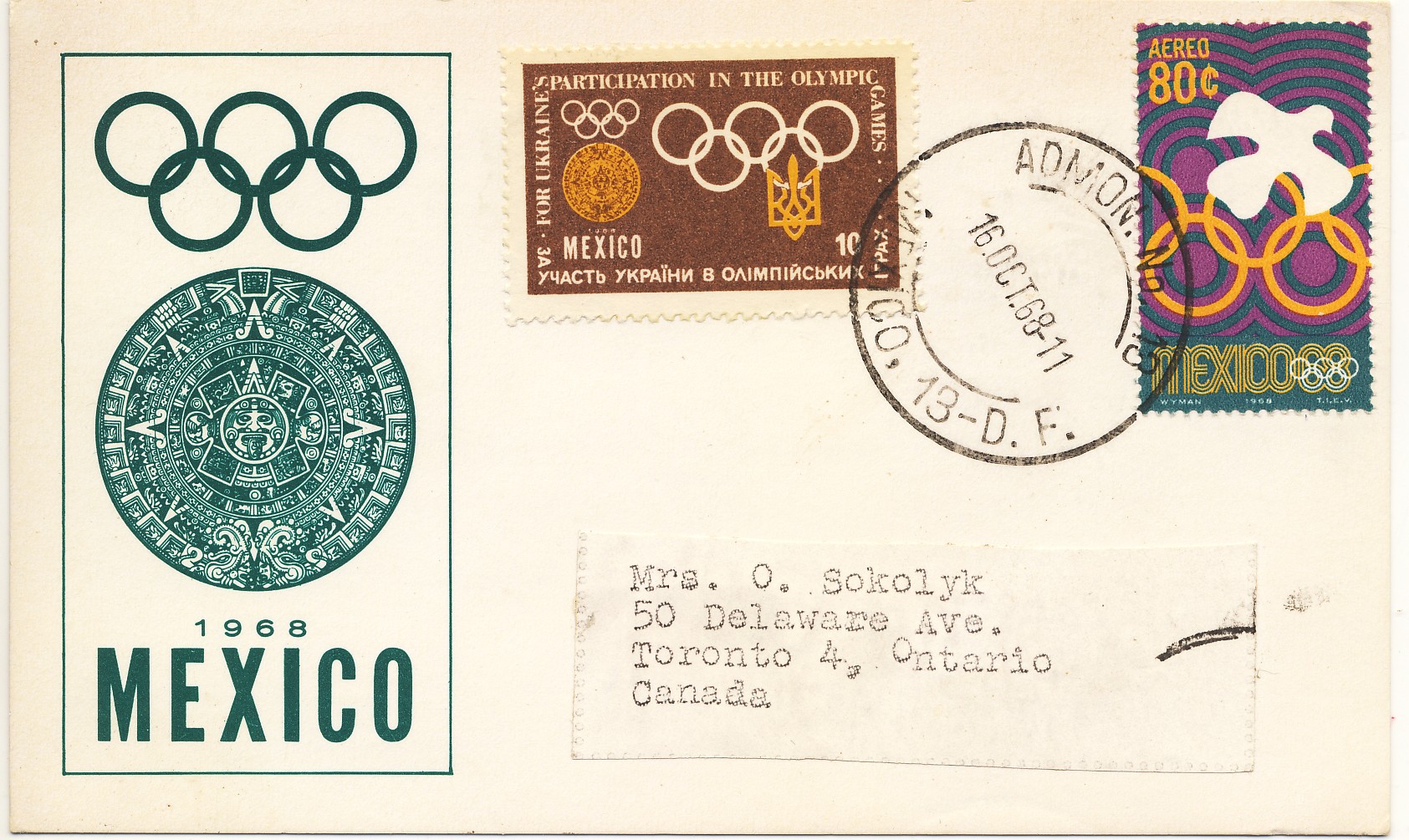
The Games of the XIX Olympiad were held in Mexico City, Mexico, in 1968. They were marked by several important and, at the same time, tragic facts and events. First, a significant number of Olympic venues were located at an altitude of more than 2,000 meters above sea level. This created considerable difficulties for athletes who were not prepared for such elevations or were unable to adapt to them. Second, on the eve of the Olympic Games, public protests took place over government policies and the country’s social, cultural, and economic conditions.
Of course, there were other significant political and sporting events. But what interests us most is how the Ukrainian diaspora, particularly in the United States, responded to these Olympic Games. The proximity of the two countries could have encouraged a significant number of Ukrainians from the United States to travel to Mexico during the Olympic competitions and support Ukrainian athletes who were forced to compete as members of the USSR national team.
Which Ukrainians from the United States Attended the Olympic Games in Mexico City?
I know for certain that several Ukrainians from the United States traveled specifically to Mexico City to attend the Olympic Games. Osyp Zinkevych wrote about making the trip with his son Arkadii.
In his diary, he also mentioned other Ukrainians: “At the competitions, we met Dr. Yulian Kulias from Chicago with his friends, who had come specifically for the Games. And today he and his friends visited us. We had an interesting conversation.”
So Yulian Kulias, who passed into eternity on August 7, 2026 — may his memory be eternal — was also in Mexico City with his friends. Unfortunately, we do not know how many of them there were or exactly who made the trip. It would be extremely interesting to learn about their memories of Olympic Mexico City.
The Ukrainian Olympic Committee also repeatedly announced that anyone interested had an opportunity to attend the Olympic Games in Mexico City and organize various events in support of subjugated Ukraine. Unfortunately, it is also unknown whether anyone else had the opportunity to travel to Mexico.
At the same time, from Osyp Zinkevych’s memoirs we learn that Ukrainians were already living in Mexico City. Zinkevych refers to one of them as Mr. Bohdan M. We do not know his surname either. We know only that he had a son. From Zinkevych’s letters, we also know of Mrs. O. Koval and Mr. Bohdan Borys in Mexico City.
I have information that Osyp Zinkevych advocated for the well-known Ukrainian American athlete and journalist Zenon Snylyk to travel to Olympic Mexico City. Osyp Zinkevych, Secretary General of the Ukrainian Olympic Committee, and Bohdan Shebunchak, President of the Committee, wrote about this to Yosyp Lysohir, President of the Ukrainian National Association, and Antin Drahan, editor of the Ukrainian daily Svoboda:
“Following up on our several previous conversations, we would like to suggest that the Ukrainian National Association and the editorial board of Svoboda send editor Z. Snylyk to the Olympic Games in Mexico in October of this year. With his tremendous experience and numerous connections within Olympic circles, editor Z. Snylyk would not only be an indispensable Svoboda correspondent in Mexico, but could also carry out important Ukrainian work there within Olympic and press circles.”
I agree with Osyp Zinkevych’s view. Zenon Snylyk was a legendary Olympian with the U.S. national soccer team, a team captain and leader, a participant in the Olympic Games, and, after completing his athletic career, a successful journalist. His presence and work during the Olympic Games in Mexico City would have added considerable strength to Ukrainian initiatives.
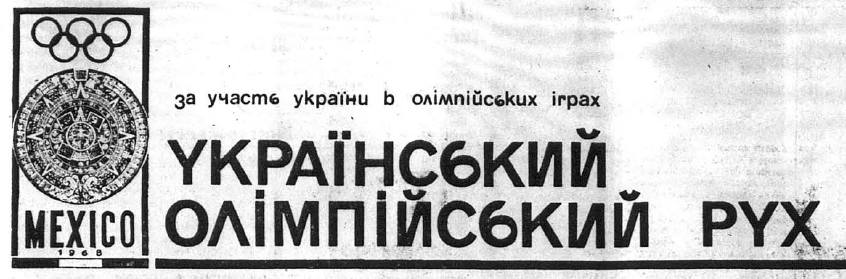
It should also be added that Ukrainians from Canada traveled to Olympic Mexico City to give an artistic performance. At the same time, I should note that the Ukrainian presence in Mexico City could have been dozens of times larger.
In one of the Ukrainian Olympic Committee’s letters, Osyp Zinkevych wrote that more than one hundred people had initially signed up to travel to Mexico. A plane had been chartered, tickets reserved, hotel accommodations arranged, and so on. But for some reason, unfortunately, the trip never took place.
Osyp Zinkevych on the Olympic Games in Mexico City
I have Osyp Zinkevych’s recollections of his stay in Mexico City during the Olympic Games, which he recorded in his diary. I also contacted Arkadii Zinkevych, who accompanied his father on the trip. Since Arkadii was still very young at the time, almost none of his memories of those events have survived. After all, a great deal of time has passed since then.
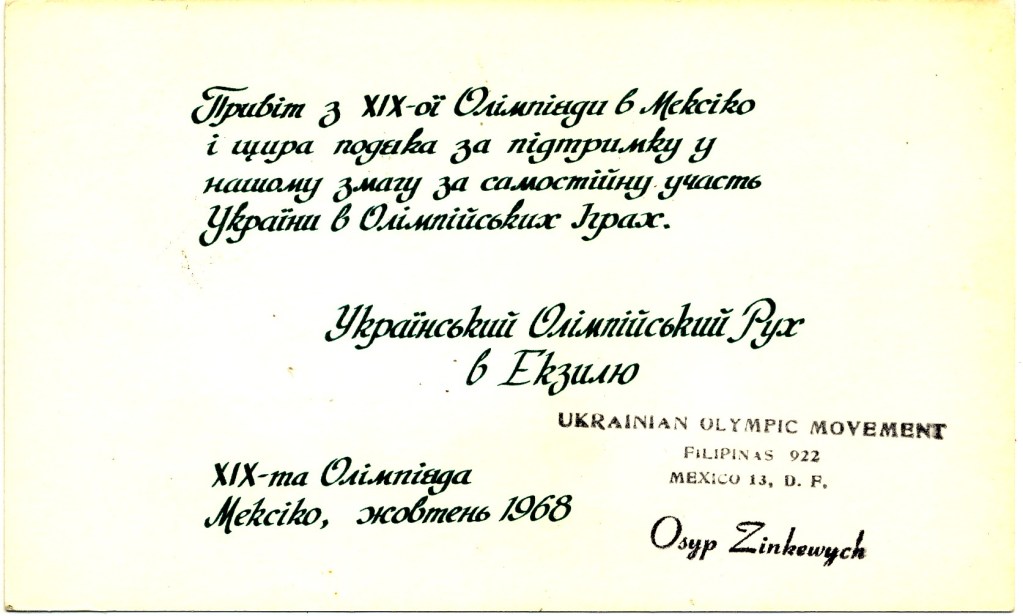
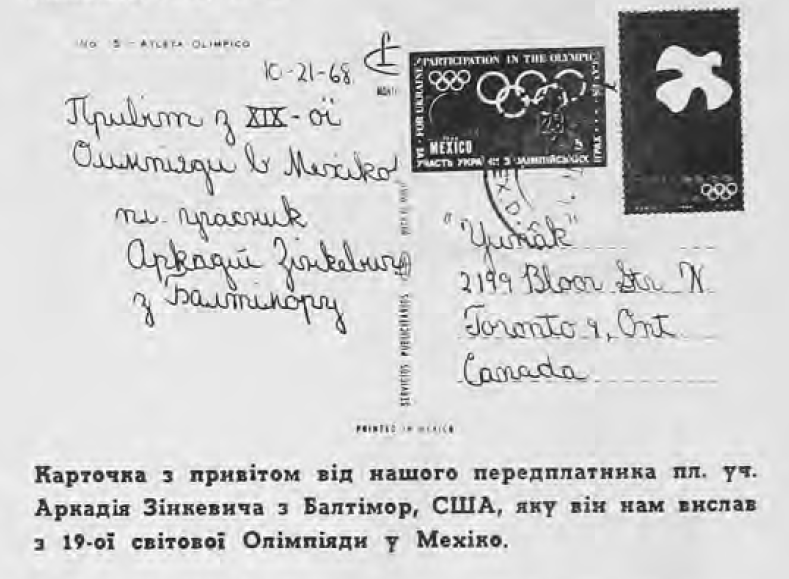
However, the 1968 issue of the magazine Yunak contains a unique photograph — a postcard with greetings from one of the magazine’s subscribers, Plast member Arkadii Zinkevych.
So here is what Osyp Zinkevych remembered about the 1968 Olympic Games in Mexico City. I present excerpts from his memoirs in chronological order.
September 12: “With the help of Svoboda, I found a Ukrainian in Mexico City. I have already been corresponding with him for some time. He agreed to host us during the Olympic Games. I decided to travel with Arkadii.”
As I mentioned above, Osyp Zinkevych found Ukrainians in Mexico City who agreed to help him, including with accommodation.
September 28: “Arkadii and I are ready to travel to Mexico City, but there is almost a revolution there. Many people have been killed. The government is crushing the resistance, and the Olympics will take place. The Ukrainian service of Radio Liberty learned that I was going to the Olympics, called me and offered me the role of their correspondent. I agreed. And today Rostyk Khomiak brought me a tape recorder, instructions, and an address in Mexico City from which I will be able to send them my reports.”
As we can see, even the dangerous situation in Mexico did not prevent Osyp Zinkevych from traveling to Mexico City for the Olympic Games. I mentioned this danger above when outlining several important and extraordinary facts about the Games.
October 6: “We are already in Mexico City. Mr. Bohdan M. and his son met us at the airport. A very pleasant man. And immediately we made a major mistake. Mexico City is located at an altitude of three thousand meters above sea level. You have to acclimatize to this altitude, but we did not think about it. Straight from the airport, he took us to the highest pyramid in Mexico City. We climbed it, came back down, saw the famous views from above… and suddenly I became very ill. I collapsed… My blood pressure went up.”
Other tourists and athletes who had not had time to adapt to the high altitude experienced similar effects.
October 9: “Today Mr. Bohdan drove us in his car to the Olympic Press Center. I had a certificate from the Smoloskyp Information Service stating that I was a journalist… I registered, and without any difficulty they issued me full press accreditation. Arkadii was refused because, they said, he was a minor.”
Press accreditation offered many advantages, as Osyp Zinkevych could attend various competitions, speak with athletes and coaches, visit the Olympic Village, and so on. Incidentally, Arkadii was also eventually allowed to attend Olympic events with his father.
October 12: “Today the Olympic Games opened. Arkadii was allowed in, and we sat in the press center. I sat there writing a five-minute report for Radio Liberty… I emphasized the participation of Ukrainians in these Games and the fact that Ukraine, a founding member of the United Nations, was not participating in the Olympics.”
This was precisely the key issue in the international struggle to liberate Ukraine from Soviet occupation. At the Olympic Games, Ukrainian athletes should have represented their own national team, not the team of the state that had subjugated Ukraine.
In addition, at the press center they placed several booklets and English-language lists of Ukrainian participants in the Olympic Games — athletes whom the USSR called Russians — on the tables.
On October 13, a humorous incident occurred in the press center that amused the local police officers: “Arkadii and I were sitting there putting notices into envelopes. Then we would lay out about ten of them in a row, run a wet sponge over them, seal them, and sit on them so they would stick properly. This procedure attracted the attention of the police guards, who gathered around us, watched, and laughed when we sat on those envelopes.”
October 19: “We went to the Olympic Village, and an athlete with a powerful build was walking out. It turned out to be weightlifter Leonid Zhabotynskyi. We approached him and spoke to him in Ukrainian. He was surprised. We asked him, and he posed for us while I took his photograph.”
This was truly a rare case in which a Ukrainian athlete on the USSR team could leave the Olympic Village on his own and speak freely. Usually, every athlete — especially a Ukrainian — was constantly surrounded by escorts, meaning agents of the Soviet security services. Naturally, they would never allow Ukrainians to speak freely with local residents or journalists, and if the other person was a representative of the Ukrainian diaspora, such communication was completely taboo. This time, Osyp Zinkevych and Arkadii were fortunate to have an opportunity to speak with the legendary Ukrainian athlete.
On October 27, the closing ceremony of the 1968 Olympic Games took place in Mexico City, Mexico. Osyp Zinkevych and his son were also present at this unique event. His diary contains the following entry for that day:
“Today the Olympic Games closed. Arkadii and I were there together. A wonderful program. It is a pity, but the Games are over. Every other day I prepared reports for Radio Liberty, and every few days I wrote press releases for the Ukrainian press about Ukrainian winners.”
Such productive work is truly impressive, especially considering that there was no high-speed internet at the time and transmitting information required considerably more time.
According to Osyp Zinkevych’s calculations, 51 athletes from Ukraine took part in the Games. Ukrainian athletes won 16 medals — 7 gold, 4 silver, and 5 bronze. Had Ukraine competed with a separate national team, it would have ranked ninth in the unofficial team standings.
According to calculations conducted by specialists in 2016, the statistics are somewhat different: 52 athletes — 46 men and 6 women — competed for medals in 15 sports. Thirty athletes became Olympic champions or medalists, winning 33 medals — 12 gold, 12 silver, and 9 bronze — in individual and team events. Thus, a Ukrainian national team would have ranked among the five best Olympic teams in the world.
Osyp Zinkevych recalled that while in Mexico City he had the opportunity to meet many Ukrainian athletes, including V. Holubnychyi, L. Zhabotynskyi, V. Kozyr, V. Nemshylov, and others. Unfortunately, however, these encounters did not always result in interviews. Most athletes, when they learned that he was a Ukrainian journalist from the United States, refused to give interviews.
At the same time, Osyp Zinkevych had opportunities to meet journalists and official representatives from various countries, as well as representatives of the Olympic Games Organizing Committee. Through them, he conveyed information about the Soviet Union’s subjugation of the Ukrainian people. He provided them with evidence and facts concerning crimes, genocide, and oppression of the Ukrainian nation and asked them to spread this information in their own countries.
October 30: “We are pleased that… we had an opportunity to convey to the international press that our Olympians are indeed Ukrainian Olympians, not Russians, as the international press called them.”
In this way, the world learned more of the truth about Ukrainian athletes and Ukraine.
Thus, if you know your history, you achieve victory!
Author: Oleksii Lyakh-Porodko