


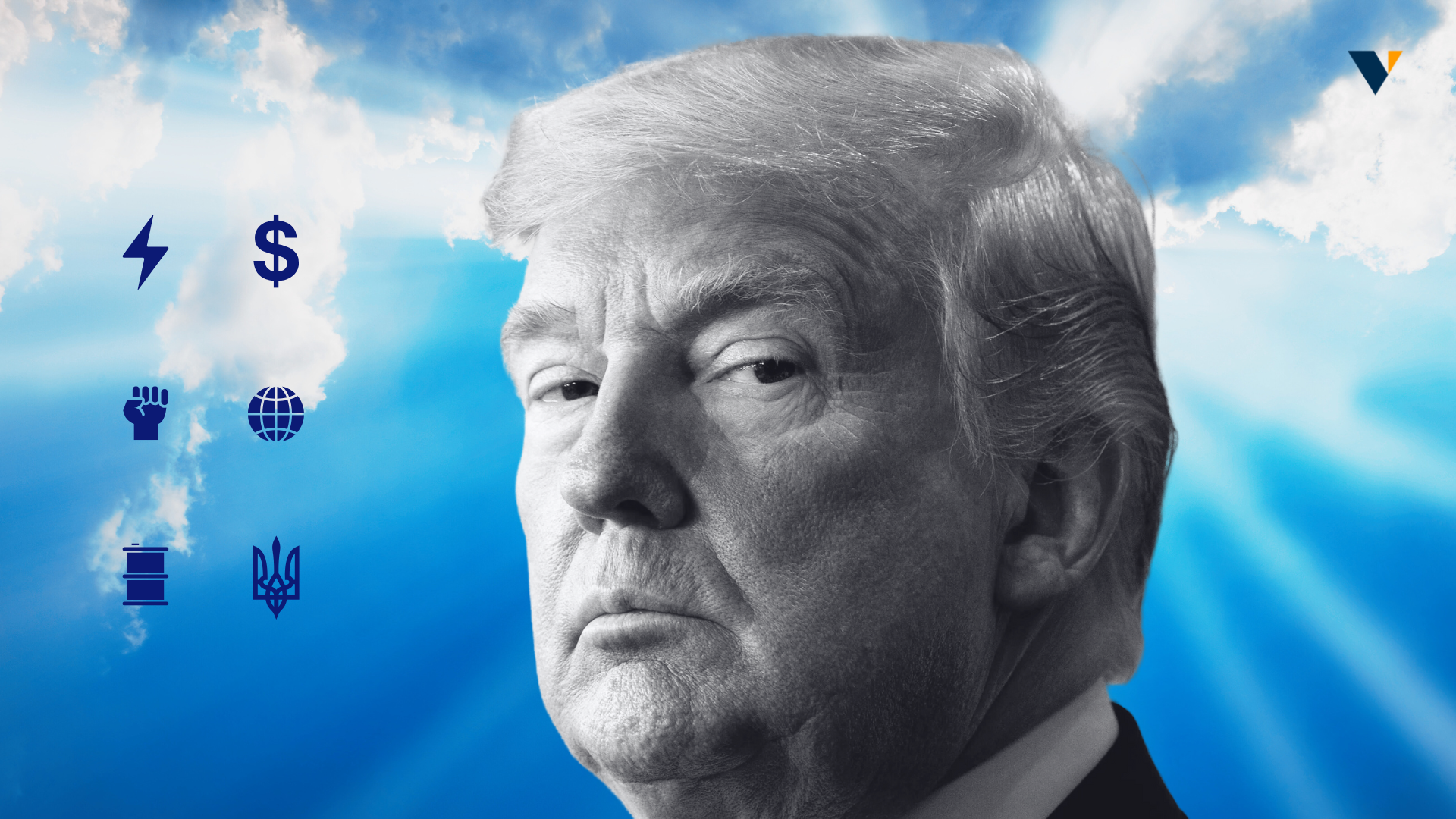
 On January 20, Donald Trump, the 47th President of the United States, entered the White House and immediately launched his directives at full speed in turbo mode.
An Unconventional Inauguration for a Defender of Traditional Values
The U.S. presidential inauguration is one of the most traditional ceremonies, with a nearly unchanged script repeated on the same day—January 20—usually outdoors on the steps of the Capitol. This setting allows the swearing-in and assumption of the highest office to be as public and open as possible, giving everyone the opportunity to witness the U.S. political system in action. It emphasizes the democratic nature of the process and serves as its vivid manifestation.
This key democratic feature was absent in the inauguration of the 47th president, which took place indoors in the Capitol Rotunda. The official reason cited was unusually cold weather—temperatures dropped to -10°C (14°F) in the morning and warmed slightly to -5°C (23°F) later. However, January in Washington, D.C., is hardly comparable to California’s climate, and everyone, including the First Family, would have known how to dress warmly to withstand the chill. (Why, then, did Melania Trump obscure half her face with a hat if the event was held indoors?) In my opinion, the true reason was likely a concern that even the most enhanced security measures around the Capitol Square wouldn’t guarantee absolute safety. Alternatively, one could agree with Vitaliy Portnikov, who remarked during the Saturday Political Club program on Espreso TV on January 25 that the intent behind the indoor inauguration might have been to turn the grand public spectacle of American democracy into what he called a "corporate party," restricted to select guests with tickets priced astronomically high. Whether this shift was deliberate, the result of unforeseen weather, or an attempt by Trump to draw parallels with Ronald Reagan (whose inauguration also took place in the Rotunda due to cold weather), the outcome was clear: an event with exclusive guests, a limited audience, and exorbitant ticket prices.
Among the attendees, in addition to the traditional presence of former presidents and first ladies, were heads of several foreign states, breaking with another tradition. Typically, foreign guests are not invited to U.S. presidential inaugurations, as it is strictly a domestic affair. However, Trump extended invitations to Chinese President Xi Jinping (represented by his deputy), Italian Prime Minister Giorgia Meloni, and Argentine President Javier Milei. It’s likely he also invited Hungarian Prime Minister Viktor Orbán, who had met Trump at his Mar-a-Lago estate, though Orbán did not attend the ceremony. These invitations highlighted Trump’s priorities for international cooperation and the type of Europe and South America he envisions—ones that mirror his vision for the United States.
On inauguration day, Trump delivered three speeches: the official one based on a prepared text; two informal speeches to a narrower circle of supporters within the Capitol; and an evening address at an indoor arena with a capacity of up to 20,000 people.
Rhetorical Devices and Hate Speech: Tools of Political Success
In all of these speeches, the 47th president not only outlined his upcoming political agenda but also reiterated the myths about the "stolen" 2020 election and the alleged "deep state-orchestrated" attack on the Capitol on January 6, 2021. His speeches revealed his overarching perspective on the United States and the world: America is on the brink of collapse, deceived, exploited, and destabilized by every nation in the world—and even by its own Democrats. According to Trump, European Union leaders are driving Europe to disaster. Only Viktor Orbán, Giorgia Meloni, and Elon Musk-backed far-right movements in Germany and the UK might save the continent.
In Trump's rhetoric, "every country" deliberately "sends criminals from their prisons and patients from their psychiatric facilities to us." Canada, Mexico, and the EU supposedly refuse to buy American farmers' and manufacturers' products. The Panama Canal is "controlled by China," which, naturally, results in the alleged discrimination of American ships. Domestically, the judicial branch is portrayed as being "weaponized for political purposes," government agencies are described as corrupt, and public institutions are said to be undermined by privileges for racial and other minorities. Trump blamed all these issues on the Biden presidency, which he described as weak, subservient to the far-left wing of the Democratic Party—those who "hate America" and have "deliberately opened our borders."
However, Trump declared in his speeches that, from the moment he took the oath of office to uphold the Constitution and serve the American people, a "golden era" had begun. He emphasized that Providence had spared him from death during an attack in Pennsylvania this summer "so that I could save America."
These exaggerations, mostly simplistic literary hyperboles, repeated by Trump at every appearance since his 2016 presidential campaign, and amplified thousands of times on social media by him and his devoted followers, secured his presidency in 2016 and again today. Of course, this did not happen in a complete vacuum—problems in the U.S., including those Trump mentions in his speeches, do exist. However, it seems that not a single voter who supported him this year asked themselves two basic questions:
- Is the U.S. truly in such a dire state that it requires immediate and extraordinary measures to prevent inevitable catastrophe?
- Will the political measures proposed by Trump actually save the country from this catastrophe?
Had voters asked these questions, they would have discovered that the answer to the first is "no." The U.S. is far from being in a state of total collapse. While the problems highlighted by Trump are real, they are nowhere near as exaggerated as he portrays them.
Among those who have crossed the border outside the legal framework (at various times, not just under Biden), there are criminals, but certainly not the "millions" that other countries allegedly "deliberately send," as Trump claims. The primary reason for such crossings is escaping persecution, as obtaining the right to legally cross the border (such as gaining refugee status) often requires months of waiting in countries where those fleeing sometimes face mortal danger. This highlights one of the flaws in the U.S. immigration system, which has long required comprehensive reform. However, several attempts to draft such a reform bill have failed in Congress. Trump is undoubtedly aware of this, but he deliberately exaggerates the problem, turning all undocumented (and sometimes even documented) immigrants into an easy target for overt hate speech.
It’s worth noting that the rigorous process for obtaining political asylum effectively filters out criminals.
The same kind of exaggeration can be found in Trump’s statements about the economy and international trade. Inflation in the U.S. in December was 2.9%.
No country trades in a way that causes losses for itself—not the U.S. nor its partners. Trade happens only on a mutually beneficial basis. "In 2023, the U.S. exported goods and services to the EU worth over $639 billion," including $12.3 billion in agricultural products (ranking 4th on the market) and 271,476 U.S. automotive products, placing 2nd in the European market, CNN reports. If Trump imposes trade tariffs, it will lead to price hikes in the U.S. domestic market.
As for the Panama Canal, it is indeed managed by a company based in Hong Kong. However, this is because the company won a fair tender in 2004, announced by the Panamanian government, according to CNN in the cited article.
"There are legitimate concerns about Chinese influence on infrastructure at and around the Panama Canal. For instance, a subsidiary of the Hong Kong-based company manages a port at each end of the canal, having first won a contract through a tender in the 1990s. However, Panama itself has controlled the canal since the U.S. handed it over to the country in 1999. The canal is administered by the Panama Canal Authority, whose administrator, deputy administrator, and 11 board members are Panamanians appointed by the Panamanian government. The overwhelming majority of its employees are Panamanians. It is Panama that decides which companies receive contracts to manage ports on the canal. Other ports along the canal are managed by companies that are not Chinese, including one run by a joint American-Panamanian venture.
'The canal is and will remain Panamanian, and its administration will continue under Panama’s control, maintaining its permanent neutrality,' said Panamanian President José Raúl Mulino.
Rescue in Turbo Mode?
Right out of the gate, the 47th president began issuing executive orders at breakneck speed. Declaring a state of emergency on the Mexican border, enabling the deployment of National Guard troops and Pentagon resources. Revoking birthright citizenship for children born in the U.S. if their parents did not have legal status at the time of birth (despite birthright citizenship being guaranteed by the 14th Amendment of the U.S. Constitution). Halting the acceptance of all refugees—completely and immediately.
Granting pardons to everyone involved in the January 6, 2021, Capitol attack—more than 1,500 people in total. After all, they’re not criminals but "hostages," as he put it!
Suspending all funding for State Department humanitarian projects worldwide, including those managed by USAID, for 90 days. Completely dismantling all departments established by the previous administration to promote "diversity, equity, and inclusion" in government institutions. Placing millions of federal employees on paid leave. Firing inspectors general from various agencies. Renaming the Gulf of Mexico to the "American Gulf" and reverting the name of Denali, a mountain in Alaska that was restored to its Native Alaskan name in 2016, to its previous name honoring U.S. President McKinley.
As a result of these chaotic and rapid-fire orders, undocumented immigrants began being flown out on military aircraft to countries in Central and South America. Mexico and Colombia, both allied with the U.S., openly refused to accept these planes. So far, only Guatemala has taken a few flights.
No one seems to have asked what fate awaits these people. Are they all undocumented immigrants? Was there even a possibility to verify this? Did anyone care? I doubt it.
Simultaneously, what Trump repeatedly referred to as the "largest mass deportations in U.S. history" began. Should this be a source of pride? The word "mass" implies indiscriminate raids, where not only undocumented immigrants who have committed crimes in the U.S. (the stated goal of these raids) are caught, but also honest workers, and sometimes even legal residents who simply didn’t have their documents on hand at the time of the raid.
The suspension of refugee admissions has also blocked entry for all those who had already been granted refugee status, including Ukrainians who had been approved for entry under the U4U program (introduced by Biden immediately after the start of the full-scale war in 2022).
Hundreds of thousands of families have been torn apart simply because someone in the family had, at some point, crossed the border illegally. In some of these families, grandchildren—born in the U.S. to children also born in the U.S.—are now growing up. Could this be why Trump is targeting the 14th Amendment? Deporting hundreds of thousands of people into an uncertain fate without investigating the reasons behind their undocumented status raises serious questions.
The suspension of USAID activities has halted vital programs such as mass vaccination of children and adults in African countries, as well as the construction of schools, hospitals, and clinics. This includes all humanitarian aid to Ukraine, a matter of life and death amidst Russia's terrorist actions.
Even a temporary pause in these programs, particularly in African nations, will inevitably create a vacuum, paving the way for increased influence from Russia and China.
This suspension stems from Trump's directive to review all these programs for their "alignment with U.S. foreign policy goals," as envisioned by the 47th president. These programs, in his words, must "enhance U.S. influence for the benefit of Americans." In other words, funding for programs addressing climate change, gender equality (including LGBTQ+ initiatives), and certain feminist programs will likely be cut. On the other hand, funding for ideologically right-wing programs is expected to increase. The fate of critical programs like mass vaccination in Africa may hinge on whether Robert F. Kennedy Jr. is confirmed as Secretary of Health and Human Services.
Meanwhile, the mass dismissal of federal employees who don't align with Trump's worldview will lead to higher unemployment and, at least temporarily, chaos in federal administration. The U.S. federal apparatus, comprising millions of workers, has evolved over decades and may not withstand the shock of such a sudden "earthquake reform." Previous attempts by presidents like Reagan and Clinton to reduce bureaucracy were largely unsuccessful.
Unlike during Trump's first term, his actions now face fewer constraints from checks and balances. For instance, during the Senate confirmation of Pete Hesset, a controversial nominee for Secretary of Defense, only three Republicans joined Democrats in voting "no." Vice President J.D. Vance cast the tie-breaking vote in Hesset’s favor. Even opposition from figures like Mitch McConnell, the former Republican Senate Minority Leader, failed to sway enough votes to block what many view as a risky experiment—appointing an obvious non-expert to such a critical role.
Nevertheless, some of Trump’s turbocharged orders are encountering resistance. For example, the executive order revoking birthright citizenship is already being challenged in court by 22 states. This case will likely reach the Supreme Court, where it will depend on the justices' interpretation of the 14th Amendment. If the Court finds that such a change requires amending the Constitution, Trump would need two-thirds support in Congress and approval from two-thirds of state governors—an almost insurmountable hurdle.
Other orders, like renaming the Gulf of Mexico or Denali, are simply not credible. Geographic names are not changed through presidential decrees. Imagine the chaos if every president renamed landmarks at will.
The tragicomic outcomes of Trump’s first week back in office demonstrate that even the issues highlighted in this brief overview cannot be resolved through brute force. These are complex problems requiring gradual, phased, and comprehensive solutions. The turbo mode only complicates matters, creating new problems and deepening divisions in American society.
If Trump and his appointees approach the resolution of the Russia-Ukraine war with the same tactics, it’s doubtful he’ll achieve success. Putin would likely challenge Trump to a duel of "who’s tougher," and it’s unclear who would dominate in such a scenario. However, figures like Keith Kellogg, Marco Rubio, and others in Trump’s inner circle might persuade him that as the "savior of America and the world," he cannot afford to risk strategies that might portray him as weak. One can only hope that Trump understands this: his fiery rhetoric and threats toward the Russian dictator must be backed by decisive actions that lead to Ukraine's victory—not a "dignified draw."
Author: Nadiya Banchyk