


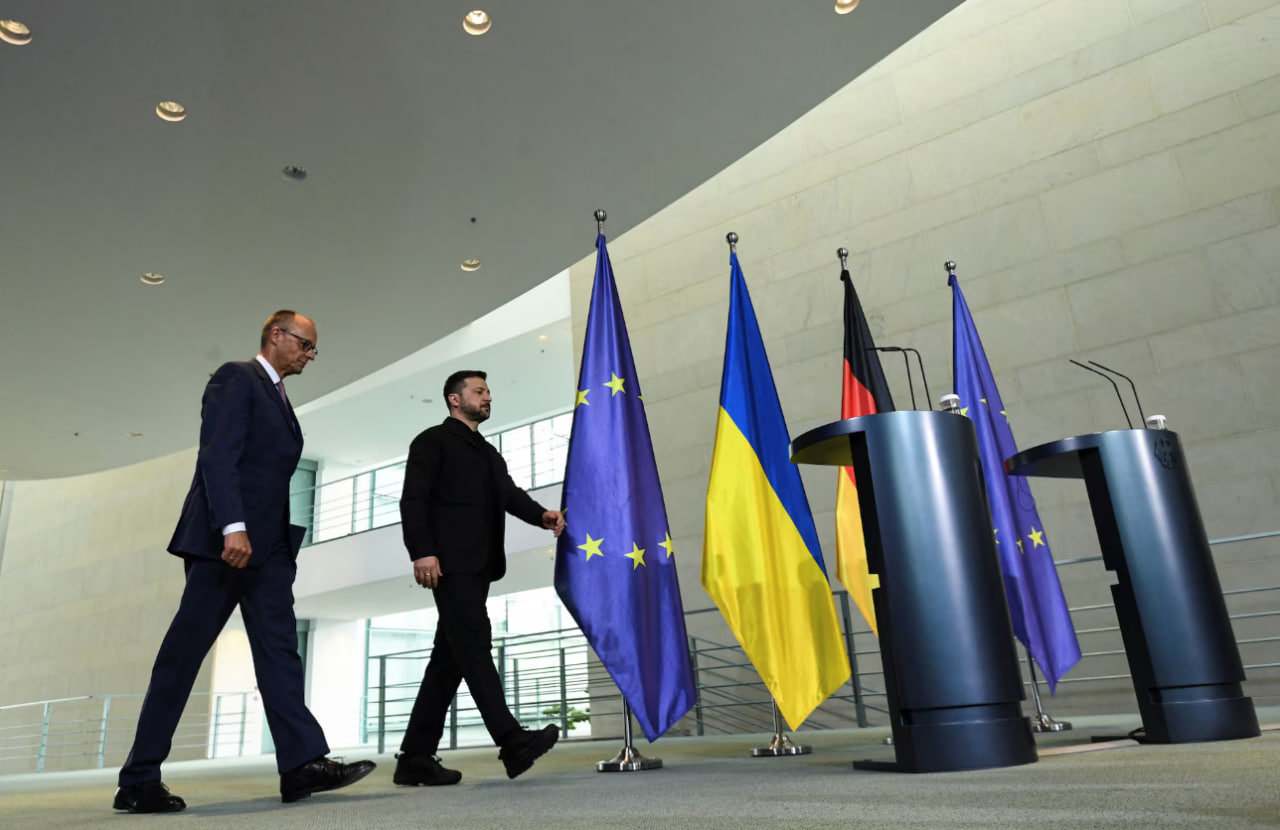
Following the largest air attack since the beginning of the war, Ukraine has gone on the offensive. It has struck defensive targets in Moscow, negotiated with Germany on the joint production of long-range weapons, and prepared for a new round of diplomatic talks. The U.S. sends a clear signal that the Kremlin's ultimatums are unacceptable.
Ukraine strikes back after a massive Russian attack
In response to Russia's three-day attack involving 367 drones and missiles that killed at least 12 people, Ukraine launched a large-scale strike on Moscow.
The targets were enterprises in Zelenograd and Dubna, including a factory that manufactures microchips used in Russian missile systems and a factory that produces strike drones. The strikes disrupted logistics and air traffic, forcing the closure of Vnukovo, Domodedovo, and Sheremetyevo airports.
The United States does not support Russia's demands for the withdrawal of Ukrainian troops
President Zelensky said, the United States has made it clear it will not support conditions requiring Ukraine to surrender its territories. Washington considers the Kremlin's demands for Ukrainian troops to withdraw from the temporarily occupied parts of the Donetsk, Luhansk, Kherson, and Zaporizhzhia regions to be unacceptable.
In turn, U.S. Vice President Jay D. Vance described Russia's position as "unrealistic" and called for more balanced negotiations without ultimatums.
ППО та ракети Patriot
Ukraine has existing stocks of Patriot missiles, which it deploys strategically and sparingly, primarily to destroy ballistic and cruise missiles. Partners are helping replenish the stockpile. Meanwhile, Ukraine is close to receiving additional air defense systems and licensing new platforms.
Ukraine is keeping pace; it produces 300–500 drones (including long-range and interceptor drones) per day, but requires additional funding to expand production. The Ukrainian government is working to launch production lines abroad.
Germany and Ukraine are set to jointly manufacture long-range weapons
In Berlin, Chancellor Friedrich Merz and Ukrainian President Volodymyr Zelenskyy announced the joint production of Taurus missiles and similar weapons without range restrictions.
"Our defense ministers will sign a memorandum of understanding today on the purchase of Ukrainian-made long-range weapons systems," said Merz. "There will be no restrictions on range, which will allow Ukraine to fully defend itself, even from military targets outside its own territory."
Merz also confirmed that Germany will not resume Nord Stream 2, maintaining the energy pressure on Moscow.
New offensive actions by the Russian Federation and increased drone production
According to Zelenskyy is focusing his efforts on several fronts: reaching the borders of the Donetsk and Luhansk regions, crossing the administrative border of the Dnipropetrovsk region, and creating a 10-kilometer buffer zone in the Sumy region. The strongest groups are concentrated in the Kursk direction. There are also signs of preparations for operations in Zaporizhzhia and across the Dnipro in the Kherson region. The Russian Federation is actively increasing strike drone production to 300–350 units per day with plans to reach 500.
Putin has set "red lines": rejection of NATO and lifting of sanctions
The Kremlin leader has outlined conditions for ending the war in Ukraine, including a written promise from Western leaders to halt NATO's eastward expansion and remove some sanctions against Russia.
"Putin is ready to make peace, but not at any price," said a senior Russian source familiar with the Kremlin's thinking, speaking on condition of anonymity.
Zelensky names three realistic venues for talks
Zelensky labeled Turkey, the Vatican, and Switzerland are the most realistic venues for the next round of talks with Russia, rejecting Belarus as a venue — an option that Russia is trying to propose.
In a conversation with journalists, Zelensky said: "I believe the three most realistic locations are Turkey, the Vatican, and Switzerland. They are clear and neutral. We are ready for any format.”
Author: Danylo Pievchev