


For several days this past week, Ukraine’s battered—but unbroken—capital barely flinched at the wail of air raid sirens. In Moscow, the Kremlin’s mafia minded elite held its breath, convinced that events in Kyiv would topple the “Kyiv regime.” Even missiles and drones were kept on standby—“let the Ukrainians finish themselves off,” or so the logic went.
Yet while the imagination in Moscow spun its favorite scenarios, reality showed just how little Russia’s organized crime state understands Ukraine, and how far it is from grasping what direct democracy looks like in a free country.
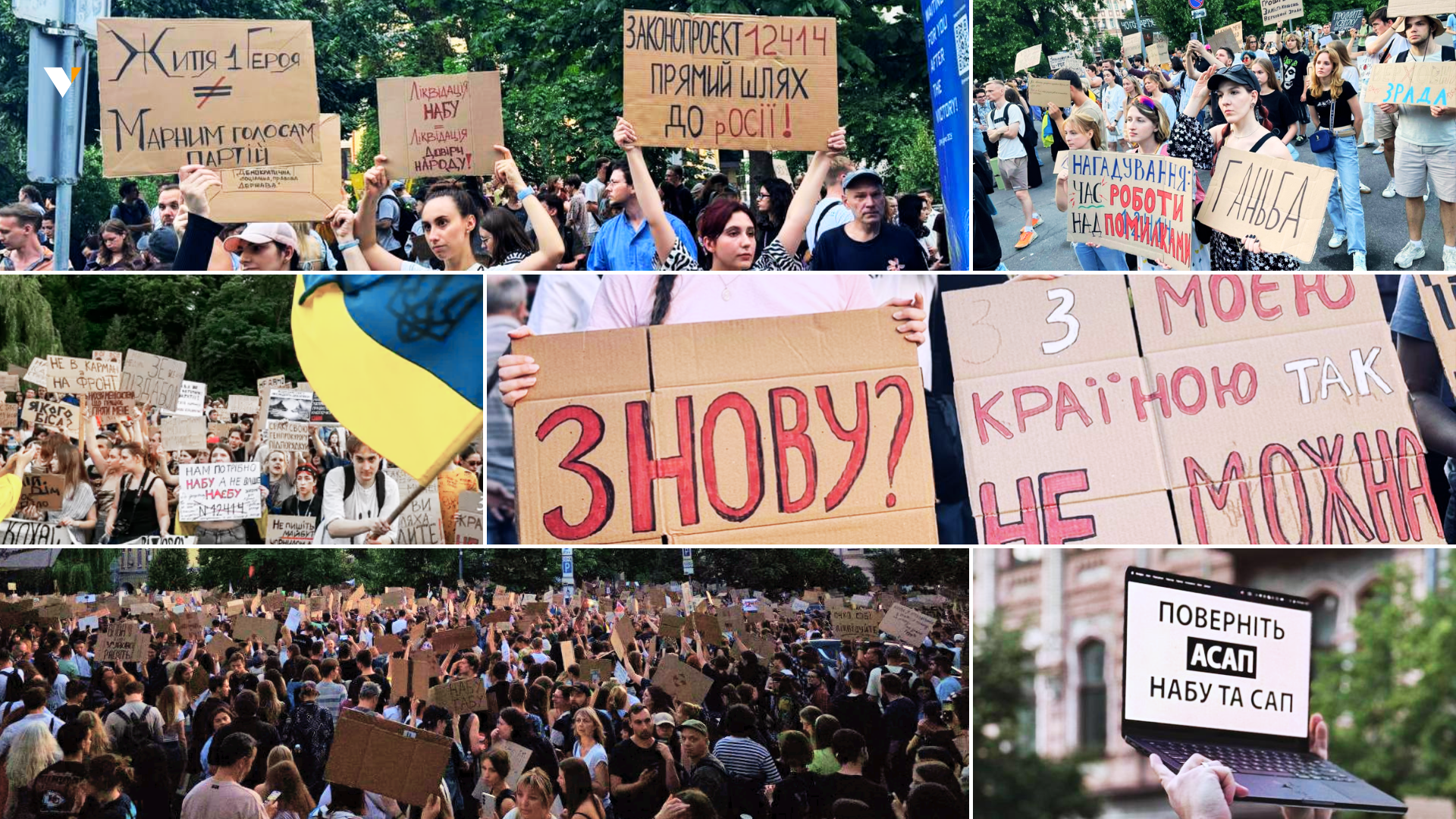
A small park off Khreshchatyk has seen crowds only when the nearby Ivan Franko Theater stages a sold out performance. This week, however, the square throbbed with the voices of thousands. Glancing instinctively at the sky under the threat of another Russian strike, young people hoisted signs reading “Corruption kills as surely as rockets” and “The Heavenly Hundred sees everything.” For the first time since the full scale invasion began, a crowd flooded the capital’s main streets, sparking parallel rallies in Lviv, Dnipro, and Odesa and proving that even in a nation at war citizens will not sit quietly through legislative macabre. The bid to strip the National Anti Corruption Bureau (NABU) and the Specialised Anti Corruption Prosecutor’s Office (SAPO) of independence was a trigger—though not the root cause.
The spark was Law 12414, rammed through parliament in five hours without debate and immediately signed by President Zelensky. The bill placed NABU and SAPO—created precisely to shield investigations from political pressure—under the control of the Prosecutor General. In Ukraine and across the West, the lightning fast, opaque procedure read like a neon sign of bad faith.
Every analyst who parsed the text pointed to the same danger: the prosecutor would gain virtually unlimited power to stall high profile cases for years. It amounted to a 180 degree turn away from the country’s European path. Striking at corruption—the wound most painful to Ukrainians—pitted the government’s ratings against a street armed only with the right to protest.
Sociological snapshots showed remarkable cross section: students and IT engineers, soldiers’ mothers and veterans, small business owners and artists. Geography was just as varied—Khreshchatyk, Lviv’s Rynok Square, the squares of Dnipro and Odesa. The youngest, barely out of high school, chanted “Youth still wants the EU,” setting the rally’s tempo.
A distinct layer of protesters featured uniformed service members and their families. Their handmade posters reminded the government quarter that bribes at the rear demoralize more than enemy mines at the front. The fusion of frontline experience and civic resistance neutralized attempts to pit “rear” against “trench”—the most dangerous narrative for a nation fighting for survival.
The marches also served as litmus for state communications. Bankova’s bet on Telegram channels and “positive” bloggers failed spectacularly; the raw energy of ordinary Ukrainians shattered the manufactured online agenda. Tired clichés about “external control” dissolved in a sea of memes and sharp, often profane—but laser accurate—cardboard slogans that flooded social media.
Reactions in the United States were swift. Within 24 hours “hawks” Senator Jeanne Shaheen (D NH) and Senator Lindsey Graham (R SC) released a joint statement warning Kyiv that “weakening NABU and SAPO jeopardizes U.S. support.” Dozens of lawmakers, diplomats, and experts echoed them, and Kyiv Post splashed the headline “US Senators Slam Ukraine’s Anti Corruption Rollback.” Meanwhile Representative Marjorie Taylor Greene seized the moment for another attack, branding the rallies an “anti war mutiny” and “proof of Zelensky’s dictatorship.”
Yet most American media and policy circles recognized the truth: the world was witnessing democratic oversight of Ukraine’s authorities, not capitulation born of internal squabbles. Leading English language outlets framed the protests as a reaction to threats against the greatest achievement of the Revolution of Dignity—independent anti corruption bodies. Ukrainian youth see NABU and SAPO as symbols of the road to Europe and refuse to let prosecutors “Romanianize” them. In essence, the press confirmed a textbook act of direct democracy, safeguarding Ukraine’s image even as the president’s personal ratings took a hit.
Credit is due to Volodymyr Zelensky, who heard and felt the streets quickly: less than a day after signing, he promised new legislation “to preserve the independence of anti corruption institutions.” Narrowing the focus raises hard questions: was this “red line test” deliberate, and did it truly gauge society’s tolerance for governance that skirts democratic norms?
Was the law’s passage merely a presidential team blunder? Some analysts argue it was a Kremlin special operation striking at the softest spot—corruption, named problem №1 by 70 percent of Ukrainians. Long running efforts to convince Zelensky to scrap the pesky, autonomous NABU and SAPO reached a boil as criminal cases edged closer to his entourage. Once he acquiesced, parliament snapped into action—led chiefly by lawmakers who have sworn lifelong love for Russia, converse in Russian at home, and view Ukraine’s tragedy as a chance to extend their political careers and multiply the “business” that protesters simply call corruption.
Moscow miscalculated: instead of chaos, Ukrainians offered the world a master class in nonviolent civic pressure.
A crucial lesson: the mobilization never opposed the army. Protesters chanted “The Armed Forces are our honor,” maintaining solidarity with the front. Attempts to spin a trenches vs squares narrative collapsed. In media terms, even during war the government faces multiple red lines, and ignoring a new generation of passionate citizens erases political futures—a heartening thought indeed.
For Ukrainians in the United States the stakes are concrete. Persuading Congress that aid will not vanish into a black hole just became a bit easier: Ukrainian society can instantly punish backsliding on reforms, making U.S. support an investment in the liveliest democratic project on the continent. The Shaheen Graham letter should be quoted at every advocacy meeting; it shows the anti corruption agenda unites both parties, empowering the diaspora to act in bipartisan fashion.
Ahead lies the parliamentary vote on the president’s promised new bill. Will it restore trust? Pessimists note that 62 percent of citizens distrust anti corruption agencies overall. Optimists counter that a peaceful, mass rally under sirens proved society will not surrender its principles even in the maelstrom of war. In that sense, today’s crisis is shot through with light: it forges the post Maidan generation, teaches the government to listen, and reminds the West to trust Ukraine’s direct democracy.
About Author:
