


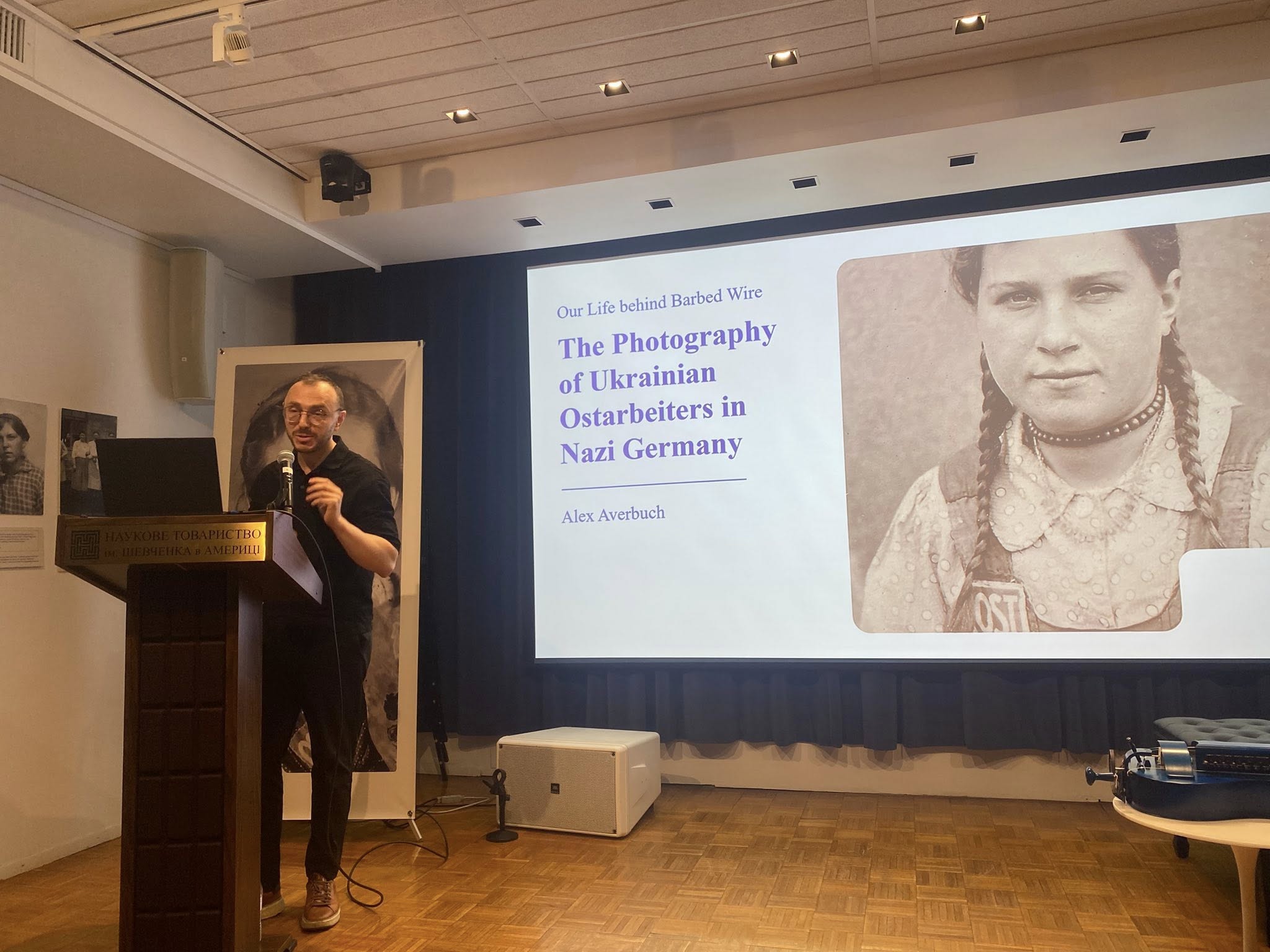
A premiere of the exhibition “Our Life Behind Barbed Wire” took place in New York, dedicated to the stories of Ukrainian forced laborers (Ostarbeiters) in Nazi Germany. The event began with a lecture by Oleks Averbukh — poet, researcher, and exhibition initiator — and concluded with a moving music and poetry performance held directly within the exhibition space. The combination of historical materials and live artistic expression connected the traumas of the past with the pain of Ukraine’s present war.
This was reported Shevchenko Scientific Society in collaboration with Razom for Ukraine.
According to the Shevchenko Scientific Society in cooperation with Razom for Ukraine, the event opened with Averbukh’s public lecture introducing the exhibition, which features photographs and letters of Ukrainians who were deported to Nazi Germany during World War II. Visitors then explored the exhibition itself.
 The display includes rare archival materials, personal testimonies, and intimate artifacts from everyday life in forced labor camps — from pregnancies in captivity and secret marriages to forbidden letters home and acts of defiance and survival under totalitarian rule. The exhibition will remain open until January 1, 2026.

Guests were then immersed in a music and poetry performance that featured Averbukh’s documentary poetry collection “Furious Harvest” in English translation by Oksana Maksymchuk and Max Rosochinsky. Composer Olha Zaitseva-Herz created and performed original pieces for piano and lyre, intertwining her music with Averbukh’s verses. The performance took place among the exhibits, deepening the emotional resonance and drawing parallels between the Holocaust, wartime deportations, and russia’s current war against Ukraine.
Writer Ihor Satanovsky shared his reflections: “This evening stirred long-buried memories of my grandparents’ close friend — she was only 16 when she was forced to work in Nazi Austria. She spoke openly against the Soviet regime in Kyiv long before perestroika. That kind of spirit endures across generations.”
The event was part of the Ukrainian Cultural Festival organized by Razom for Ukraine and the Shevchenko Seminar in Ukrainian Studies.
Background
Oleks Averbukh – poet, translator, and scholar from Novoaydar, Luhansk region. Author of several poetry collections and over 70 translations between Hebrew, Ukrainian, Russian, and English. His works have been published in leading international literary journals and translated into multiple languages. His latest collection, Furious Harvests, translated by Maksymchuk and Rosochinsky, is forthcoming from Harvard University Press. Finalist for the Shevchenko National Prize, he currently serves as Associate Professor of Ukrainian Literature and Culture at the University of Michigan.
Olha Zaitseva-Herz – ethnomusicologist and postdoctoral researcher at the Kule Folklore Centre (University of Alberta), originally from Dnipro. Her work explores cultural resilience in digital spaces, music during russia’s war, and experimental projects such as Bakhmut Rhapsody and the “Sonification of Ukrainian Embroidery.” Founder of the Zaitsa ensemble (Germany), known for fusing Ukrainian folk with jazz, pop, and klezmer.
Oksana Maksymchuk – Ukrainian-American poet, philosopher, and translator. Author of Still City: Diary of an Invasion, longlisted for the Griffin Poetry Prize 2025 and the PEN/Voelcker Award. Co-editor of Words for War: New Poems from Ukraine (2017). Holds a PhD in Philosophy from Northwestern University.
Max Rosochinsky – poet, translator, and scholar from Simferopol. His translations have appeared in Words Without Borders, Modern Poetry in Translation, Poetry International, and Best European Fiction. His English rendition of Lyuba Yakimchuk’s “Prayer” was performed at the 2022 Grammy Awards. Co-translator of Apricots of Donbas (Yakimchuk), Voices of Babyn Yar (Kiyanovska), and co-editor of Words for War.
Photo: Olha Khometa
Author: Inna Mikhno