


 The Ukrainian delegation is intensifying its dialogue with the team of the U.S. President, while Donald Trump’s envoys are already in Moscow presenting to Putin the proposals produced in Miami. Washington is attempting to advance its own peace track, limiting Europe’s role in the process and simultaneously testing Kyiv’s readiness for compromises. The Kremlin is taking advantage of the pause, dragging out time and trying to portray itself as the “constructive side” amid economic exhaustion and failed military objectives. For Ukraine, this means an even tougher fight for its own agency in the negotiation process.
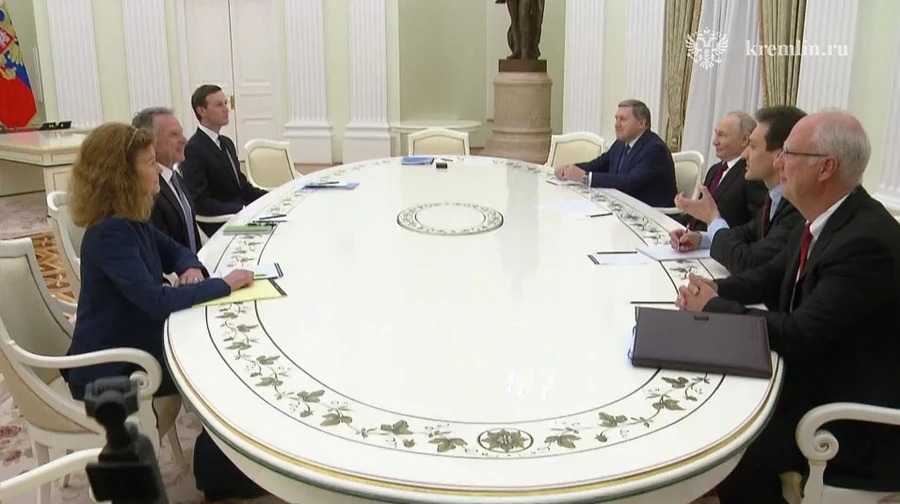
Special Envoys Witkoff and Kushner Arrive in Russia
U.S. presidential envoy Steve Witkoff and businessman and Trump’s son-in-law Jared Kushner have arrived in Russia and already begun discussing Trump’s peace plan with Putin. After Russia, they are expected to travel to a European country to meet with President Volodymyr Zelensky.
Kremlin spokesperson Dmitry Peskov stated that no one except the American negotiators and interpreters would attend the meeting. Earlier, the “one-on-one” format using Kremlin translators had been criticized as risky for transparency and the integrity of the discussions.
The Witkoff–Kushner contact with Putin comes against the backdrop of statements by Ukraine’s National Security and Defense Council Secretary Rustem Umerov regarding “significant progress” in aligning the positions of Kyiv and Washington following talks in Florida.
Zelensky Receives a Full Report on the U.S. Talks
President of Ukraine Volodymyr Zelensky held an in-depth meeting with the Ukrainian delegation that returned from the United States after negotiations in Florida. He noted that the discussions also covered issues “that cannot be said over the phone,” highlighting the sensitivity of certain decisions.
NSDC Secretary Rustem Umerov and other members of the delegation reported on the key priorities of the American side and the adjustments to the Geneva document, which formed the basis of the discussions. Particular attention was paid to the briefing by General Staff Chief Andriy Hnatov for U.S. partners about the real frontline situation and possible steps should the intensity of fighting change.
Zelensky stressed that talks with the Americans included security guarantees in the event of a ceasefire and the risks of agreements being derailed by Russian strikes.
Ukrainian and American intelligence agencies assessed the prospects of implementing various military and security scenarios. The President noted that Ukrainian diplomats are working in parallel with European partners and countries from the “Coalition of the Willing” to secure broader involvement in decision-making.
He also noted the launch of new Russian disinformation campaigns connected to its planned meetings with the U.S. side and instructed officials to continue “maximally constructive work” with Trump’s team and allied partners.
Miami Negotiations: “Agreeing to Keep Agreeing” and Passing the Ball to Moscow
The talks in Miami between the Ukrainian and U.S. delegations ended without joint statements or signed documents, yet both sides described the atmosphere as “constructive” and noted some narrowing of positions.
Ukraine’s delegation was represented as broadly as possible — from the NSDC and MFA to the General Staff and military intelligence — enabling a comprehensive presentation of legal, military, economic, and social aspects of Ukraine’s position. The American team, in a narrow composition — Steve Witkoff, Jared Kushner, and Marco Rubio — tested Ukrainian proposals against the backdrop of U.S. domestic politics and upcoming talks with Moscow.
Analysts emphasize that the negotiating “ball” is temporarily on Moscow’s side: Witkoff presented the Miami proposals to Putin to determine which points the Kremlin might accept or reject. However, experts also point to a structural flaw in the current approach — the attempt to find “what can be offered to Russia and taken from Ukraine,” making the process inherently dangerous for the victim of aggression.
Internal anti-corruption scandals in Ukraine served as an important backdrop and, according to several political scientists, are being used by external actors as an additional lever of pressure on Kyiv. Politically and diplomatically, the U.S. remains Ukraine’s key security partner — but increasingly acts as a mediator in a format where Europe is pushed away from the table, and Kyiv must simultaneously account for both Washington’s and Moscow’s positions.
Strategically, observers note that time is increasingly working against Russia due to military failures and economic depletion. Ukraine’s long-range strikes on Russian oil-refining and energy infrastructure, along with sanctions against Lukoil and Rosneft, are complicating Moscow’s ability to export and process oil, forcing it into risky “shadow fleet” schemes.
Economists predict a deepening Russian budget crisis in 2025–2026, when the war will cease to be a distant image and begin to hit the living standards of the population directly. Against this backdrop, Putin is trying to extract at the negotiating table what the Russian army has been unable to achieve on the battlefield — issuing deliberately unrealistic demands for Ukraine to withdraw from key Donbas cities, which exacerbates the clash between diplomatic formulas and the real balance of power.
White House: Ukraine’s Corruption Scandal Is Harmful but Does Not Change U.S. Intentions
White House press secretary Karoline Leavitt statedthat Donald Trump considers Ukraine’s corruption scandal harmful to the peace process but that it “does not diminish the administration’s resolve to bring the war to an end.”
She emphasized that the President opposes “abuse of American taxpayer dollars,” explaining the rejection of the “blank checks” allegedly issued by the previous administration. Instead of direct funding, the U.S. is now selling weapons to NATO allies, which then transfer them to Ukraine.
However, she stressed that the altered format of support does not imply reduced political will on the part of the Trump administration to achieve an end to the war. According to Leavitt, the President prioritizes American taxpayers’ interests while seeking to balance Ukraine support with domestic priorities.
Bloomberg: The U.S. Outpaces the EU in the Race for Rare-Earth Metals for Weapons Production
European defense companies find themselves at a disadvantage compared to their American competitors in securing access to rare-earth metals essential to modern defense technologies.
With China tightening export controls and banning supplies to firms producing weapons, prices for these metals have surged while non-Chinese reserves are rapidly shrinking. European experts warn that some stocks may be depleted within months, threatening rearmament timetables.
Market participants note that U.S. companies act faster and more aggressively, leveraging better information and stronger financial instruments, while European firms often purchase raw materials in a fragmented way without sufficient government coordination. Bloomberg reports that the U.S. can secure key elements within days, whereas Europeans often need weeks — giving Americans a substantial advantage in supply chains.
In response, the EU has adopted the Critical Raw Materials Act and is preparing to launch the RESourceEU initiative to strengthen internal supply chains and diversify imports beyond China. Countries such as Germany are creating special funds to support raw-materials projects.
Rare-earth elements remain critical components for sensors, precision engines, guidance systems, and other technologies used in frigates, fighter jets, and drones — making competition for them a direct factor in Europe’s defense capabilities.
Author: Danylo Pievchev