


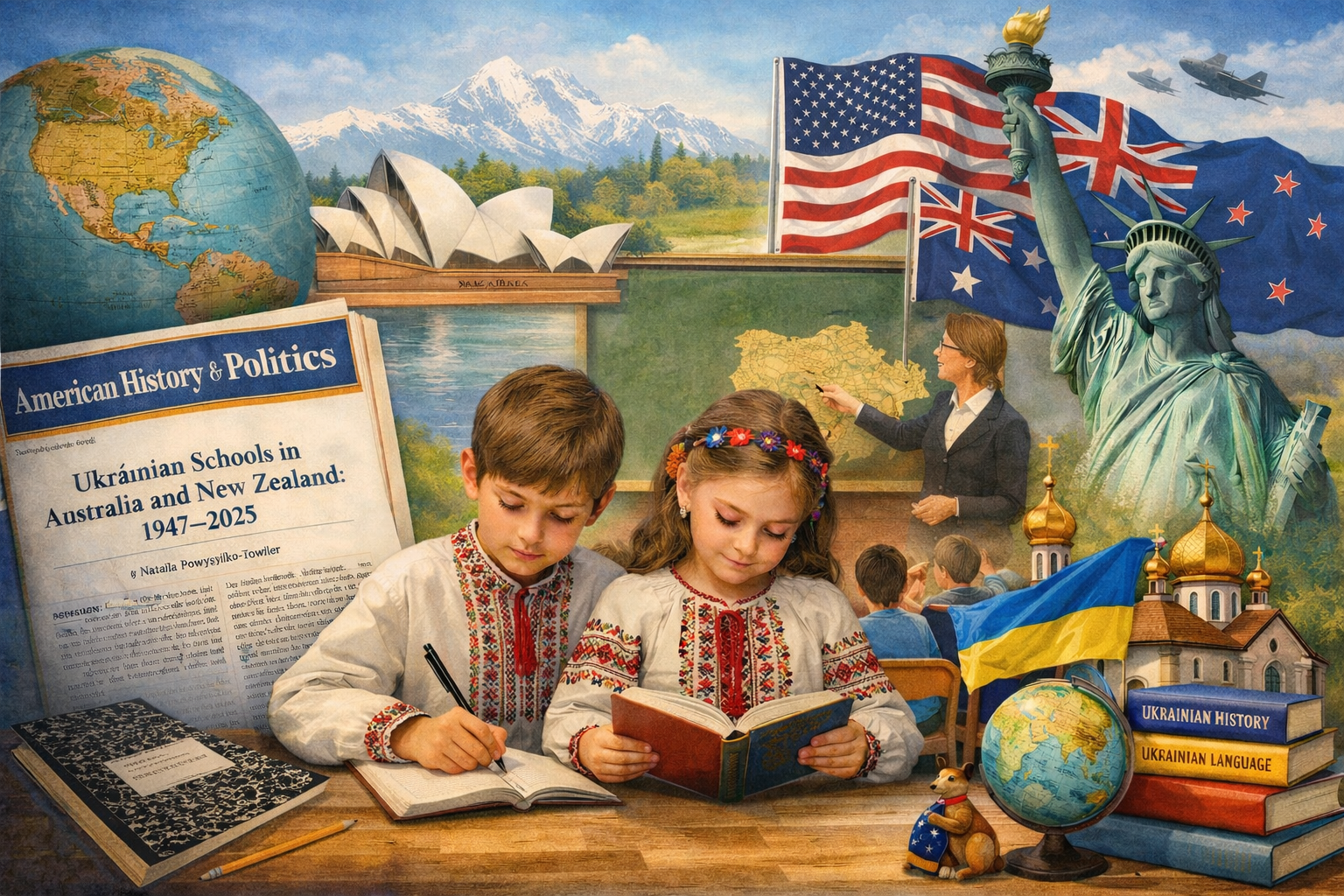
A scientific article has been published in the USA, devoted to the history and contemporary challenges of Ukrainian schooling in the diaspora. The anniversary issue of the professional journal “American History & Politics” published a thorough study by the Vice President of the Ukrainian World Congress, Natalia Poshivaylo-Tawler. The material analyzes the formation and development of Ukrainian Saturday and Sunday schools in Australia and New Zealand in 1947-2025, and also draws extensive parallels with Ukrainian schooling in the USA.
This was reported by Ukrainian World Congress.
The publication in the American scientific journal focuses on how Ukrainian communities outside Europe, in particular in the countries of the Pacific region, were able to build their own system of preserving language, culture, and historical memory. The study shows common problems faced by Ukrainian schools in the United States, Australia, and other diaspora countries: assimilation processes, limited teaching time, personnel and financial challenges, and the need to update curricula.
The article traces the history of Ukrainian schooling from the first waves of post-war immigration after World War II. It was then that thousands of Ukrainians who found themselves in displaced persons camps in Western Europe sought opportunities to leave for democratic countries. Due to immigration restrictions in the United States and Canada, a significant number of Ukrainians settled in Australia and New Zealand, where they later began to form organized public life.
The author emphasizes that the first Ukrainian schools arose on the initiative of families, churches, and public organizations themselves. Education often began in private homes, and later developed into stationary Saturday and Sunday schools. This model was similar to that already in operation among Ukrainians in the United States, and over time became characteristic of the entire diaspora.
Australia: a systemic model of ethnic education
A separate large section of the study is devoted to the state of Victoria in Australia, in particular the city of Melbourne, where an extensive network of Ukrainian schools has been formed since the 1950s. The article describes in detail the dynamics of growth and decline in the number of students, the role of school boards, the participation of churches and women's and youth organizations, as well as the impact of Australian state policy on supporting ethnic language schools.
It is emphasized that the Australian experience is also interesting for the United States: Ukrainian schools in Australia are integrated into the state system of ethnic education, are accredited, receive partial funding and access to advanced training for teachers. At the same time, they are forced to adhere to strict requirements for programs and student safety - a challenge that is also familiar to American communities.
New Zealand: Fragmentary but Indicative Experience
Unlike Australia, the Ukrainian community in New Zealand was much smaller, which also affected the development of schooling. The article records several attempts to create educational centers - from home groups in the 1950s to full-fledged Saturday schools in the 2000-2010s. Although most of them did not work for long.
Comparison with the USA: Common Challenges
A significant part of the study is devoted to a comparative analysis with Ukrainian schooling in the USA. The author draws attention to the limited number of school days in Saturday schools, the problem of outdated textbooks and the need for modern programs adapted to children for whom Ukrainian is often a second or third language.
The importance of cooperation between Ukrainian educational institutions in the USA and institutions in Ukraine is especially emphasized. An example of an effective model is the conclusion of agreements on academic cooperation, the development of methodological materials and the involvement of teachers from Ukraine in working with diaspora schools - an approach that can be scaled up to other countries.
The study also covers the recent period associated with the full-scale Russian invasion of Ukraine. New waves of forced migration after 2022 led to a temporary increase in the number of students in diaspora schools, in particular in Australia. At the same time, by 2025, a significant part of newly arrived families had stopped attending Saturday schools due to adaptation in an English-speaking environment or distance learning in Ukrainian institutions.
As noted, Ukrainian schools in the United States also faced the need to quickly adapt programs, integrate children from Ukraine and find solutions for the recognition of learning outcomes.
The publication in American History & Politics concludes that Ukrainian schooling abroad – in the USA, Australia and partly in New Zealand – has emerged as a sustainable educational and cultural phenomenon. It remains one of the key mechanisms for preserving the national identity of Ukrainians in a multicultural environment.
Photo: generated by AI
Author: Danylo Pievchev