 The upcoming 2026 Winter Olympics are drawing increasing attention to the historical legacy of these global international competitions. Ukrainians have been part of the Winter Olympic tradition since its very beginning — in 1924. Over the decades, Ukrainian athletes, coaches, journalists, volunteers, activists, and spectators have participated in and organized various initiatives during the Winter Olympic Games.
The 1980 Winter Olympics in Lake Placid (USA) became a particularly significant moment for the Ukrainian diaspora. Since Ukraine was under Soviet domination at the time, and the upcoming Summer Olympics were to be held in Moscow (with some events also taking place in Kyiv), Ukrainians in the free world — especially in the United States — set out to organize large-scale awareness and protest campaigns in Lake Placid to draw the world’s attention to the plight of Ukraine.
The “Smoloskyp” Campaigns
Ukrainian American media reported on the start of Smoloskyp’s Olympic campaign in Lake Placid as follows:
“On Saturday, February 16, this year, during the XIII Winter Olympic Games, began the Olympic demonstrations organized by Smoloskyp — The Human Rights Protection Organization in Ukraine. On Friday, February 15, young Smoloskyp members from various cities across the U.S. and Canada arrived near Lake Placid, established an information bureau, and began preparing Ukrainian demonstrations and supplying information for the foreign press.”
Thus, Smoloskyp activists had arrived in advance to coordinate all organizational arrangements.
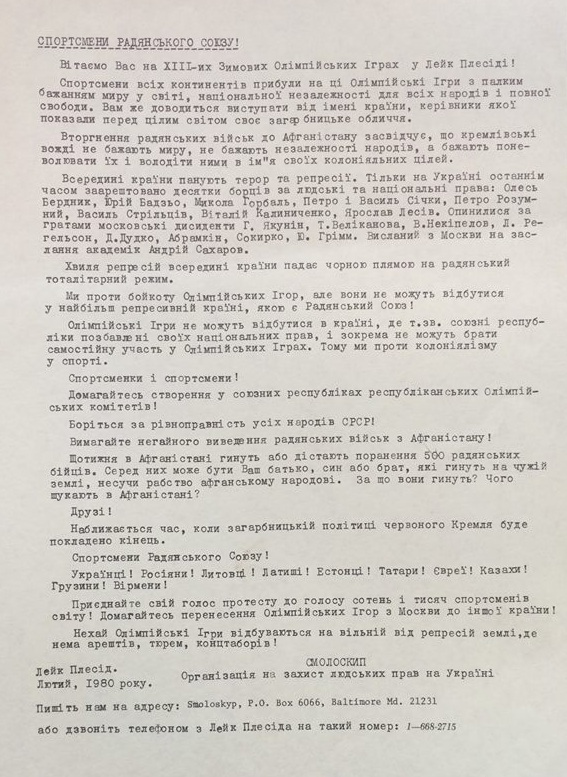
Their campaign pursued three main goals: To demand that the Olympic Games be moved from Moscow to a neutral country in protest against mass arrests in Ukraine and the Soviet invasion of Afghanistan. To demand independent Ukrainian participation in the Olympics. To protest Soviet colonial control over sports.
The goals were indeed extremely ambitious, but the place and time for their implementation were chosen successfully. After all, the Winter Olympic Games are international sports and cultural events of a global scale with television coverage of millions of viewers around the world.
Smoloskyp had prepared extensively — producing flyers, bumper stickers, and postcards addressed to the President of the International Olympic Committee, organizing protests, speeches, and press briefings.
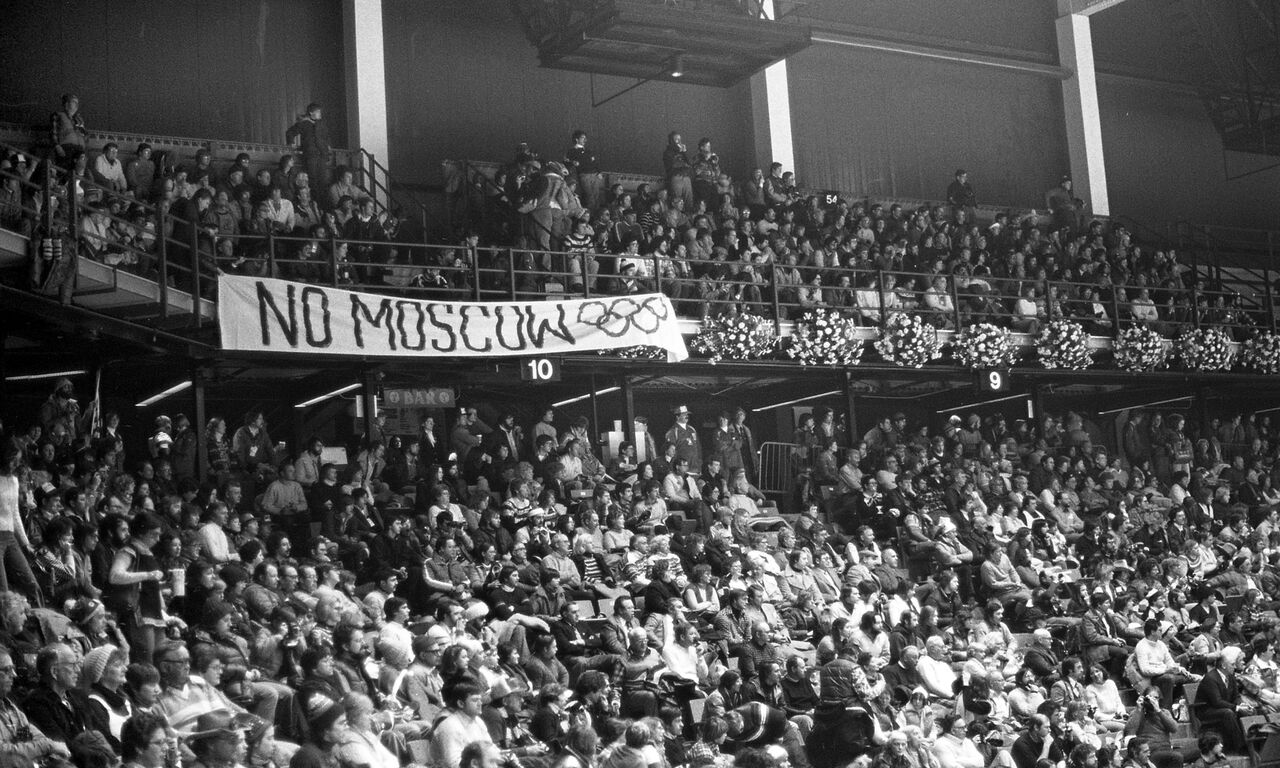
The Ukrainian action, seen by hundreds of people in the ice arena and by thousands on television — and possibly even behind the “Iron Curtain” (if Soviet security services did not interrupt the live broadcast) — took place during the hockey match between the USSR and Poland national teams.
One highly visible action occurred during the ice hockey match between the USSR and Poland, when a massive 25-meter banner reading “No Moskow” appeared, with Olympic rings wrapped in barbed wire. Another 20-meter banner in Ukrainian and English read “Freedom for Ukraine,” hung opposite the Soviet delegation’s section.
The determination and practical activism of Smoloskyp made the communist occupiers feel uncomfortable in the United States. Thousands of athletes and tourists in Lake Placid, as well as millions of television viewers, witnessed this. The action so infuriated the USSR delegation that its representatives appealed to the police and confronted the Ukrainians. Under pressure from the arena administration and security services, Smoloskyp activists were forced to remove the banners. Yet the main goal had been achieved — the whole world began talking about Ukraine.
At the same time, other members of Smoloskyp were distributing thousands of leaflets, stickers, and protest Olympic badges. This large-scale information campaign by Ukrainians attracted the attention of the international press. In particular, the chief correspondent of the French newspaper Le Figaro interviewed members of the Ukrainian group. Osyp Zinkevych gave an interview to Radio Liberty, while Andrii Karkots provided one for the Ukrainian Service of the Voice of America. These conversations were heard by millions of people in Europe and America.
The next striking action by Smoloskyp and its activists was an attempt to secure a personal meeting with the President of the International Olympic Committee, Michael Morris Killanin. Here is how it happened: “On February 16, representatives of the Ukrainian group—A. Karkots and O. Zinkevych—visited the office of the International Olympic Committee and submitted a formal request asking that Lord Killanin, President of the IOC, receive representatives of the Ukrainian group and formally accept new documents—appeals from members of the Human Rights Movement in the USSR regarding the Summer Olympics in Moscow.” Unfortunately, the IOC Secretariat refused the Ukrainians. Their response cited the IOC Charter, which did not allow the official acceptance of these documents. However, an alternative was proposed: the IOC would accept them through the mediation of the United States Olympic Committee. Such politically and “Olympically” acrobatic maneuvers were used by IOC representatives in order to avoid official communication with Ukrainians from the diaspora.
Overcoming all the challenges that stood in the way of Smoloskyp activists, they continued their Olympic-related activities. A unique and extremely timely event was a press conference. Here is how the newspaper Svoboda (USA) wrote about it:
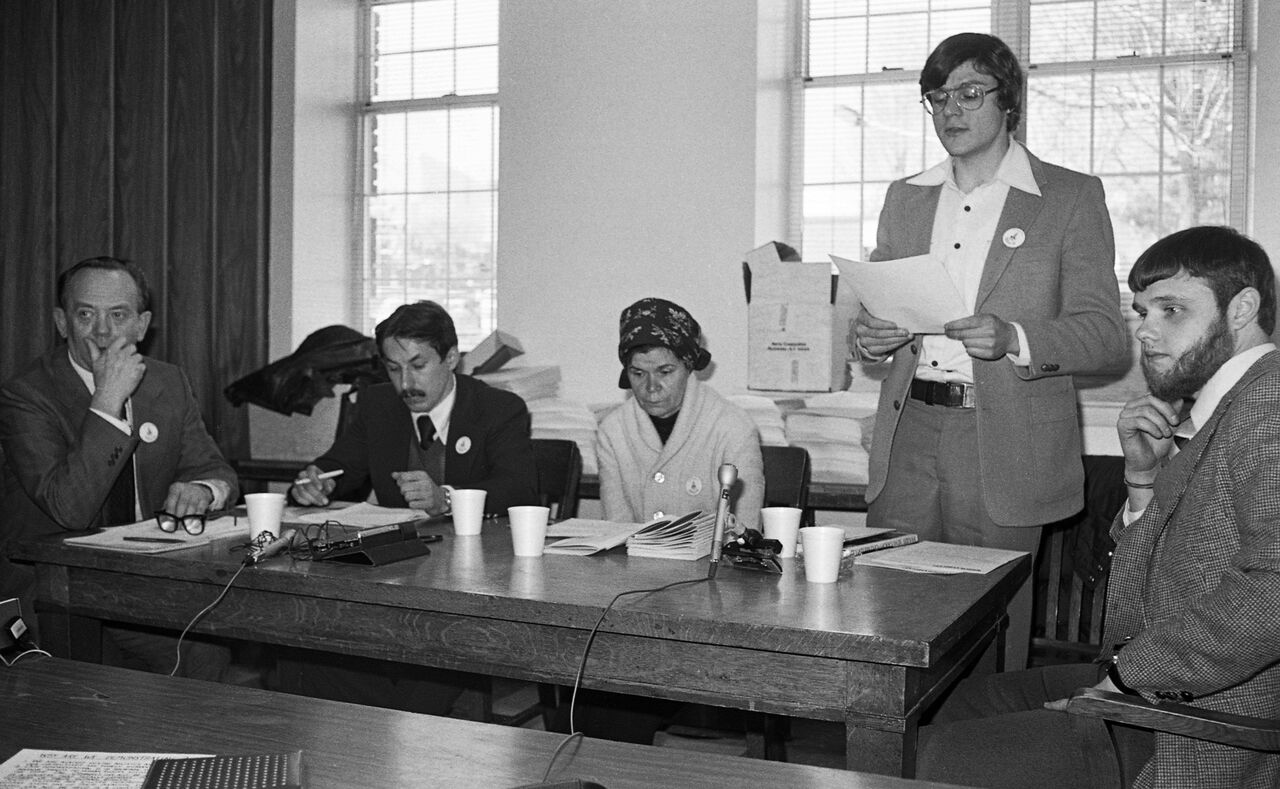
“Lake Placid, N.Y., XIII Winter Olympic Games (UIS ‘Smoloskyp’). On Monday, February 18 of this year, a press conference organized by Smoloskyp—the Organization for the Defense of Human Rights in Ukraine—took place here in the conference hall of the City Administration, at which Nina Strokata-Karavanska spoke on behalf of the Kyiv Ukrainian Helsinki Group.”
The level of organization of this event was truly impressive. A well-known human rights defender and dissident, Nina Strokata-Karavanska, who fully shared the goals of the organization, joined the Olympic initiatives of Smoloskyp activists.
The press conference was opened by Petro Kachmar. The statement was read in Ukrainian by Osyp Zinkevych and in English by Yurii Deichakivskyi. Documents addressed to the International Olympic Committee from the Association of Helsinki Guarantors in the USSR, as well as a document signed by 58 dissidents in the USSR, were presented by the chief spokesperson of the Ukrainian group in Lake Placid, Andrii Karkots. On behalf of the Kyiv Ukrainian Helsinki Group, Nina Strokata-Karavanska issued a call to move the Olympic Games from Moscow to another, free country. Organizational matters of the press conference were assisted by Yarema Harabach, Bohdan Balagutrack, and other activists.
On February 24, Smoloskyp organized a second press conference. The moderator of the event was Orysia Hevka, a member of the Committee for the Defense of Human Rights in Ukraine from Philadelphia. Among the speakers were Yurii Deichakivskyi and Andrii Karkots. The latter spoke about a resonant and at the same time mysterious case involving Ukrainian athletes—the Papirov brothers.
The Papirov brothers were supposed to compete in Lake Placid in luge events but never arrived in the United States. It turned out that they had been included in the USSR national team, yet they did not appear at the Winter Olympic Games. According to one version voiced by Andrii Karkots:
“According to information we received, the KGB accused them of nationalist tendencies and labeled them politically unreliable… as a result, they were barred from competing in the Lake Placid Olympics.”
This was a demonstrative and profoundly unsportsmanlike story of the communist regime’s abuse of Ukrainians—a reality of that time. Later, I personally asked one of the Papirov brothers about the reasons for their absence. He replied that such practices were common back then—removing Ukrainian athletes and replacing them with Russians, even when Ukrainians were clearly superior.
That is exactly what happened this time as well: the Papirov brothers were the strongest luge athletes and had every right to compete in the Olympic Games. Yet the genocide of Ukrainians in the USSR manifested itself even in sports.
Olympic Ukrainian Liberation Front
Activists of the Ukrainian Liberation Front (ULF) also actively joined the Ukrainian Olympic actions. The organization categorically opposed holding the Olympic Games in the capital of a terrorist state—Moscow. There were strong reasons for this: the oppression of nations by the USSR, including Ukrainians; systematic violations of human rights; national repression; political persecutions; military aggression in Afghanistan, and more. This list of crimes of the communist regime is far from complete.
From the beginning of the year, during the XIII Winter Olympic Games in Lake Placid, activists of the Ukrainian Liberation Front launched their activities. After arriving in the United States, they protested near the U.S. mission to the United Nations in New York and later directly during the Olympic Games.
These protest actions lasted for a week—from February 17, three days before the final decision of the U.S. authorities to boycott the Moscow Olympics. Members of TUSM and SUSTA held a demonstration in front of the U.S. mission to the UN, demanding that President Jimmy Carter keep his promise to the American people: if Soviet troops were not withdrawn from Afghanistan, the United States should boycott the Olympic Games.
The demonstrators drafted an appeal to the President of the United States, the American Olympic Committee, athletes, and the public, calling for a boycott of the Moscow Olympics. The action was covered by American television and radio companies, including NBC, WPIX, WNEW, UPI, as well as Venezuelan television and others.
 On February 20, ULF activists from the United States and Canada arrived in Lake Placid. Their main goal was to inform approximately four thousand accredited journalists about the fate of Ukraine and to put forward their demands to the International Olympic Committee. They protested against violations of human rights, national dignity, and Ukrainian identity, against KGB interference in sports, and sought the broadest possible international support for the Ukrainian cause.
One representative of the Ukrainian Central Information Service of the Liberation Front held full press accreditation from the Olympic press center. He systematically visited major international news agency offices, delivering documents and materials calling for a boycott of the Moscow Olympics. By Saturday, February 23, the Olympic press center was literally flooded with propaganda materials—letters, leaflets, and informational appeals. In response, the representative of UCIS was stripped of his accreditation. In effect, this became an act of retaliation by representatives of the Soviet delegation.
ULF activists were also present at three sporting events: skiing competitions and the USSR–Canada and USA–USSR hockey matches. During these events, they displayed Ukrainian flags and banners, distributed leaflets, and even engaged in direct conversations with spectators from the USSR.
The next step for ULF activists was another attempt to secure a personal meeting with IOC President Lord Killanin—similar to the efforts made by Smoloskyp. Each time, however, Ukrainians were refused. Then some ULF members (16 people) took an unprecedented step. They entered a hotel in Lake Placid and headed to the IOC’s main office located in the Governor’s Hall. Breaking through police security, the activists reached the office and declared its “occupation,” demanding an immediate meeting with the IOC President. After an hour and a half, police forced the demonstrators to leave the premises—fortunately, without arrests.
Despite attempts to conceal the incident, the demonstration became widely known. In particular, a report on the “occupation” of the IOC office was broadcast to Ukraine by the Voice of America radio station.
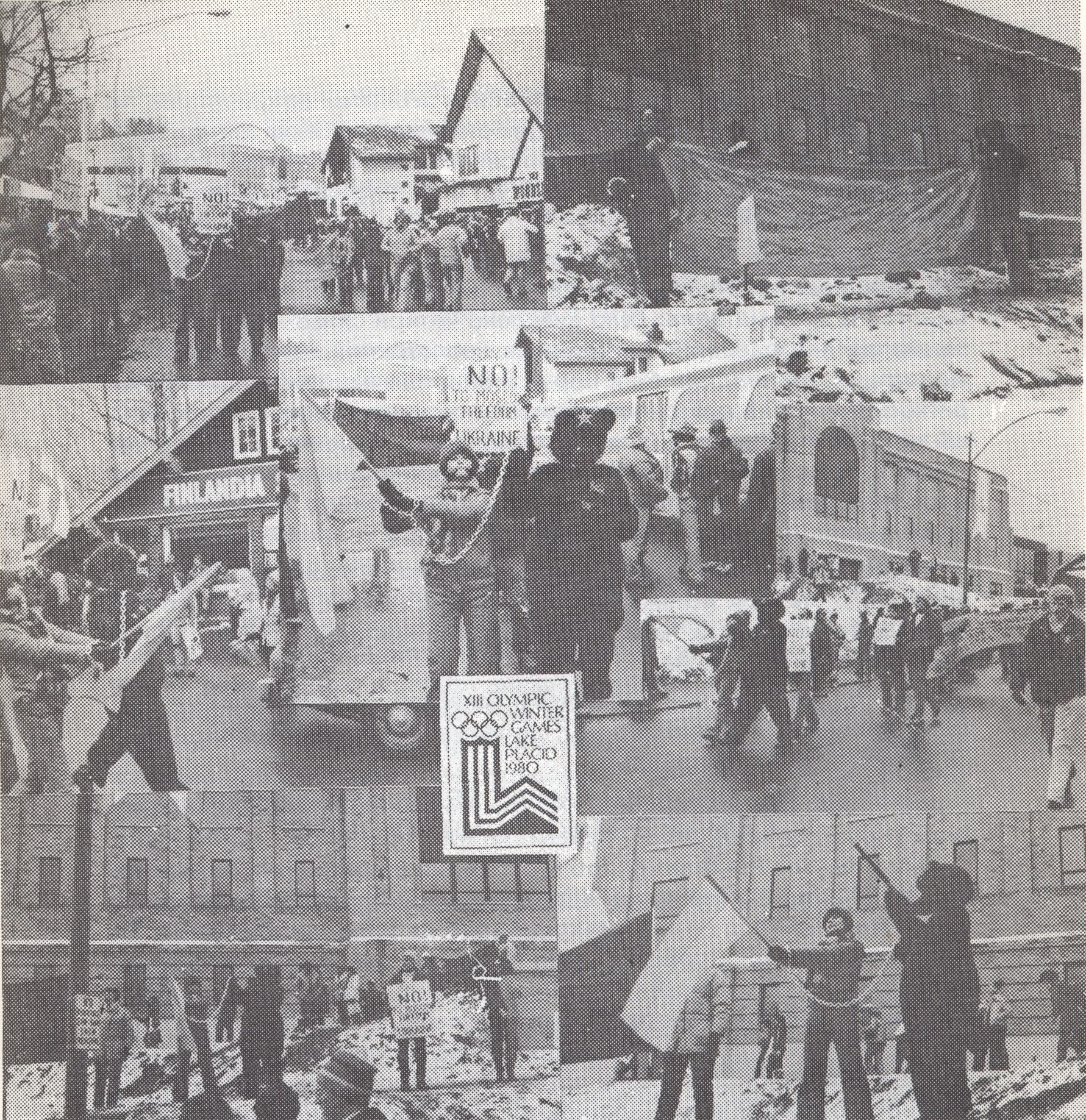
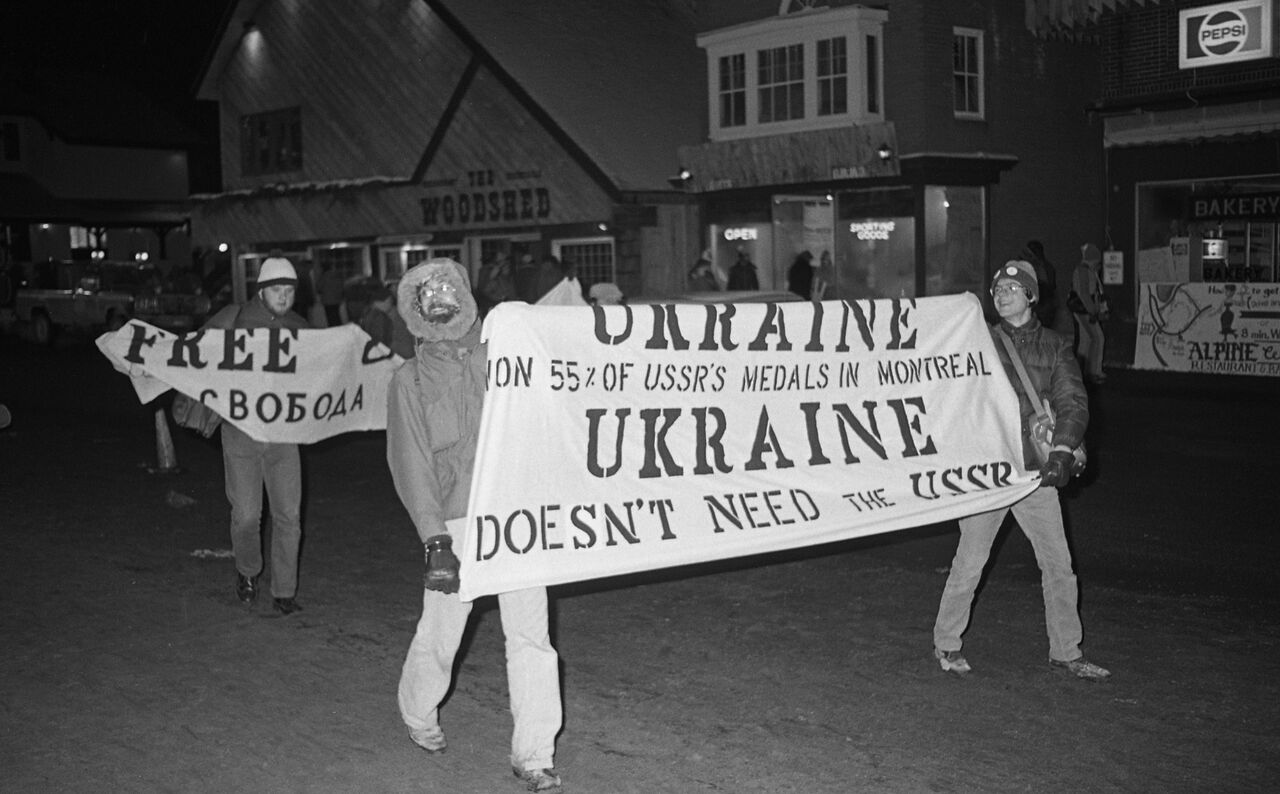
ULF actions continued despite all obstacles. One of the most effective ways of informing the public (about 50,000 tourists arrived in Lake Placid daily) was street demonstrations. Especially symbolic was a march with four Ukrainian flags, five large banners, and an activist dressed in a bear costume. On the “bear’s” chest was a hammer and sickle; in its right hand it held a rifle, and in its left—a chain binding a Ukrainian girl holding a Ukrainian flag. During this action, about 20,000 propaganda leaflets were distributed. The demonstration caused unprecedented excitement among tourists and media representatives: thousands of people stopped to watch, activists gave numerous interviews, and television crews filmed the event.
More than 30 members of the Ukrainian Liberation Front took part in the demonstration. In addition, ULF activists identified the residences of Soviet athletes and made direct contact with them, distributing Ukrainian leaflets, brochures, stickers, badges, newspapers, and magazines.

In the city of Utica, near Lake Placid, the local Ukrainian community—particularly SUM youth—organized a bright, city-wide visual action. An entire street was decorated with Ukrainian flags and national symbols, including the State Coat of Arms of Ukraine.
We have much—and many—to be proud of!
Oleksiy Lyakh-Porodko