


In Brooklyn, the Crimean Tatar community of New York held a memorial event to mark the 82nd anniversary of the Surgun genocide of 1944 – the mass deportation of Crimean Tatars by the Soviet regime. The event combined a memorial service, an academic discussion, and a presentation of new scientific research on Crimean Tatar subjectivity and Crimea.
This was reported by by the Crimean Tatar Foundation USA Inc.
The memorial took place on May 17 at the American Association of Crimean Turks building in Brooklyn, near the UN headquarters. Representatives of the Crimean Tatar diaspora, youth, researchers, activists, and community members participated in the event. The commemoration began with the performance of the Crimean Tatar national anthem.
The President of the American Association of Crimean Turks, Esma Resutova, and the Director of the Ismail Gasprinsky School, Elzar Celebi, opened the memorial ceremony. The imam of the mosque at the association read a funeral prayer for the victims of the deportation.
Under the leadership of the Crimean Tatar language teacher, Leyla Ametova, the children recited poems by Crimean Tatar poets in their native language. The participants also laid out candles in the shape of a tamga, the national symbol of the Crimean Tatar people.
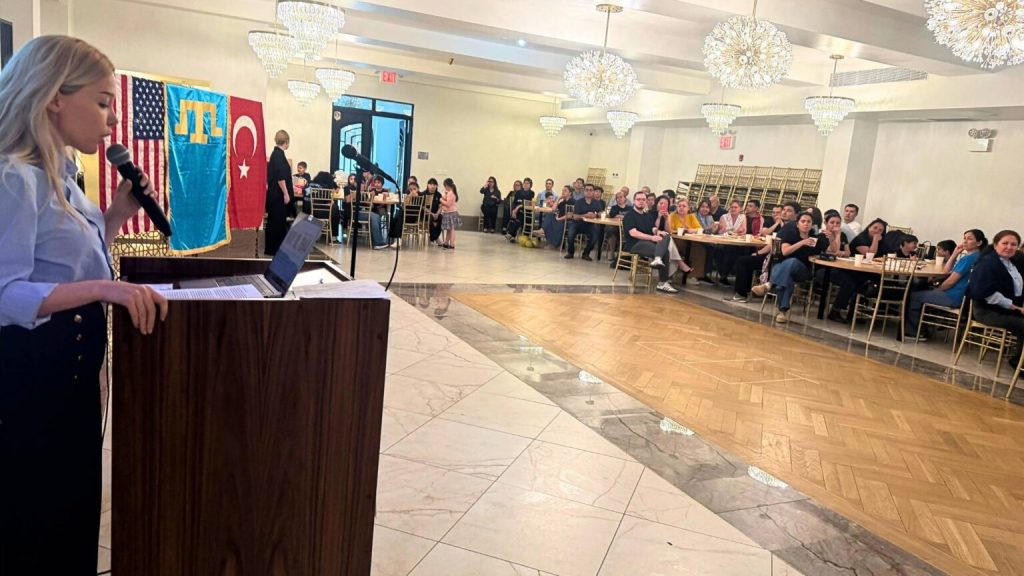
The organizers emphasized that the memorial was not only an act of remembrance, but also a reminder of the modern struggle of the Crimean Tatars for the right to be the subject of their own history.
This year, the memorial event also became an academic platform. During the event, two new monographs by researchers Zera and Zarema Karashaysky Mustafaev were presented - the result of three years of work at Purdue University. The authors are researchers at the Brian Lamb School of Communication at Purdue University and co-founders of the Crimean Tatar Academy of Arts and Sciences.
The first monograph, “The Crimean Tatar Nation in Great Works of Art,” explores the historical presence of Crimean Tatars in Crimea through European art of the 16th–19th centuries. The second work, “The Autochthonous Nation of Crimea: Crimean Tatars in the Russian-Ukrainian War,” explores the topic of cognitive warfare and how language and narratives influence the international perception of Crimea and the Crimean Tatar issue.

During the discussion, the authors emphasized that Ukraine’s legal position on Crimea is strengthened by recognizing the rights of the Crimean Tatars as an autochthonous nation.
“Ukraine’s right to Crimea is derivative and secondary to the primary right of the autochthonous nation, the Crimean Tatars. This does not diminish Ukraine’s rights. It strengthens them,” said Zera Mustafaeva.
She emphasized that in future negotiations on Crimea, the Crimean Tatars should be considered as a sovereign entity, not just an “indigenous people” or an “issue.”
“The strongest argument in international law is not ‘we want to return our land,’ but ‘this land has never legally left the sphere of sovereign autochthonous subjectivity,’” the researcher noted.
The event also officially announced the establishment of the Crimean Tatar Academy of Arts and Sciences, the first sovereign academic institute of the Crimean Tatar nation.

According to Zera Mustafayeva, the academy should become a platform for the development of Crimean Tatar research, education, and international communication.
"The Academy, founded in 2026, is an institutional response to the challenge we document in our research. The autochthonous nation needs its own academic institutions — not because other universities are inadequate, but because questions of Crimean Tatar subjecthood require a research framework that centers the Crimean Tatar nation as a subject, not an object of study. The Academy is to become the place where young Crimean Tatar scholars receive the instruments for defending their people — legal, academic, communicative. This is a matter of justice. We want Crimean Tatar history to be not only preserved, but integrated into global narratives." she said.
Let us recall that the deportation of Crimean Tatars on May 18, 1944, known as Surgun, became one of the greatest tragedies in the history of the Crimean Tatar people. By order of the Soviet authorities, hundreds of thousands of people were forcibly deported from Crimea to Central Asia and other regions of the USSR. Thousands of people died during the deportation and in the first years of exile.
Today, the Crimean Tatar community around the world holds annual memorial events, recalling the genocide, the struggle for the right to a homeland, and modern repression in occupied Crimea.
Photo: Crimean Tatar Foundation USA Inc
Author: Inna Mikhno