


The House is set to vote as early as June on the Ukraine Support Act, H.R. 2913, after supporters of the legislation have successfully used a rarely invoked procedural maneuver known as a discharge petition to force the bill onto the House floor. The process allows lawmakers to force a vote on legislation that has been stalled or blocked by committee chairs, who wouldn't markup the bill, or the House speaker who refuses to bring up for a vote a bill that has already passed committee. To succeed, the petition required signatures from a majority of House members — in this case, 218 lawmakers. The final and decisive signature came May 13 from Rep. Kevin Kiley, officially completing the procedure and clearing the way for a House floor vote.
The bill, which combines sanctions against Russia with provisions supporting Ukraine, had remained blocked in House committees for months without advancing to a vote. Lawmakers then turned to the discharge petition process to force action on the measure. The Ukraine Support Act would become the first major Russia sanctions package to receive a vote in the current Congress.
The effort to secure the necessary signatures involved months of work by Ukrainian advocacy groups and activists, who met with lawmakers and congressional staff, organized calls from constituents and pushed members to support the petition.
What the Discharge Petition’s Success Means
A discharge petition is typically used when House leadership or committee chairs effectively block a bill from advancing. Under normal procedure, legislation must first move through relevant committees before House leadership decides whether to bring it to the floor for a vote. But when a bill remains stalled for months, lawmakers can bypass leadership through a discharge petition. That is what happened with the Ukraine Support Act.
“After months, the Ukraine Support Act was still not marked up by committees, which means that it cannot advance for a floor vote,” said Eugene Goncharov, Policy Lead at the American Coalition for Ukraine. “A discharge petition is a way around this.”
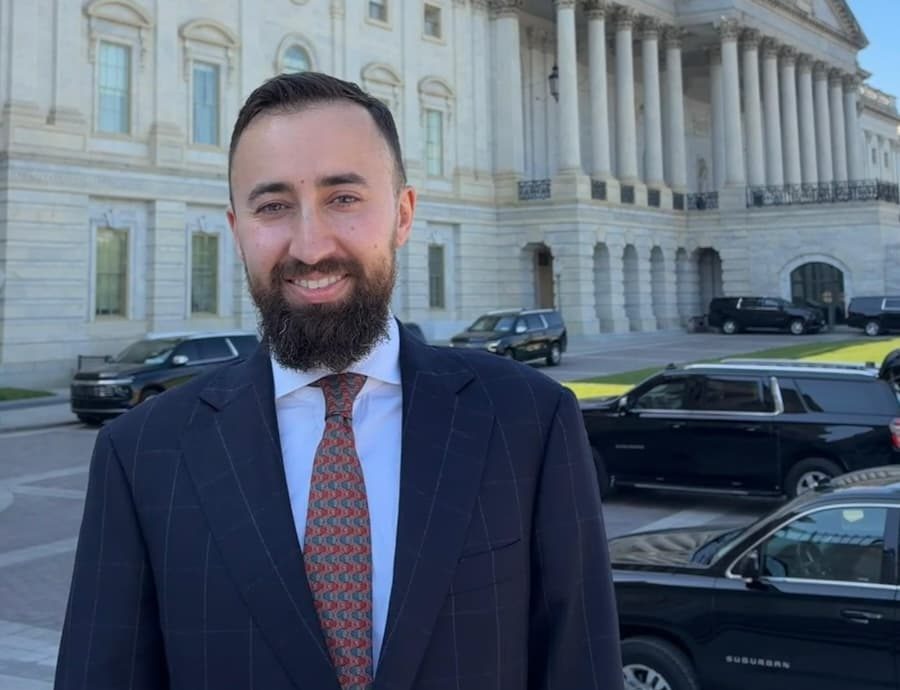
Goncharov said the discharge petition ultimately became the only viable path for supporters trying to move the Russia sanctions package out of congressional deadlock.
“The discharge petition has now enabled the bill to go for a floor vote, which is incredibly important because this bill is a comprehensive bill of sanctions against Russia and aid for Ukraine,” Goncharov said.
What the Ukraine Support Act Would Mean for Ukraine and Sanctions on Russia
The Ukraine Support Act is a sweeping legislative package that combines expanded U.S. support for Ukraine with new economic sanctions targeting Russia.
The bill includes provisions:
- to continue military assistance to Ukraine
- establish a lend-lease mechanism for faster weapons transfers
- impose sanctions on Russia’s energy, banking and defense sectors
- also targets Russian officials, oligarchs and companies tied to the Kremlin,
- while introducing measures aimed at preventing sanctions evasion through third countries.
- in addition, the legislation includes provisions related to the use of frozen Russian assets
- support for Ukraine’s postwar reconstruction.
The text of the legislation states that its purpose is to “support Ukraine and hold Russia accountable for its aggression,” while reaffirming that it is U.S. policy to support Ukraine’s sovereignty and territorial integrity.
Unlike many previous Ukraine-related measures introduced in Congress, the bill goes beyond symbolic resolutions and statements of support. Instead, it proposes a broad legislative framework for increasing economic and political pressure on Moscow.
Goncharov said the combination of sanctions and Ukraine aid also made the legislation politically more difficult to move through Congress, where debates over additional support for Kyiv have increasingly divided Republicans.
In recent months, Congress has seen a series of Ukraine- and Russia-related proposals introduced on Capitol Hill, but most never advanced to the House floor.
“We looked at two things: what exactly the bill does, and whether it actually has a chance of becoming law,” Goncharov said.
That is why advocacy organizations, including the American Coalition for Ukraine, increasingly concentrated their efforts on the Ukraine Support Act — the measure they believed currently stood the best chance of reaching the House floor and passing the chamber.
Why It Was So Difficult to Pass
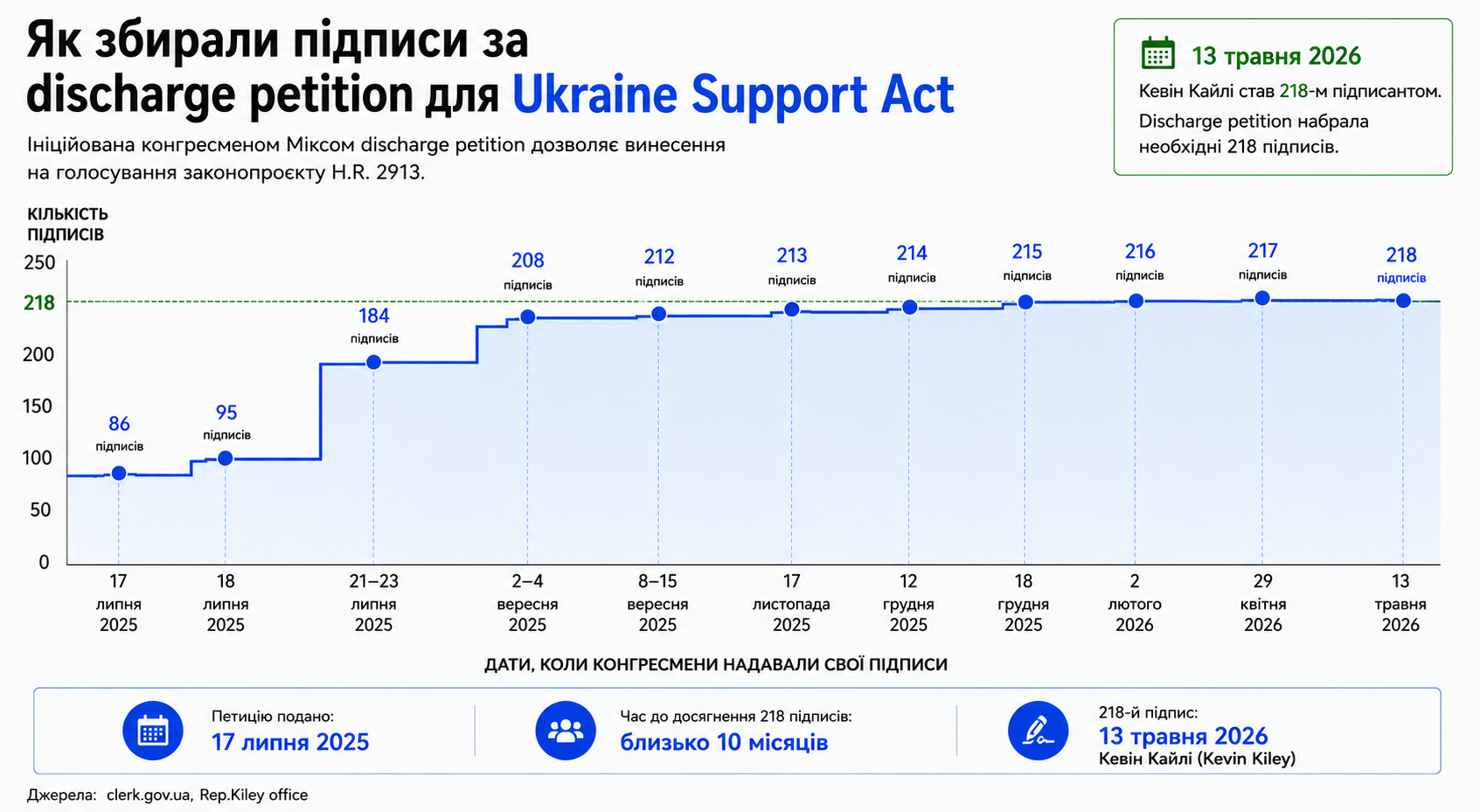
The discharge petition for the Ukraine Support Act was launched July 17, 2025, by Rep. Gregory Meeks, the top Democrat on the House Foreign Affairs Committee — and the author of the Ukraine Support Act itself. In a statement announcing the discharge petition, Rep. Meeks argued that Congress needed to step in if the White House failed to increase pressure on Moscow. “If the administration refuses to do what is necessary to bring this war to an end, Congress must take action by supporting Ukraine to put it in the strongest possible negotiating position and cracking down on Russia’s ability to fund its war machine,” Rep. Meeks said.
The discharge petition initially gained signatures at a relatively steady pace, with most Democrats backing the effort early. By Sept. 15, 2025, supporters had secured 212 signatures, leaving it just six votes short of the 218 needed to force the bill onto the House floor. But those final six signatures proved far more difficult to obtain. For nearly eight months, the petition remained stalled. The fight ultimately centered on Republicans, whose support became essential to pushing the petition across the 218-signature threshold.
“Signing a discharge petition, by definition, means that a lawmaker does not trust leadership to bring the bill up and wants to go around them,” Goncharov explained. “It's a drastic step."
“Signing a discharge petition, by definition, means that a lawmaker does not trust leadership to bring the bill up and wants to go around them,” Goncharov explained. “It's a drastic step." For Republicans, signing the discharge petition carried political risk, too. The move amounted to a public signal that a lawmaker was willing to break with House leadership and bypass the normal process.
That dynamic is why the advocacy campaign organized by the American Coalition for Ukraine focused on a relatively small group of Republican lawmakers viewed as potentially persuadable.
Over the course of several months, pro-Ukrainian advocacy groups and activists mounted a coordinated campaign targeting both Capitol Hill and lawmakers’ home districts. The effort included meetings with congressional offices, constituent phone calls, letter-writing campaigns and direct outreach aimed at persuading members to support the discharge petition.
“We consistently presented updated polling showing that a majority of Americans support sanctions against Russia,” Goncharov said.
Activists increasingly framed their case not only in terms of support for Ukraine, but also as a matter of U.S. national security. After tensions involving Iran escalated, campaign organizers argued that Russia was aiding governments and armed groups that threaten U.S. allies and American forces abroad. They also pointed to expanding military cooperation between Ukraine and the United States in drone warfare, citing Ukraine’s battlefield experience as increasingly relevant to American security planning.
“Ukrainian drone experts are now working on U.S. bases in the Middle East, helping American forces counter Iranian swarm-drone tactics,” Goncharov said.
A key breakthrough came with the signature of Rep. Don Bacon, the first Republican to back the petition. Bacon signed on Sept. 11, 2025, becoming the 211th lawmaker to support the effort and signaling that the initiative was beginning to attract bipartisan support.
Another major milestone came Dec. 18, 2025, when Rep. Brian Fitzpatrick joined the petition as the 215th signer, bringing supporters within three votes of the threshold needed to force a floor vote.
The 218th Signature
The final breakthrough came May 13, 2026, when Rep. Kevin Kiley of California provided the decisive 218th signature needed to force the Ukraine Support Act onto the House floor.
In a statement released afterward, Kiley framed support for Ukraine as directly tied to broader U.S. security interests.
“Recent Ukrainian gains have created an opportunity for peace, but the collapse of the recent ceasefire shows that leverage is needed for diplomacy to succeed.” Kiley said in a statement after signing the petition. “Congress can act now, in a bipartisan way, to strengthen that leverage and advance a durable peace that protects the interests of the United States and our allies.”

He also argued that “we must also send a strong message that Russian support for Iran’s targeting of U.S. military assets will not be tolerated.”
In an interview with MSNBC, Kevin Kiley noted that Congress had already approved a bipartisan Ukraine aid package worth more than $60 billion two years earlier, but said lawmakers had not remained actively engaged as the war continued.
“Congress has spoken in a bipartisan way before, saying that we need to support Ukraine, we need to deter Russian aggression,” Kiley said. “But as I said, that was two years ago and Congress has not really been actively involved as this conflict has worn on and as so many lives have been lost.”
Rep. Kiley said that was why he decided to provide the decisive signature for the discharge petition.
“So I provided the decisive signature on this discharge petition, which is a way to bring a bill to the floor simply by the members of the House demanding it,” he said.
“I Was Just Speaking From the Heart”: The Story of an American Mother Whose Son Died Fighting for Ukraine
Behind the scenes, one of the most resonant voices in the campaign for the Ukraine Support Act was Alison Magallon, a resident of Rep. Kevin Kiley’s district and one of his constituents. In Congress, pressure from voters in a lawmaker’s own district often carries particular political weight.
Magallon became one of thousands of American constituents who spent months calling congressional offices, writing letters and meeting with lawmakers’ staff members in support of the petition.
Her involvement in the campaign, she said, was deeply tied to the story of her son, Jericho Magallon — an American volunteer who traveled to Ukraine after Russia’s full-scale invasion in 2022, later joined the Ukrainian military, and was killed near Bakhmut.

Magallon said that after moving into Kiley’s district, she was contacted by members of the Ukrainian community and activists who were trying to persuade the congressman to support the discharge petition.
“I was never really involved in politics,” Magallon said. “But people told me Kevin Kiley had supported Ukraine over the years, yet he still hadn’t signed the petition and that his signature was needed. I made multiple telephone calls and I wrote emails.”
Magallon said she was never able to secure a face-to-face meeting with Kiley, but continued contacting his offices for months through calls, emails and repeated conversations with congressional staff.
“I don’t even speak the language of politics,” Magallon said. “But my heart is right there. This is not political, it’s humanitarian.”
She told the story of her son, who decided to help Ukraine and ultimately lost his life there.
Magallon recalled that in February 2022, her son called her from a passport office in Los Angeles, where he was preparing travel documents, and told her he was flying to Ukraine. At the time, she said, Jericho had an adopted son to whom he was deeply attached, and she tried to persuade him to remain in the United States. But she said he had already made up his mind.
“Mum, this is like watching a bully beat up a child in the playground while everyone just stands around watching and doing nothing. I have to go help,” Alison Magallon recalled her son telling her.
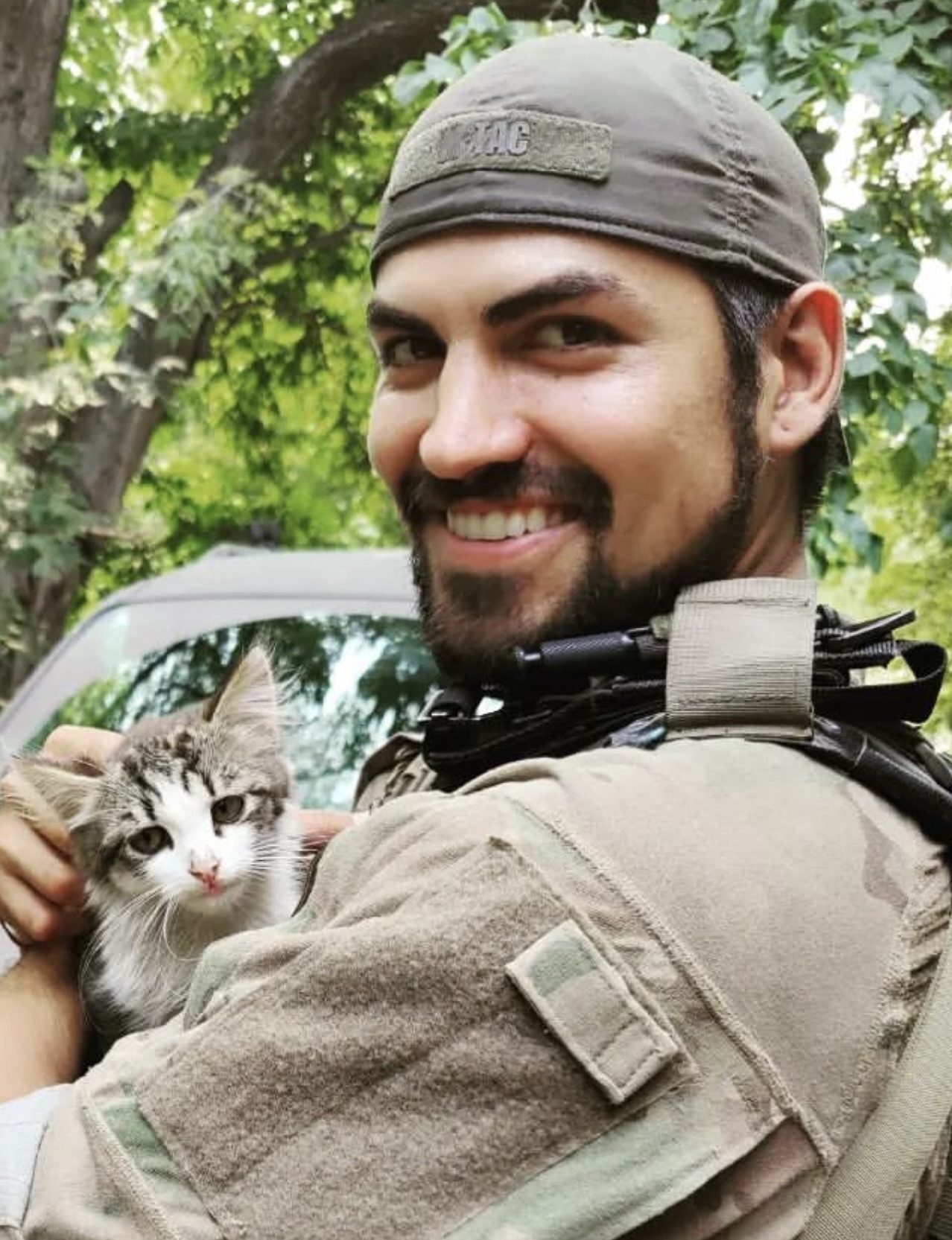
Magallon said her son had previous military experience in the United States and served four years in the U.S. military. After Russia’s full-scale invasion began, he searched for ways to reach Ukraine, contacting both the Ukrainian and U.S. embassies. But, she said, he was told that if he decided to go, he would have to do so on his own.
On the way to the airport, Jericho bought a bulletproof vest, flew to Warsaw and then hitchhiked his way to Kyiv. He initially worked with volunteer groups helping evacuate civilians before later joining the International Legion and eventually transferring into the Ukrainian military’s special forces.

Magallon said her son became deeply immersed in Ukraine during his time there. Over roughly 10 months, she said, he learned Russian and Ukrainian well enough that he was later used by military units as a translator.
After nearly a year in Ukraine, Jericho returned to the United States because his adopted son, who was very attached to Jericho, was struggling with his absence. Around the same time, Jericho learned that his partner was pregnant with what would have been his first biological child.

Magallon said that after returning home, her son often spoke not only about combat operations but also about the civilians he encountered during the liberation of Ukrainian cities.
“It’s hard to hear, but I believe the public needs to hear it because these are stories we’re not hearing on the news,” Magallon said. “People talk about the war in general, but behind it is what’s really happening to civilians — the torture, the abduction of children in Ukraine, civilians living under occupation.”
Magallon said her son told her about a young woman Ukrainian forces evacuated after the liberation of Izium. According to Magallon, she remains in contact with the woman, who is now living in Germany.
“The Russians came in and killed her father immediately. They killed her brother. They even killed her dog,” Magallon said. “Her mother was pregnant. They raped her mother while she was pregnant, tortured both of them, and killed her mother in front of her.”
Magallon said the woman eventually managed to escape and was later evacuated to Germany, where she now lives.
“This is one story of multiple stories, probably tens of thousands,” Magallon said. “These stories are real. These are not getting reported. We don't hear this stuff on the news.”
After returning home, Jericho agreed to travel back to Ukraine for what was supposed to be a 10-day mission training Ukrainian soldiers. His mother said he promised he would not take part directly in combat operations, but eventually found himself near Bakhmut.

“On the last day, he promised he wasn’t going to go out and fight,” Magallon said. “But that was just Jericho’s nature.”
Jericho was killed Sept. 5, 2023, during combat operations near Bakhmut.
After her son’s death, she began traveling regularly to Washington and taking part in advocacy campaigns related to Ukraine.
For Magallon, support for Ukraine had long since stopped being an abstract foreign policy issue.
“I believe this is genocide that we’re watching,” Magallon said. “And it needs to stop.”
What Happens Next?
The Ukraine Support Act is now expected to receive a House floor vote, likely as early as June.
In an interview with MSNBC, independent California Rep. Kevin Kiley said the measure could receive broad bipartisan support in the House.
“In the next couple weeks, we are going to see a vote in the House, which I think will get pretty broad bipartisan support,” Kiley said. “We’re going to continue to support Ukraine. We’re going to have a lend-lease authority, and we’re going to have aggressive sanctions against Russia.”
Rep. Kiley also suggested that passage of the bill could increase pressure on both the Senate and the White House.
“And I think ultimately this could provide the needed leverage to eventually bring this conflict to a close in a way that will ensure that we do not continue to have Russian aggression,” he said.
If the House passes the Ukraine Support Act, the legislation will face a far more difficult path in the Senate, according to Eugene Goncharov.
“In the Senate, discharge petitions essentially do not exist,” Goncharov said. “There is the filibuster there, so the situation is much more complicated.”
The filibuster is a Senate procedure that allows lawmakers to delay or effectively block a vote on legislation by extending debate. As a result, even bills that pass the House can stall in the Senate if opponents refuse to allow them to move forward. They require as supermajority rather than a simple majority, to pass.
Still, Goncharov argued that even a successful House vote would carry significant political weight.
“This is a way to show the White House how strong support for sanctions is in Congress,” he said.
According to Goncharov, if sanctions legislation receives majority backing in Congress, it would send an important signal to the administration even as the White House continues to emphasize negotiations.
“It’s a signal that lawmakers are tired of waiting and want real sanctions against Russia,” he said.
How Advocacy Works
For the American Coalition for Ukraine, the campaign also serves as further evidence that the Ukraine Action Summit in Washington can translate advocacy into tangible legislative results.
Twice a year, hundreds of activists from across the United States travel to Capitol Hill during the Summit to meet with lawmakers and congressional staff, holding hundreds of meetings in just a few days. After returning home, many continue the advocacy campaign inside their own congressional districts. This spring, the organization's 8th Ukraine Action Summit was held April 19–22 and attracted over 700 attendees. As part of the Summit’s Advocacy Days, constituents held 445 meetings with Congressional offices. Within a month following the Summit, pieces of legislation that attendees advocated for saw a surge in support, gaining 61 new co-sponsorships in total, across target legislation. According to Eugene Goncharov, this is the largest surge in new congressional co-sponsors for Ukraine-related legislation in the Coalition’s history.
“We've seen a very strong pattern: after our advocacy visits, after our Ukraine Action Summit visits, the number of co-sponsors on pieces of legislation related to Ukraine spikes dramatically,” Goncharov said.
He argued that personal meetings with constituents often prove decisive in shaping lawmakers’ positions.
“Every co-sponsor on a bill is essentially a public endorsement by a member of Congress that they support that legislation,” he said.
For supporters of the Ukraine Support Act, the battle over Discharge Petition No. 8 became perhaps the clearest demonstration yet of how Ukrainian advocacy works in Washington: months of phone calls, emails, trips to Capitol Hill, meetings with congressional staff, pressure from constituents in lawmakers’ home districts and deeply personal stories from Americans and Ukrainians for whom the war had long ceased to be an abstract foreign policy issue. In the end, the effort came down to a single person, Representative Kiley, who provided the decisive 218th signature needed to force the bill onto the House floor.
Author: Andrew Getman
