


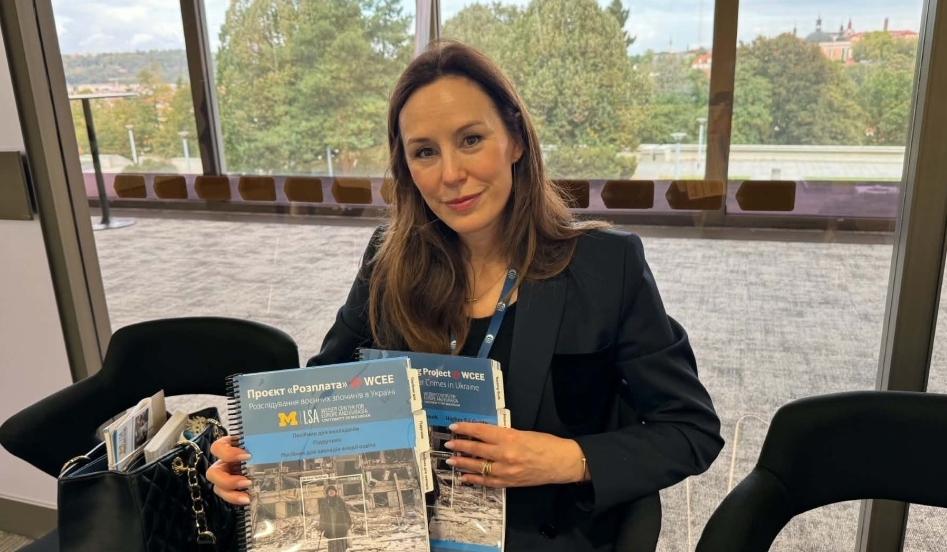
The University of Michigan has developed educational materials to help American educators explain Russia's war against Ukraine using documentary evidence, digital archives, and virtual reality technology. The initiative brings together the academic community and Ukrainian journalists who are documenting war crimes. The creators aim to share the Ukrainian experience with an international audience, particularly those who previously had little interest in Ukraine. The project is being developed by the Weiser Center for Europe and Eurasia at the University of Michigan.
This was reported by Ukrinform.
The educational materials are based on data collected by the international initiative "The Reckoning Project: Ukraine Testifies." Founded in the spring of 2022 by journalist Nataliya Gumenyuk and international colleagues, the project documents accounts of crimes committed during the Russian invasion.
The team worked with lawyers to ensure that the materials gathered by journalists met the standards required for use in legal proceedings. The initiative also collaborated with the Office of the Prosecutor General of Ukraine. The documented testimonies could prove crucial for cases heard in Ukrainian courts and the International Criminal Court in The Hague.
The University of Michigan has utilized these findings to create materials that bring the documented experience of the war into the educational setting. According to Zubrzycki, this makes it possible to discuss Ukraine not merely as a specific international conflict, but also to examine broader issues ranging from human rights protection to accountability for war crimes and genocide.

The project goes beyond a standard textbook. Its website hosts a collection of digital materials, including a map that tracks the advance of Russian troops, the resistance of Ukrainian forces, and documented instances of violence resulting from the invasion.
A distinct component of the project involves the use of virtual reality. Through specialized tools, users can experience the sights and sounds of locations under bombardment. This enables educators to supplement the theoretical study of the war with materials that convey the lived experiences of those caught in the conflict zone.
Work on the project began in August 2022. Initially, the team focused on gathering testimonies, subsequently creating an archive, a digital resource, and educational materials.
The textbook has already been translated into Ukrainian, Russian, and Belarusian in collaboration with Taras Shevchenko National University of Kyiv. Polish and French versions are currently in preparation, with future plans for translations into Spanish and Portuguese.
Expanding the range of languages aims to help disseminate information about Ukraine to people from diverse cultural and political backgrounds. Zubrzycki noted that the educational materials are also designed to reach audiences with little prior knowledge of the country or those who have shown little interest in the war.
"So, there are various ways to sensitize the American public to the situation in Ukraine, even if they know nothing about the country and are completely indifferent," the professor explained.
She emphasized that the university employs various formats to inform American society about Ukraine. Notably, in December 2024, a meeting was held featuring experts who had prepared recommendations for the newly elected administration of Donald Trump.
In Zubrzycki’s view, it is important to involve young people in such initiatives, as their understanding of international events is still taking shape. Educational programs, she noted, can help explain not only the circumstances of the war but also the significance of sovereignty, democracy, and human rights.
"So, this is very important. Education is the key to this. Absolutely. We are doing what we can," the scholar emphasized.
Educational materials are available for free on the project's website.
Photo: Olha Tanasiichuk / Ukrinform
Author: Danylo Pievchev