


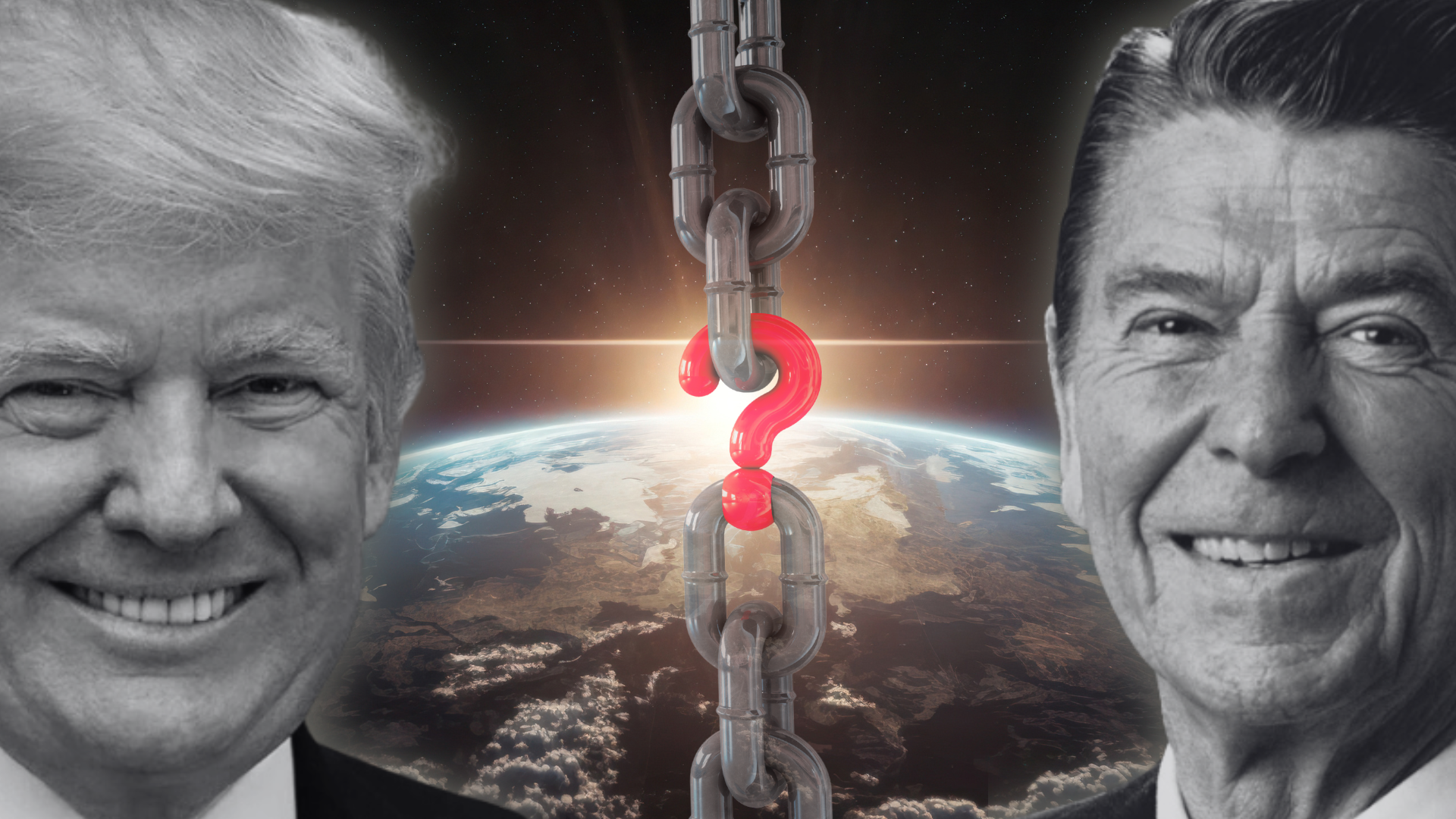
Ronald Reagan declared the USSR an "evil empire" and contributed to its collapse. Putin's Russia once again threatens Europe. During Reagan's time, the USSR was bogged down in Afghanistan; today, Russia is stuck in a protracted war in Ukraine. But can the events of 35 years ago repeat themselves in a new spiral of history? Agreements instead of victory?
Then and Now
Ronald Reagan, like Donald Trump, was elected on a wave of widespread dissatisfaction among Americans with the excessively leftist leanings of their predecessors (Carter and Biden). On the surface, there are many similarities in the global power dynamics of then and now. Back then, the Cold War never ceased for a moment; today, it continues in somewhat new forms. The USSR launched an aggressive invasion of Afghanistan, hoping for a quick victory, but became entrenched in a fierce battle with almost the entire Afghan population (a people who, as history has conclusively proven in our time, tolerate no foreign interference and defeat even the strongest adversaries). Today’s Russia is similarly bogged down in its war with Ukraine, despite initially planning to "capture Kyiv in three days." Afghanistan received covert support from the West; Ukraine is openly supported as a victim of aggression threatening to dismantle the entire modern world order.
The USSR of that era had a sphere of influence over half the world; today’s Russia ostensibly has the BRICS countries under its sway.
At this point, the parallels between the two situations likely end. The most striking difference is China, which during Reagan's era was only beginning to gain strength, "coldly friendly" with the U.S., and at odds with the USSR. Today’s China, with its vastly increased military and economic power, poses a strategic challenge to the U.S. and the entire Euro-Atlantic community. In fact, it is not Russia but China that leads BRICS, with Russia serving as a vassal to China.
However, the most significant difference between Reagan's world and the modern one lies in the absence of a powerful "inoculation" against a hot war in Europe—a fresh memory of World War II. During Reagan's time, this was still present in Europe, the U.S., and, to a large extent, the USSR. Even the most hawkish Soviet leaders did not seriously consider nuclear blackmail, let alone initiating any significant armed conflicts in Europe. Yes, there was an arms race, including weapons of mass destruction, but it was conducted under the doctrine of mutual assured destruction, with policies of peaceful coexistence prevailing.
Putin, in contrast, is blatantly destroying this policy as if he truly intends to sacrifice his country to his own phantom pains (which seemed to be healing during Gorbachev's and early Yeltsin's times but reopened surprisingly quickly during the Chechen wars, with Putin aligning with the expectations of his people). Today, thanks to Putin’s Russia, the world has nearly lost both the restraining force of the doctrine of mutual assured destruction and the anti-war inoculation provided by World War II. In other words, the objective anti-war factors that restrained the Euro-Atlantic world from conflict during Reagan’s time no longer exist today.
However, an increasing number of American experts and politicians are urging the newly elected president to abandon hopes for a quick resolution to the war in Ukraine and instead adopt a strategy focused on Ukraine's decisive victory. They emphasize the systemic challenge posed by anti-Western states, which have united in what has been described in numerous articles on this topic as an "axis of upheaval" to the global order.
This theme has been widely covered in the American press, both by Democrat- and Republican-leaning outlets. For instance, former Senate Minority Leader Mitch McConnell argues in a detailed article in Foreign Affairs that the isolationism advocated by some of Trump’s advisors, as well as calls to pivot toward the Indo-Pacific region at the expense of attention to Europe—particularly Ukraine—risks sparking a direct conflict between Russia and NATO.
"Confronting China will require Trump to reject the shortsighted advice of prioritizing this challenge while abandoning Ukraine. A Russian victory would not only damage U.S. interests in European security and increase the military demands on the U.S. in Europe; it would also heighten threats from China, Iran, and North Korea. Indeed, wavering in the face of Putin's aggression has already exacerbated these interconnected challenges," McConnell writes.
McConnell openly calls on Trump to reject isolationism in all forms and to significantly increase investments in defense and modernize the U.S. Armed Forces. Isolationism today, he warns, could lead to consequences as dire as those at the beginning of World War II.
Russia truly threatens the West with War
Modern Russia is already formulating plans to dismantle the Euro-Atlantic community, whether through hybrid warfare or a series of "special measures" involving espionage and covert operations. With contemporary technologies, as evidenced by numerous incidents—be it interference in elections in Europe and the U.S. or various FSB and GRU operations—such a war is entirely plausible, and nations are preparing for it.
But is Russia ready to engage NATO countries in a full-scale, "hot" war? This depends solely on its military potential—ideologically and morally, it is fully prepared. While Russia is bogged down in Ukraine, it is slowly advancing in the Donetsk region, paying no heed to enormous losses and even deploying North Korean troops in the Kursk area. To satiate his phantom pains, Putin has even endured the humiliation of withdrawing from Syria.
So, what kind of potential are we talking about when Russia prepares to take the war to NATO countries? This is the systematic preparation of Russia for a prolonged "existential" war against Western civilization.
"Putin has transformed Russia in such a way that it will remain a challenge to the West as long as he is in power, and likely long after he is gone," note Andrea Kendall-Taylor (former Deputy National Intelligence Officer for Russia and Eurasia at the U.S. National Intelligence Council from 2015 to 2018) and Michael Kofman (Senior Fellow at the Carnegie Foundation) in Foreign Affairs. Their detailed article outlines how both Russia and the circumstances are ripe for its attempt to destabilize NATO unless it is defeated in Ukraine.
This systematic preparation of Russian society for a protracted war includes a repressive regime, the restructuring of the economy into a full-fledged war camp, the strengthening of its "alliance of convenience" with Iran, North Korea, and China, and an escalating conflict with the West. Putin's simultaneous tendencies toward risk-taking and miscalculation further heighten the risk of war between Russia and NATO, the authors conclude.
With such risks, any shift in U.S. focus away from Europe—particularly a pivot toward the Indo-Pacific region, as some of Trump’s advisors advocate—could embolden Putin to pursue his plans in Europe.
"The current low-scale conflict with NATO countries is likely to continue until the Russian military rebuilds—a process that may take years. But the Kremlin will look for opportunities to further undermine NATO. Moscow will still have reasons for caution, not least because it views the Alliance as a superior force. However, it might yield to temptation if it becomes clear that the Allies—particularly the United States—lack resolve regarding collective defense. The Kremlin will be most inclined toward such calculations if the United States becomes involved in a major conflict with China in the Indo-Pacific region, which Washington considers its highest national security priority. If the Kremlin concludes that Washington will not—or cannot—defend Europe, and that Europe itself cannot prevail, then Moscow may target a country on NATO’s eastern flank, forcing NATO to respond," the authors note.
The Gateway of Opportunity
The Putin regime shows no signs of exhaustion or impending change. On the contrary, during his annual press conference, Putin insisted on his ultimatums, despite their proven impossibility and unrealistic nature.
However, the almost sudden withdrawal of Russian forces from Syria demonstrated just how exhausted the Putin regime is. It cannot wage war on two fronts, let alone attempt to fight NATO. Many experts emphasize the depletion of Russia's economy.
Moreover, the repressive regime in Russia continues to intensify, accompanied by the blatantly absurd and reactionary “laws” churned out by the State Duma. This, of course, keeps society in constant fear, but “an over-reliance on this, as Putin has done, can increase the likelihood of leaders making destabilizing mistakes,” note Kendall-Taylor and Kofman.
Thus, a small "gateway" of opportunity exists for the West between the strengthening of Putin's dictatorship and the regime's potential sudden collapse—something the West is not even preparing for (at least, it is rarely discussed in leading media outlets).
What Can and Should Be Done? First and foremost, resources should be directed toward preventing not only the resurgence of ISIS in Syria but also the restoration of Russian influence in the country (currently, hatred toward Russians there likely reaches its peak—this moment must not be missed). All utopian hopes that Russia might “help” against ISIS should be abandoned. Not only will it fail to help, but it will exploit the situation.
Make an attempt, even if belated, to support pro-European forces in Georgia (which has been blatantly overlooked).
Furthermore, dedicate much greater attention to Russian operatives in Europe and the United States (will the candidate for Director of National Intelligence, Gabbard, contribute to this effort?!).
It is crucial to carefully examine those Russians who oppose the regime, not only abroad but also those who, risking their freedom and sometimes their lives, resist within Russia itself. Yes, they quarrel, lack a unified strategy, and often defend imperial interests "without Putin"—all of this is true. However, it is urgently necessary to study the experience of working with antifascists during World War II and enhance these approaches with modern methods and technologies. There are no other anti-Putin forces available, so it is vital to engage with those who exist. People are capable of change, so diligent work must be carried out in the desired direction. More attention should be given to the "Freedom of Russia Legion," which is shedding blood on Ukraine's frontlines.
But most importantly, any discussions about reducing (let alone halting!) support for Ukraine in all possible areas and by all means must cease immediately! On the contrary, lessons must be learned from the overly cautious stance of the Biden administration (which may have been partially justified at the time due to Russia’s greater strength and the risks of a larger war not yet fully assessed). A strategic goal must finally be set: Ukraine's victory, not a "draw" in negotiations, which may not even take place, as Putin has no interest in them.
A Deal-Maker or a Leader of the Free World?
Donald Trump, by nature, is a deal-maker and seeks to apply the approaches of a businessman to both foreign and domestic policy. To achieve his goals (whether self-imposed or dictated by circumstances), he employs a wide range of tactics, from outright showmanship to sophisticated legal maneuvering, backdoor channels, and even threats (a striking example being his threat to initiate criminal proceedings against Liz Cheney simply for supporting impeachment after the infamous January 6, 2021, attack on Congress).
Trump appears to approach the resolution of the Russian-Ukrainian war from a deal-maker’s perspective, likely considering various plans suggested by his advisors. All proposed plans seem to boil down to organizing negotiations between Russia and Ukraine in various formats under U.S. mediation.
Most likely, Trump sees similar deal-makers in both Putin and Zelensky (whom he mockingly referred to as "the best deal-maker," likely jealous that Ukraine's president might take this "honorary title" from him). Trump thus hopes either to tempt Putin with partial sanctions relief for Russia or to threaten him with arming Ukraine to the point where it could achieve victory. At the same time, he implies that if Zelensky refuses to negotiate, he will cut off U.S. support for Ukraine.
Such an approach is doomed to failure because the deal-maker's perspective cannot be applied to the Russian-Ukrainian war. This war is neither a personal "dispute" between Putin and Zelensky nor merely a territorial conflict. What began as Putin's phantom pains—rooted in his ability to plunge his nation into the darkest fanaticism—has escalated into a civilizational war between the free world and the dictatorial regimes of the "axis of evil." It can only end with the victory of one side, carrying profound consequences for the global order.
If Ukraine is not given the means to win, and both sides are instead forced into some kind of "draw"—a painful compromise involving Ukraine's loss of occupied territories—the war will not only resume in a few years within Ukraine but will also spill over into NATO territory.
Even if negotiations are pursued, an essential condition for ceasing hostilities must be effective guarantees for Ukraine and tangible mechanisms to deter future aggressive actions by Russia. While guarantees to prevent another Russian aggression against Ukraine are being actively discussed, the issue of deterring Russia receives significantly less attention. Yet these issues are interconnected.
"Assistance to Ukraine is not charity driven by compassion for its suffering—it is an investment in global security, primarily for Europe." This slogan, repeated in various forms, still lacks sufficient substantive depth. However, this perspective must become the core of a strategic approach to global security.
This is precisely the Reagan approach. In today's context, it means viewing support for Ukraine, aimed at its decisive victory over the aggressor, through the lens of the future of the world.
Most likely, the logic of events will compel Donald to become Ronald—if he has the will, strategic vision, and systemic approach to global security.
Author: Nadiya Banchyk