


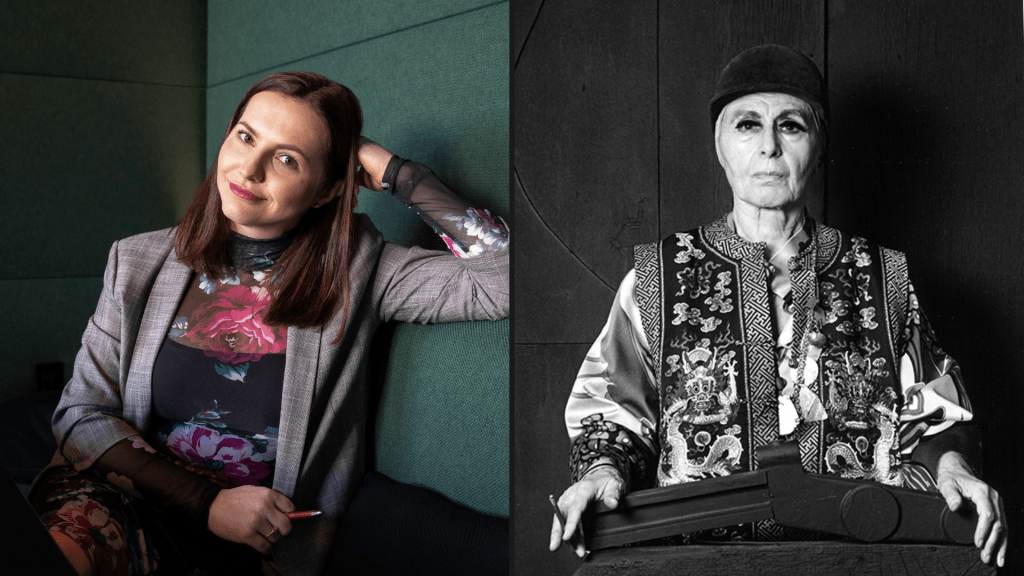
Ukrainian art has been buried under foreign banners for centuries. The names of our artists have been erased, appropriated, and their histories altered as if we had no right to our own voice. However, today, as Ukraine continues its struggle on all fronts – on the battlefield, in the information space, and in culture – there are those who are reclaiming our truth.
Anastasia Hudko, through her study of art, is reshaping the world’s perception of Ukrainian heritage and fighting to ensure that everyone whose journey is tied to Ukraine remains Ukrainian in history. Janet Sobel, Louise Nevelson, Leon Golub – these are just a few names of American artists Anastasia is reclaiming for Ukraine, rejecting the narratives of a colonial past.
This is a conversation about a mission that intertwines memory, art, and identity – and about how each of us, even far from our native land, can become part of this struggle.
LS (Lukian Selskyi): A question many still cannot answer: does all art deserve to exist? What is your subjective opinion?
AH (Anastasia Hudko): I believe we live in a time of oversaturation – of information and art alike. I think art should evoke emotion. Even if I don’t like it, that’s still an emotion. But evaluating the value of any artwork is a task for professionals – art critics and curators.
LS: Do I understand correctly that you identify two criteria for the value of art? The first is the emotion it evokes. The second is the personalization of art perception – because some may feel an emotion from it, while others do not. Accordingly, if it evoked an emotion in, say, Person X, then it worked and fulfilled its function.
AH: In my opinion, evoking emotion is the success of a work. Truthfully, anything can be art – even the marker I’m holding in my hand. If I now take some tape and stick it to the wall behind me, it might resemble Cattelan taping a banana and causing a sensation.
LS: But that’s simulacre – baudrillard-esque!
AH: Yes, it’s an imitation of something that doesn’t exist. But it’s still considered that Marcel Duchamp made a breakthrough when he presented a urinal and declared it art.
LS: What was the art in that? The challenge?
AH: That too… the provocation. At that time, let’s say, it was the art of provocation.
LS: For me, the value of the banana was in how quickly it rots and changes texture. To me, it speaks of the fleeting nature of all living things. The value lies in the brief moment of life.
AH: Bingo! That’s exactly the meaning he put into it. Everything is fleeting, and the value of anything will fade over time. By the way, in New York’s Washington Square Park, there’s a dancer – an Asian woman with very long hair, which she dips in water and uses to paint. Next to her, there’s a box. People not only throw money into it but also find some meaning in her actions. If I understand correctly, she started doing this during COVID, embedding even more meaning into her performance. Did this meaning always reach the audience? Not always.
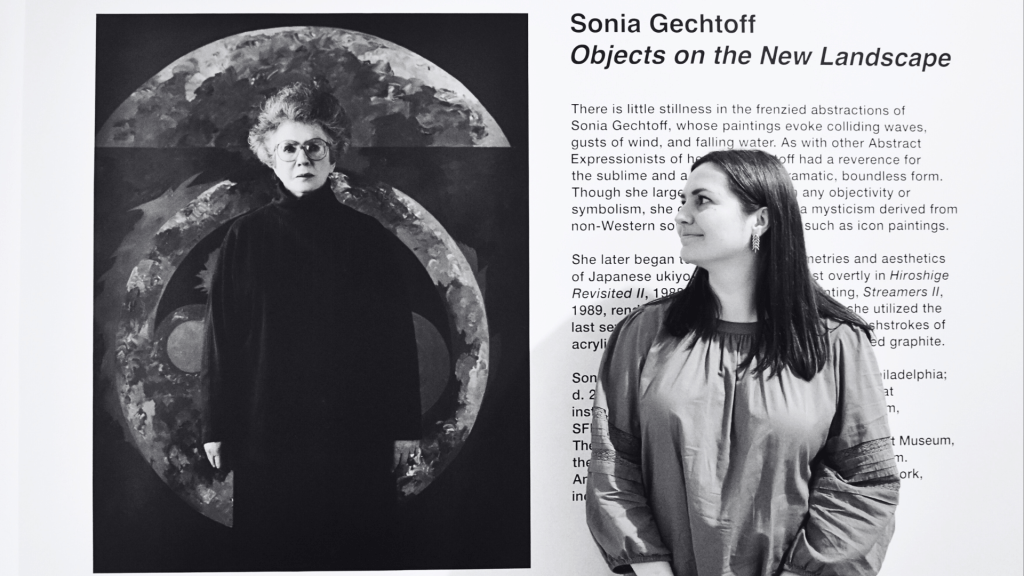
LS: Alright, then can the paintings by artists from, say, Andriyivskyy Descent be considered art?
AH: That is also art. But as you rightly pointed out, there is both commercial and non-commercial art. There are people who paint but never exhibit their works. For example, I know an American artist of Ukrainian descent who works exclusively with one gallery. He doesn’t earn a living from his art. He has a main job that supports his family, and in his free time, he paints. In principle, he is recognized among his colleagues. And most likely, as often happens, his art will be appreciated only after he is no longer with us.
LS: Speaking of posthumous recognition, I find the stories of Ukrainian artists from the Soviet era very moving. All of them were counted, codified, controlled. Zaretsky, Horska, hundreds of others… They made a living from art that was strictly formatted and articulated by overseers, but when they stepped outside the rules, they lost access to resources. Today, we also live in times of heightened anxiety. Can this state of danger and unease provoke more bursts of artistic energy and emotions? Where is it better to create – under missile attacks or in a peaceful environment, like in New York?
AH: That’s an interesting question. I think it depends on the artist. Some need to be directly in the midst of instability. They draw material for their art from it. For instance, if you look at the works of Leon Golub, an American artist of Ukrainian descent, much of his work is about killings, persecutions, camps… things he and his family experienced.
And Janet Sobel – one of my favorite American artists, who has only recently gained fame—was also of Ukrainian descent, born in the city of Dnipro. Her family fled to America in the early 20th century because of Jewish pogroms. Like many women of her time, she married early and had four children. Her husband was a businessman, and her eldest son was into art, painting pictures. At some point, he hit a creative block, and Janet, wanting to help, decided to offer some advice. Her son replied, "Who are you to advise me? Do you know anything about this?"
LS: And that was a challenge!
AH: Exactly! And it pushed her to take up brushes and try painting herself. She began painting and quickly gained recognition. She painted in a naïve style, similar to Maria Prymachenko. The difference is that Prymachenko painted from nature and imagination, while Sobel’s paintings depicted people who died from violence and war – her art is imbued with these experiences. And this is the answer to your question. Both Janet Sobel and Leon Golub lived and created in peaceful and safe America, but their art was filled with what they had endured.

LS: A non-artist who became an artist by accepting a challenge – an interesting way to start painting.
AH: Her son inspired her, and Janet Sobel, in turn, inspired – this is documented – Jackson Pollock himself to paint in his "drip art" or "all-over art" style. In one photograph, she’s shown painting on the floor of her living room at home. It’s also known from stories that she would take paint and literally "splatter" it onto the canvas, which became the foundation of Pollock’s technique. At one exhibition, he saw her works and began experimenting with the approach himself. It became his signature style, his hallmark. Now this story is well-known, and Janet Sobel has been restored to the place in history that she was always meant to have.
LS: Can you roughly estimate how many individuals of Ukrainian origin have influenced American art?
AH: Humbly speaking, I’m just at the beginning of this research. So far, we have 126 artists in our Discover Database – a resource specifically created to gather in one place Ukrainians who have been or are part of American art or have influenced it. However, the story behind the creation of this database and the Borshch of Art project – a nonprofit I founded – started with one specific incident.
One day, while visiting the Metropolitan Museum of Art again, I found myself in the modern art wing. One of the exhibits occupied an entire massive room. It was a black, square, abstract structure with a wooden base, completely painted in monochrome black. On the label beside it, I read: “Mrs. N’s Palace, Louise Nevelson, Kiev, russia.” This detail made a profound impression on me. This was around 2015 or 2016. I thought, “That’s the wrong spelling and the wrong country of origin. It’s Kyiv, and it’s not russia!” But at that time, I had no idea that I could do anything about it. What also struck me was the fact that an artist whose works are featured in one of the most famous museums in the world was from my city, and I had never heard of her.
LS: But it planted a spark?
AH: Definitely. I started researching her and found that many sources confirmed Louise Nevelson was born in Pereiaslav, near Kyiv. I became curious to learn more about her and ordered a book about her biography. Later, as I studied Nevelson’s work, it was incredible and delightful to discover that her pieces are housed in virtually all major museums in America. To be precise, over 180 museums. She also has five stamps issued in her honor and the title of being the first – and until recently, the only – woman to have a plaza named after her in New York City, where her sculptures stand. Additionally, she created an amazing project on the corner of Lexington Avenue and 54th Street – the Nevelson Chapel.
I’m telling this story to illustrate that a person who played one of the greatest roles in American art has a connection to Ukraine. Yes, as a child of four or five years old, she was taken from Ukraine to America due to anti-Semitic pogroms. Was she shaped as a Ukrainian? Definitely not.
LS: But the truth is the truth. And you took it further.
AH: I was so captivated by this story that, upon learning about a conference where her granddaughter was speaking about her famous grandmother’s work, I decided to attend and introduce myself. I met her in the hallway, introduced myself, and told her I was from Ukraine. Since then, we’ve been in touch and, you could say, have become friends. Thanks to this artist, many of my advancements in art and in organizing the Discover Database have taken place. It turned out there are quite a few individuals like Nevelson.
LS: And you began tracking the names of Americans of Ukrainian descent?
AH: At first, it was just a small notebook, then an Excel spreadsheet. I would enthusiastically share my “discoveries” with all my friends. Eventually, it was time to formalize this enthusiasm. That’s how the Discover Database was born. Later, I asked Maria Nevelson whether there was anything Ukrainian in their family. I really hoped she would say “yes.” But no. However, Maria does acknowledge that it’s part of her family’s history.
LS: But other artists must have memories of Ukraine, particularly from childhood. Ukrainian Jews, for instance, often fondly recall borshch.
AH: By the way, the correct spelling in English is borshch, while the version with a t at the end is simply the Yiddish transliteration.
LS: So it’s a linguistic as well as a culinary way to fight russian imperialism!
AH: A lot of American artists of Ukrainian descent are labeled as “russian.” It’s important to understand that our art, our identity, everything connected to Ukraine over the last 300 years, has been colonized. We grew up in a country of distorted mirrors. We were told lies presented as truth, and everything was twisted. Ukrainians have a lot to rediscover. First, we need to cleanse ourselves of this burden of illusions. Second, each of us, without shifting responsibility onto others – including the state – must engage in self-education. If you want to delve into a particular topic, take it upon yourself to explore it.
The mission of the Borshch of Art nonprofit is to educate people about the Ukrainian origins of American artists. We discover, study, communicate, and engage in enlightenment within a field that had previously been unexplored, unorganized, and unsystematic.
LS: It would be interesting to hear the names of artists who have been subject to such manipulation.
AH: Take, for example, Kazimir Malevich. I’m not a historian or cultural expert, but I study a lot about art. Recently, it has become widely recognized that Malevich was born in Kyiv. This only came to light after Ukrainians gained access to archives. By studying the necessary documents, it was established that Malevich was a Ukrainian artist of Polish descent who also practiced in russia. This truth changes the narrative imposed on us by the aggressor country, doesn’t it?
LS: I’m sure russians would disagree!
AH: For decades, russians have used methods like “whoever shouts the loudest is right” to maintain narratives that suit them on the global stage. Through powerful cultural diplomacy, they promoted their version of history and culture, investing large sums of money into creating their own version of events.
LS: So, what’s the plan of action?
AH: We need to present information based on facts, research, and academic work. We need to teach our future art historians and curators that Soviet art and russian art of the 20th century do not exclusively belong to russia. Much of it was created in Ukraine. People should deepen their expertise in this topic, study Ukrainian art and its representatives, and then act on a broader scale. I dream of the emergence of patrons willing to fund Ukrainian art departments in major museums and institutions or sponsor themed exhibitions. It’s essential to train curators who will become experts in Ukrainian art, capable of forming collections, proposing exhibitions, and providing proper descriptions. These individuals must already have a decolonized education and values.
LS: Then my next question is about the future. In Europe, for example, many borders have already disappeared. Multicultural and multiethnic diversity increasingly removes the need to identify art by the country in which it was created. Artists often see themselves as citizens of the world, creating not because they are Ukrainian, French, or American, but because the art, emotions, and values flow through them.
Is it still important to identify art in this way? Is it still relevant that art is connected to a particular country, in this case, Ukraine?
AH: This is definitely not about inferiority, especially in the context of an active war aimed at destroying an entire layer of culture, language, and people. Right now, it is crucial to defend what is ours. Our nonprofit Borshch of Art has the slogan “Reclaiming Ukrainian Heritage.” That means we aim to restore justice by truthfully describing these people of Ukrainian origin. Yes, they are all Americans, but their Ukrainian heritage often plays a role.
There was a remarkable, vibrant, and creative artist, David Burliuk, often called the father of russian Futurism. But why? russia claimed him as “theirs.” However, Burliuk was born in Ukraine, and his work is filled with Ukrainian themes: Cossacks, horses, rural life. He achieved significant success and made a name for himself in America. But can we separate his origins from his art? Could he have created his works without the influence of Ukrainian landscapes, colors, ethnic motifs, words, and music?
We all come from somewhere. Generations of ancestors stand behind us. You can be a cosmopolitan, but you’re still from somewhere. Someone carries your DNA, these encoded messages. We may not know certain details, but we intuitively feel them. I believe that in America, a country of immigrants, identification is very important. Here, everyone talks about their heritage, their roots, and takes pride in them.

LS: It’s important for me to understand your journey because it explains the place you’ve reached now. Please tell me how you ended up in New York and how your project began.
AH: My husband and I arrived in New York in August 2013. Why do I emphasize August? Because it was before the events of the Maidan and the Revolution of Dignity. We came to study and see how people live here. In New York, I wanted to try myself in art and culture because this city is the epicenter of everything connected to art: the best museums, countless galleries and exhibitions, foundations, and open-air parks.
LS: So how did the transition to artistic fields happen?
AH: In 2018, I enrolled at Baruch College in the Arts Administration program, which focuses on managing art-related organizations. It was a two-year master’s program. I was very fortunate. The program had a variety of professors and covered a wide range of topics – from art finance to nonprofit marketing. In the U.S., nonprofits aren’t directly funded by the government. They receive funding from both individuals and entities – companies, corporations, and other organizations that provide financial support for the arts.
LS: So, you followed the nonprofit path?
AH: Yes. Once I realized that all major institutions, such as museums or even opera houses, are nonprofits, I understood the vast scope of this sector. Everything they earn is reinvested into their programs. For example, if there’s a gallery at Lincoln Center, it has to be a nonprofit. By selling artworks, the gallery must use its income to develop itself, support artists, or engage in educational activities.
LS: So, the goal was to create value, and the nonprofit is just the form?
AH: Exactly, you’ve put it perfectly. I’m someone with an idea who understands how to bring that idea to life. I strive for justice. I want Ukrainian artists to take their rightful place in history. I want the world to see Ukraine as a country that has given the world many talented individuals who have influenced culture, art, and science. It’s important to me that Ukrainian origins are recognized and acknowledged. I’m passionate about developing history and creating an organization that stands the test of time – whether I’m here or not.
A single painting can outlast centuries, and we will still look at it, learn its history, and learn about its creator.
Art, in essence, is eternal.
Learn more about Borshch of Art and Anastasia Hudko’s work by visiting: https://borshchofart.org/
Author: Lukian Selskyi