


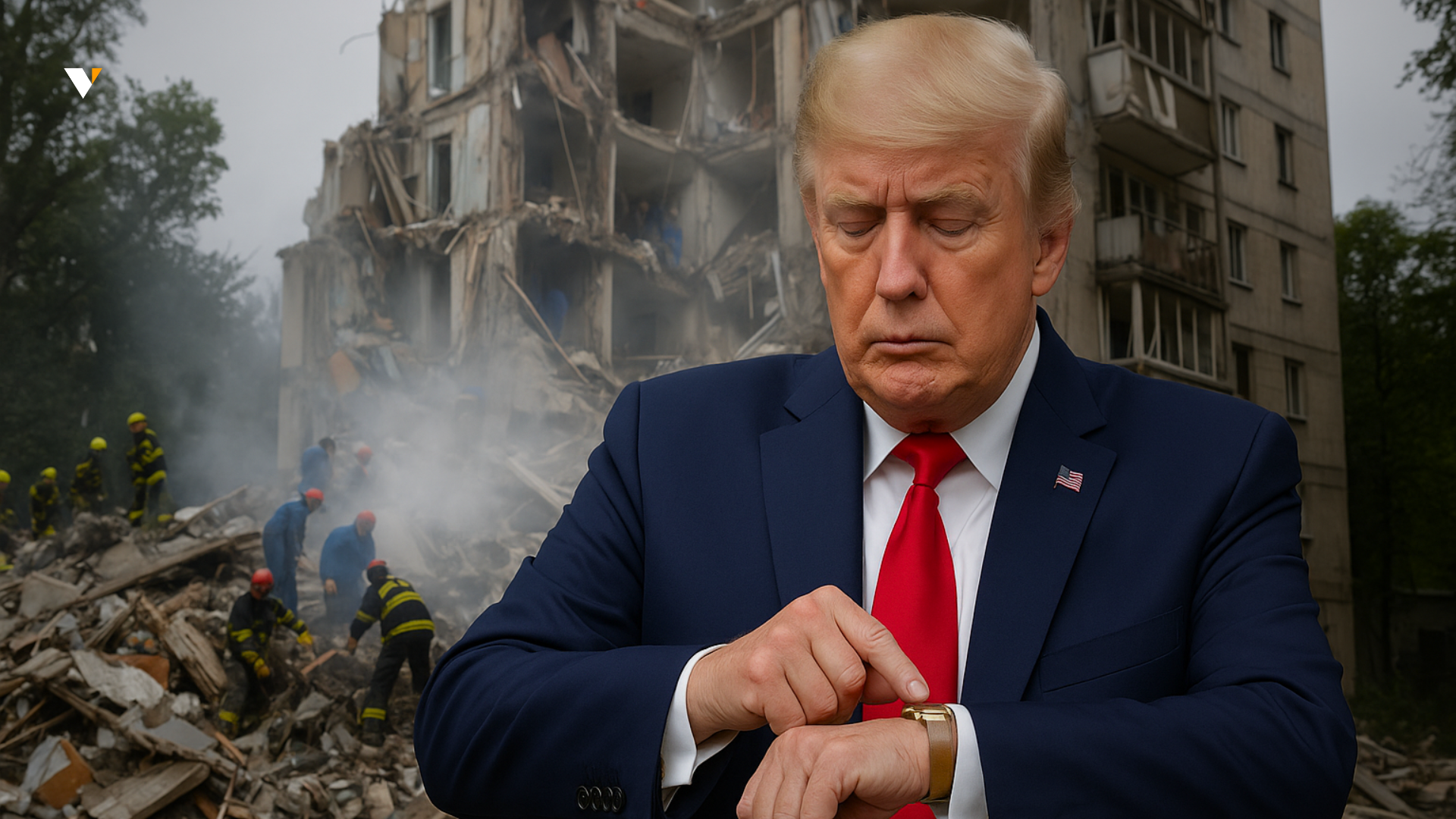
I am writing this text against the backdrop of yet another loud explosion in Kyiv. A ballistic missile launched by Russia at the Ukrainian capital detonated almost outside my window on the night before President Donald Trump’s special envoy, Steve Witkoff, was due to arrive in Moscow. Earlier there had been a massive combined missile-and-drone strike on Kyiv—possibly the largest in recent weeks. It took place almost immediately after President Trump announced that he was shortening the deadline of his ultimatum to Russian President Putin from fifty to ten days—the period he set for ending the Russian-Ukrainian war. Once that deadline expires, the United States is to impose new sanctions on Russia and its energy partners.
The way Putin is reacting to this shortening demonstrates his utter disregard for the American president’s desire to end the war. With every shelling, every new explosion in Kyiv and other Ukrainian cities, the Russian leader underscores his readiness to wage a war of attrition for as long as he pleases, showing that none of his American counterpart’s ultimatums can alter the decisions he has made.
Of course, this became clear immediately after Donald Trump returned to the Oval Office. From the very start, negotiations with Putin were for the Kremlin merely an imitation of a diplomatic process, a means of buying time—time needed to prepare for an offensive, for new attacks on Ukrainian territory. People were saying this even then. After the sixth phone call, Trump himself realized it too.
Obviously, when the American president announced his fifty-day ultimatum, he was hoping for a serious dialogue with Putin that would end in a ceasefire. But what was bound to happen did happen: Putin ignored the ultimatum and paid no attention to the threats. Only after Trump cut the period to ten days did the Russian president sarcastically comment on the situation at a joint press conference with Lukashenko, remarking that “disappointment arises from inflated expectations.” In other words, Putin himself characterized Trump’s attempts to end the war through dialogue as naïve—and in this, it must be admitted, he proved far more realistic than his American counterpart.
So what is Trump to do now? The American president himself acknowledges that the sanctions he intends to impose on Russia and its energy partners may not have the desired effect. Yes, the volumes of oil that Russia currently sells to Global South countries may decrease, and revenues to the Russian budget may shrink. But that will certainly not be enough to force Putin to end the war in the near term, at least within Trump’s presidential term.
Can the American president make Russia stop? In my view—he can. But only if he stops acting as a peace-making mediator and becomes a true ally of Ukraine.
Ukraine needs modern weapons. It needs air-defence systems. It needs means capable of destroying Russia’s strategic assets—turning to ashes oil refineries, defence-industry plants, military airfields. A dragon stops killing only when its teeth are pulled; as long as he still has them, he will use them.
But that requires an ambitious programme of assistance to Ukraine. Not arrangements with Europe to purchase American weapons for Ukraine’s needs, but direct deliveries worth billions of dollars—U.S. budget expenditures. Aid to Ukraine and the collapse of Russia’s military efforts must become a priority for the Trump administration. Otherwise, the war will continue even after he leaves the White House—and, most dangerously, the national security of the United States itself will be undermined.
The threats the Kremlin broadcasts through former president Medvedev are not empty words. They are a sign of real readiness for confrontation with the West, which may ultimately lead to the use of nuclear weapons. And the question remains which of the two will not be afraid to use it first—Putin or Trump. The lives of tens of millions of Americans who could fall victim to a nuclear winter depend on this.
And to avoid this, not even the efforts of American soldiers are needed today—just ordinary money. Money to aid a country that is restraining a common threat. Because this is a threat not only to Ukraine—it is a threat to the United States itself and to its European allies. In my view, the events of recent weeks have illustrated this vividly.
About Author:
