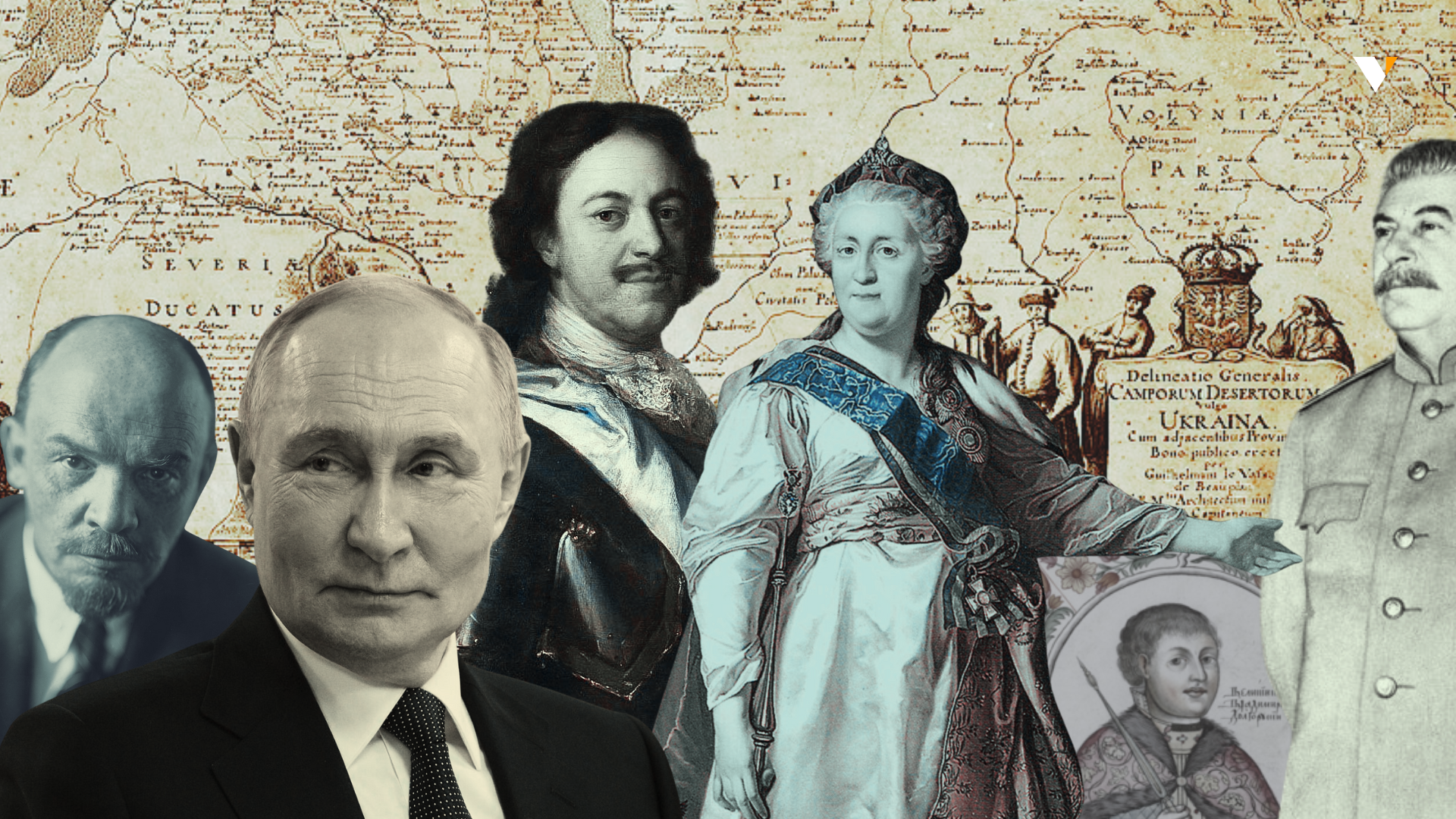
In Part One, we showed how imperial myths—from the appropriation of the legacy of Rus’ to Soviet falsifications of the Holodomor and the war—turned the past into a weapon against Ukraine. Next comes how this weapon works today: why putin needs history and what props up his aggression. And also—what exactly Ukraine is defending (not only land, but the right to memory and to its own voice) and why this is a test for the entire West.
Part Two
Why Does putin Need History? The Ideology of Aggression
History is not only the past. It is a battleground over power, ideology, and identity. In the case of russia under vladimir putin, history has become a key tool for justifying aggression against Ukraine and for shaping an imperial ideology. But why history in particular? And why is it so important to putin?
History as a Tool for Regime Legitimization
The putin regime treats history as a means of consolidating power and legitimizing its policies. In the 2000s, when putin came to power, russia faced an internal crisis: economic difficulties, weak institutions, rising separatism. A strong national narrative was needed to stabilize power—the history of a great state “restoring its historical mission.”
In this context, russian history is presented as a “history of victories”—from the Battle of Kulikovo to the Great Patriotic War—with an emphasis on russia’s “greatness” and its “special role” in the world. Any doubts or alternative views are treated as a threat to national unity.
“Russkiy mir”and(“Russian World”) and “Historical Commonality” as Ideological Weapons
One of the core ideas around which the kremlin’s imperial ideology is built is the concept of the “Russkiy mir” (“Russian World”). It asserts that russia, Ukraine, Belarus, and several other countries form a single cultural-historical space with shared roots, language, faith, and traditions.
This thesis is intended to deny the distinctiveness of the Ukrainian nation and its right to its own language and statehood. The kremlin interprets Kyivan Rus’ exclusively as russia’s “forebear,” downplaying the contribution of Ukrainian culture and its state institutions. This helps justify territorial claims, the annexation of Crimea, and the occupation of parts of the Donbas.
History as a Justification for Aggression
War is always politics, but in contemporary russia it is presented as the “defense of historical justice.” putin has repeatedly declared that the collapse of the USSR was “the greatest geopolitical catastrophe of the century,” and that today’s policy is an attempt to “restore historical order.”
Seen in this light, the war in Ukraine is not aggression but a “liberation mission” to “protect” the russian-speaking population from “Ukrainization” and “fascization.” This narrative is sustained through state media, schools, the church, and culture, instilling in russians a sense of mission and justifying losses.
Confronting the Truth: Denial of Crimes and the Falsification of History
putin’s regime systematically denies or distorts facts that contradict the official version. The most painful pages—the Holodomor, mass repressions, the USSR’s role in World War II—are subjected to revision or silence.
Denial of the Holodomor as genocide is a vivid example. The russian authorities reject the notion of a deliberate extermination of the Ukrainian people, presenting it as a “tragedy of all the peoples of the Soviet Union.” Likewise, the kremlin deploys narratives about the “great victory” in World War II, omits Soviet crimes, and accuses Ukraine of “fascism.”
This makes it possible to evade responsibility and to maintain the population’s internal mobilization for the military campaign.
History as Psychological Defense and Mobilization
The ideological struggle over history helps putin craft an image of russia as a victim of historical injustices, surrounded by enemies. This evokes national pride and patriotism as well as fear of external threats.
This psychological mechanism is typical of authoritarian regimes: by mobilizing feelings of uniqueness and peril, they strengthen their power and justify restrictions on freedom.
Why This Matters for the West
Understanding the russian narrative is the key to an adequate Western response. An ideology built on the distortion of history is not only russia’s domestic policy but also an instrument of external aggression. Refusing to recognize this leads to policy mistakes, misunderstandings, and delays.
Supporting truth, independent historical scholarship, and facts is one of the key elements in resisting imperial aggression. Ukraine is fighting not only for territory but also for the right to its own memory and future.
What Ukraine Is Defending: Not Only Land, but the Right to Memory
The war in Ukraine is not only a struggle for territory. It is a struggle for the soul of the nation, for its history, for the right to its own memory and self-determination. Today Ukraine is defending not just physical borders but something far more important—the right to truth, to tell its own story without distortions and manipulations.
The Holodomor—A Pain That Does Not Fade
The Holodomor of 1932–33 is one of the most horrific crimes of the twentieth century. According to historians, between 3 and 7 million Ukrainians died as a result of an artificially created famine. This genocide was the result of the deliberate policy of the Stalinist regime aimed at destroying the Ukrainian peasantry—the bedrock of national identity.
International recognition of the Holodomor as genocide is not merely a historical fact but a symbol of the struggle for truth. Canada, the United States, the European Parliament, and many other states have officially recognized this tragedy as genocide. Nevertheless, russia continues to deny it—part of its broader policy of historical distortion.
Eyewitness testimony, letters, and memoirs preserve the memory of this pain. They remind us that memory is a living source of strength passed from generation to generation despite all attempts to annihilate it.
Repression of Language and Culture—A War Over Identity
For centuries, the Ukrainian language and culture have been systematically suppressed. In the russian empire and during the Soviet era, Ukrainian was banned in schools; Ukrainian books, films, and theaters were prohibited. The goal was total assimilation and the destruction of national identity.
Today these attempts continue in the form of information warfare, censorship, and propaganda. But Ukrainians steadfastly fight to preserve their language—through education, media, literature, and art. The revival of Ukrainian after independence is a symbol of restored dignity and freedom.
Today’s War Is a War Against Memory
russian aggression is accompanied by the deliberate destruction of historical and cultural heritage. Museums, architectural monuments, and churches are being destroyed. There are attacks on Ukrainian activists, journalists, and historians who speak the truth.
Manipulation of history is part of hybrid war. The kremlin seeks to impose a false narrative that justifies aggression and denies Ukrainians the right to their own memory.
Education and the Media—A Front in the Fight for Memory
Schools, universities, media, and publishing play a key role in restoring and preserving historical truth. Ukrainian teachers and journalists often work under threat, yet they continue their mission—teaching the young and telling the world the truth about Ukraine.
The diaspora plays a special role—it preserves traditions and memory around the world, supports Ukraine politically and materially, and spreads the truth about Ukrainian history.
Ukrainians’ Voices—The Fight for Memory in Words
Activists, writers, and teachers all over Ukraine emphasize: memory is not just the past. It is the living foundation on which the future is built.
In this war, Ukraine is defending not only its land—it is defending the right to be itself. The right to have its own history, its own language, its own culture, and its own dignity. Supporting Ukraine means supporting these fundamental values that are the bedrock of freedom and democracy worldwide.
Why This Matters for the West: Freedom, Dignity, Truth
The war in Ukraine is not merely a geopolitical conflict on Europe’s edge. It is a battle for values the West calls fundamental: freedom, human dignity, truth, and democratic principles. To ignore this struggle is to call into question the very foundations of Western civilization.
Freedom Is the Right to Choose and to Live Without Fear
Freedom is not an abstract notion. It is each person’s right to live by their convictions, speak their own language, and choose their own path. Ukrainians have proved this with their blood—from the revolution of 1917 and the liberation struggles of the twentieth century to the present war, in which every soldier and every citizen has become a symbol of the unbreakable striving for freedom.
Consider the comparison: just as Americans fought for independence from the British Crown, Ukrainians today are fighting for freedom from imperial aggression that seeks to subjugate them and erase their uniqueness. The West, built on the values of freedom, cannot stand aside when that freedom is under threat.
Dignity Is the Foundation of Human Community and Human Rights
Human dignity is the foundation on which democratic societies rest. It guarantees that every person has the right to respect, protection, and justice. russian aggression is deliberately destroying this dignity in Ukraine—razing entire cities, killing civilians, and trampling basic rights and freedoms.
Supporting Ukraine means supporting the dignity of every human being, regardless of nationality or origin. It sends the world a message that no one can be forced to renounce their “self” under the pressure of force and fear.
Truth Is the Basis of Peace and Trust
In a modern world where information warfare and propaganda have become integral to conflicts, truth takes on special weight. Ukraine is waging not only a military struggle but also an informational one, defending its right to the truth about its history, present, and future.
For the West, truth is not only a moral value but also a security instrument. Without truthful information there can be no effective decisions, no dialogue, and no peaceful coexistence. Supporting Ukraine therefore also means countering disinformation and manipulation that can destabilize the entire world.
Defending Ukraine Is Defending the Global Order
Supporting Ukraine means upholding international law and the principles of sovereignty that have shaped the world order since World War II. If an aggressor is allowed to violate borders with impunity, it creates a dangerous precedent for other regions and conflicts.
The West must remember that today’s aggression against Ukraine is a threat not only to Europe but to the entire world built on respect for human rights and state independence.
Supporting Ukraine is not just an act of solidarity; it is a strategic investment in the future of the free world. It signals that democracies are prepared to defend their values, even when it is hard and costly. Freedom, dignity, and truth are the principles that unite us in the struggle against aggression and tyranny.
Today, Ukraine stands on the front line of this fight. And everyone who supports it contributes to preserving a world order in which human rights and freedoms are paramount.
By way of a conclusion, we may state that history is not merely the past, frozen in textbooks or museums. It is the living fabric from which our present and our future are woven. How we view the past shapes our worldview, determines our values, and therefore our actions.
For Ukraine, history is not a cold record of events but a battlefield on which the struggle for the right to be oneself is waged. It is a struggle for the memory of the millions who perished in the Holodomor, for recognition of the heroism and tragedy of the liberation struggles, for the right to call things by their proper names without submitting to imperial myths and distortions.
This war is not only about territory. It is a war over meanings—over the right to tell one’s own story, to preserve one’s culture and language. russian aggression is an attempt not merely to occupy land but to destroy the very essence of Ukrainian identity.
History becomes both weapon and shield. A weapon in the hands of those who want to distort the truth and impose their will. A shield for those who fight for freedom and dignity.
For the Western world, this is a signal that the values of freedom, dignity, and truth cannot be taken for granted. They require defense, support, and solidarity. By supporting Ukraine, the West supports its own foundations—democracy, international law, and the right to self-determination.
This struggle shows that history is not just a chronicle of the past but a living process in which we all participate. And our shared future depends on how clearly and consciously we choose our side.
Because history is not about the past. History is about us—about our right to freedom, to truth, and to a life of dignity.
And this struggle continues until truth and freedom prevail. And they will prevail—therefore Ukraine will prevail.
About Author: