


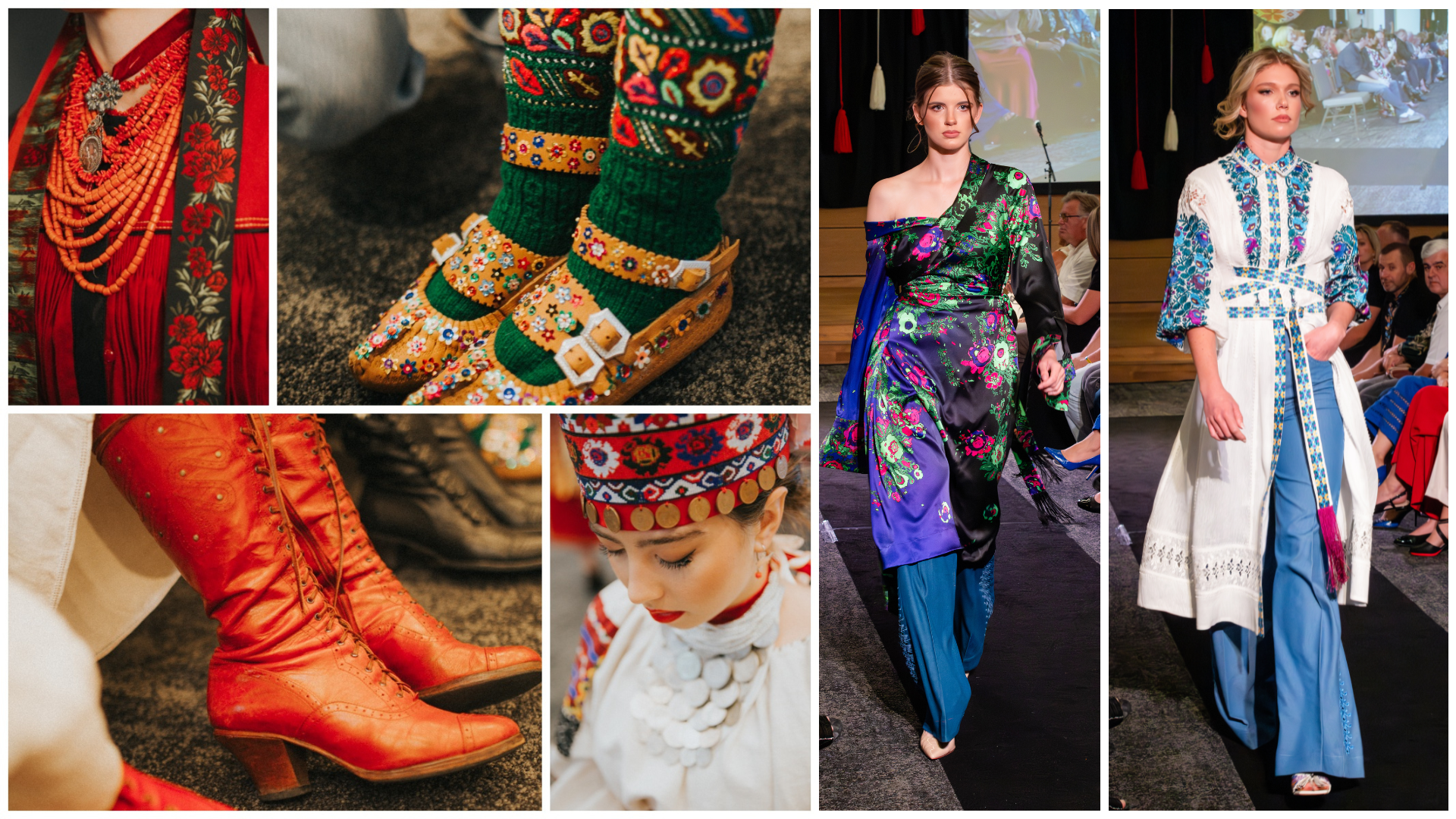
In September, one of the westernmost states of America became the stage where ancient Ukrainian culture met modern fashion and revealed itself in all its beauty before the American public. Two Ukrainian Fashion Shows — on September 14 at the Ukrainian Cultural Center in Los Angeles and on September 20 at the Downtown Event Center in Fremont — turned into highly spectacular events that manifested themselves as profound cultural acts and testified to the strength of continuity and the Ukrainians’ determination to preserve their identity even in the most difficult times.
The atmosphere of the two evenings was extraordinarily rich. The hall was filled with solemnity, which, surprisingly, combined with a family-like warmth. Guests, including both Ukrainians and Americans, became witnesses to a spectacle where fashion went far beyond style, transforming into an instrument for preserving and transmitting cultural memory.
The organizers were the Ukrainian Heritage Club of Northern California, the Ukrainian Culture Center in Los Angeles, and the Ukrainian Support Foundation. They managed to achieve what was almost impossible — to provide the events with dozens of models, as well as stylists and makeup artists, to flawlessly organize catering and logistics, and at the same time to create a festive atmosphere that combined the sophistication of a fashion show with the spiritual depth of national culture. Before the audience unfolded the story of a people, encoded in embroidered ornaments, fabrics, and forms.
The shows consisted of two main parts. The first featured the collection of Maria Muliava, a researcher and collector of folk clothing who has devoted more than fifteen years to gathering authentic garments from various regions of Ukraine. The second showcased modern models by Roksolana Bohutska, a renowned designer who skillfully combines ethnic motifs with high fashion.
Between the runway segments, the audience experienced other highlights: a performance by singer Annychka, a charity auction, and also a short film about the Holodomor, which became the culminating moment of the evening. After the screening, many in the hall could not hold back tears, and some were even forced to leave to collect themselves. It was a very effective emotional bridge that connected centuries of history and made it possible to literally feel what treasure Russian occupiers have tried to desecrate over the centuries: the unique beauty, colorful culture, and life-affirming spirit of Ukrainians.
Maria Muliava’s collection includes over 600 exhibits, among them about 130 unique embroidered shirts. These are garments from Hutsulshchyna, Pokuttia, Bukovyna, Zakarpattia, Poltava region, Naddniprianshchyna, and Slobozhanshchyna. She speaks modestly about her work: “Traditional Ukrainian folk clothing is a hobby, a passion, and a fascination that grew into the work of a lifetime.” She not only collects but also reconstructs clothing, reviving the techniques and ornaments passed down from generation to generation. During the show, these garments were not museum exhibits — they came alive on stage, endowed with dynamism and vitality. The audience saw not just embroidery or fabric but literally the story of a Ukrainian girl or young woman who, radiant and proud, walked to a wedding, to church, or to a celebration.
In conversation, Maria Muliava emphasizes: “Every shirt is not just clothing. It is a text written by the hands of women who invested their love, their prayers, their dreams into the ornament. This code cannot be forged or erased.” Her collection became visible proof that even in times of war, cultural memory can have no less powerful an impact than weapons.
Another facet of the Ukrainian code was revealed by Roksolana Bohutska — a designer whose name has long been known in Ukraine and beyond. A graduate of the Lviv National Academy of Arts, who became the founder of her own brand combining ethnic motifs and the aesthetics of high fashion, she has long been a role model for Ukrainian designers. Her works have been exhibited in New York, Washington, Chicago, Dubai, Vancouver, and many European cities. Among her notable projects are stage costumes for Eurovision 2004 winner Ruslana and other Ukrainian stars. In her address to the California audience, Bohutska said: “I am so glad that you have not grown tired of the Ukrainian, that you support Ukraine. This celebration was created from a heartfelt call, from enormous work. I am grateful to the whole team of energetic people who see and believe in our victory.”
Roksolana Bohutska’s collection showed that the vyshyvanka is not only an archaic symbol. In a modern interpretation, it becomes a universal language, understandable anywhere in the world. “Each vyshyvanka is a story and a hope. Through my collections I want to show how deep and rich Ukrainian culture is,” the designer emphasizes.
A particularly significant part of the evening was the screening of a short film about the Holodomor. It told of one of the most tragic pages of Ukrainian history, which Moscow tried to erase from memory. The contrast between the screen and the runway, between the frames of ruined lives and the colorful garments coming alive on stage, created a powerful emotional effect, exposing the obvious: Ukrainian culture survived despite prohibitions, famine, and war. Today it appears before the world not as a victim, but as living, luxurious, refined, and modern.
Ukrainian Fashion Show став також благодійною ініціативою. Всі пожертви були спрямовані на гуманітарні програми для України. Також на гостей чекало частування з традиційними українськими смаками, а також виставка традиційних прикрас, писанок та етнічних аксесуарів. Цей простір став своєрідною галереєю українського мистецтва, де кожен міг знайти щось для себе – від коралового намиста до сучасних інтерпретацій орнаментів.
The Ukrainian Fashion Show was also a charitable initiative. All donations were directed to humanitarian programs for Ukraine. Guests also enjoyed traditional Ukrainian flavors, as well as an exhibition of traditional jewelry, pysanky, and ethnic accessories. This space became a kind of gallery of Ukrainian art, where everyone could find something for themselves — from coral necklaces to modern interpretations of ornaments.
Maria Muliava
— Maria, this evening you presented a large collection of outfits. How many exactly and from which regions of Ukraine?
— We showed seventeen outfits from about half of the regions of Ukraine. There were two outfits from Borshchiv, two from Bukovyna, also Hutsul and Polissia outfits, outfits from Poltava, Chernihiv, Odesa, Zakarpattia. I would separately highlight three outfits from Pokuttia — from Horodenka, Kolomyia, and Sniatyn. They are especially close to me.
— Are all these outfits authentic?
— The shirts — yes, all old. But some items are reconstructed. I consider it my task not only to preserve but also to restore. So that every Ukrainian woman could wear an outfit in good condition, made of the same materials and cut as a hundred years ago.
— What exactly had to be reconstructed?
— First of all, headpieces. Wreaths very rarely survived in good condition. We restored them based on samples from craftswomen. In California, for example, lives Mrs. Svitlana Kryshtofovych. She came to America twenty-five years ago, began making wreaths for children’s holidays, and now recreates real traditional ones. Another craftswoman is Olha Trofymiuk, also here in America. Thanks to such people, we can show restored Borshchiv or Poltava wreaths.
— And what has survived in its old form and impresses you the most?
— I love namitkas and peremitkas — these archaic headscarves of married women. They signified status but at the same time were extraordinarily refined. I have always been impressed by how women, forced to cover their hair after marriage, found thousands of ways to tie these fabrics so that it looked beautiful and dignified. That is real art!
— Have you encountered the most unusual clothing elements?
— Oh yes! For example, the kichka. It is a kind of roll on which hair was wound for a high cap. In general, when you take an old outfit in your hands, you are amazed by the inventiveness and practicality of people.
— How do you feel about the fact that today in Ukraine there is a real “boom” of vyshyvankas — from simple factory-made ones to expensive designer ones? – від простих фабричних до дорогих дизайнерських?
— It is good because the tradition develops. But it is important to clearly distinguish: there is true traditional clothing, and there are modern designer reinterpretations. And they should not be mixed. Because the traditional embroidered shirt is a separate category, it is the nation’s code. And designer interpretations are also valuable if done skillfully, but that is another layer of culture.
Roksolana Bohutska
— Roksolana, how many models did you present in California?
— More than sixty. I always build collections in blocks: several color schemes, printed fabrics on silk, and hand-embroidered items. About a third were embroideries.
— What are your impressions after Los Angeles and Fremont?
— Los Angeles was more chamber-like, fewer people came. But in Fremont I felt what I am used to at our shows in Europe: a full hall, interest, the atmosphere of a real event. The organizers did enormous work.
— You work for both Ukrainians in the diaspora and for Americans. Do you see a difference in perception?
— Є різниця. Багато хто з українців приходить, бо має ностальгію. Їм бракує України, і вони хочуть побачити щось рідне. Американці ж дивляться на це як на мистецтво. Вони кажуть: «Вау, це так гарно». І це для мене важливо – я хочу, щоб український орнамент вийшов далеко за межі нашого етнічного простору.
— The vyshyvanka has now become very popular, but at the same time a lot of sameness and bad taste has appeared. How do you perceive this?
— That is true. Many people make vyshyvankas just for profit. And then they become the same, without soul. Once I saw at a show in Dubai: the tassels were the same for all designers. They copied each other. But I do not want to go that way. For me, the vyshyvanka is art. I make prints like paintings. And I do not want them to be copies of old shirts. I want them to be inspiration — new and alive.
— You often talk about inspiration from Ukrainian ornaments. How does this work?
— I can take the sleeve of an old shirt and make forty variations based on it. That is my source of strength. Once I thought: if Dolce & Gabbana can take Sicilian ornaments as motifs, then why can I not take Ukrainian ones? And I did. Now this is my path — to show Ukraine to the world through ornament, through clothing, through beauty.
The Ukrainian Fashion Show in Los Angeles and Fremont essentially became a touching conversation between Ukrainians and the world. Here, fabrics, ornaments, and symbols spoke. Every stitch on a shirt, every restored wreath, or modern dress with a Ukrainian code became a sign of resilience. At a time when Ukraine is fighting for freedom, such events remind the world of the greatness and beauty of our culture, affirming it as an integral part of the contemporary global artistic space.
Ukrainian identity has finally ceased to be a museum exhibit — it breathes, develops, adapts, and at the same time preserves a deep connection with the past. And in this lies the main secret of its invincibility: in the ability to combine memory and modernity, pain and beauty, roots and wings.
Warm gratitude for photos to Daria Korkuna, Valentyna Naboka and Mila Silchuk
About Author:
