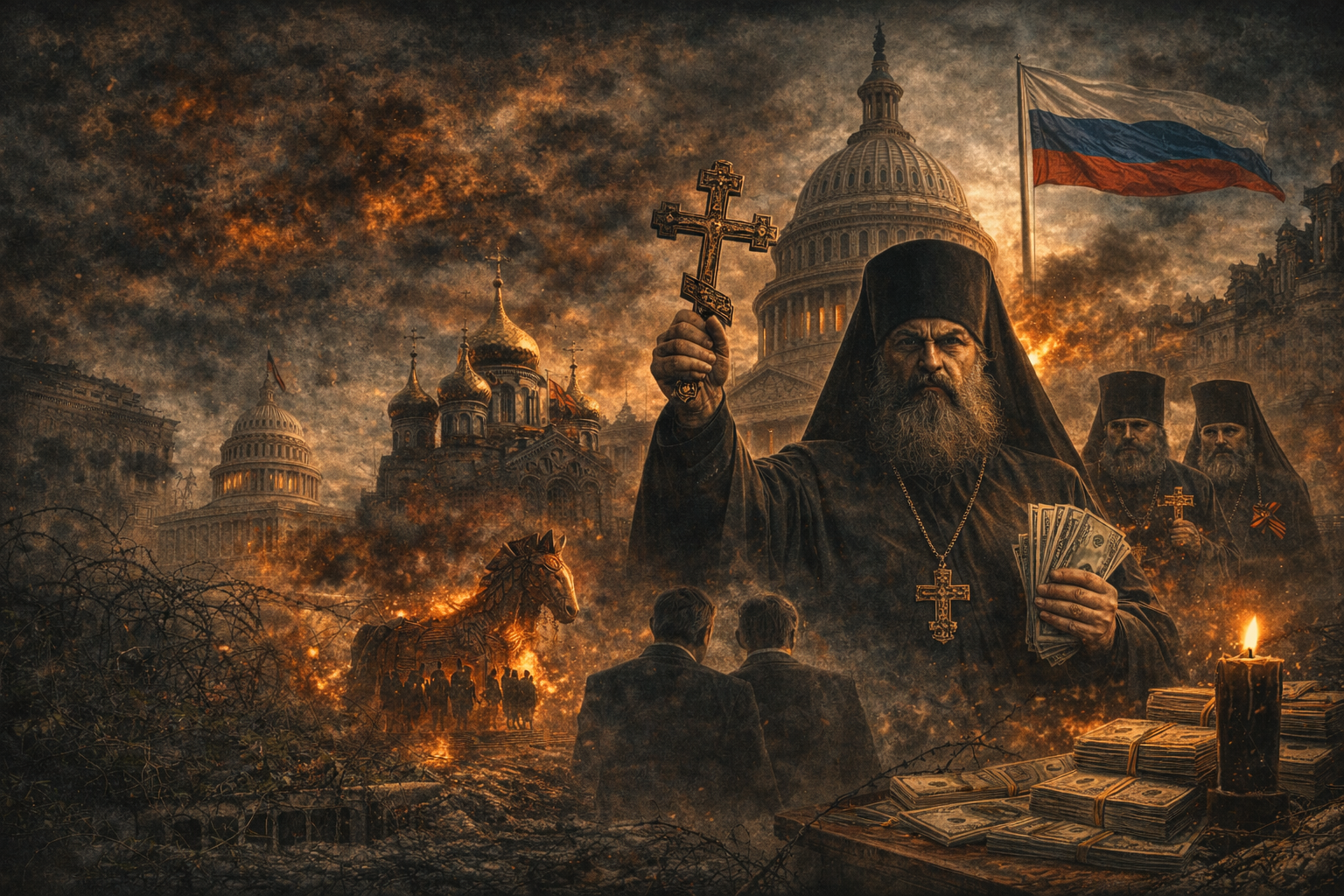
 For the second time, the Russian Orthodox Church outside of Russia came to Washington to lobby imperial narratives: the first such attempt was in November 2025, and a month later the delegation arrived again. Thus, people who advocate on Capitol Hill according to the methodology of Russian propaganda say that Christians are persecuted in Ukraine, there is no religious freedom, and the President of Ukraine Zelensky is a criminal who oversees the above. In turn, Ukrainian activists got ahead of the Russians and went to the offices of several congressmen, where they found a common understanding that the Russian Church is now an organ of the Russian state propaganda machine, and people who lobby Russian narratives in the American Congress are part of the large system of imperial Russia. In addition to advocacy, Ukrainians in the US held a press conference at which they tried to dispel the myths that the Russians were sowing on Capitol Hill. Ulyana Boychuk followed the topic especially for Vilni Media.
Religion as a tool of influence
Attempts at Russian advocacy, disguised as rhetoric to protect human rights and freedom of religion, have intensified on Capitol Hill in Washington. For the second time in recent times, representatives of the so-called Russian Orthodox Church Abroad, who publicly declare their independence from Patriarch Kirill and the Russian Orthodox Church and at the same time post information about the head of the ROC on their official resources, are addressing American lawmakers with narratives that are devoid of common sense.
For example, Russian lobbyists based their advocacy on a letter from The Society of Saint John, which states that Ukraine as a state is allegedly violating religious freedoms during the war. In form and rhetoric, this letter corresponds to typical Russian information special operations in the West: under the guise of “human rights,” a narrative is promoted that aims to undermine trust in Ukraine among its allies. The letter claims that Ukraine is supposedly banning the Ukrainian Orthodox Church at the legislative level, and calls Ukrainian President Volodymyr Zelensky a “criminal.” From the first sentence of this letter, Russian propaganda theses are traced, which do not correspond to reality. After all, Ukraine does not ban the Ukrainian Orthodox Church, the restrictions concern the Russian Orthodox Church in Ukraine, which for a long time operated on the territory of the state through the Ukrainian Orthodox Church of the Moscow Patriarchate, where Metropolitan Arseny and Metropolitan Onufry were the leaders. Both are also mentioned in the letter, but Russian lobbyists call them “victims of the Zelensky regime”: Metropolitan Arseny is currently allegedly imprisoned for preaching, and his colleague Onufry, according to the letter, was deprived of Ukrainian citizenship. And Russian lobbyists completely ignore the fact that two Russian “fathers” together with other “colleagues” are figures in more than 170 cases that the Security Service of Ukraine is investigating against priests of the UOC-MP on suspicion of treason and inciting interreligious hatred. By the way, according to the SBU, the same Metropolitan Onufry voluntarily received Russian citizenship in 2002.
Among other things, the authors of this appeal and lobbyists “for the rights of Christians” completely ignore the obvious context of a full-scale war, in which the Russians are openly violating human rights, Christians, committing atrocities and mass murders.
According to experts, this is a typical scheme of Russian soft power, where religion is used as a channel for legitimizing political goals.
“Russians use the church as a tool that works in favor of the government. In Russia, the church is not a separate institution, but part of the system of power, a large imperial mechanism,” emphasizes Russian-American historian Yuri Felshtinsky.
In response to the Russian advocacy campaign, Ukrainian religious leaders, lawyers, historians, and public figures held a press conference in Washington to debunk key myths of Russian propaganda and explain how the Kremlin uses religion as a tool of influence abroad. The Ukrainian activist, main initiator and organizer of the Working Group on Advocacy for Ukraine in the District of Columbia, Roksolyana Vinar, brought everyone together at one discussion table. Below are the main theses that may be useful to everyone involved in counter-propaganda.
Non-traditional traditional values
The Russian Orthodox Church Abroad, with its subversive advocacy, is trying to prove to Washington that it allegedly has no common values with Ukraine and, above all, wants the West to form in its imagination Russians as defenders of traditional and family values. However, the American nun from the Orthodox Church of Ukraine, Dr. Sr. Vassa Larin, draws attention to the selectivity of Russian rhetoric when it comes to human and Christian rights: “Russian lobbyists and Russians in particular want everyone to believe that they are for traditional values and family, but when appealing to traditional values and family, they never talk about war crimes. It is impossible to defend family values while simultaneously justifying murders, atrocities in Irpen, Bucha, Borodyanka, Kherson and other Ukrainian cities, or kidnapping Ukrainian children, of which at least 20 thousand cases are known.”
The main goal of Russian lobbyists is to divide people in the US parliament.
“This is not about faith. This is a strategy. Russia uses the church as soft power, and the ultimate goal is to divide society and influence the decisions of the US Congress. This is a Trojan horse in America, which Russia is launching,” emphasizes Roman Kapran, pastor and deputy chairman of the Ukrainian Evangelical Baptist Convention (USA), and adds: “In Ukraine, there is freedom for all churches, the Ukrainian government does not persecute priests, everyone has the right to pray and profess their faith – from Christians to Muslims, but when it comes to the Russian Orthodox Church or belonging to it, we must understand that these are, first and foremost, agents of the Kremlin.”
Unlearned Soviet history: the church in exile and the church under occupation
Managing the church by the authorities and the government is something that Russia has been doing since the days of the Soviet Union, and nothing has changed today. The history of the Ukrainian Greek Catholic Church, Evangelicals and Crimean Tatars, which suffered from systematic persecution by the Soviet authorities in the 20th century, is a vivid example of the fact that with the advent of the occupation authorities, freedom of religion disappears.
“The history of the persecution of the Ukrainian Greek Catholic Church by the Soviet authorities in the last century shows that freedom of religion in Russia is impossible. I have witnessed the underground of the Ukrainian Greek Catholic Church since childhood and prayed underground myself. And today history is repeating itself in the occupied territories, where there are confirmed testimonies of at least two Greek Catholic priests who were captured during the Russian occupation in 2022. There can be no religious freedom in the occupied territories,” says Father Yuriy Kozlovsky, Director of the St. Gabriel Institute of Church Communication and Diplomacy, and adds that both then and now the Russian authorities are massively persecuting evangelicals, whom they consider “American spies.”
Preemptive Action
In contrast, pro-Ukrainian activists in Washington, on the eve of the so-called “Russian religious advocacy,” launched a viral video online, reminding the public of Russian “messengers from hell,” who, under the guise of religion, are destroying churches, persecuting, and killing Christians in Ukraine.
The Ukrainian community also acted preemptively. The activists visited the office of one of the congressmen, where they refuted key narratives of Russian propaganda and told the truth about the activities of Orthodox priests of the Orthodox Church in Ukraine. In particular, about their “work,” which is currently being investigated by the Security Service of Ukraine as treason, as well as about the crimes of ecocide that Russia is currently committing in Ukraine. The meeting ended with a joint prayer for peace in Ukraine and America.
The Ukrainian Orthodox Church in the United States responded to the expressions of concern by some people about the so-called persecution of the Ukrainian Orthodox Church, which is under the jurisdiction of the Moscow Patriarchate. There is no doubt about the right to express it. However, as the church noted, the moral consistency and credibility of such advocacy should be questioned.
“Russia chose war. Russia chose massacre. Russia chose the killing of civilians, the destruction of cities, the forcible abduction of children, and the infliction of untold suffering on a sovereign state. When this unprovoked invasion began, many of the same religious leaders who today speak out about religious freedom in Ukraine and the United States remained silent. They did not condemn the aggression. They did not expose the ideology of the Moscow regime. They did not speak out against the theological and moral distortion that blessed the tanks, missiles, and mass graves. Some of them, unfortunately, directly or indirectly identified themselves with the religious narrative promoted by the Moscow Patriarchate in the service of a political dictator,” reads the message from Archbishop Daniel of the Ukrainian Orthodox Church in the United States, emphasizing that Ukraine is not waging war against Christians. звучить у зверненні від Архієпископа Української православної церкви у США Даниїла із наголошенням, що Україна не веде війну проти християн.
“It must be said clearly and unequivocally: the people of Ukraine are not persecuting Orthodox Christians. Ukraine is not waging a war against the Orthodox faith. Ukrainian society is rightly concerned when Ukrainian citizens – or those who pose as such – resort to actions that aid, abet, or cooperate with forces that kill, torture, and destroy. Prosecution for such actions is not religious persecution; it is a matter of national survival and moral responsibility.”
Breaking the system as a way to liberate Russian Orthodoxy Ukrainian theologian, professor and archimandrite of the Orthodox Church of Ukraine Kyrylo Govorun emphasized that the problem of Russia using religion as a tool of war is not unique to Ukraine. According to him, Russia systematically uses religion as a soft power, turning it into an element of hybrid warfare. “We face such challenges
Breaking the System as a Way to Liberate Russian Orthodoxy
Ukrainian theologian, professor, and archimandrite of the Orthodox Church of Ukraine Kyrylo Hovorun emphasized that the problem of Russia’s use of religion as a tool of war is not unique to Ukraine. According to him, Russia systematically uses religion as a soft power, turning it into an element of hybrid warfare. “The Baltic countries, Scandinavia, and other states where the Russian Orthodox Church is present also face similar challenges,” Hovorun noted, emphasizing that as soon as the governments of these countries begin to struggle and try to limit this influence for reasons of national security, Russia immediately accuses them of human rights violations, using the same rhetoric that it is currently promoting in Washington. “No country has yet found the perfect solution. We are still in the process of finding solutions and rely on the help of our partners. There are problems, but there are different approaches to how to deal with them,” he explained, distinguishing between two types of international reaction: “One approach is constructive, friendly criticism from partners who understand Ukraine’s difficulties and help find solutions. The other is unconstructive, harmful criticism that uses our problems to worsen our position and break us.”
According to him, these two approaches can sometimes look similar in form and even in arguments, but the difference between them is fundamental — one helps, the other destroys. “Therefore, we should all be wise enough to distinguish where the criticism comes from — from friends or from enemies. Is it helping Ukraine, or is it voluntarily or involuntarily playing on the side of Russia,” Govorun concluded.
There is no easy solution to the problem of Russian Orthodoxy and its faithful service to imperialism. Language and religion are state methods of influencing people, so the only way out is to break the system. Russia must be defeated, it will be difficult, but there is no single easy solution,” says Russian-American historian Yuri Felshtinsky.
Author: Ulyana Boychuk