


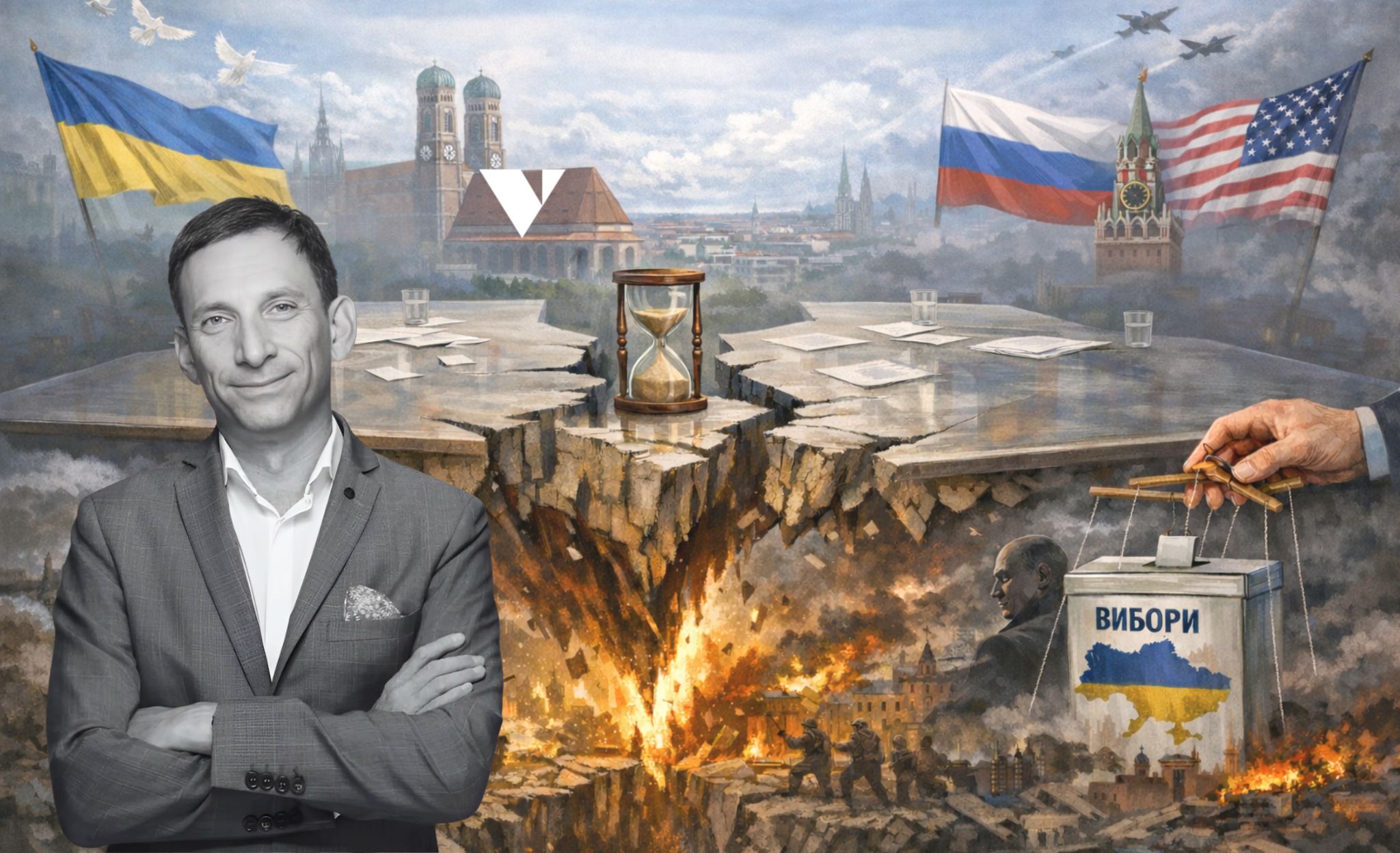
The Munich Conference, during which world leaders traditionally exchanged views about the future—and devoted a great deal of time to Russia’s war against Ukraine—took place literally just a few days before the start of another round of negotiations between the Ukrainian, Russian, and American delegations.
Many consider the very fact that such negotiations are being held to be progress and a credit to Donald Trump. But negotiations only have real meaning when they promise results. Negotiations based on the parties’ genuine desire to achieve peace—whereas Putin, it seems, is merely trying to buy time. Even during the discussions in Munich, U.S. Secretary of State Marco Rubio was forced to admit that Washington does not know whether Putin truly wants peace.
One might say that we are deceiving ourselves when we try to find something positive in Putin’s “signals.” For example, when the negotiations were just beginning, the Russian delegation was unexpectedly headed by Admiral Igor Kostyukov, chief of the Main Directorate of the General Staff of the Russian Armed Forces. The fact that, for the first time since 2022, the Russian delegation was led not by the “ideologue” Vladimir Medinsky—who is regarded as one of the apologists of the concept of seizing former Soviet republics—was seen as a sign of greater substance. If military officials were to discuss the details of troop disengagement, control over a ceasefire, and so on, it might suggest that Putin had serious intentions. Although from the very start of the process I could not understand what significance all these details could possibly have when the most important element is absent—political will to end the aggression or at least to implement a ceasefire, full or even partial.
Now Putin has returned Medinsky to the negotiating table, once again entrusting him with leading the Russian delegation. And the same people who tried to detect a positive signal in Admiral Kostyukov’s appointment now insist that Medinsky’s presence is also a good sign. Supposedly, it means that the military has already agreed on everything, and now it is time to discuss political decisions. As if Medinsky had not already discussed them several times in a row.
I would not look for a black cat in a dark room—especially if it is not there and never has been. Yes, Putin is participating in a “peace-making performance” for Trump, but he has never had any intention of ending this war through negotiations. What the Russian leader truly seeks right now was voiced in recent days by Russia’s Deputy Foreign Minister Mikhail Galuzin, who proposed introducing “external governance” in Ukraine to conduct elections and select leadership with which Russia could negotiate peace.
We fully understand that behind these words lies a barely concealed idea of dismantling Ukrainian statehood by turning Ukraine into a “UN protectorate,” enabling Russian propaganda pressure and political support for pro-Russian forces. The Russian language, the Russian church, and a pro-Russian gang—that is Russia’s recipe for the final destruction of Ukraine.
And it is quite telling that they are trying to achieve all of this through a so-called “diplomatic” path—if such an approach can even be called diplomacy. Russian troops have been unable for four consecutive years to establish control over the entirety of the Donetsk region—and Putin is using negotiations to persuade Washington to convince Kyiv to withdraw its forces from the unoccupied part of Donetsk Oblast. And now there is a new idea—to strip Ukraine of its sovereignty under the accompaniment of talk about “elections.”
So what, then—should there be no negotiations at all? Of course, there is no sense in negotiations whose sole result is to provide the President of the United States with the opportunity to claim that the process continues and that peace is very close. In reality, such negotiations do not bring peace closer—they only push it further away, because they allow the administration to refrain from applying greater pressure on Russia under the pretext of fearing to “block” the simulated “peace process.” And that is precisely how they should be viewed—as a process of distancing the achievement of peace.
Photo: generated with the help of AI
Author: Vitaly Portnikov