


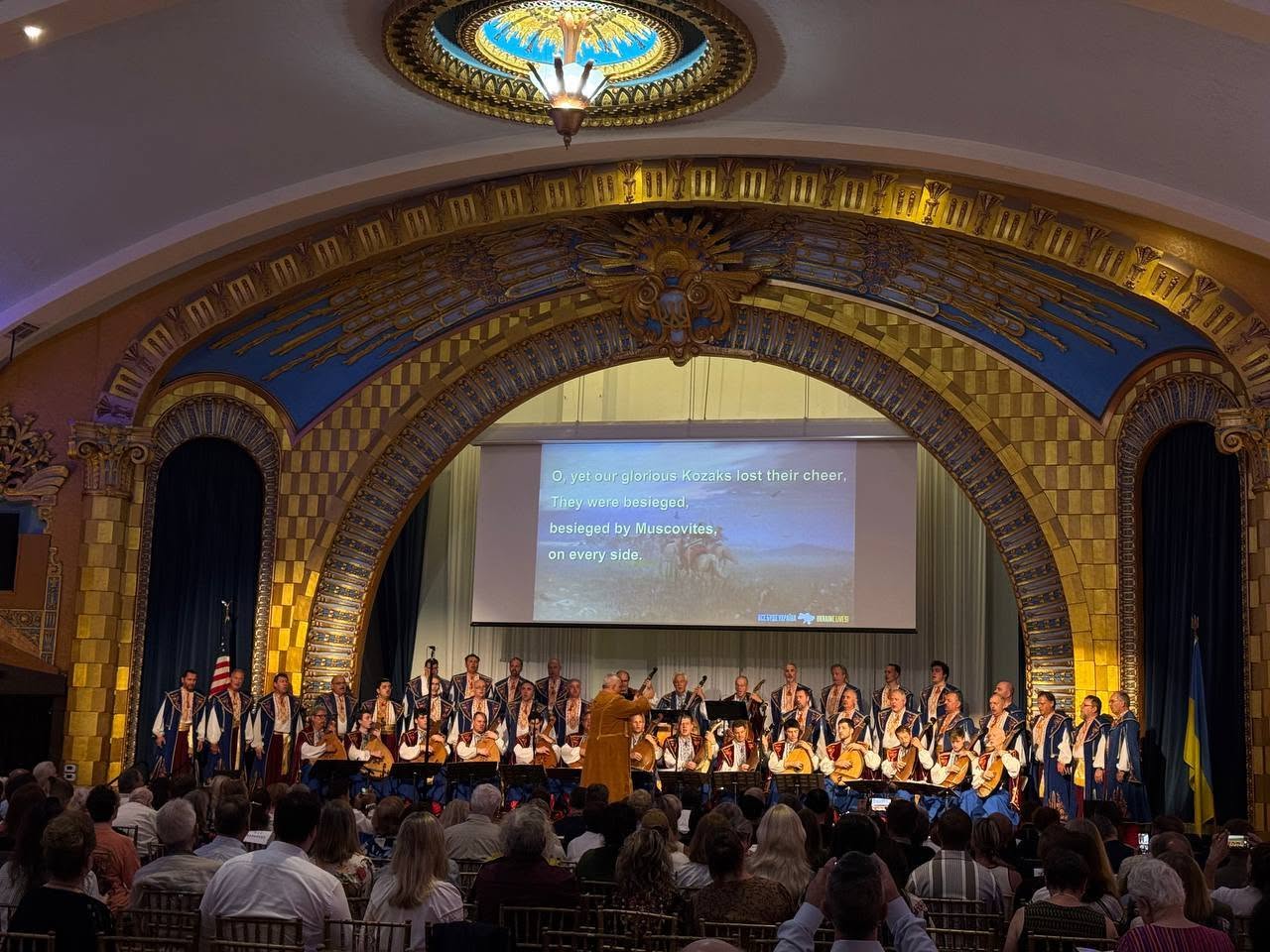
I had heard of this ensemble, but I knew neither the history of its creation nor the details of its creative path. So one could say that my acquaintance with it began during the first documentary film festival in Los Angeles, when I watched Music of Survivors — a film about the Ukrainian Bandurist Chorus of North America. Their story moved and interested me. So when I saw an announcement that, during their tour, the musicians would also visit the City of Angels with a concert at the Ukrainian Culture Center — UCC, I added the date to my calendar.
At that time, a discussion was unfolding in my Facebook bubble regarding state funding for the H. Veriovka Choir and the P. Virsky Ensemble. These groups are accused of “Sovietness,” of carrying a Soviet narrative in which Ukrainian art was represented in precisely this form. But is this perceived the same way by audiences abroad, or do they see Ukrainian culture behind it?
I became interested in finding out what musicians who live in America think about this. With these questions, I turned to the artistic director and conductor of the Chorus, Honored Worker of Arts of Ukraine Oleh Mahlay. I also asked what, or who, makes the Chorus’s existence possible. Is there a golden mean in funding such ensembles that present Ukrainian academic culture beyond Ukraine’s borders?
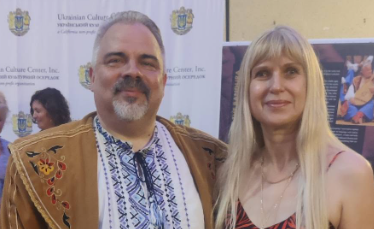
Oleh Mahlay: This is quite a complex question, but it is good that it has come up. It spread across social media after an interview with the director of the Veriovka Choir. The state and society need to support art — whether in America or in Ukraine. For example, let us talk about us. Since 1949, here in America, we have had virtually no state support. The culture and philosophy here are different.
Here, the state does not insert itself into everything, does not manage everything, and generally gives more freedom to people and organizations so that they can develop. And the state does not interfere very much. That is why we ourselves have to look for funds.
We have wonderful sponsors: whether individuals, credit institutions, organizations, and so on. Sometimes there are some grants from the state, but this is very rare. This also teaches us the philosophy that we ourselves must search, create, and support.
But there is also no censorship, no control, when someone from a ministry or some deputy says what the repertoire or program should be. Here, if our program is not strong or is bad, people will not come. And perhaps then we do not need to exist, because we have not earned it. And that means we probably did not respect the art enough for people to support us. This is our responsibility.
In Ukraine, everything is different; it comes from the Soviet mentality and regime. It is true that those habits, those customs, those financial practices still remain in organizations and ensembles that receive state support. I cannot answer for this, but perhaps it would be better to ask those ensembles: have you respected the people’s money that came from the state to your groups? Did all the money that was supposed to go toward costumes actually go toward costumes? Did those funds go toward instruments, toward art, or into someone’s pocket?
I cannot answer that, but I am asking the question. Sometimes, when the state or someone else manages things, when they want to control the money, they will also control the art. And then, sometimes, art does not develop. We are not a museum. We must also create art and draw from people what we have. And that is our responsibility.
And yes, the mentality of the Soviet person must be rejected. It is there, but that does not mean we must drive ensembles away. But we need to take a serious look at how these ensembles work. And internally, workers and musicians should also ask their ensembles what money there is and how it is being used.
And then workers and musicians should not be frightened when they ask such questions. I say all of this for the good. I want all these ensembles to develop. Because our Ukraine is so rich. The people are wonderful. The art is so deep.
Our listeners, or those who read, know what kind of music we have. Let us value it more. And perhaps we will no longer have these bad habits and these remnants of the Soviet Union.
Background
The Ukrainian Bandurist Chorus was founded in Kyiv in 1918 by Vasyl Yemets as the Kobzar Choir. On the eve of the Second World War, the ensemble was disbanded by the Soviet government. But in 1941, members of the ensemble revived it in Kyiv. Later, the members of the Chorus found themselves in a Nazi concentration camp. In 1949, the ensemble emigrated to the United States, where it continued its mission.
As Ukraine’s Minister of Culture Tetiana Berezhna reported , Vadym Yatsenko, director of the Homin Choir, became the general director and artistic director of the H. Veriovka National Honored Academic Ukrainian Folk Choir.
Author: Anna Matviyishina