


Four years into Russia's full-scale invasion, Ukraine's reconstruction paradox is becoming impossible to ignore. International non-military support — financial and humanitarian combined, has reached nearly $200 billion since February 2022, according to the Kiel Institute's Ukraine Support Tracker, outpacing military aid over the same period. Yet fresh foreign private investment in the Ukrainian economy totals less than $3 billion, around 1.5% of that figure.
The call to mobilise private capital for Ukraine's reconstruction has been a fixture of every recovery conference since 2022 and remains, four years on, largely unanswered.
The gap between donor generosity and private capital mobilisation was the central question at a roundtable convened by the Harvard Club of Ukraine and the Professional Government Association ahead of the Ukraine Recovery Conference in Gdansk.
The anatomy of a failure: what the data actually shows
Paul Klouman Bekken, a Norwegian diplomat, Harvard alumnus and former special representative to Afghanistan, has produced the most granular analysis of this gap to date.
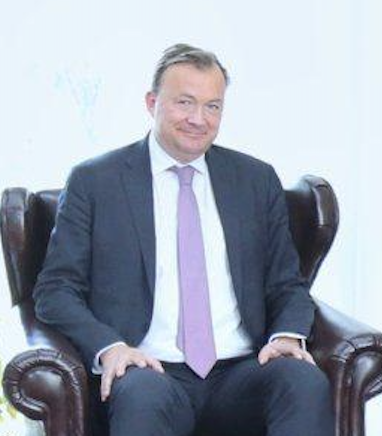
Paul Klouman Bekken spent months doing something no one had done before: going through the actual project files. He didn't rely on press releases or conference pledges. Instead, for his paper published in June 2026 by the Brussels-based think tank ECDPM, he built three original databases from official sources, mapping roughly $80 billion worth of reconstruction projects - 236 funded by international financial institutions, 62 under the EU's Ukraine Investment Framework, and 146 in Ukraine's own national pipeline.
What he found was not a funding shortage. It was a structural trap.
Paul Klouman Bekken wrote - in project after project, public institutions occupied every role simultaneously: they provided the money, they channeled it through state intermediaries, and they implemented the work on the ground. Private companies were largely absent - not because they were considered and rejected, but because the system was never designed to bring them in.
About a third of the money goes to rebuilding schools, hospitals and roads - the kind of essential public infrastructure that governments, not investors, are supposed to finance. No one expects a private company to fund a bombed-out maternity ward.
The problem starts in the middle layer. Nearly 40% of international reconstruction funding flows to state-owned companies - enterprises that in normal times would operate commercially and attract private partners. Think of a state electricity company or a municipal water utility: in peacetime, these are exactly the kinds of businesses that draw in private investment through joint ventures or public-private partnerships. In wartime Ukraine, they are receiving public loans and guarantees with no private co-investment attached. The state is being treated as the only creditworthy actor in the room.
Even the funds explicitly created to attract private capital tell the same story. Nearly $1 billion has been raised in so-called "private" reconstruction funds since the invasion began but when you look inside, the money comes almost entirely from international financial institutions and government development agencies. The private label is real; the private money is not.
Ukraine's own national project pipeline makes the contradiction hardest to ignore. Of 146 projects worth $53 billion in total, nearly half are income-generating — infrastructure that produces revenue, the kind of asset that typically attracts investors. Yet across all of them, only one project has secured confirmed private interest: an $8.9 million microgrid in the western city of Ternopil. A microgrid is a small, self-contained local power network — in this case, a system that generates and distributes electricity independently of the main national grid, useful precisely because Russian strikes have made central power supply unreliable. It is a genuinely useful project.
Two wind farm projects sitting side by side in the data show exactly why ownership structure matters more than the sector. One is a roughly $1 billion publicly owned wind project - large, revenue-generating, and attracting zero private interest. The other is a privately owned wind farm that reached a financing deal in 2024, combining $74 million in private equity with $171 million in public loans. Same industry, same country, same war. The difference was simple: one project offered private investors a stake in ownership; the other did not.
The longer this pattern continues, the harder it becomes to reverse. Every project financed entirely through public channels today becomes a state-owned asset tomorrow. At $200 billion and rising, the international community is not just filling a reconstruction gap - it is quietly deciding who will own Ukraine's economy once the war ends. And a state-dominated economy built under wartime emergency conditions will eventually collide with the market-competition rules Ukraine must adopt as part of its path to EU membership.
Bekken's recommendations follow directly from the diagnosis. Before any public money locks in the ownership structure of a revenue-generating project, the government should first test whether private investors would come in and document the answer. More public money should flow as guarantees and insurance that protect private investors from risk, rather than as direct financing that simply replaces them. War-risk insurance needs to cover lost revenues, not just physical damage to buildings and equipment because the thing that most frightens a foreign company is not a destroyed factory but months of zero income while the factory sits idle. And governments should put more money in as equity stakes rather than loans, because equity, unlike debt, actually converts public support into shared ownership rather than a bill the state will eventually have to pay alone.
The structural problem behind the numbers
The reasons are partly demand-side. Romain Desthieux, director of the French government's trade and investment agency Business France in Ukraine and a former executive who led roughly €40 million in French agricultural investment in the country, points to a fundamental demand-side problem: in most infrastructure projects, the ultimate client is the Ukrainian taxpayer, channelled through the state and local communities. With the war ongoing, no one can confidently forecast what tax revenues will look like or whether the state will be able to direct them toward reconstruction at all.
"Private investors find it hard to be confident that future tax revenues will be stable enough and that the necessary funds will flow into the projects they've backed," Desthieux said. "That's why the role of international donors in the first phase is absolutely critical."
The logic is not that donor money is unnecessary - without it, private capital won't come at all. The problem is that right now it replaces the market signal rather than creating one. International financial support is no longer only filling a gap; it is also shaping who will own Ukraine's productive assets after the war. A state-heavy structure built now will need to be unwound later to comply with EU competition rules.
For foreign companies already operating in Ukraine, the calculation looks different. Those willing to absorb the risk of Russian strikes on their assets - a risk that existing insurance programmes nominally cover but practically do not - stand to gain a first-mover advantage when the war ends.
"Sooner or later the war will end, and those already present in the market can reap significant rewards," Bekken said.
MilTech's lesson: the state, not venture capital, built Ukraine's defence miracle
While civilian reconstruction stalls, Ukraine's defence-technology sector has become a global case study in wartime innovation. But the popular narrative that Western venture capital drove the MilTech boom, turns out to be largely myth.
Volodymyr Kravtsov, deputy head of ARMADA, Ukraine's association of unmanned systems producers, presented figures that reframe the story entirely. In 2025, private venture and other investment in Ukrainian defence startups amounted to just $105–130 million, less than 2% of a sector worth $6.8 billion.
What actually drove the growth was a combination of guaranteed state demand, targeted grants (the Brave1 cluster allocated over $60 million to more than 200 companies), subsidised lending of around $160 million through an adapted preferential credit programme, and radical deregulation.
"We compressed the cycle from research and development to battlefield deployment from several years to a few weeks," Kravtsov explained. "The real lesson for the non-defence economy is not to chase venture capital. It's about how the state can create the right deregulated environment with predictable, guaranteed commitments."
The MilTech formula - a reliable buyer, targeted public support, and ruthless bureaucratic simplification is precisely what civilian reconstruction currently lacks.
Energy: the most promising test case
Denys Gaiovy, a Harvard Club of Ukraine board member and an EBRD infrastructure economist, argues that the energy sector comes closest to replicating the conditions that made MilTech work. Russian strikes have knocked out tens of gigawatts of generating capacity. The urgency of replacement is already pulling in investment, and the government has begun clearing procedural obstacles while moving electricity tariffs toward market levels.
"Energy and energy infrastructure is probably the nearest sector where we can apply the same toolkit and approach that worked in MilTech," Gaiovy said, while acknowledging that the pace of preparing complex instruments like public-private partnerships still lags far behind.
The proof of concept already exists. Oleksandr Podprugin of the German group NOTUS energy described what may be a landmark transaction: the first project-finance loan for a wind farm in Ukraine's history, and the first renewable energy project funded by foreign private capital since the full-scale invasion began. A single German company took a risk that no one else would. For now, it remains an exception rather than a trend.
Satyaki Bhattacharya of the World Bank's ESMAP programme noted that the pool of companies willing to actually show up and develop projects in Ukraine rather than merely express interest is far narrower than even the circle of potential investors. When an EPC contractor, a company that takes full turnkey responsibility for a project, goes back to its professional network and says it worked in Ukraine, that signal carries more weight than any conference declaration.
"The same four or five players keep taking the risk while everyone else watches," he said.
Speed and permit efficiency, he argued, are the levers Ukraine controls right now and closing the gap with MilTech on that front would matter more than any new financial instrument.
The perception problem money can't fix
Jonathan Browning of the UK-based Transformative Approaches Ltd. drawing on experience in the Balkans, Sierra Leone and Afghanistan, identified a barrier that guarantees and insurance schemes cannot address: Western investors systematically overestimate the risk of operating in Ukraine.
"Improving the West's perception of Ukraine is genuinely key. The risks of entering the country are smaller than they think," he said.
Romain Desthieux, whose method for attracting investors involves neither presentations nor financial models, agrees. He simply invites them to come.
"I have no ambition to convince an investor before they arrive. I just say: come. I'll take care of you."
After a first visit, he says, the reaction is almost always the same: surprise, followed by serious conversation about real opportunities.
What Gdańsk needs to hear
The World Bank estimates Ukraine's reconstruction needs at $588 billion. No combination of donor pledges will reach that number. The participants in Kyiv agreed on a single core message for the Gdańsk conference: Ukraine does not need more aid, it needs aid that works differently, converting public financing into a market signal rather than a substitute for one.
The formula exists. MilTech proved it. The question is whether Ukraine will apply it to civilian reconstruction before the war is over and whether the international community will help redesign the instruments to make that possible.

As Oleh Khalayim of the G20 Global Infrastructure Facility at the World Bank, who co-organised the roundtable through the Harvard Club of Ukraine, put it: the Ukraine Recovery Conference is a government event. But to bring in private investment, the loudest voices in the room need to be business.
Author: Andrew Getman
