



From the start of his new presidential term, Donald Trump has regularly made loud statements about what he calls the United States’ “exorbitant spending” on supporting Ukraine. In various public speeches, he has quoted figures ranging from USD 300 to 350 billion, directly accusing the previous administration and Joe Biden of “squandering funds.” At the same time, the new occupant of the Oval Office claims that “Europe spends significantly less” — roughly USD 100 billion in total. For instance, at the Conservative Political Action Conference (CPAC) in February 2025, the U.S. President said: “We’ve already spent 350 billion on Ukraine, whereas Europe spends about 100 billion, and it’s still not over.”
“We’ve Already Paid Far Too Much”
Donald Trump demands “compensation” from the Ukrainian side, trying to convince the public that Ukraine should “pay back” the money to America. This is how the idea arose of an agreement granting rights to extract minerals or rare-earth metals — primarily so that the President can explain to his voters why they should deal with the “Ukraine question” and what benefits America would gain from it.
At the same time, the White House has provided no specific explanation for the “350 billion” figure. When asked by American and international media to comment on these statements, administration representatives mostly responded with general phrases about “a large sum from the federal budget spent on security and assistance to Ukraine,” without clarifications. Thus, it remains unclear whether we are talking about actual military and financial support, or broader categories of spending such as training American troops in Europe or purchasing weapons for U.S. needs.
Meanwhile, both the State Department and the Pentagon regularly publish more detailed summaries of military assistance packages, noting that “the total amount of allocated funding may differ from the actual sums.” For example, recent reports emphasize that a substantial portion of costs goes toward rearming the United States itself and replenishing existing stockpiles, which is not direct “cash in hand” for Ukraine’s budget.
Although Donald Trump most often cites “350 billion” as a figure for non-repayable aid, there are serious doubts as to whether that number is accurate. Moreover, official administration reports indicate that part of the funding included in “Ukraine packages” covers training for U.S. and allied forces, logistics, and supplementary programs in countries neighboring Ukraine, among other things. In other words, any reference to large sums needs careful verification to determine how much is actually direct aid, and how much consists of indirect or internal U.S. expenditures.
The Closest Reality or Still a Convention?
One of the most frequently cited sources for the scope of U.S. assistance to Ukraine is the Kiel Institute, a German research center that has been tracking international support for Ukraine since 2022. According to its experts, the United States spent approximately USD 119–120 billion during the first two years of Russia’s full-scale invasion. Western media outlets often refer to this number when illustrating the general scale of “U.S. spending on Ukraine.”

In its reports, the Kiel Institute provides a fairly detailed breakdown of military, financial, and humanitarian aid. They stress that “the United States undoubtedly remains the leader in total assistance provided to Ukraine when all forms are summed, from weapons and equipment to direct subsidies and loans.” However, their analytical materials also clarify that the data may include both non-repayable financial aid and various loan programs, guarantees, and expenditures such as logistics or the training of troops outside Ukraine.
The BBC media group, which frequently refers to these statistics, further notes that “the total appropriations by the United States” are not equivalent to “the amount of cash or equipment actually delivered to Ukraine.” In a special BBC Verify piece, “How much has the US given to Ukraine?,” it is emphasized that the Kiel Institute’s estimate of about USD 119 billion still falls far short of the 300–350 billion figure repeatedly used by President Trump: “We can find no evidence to support the claim of 300 or certainly not 350 billion—even if you add every possible form of assistance and expenditure that is officially listed under ‘for Ukraine,’ the sum is notably less.”
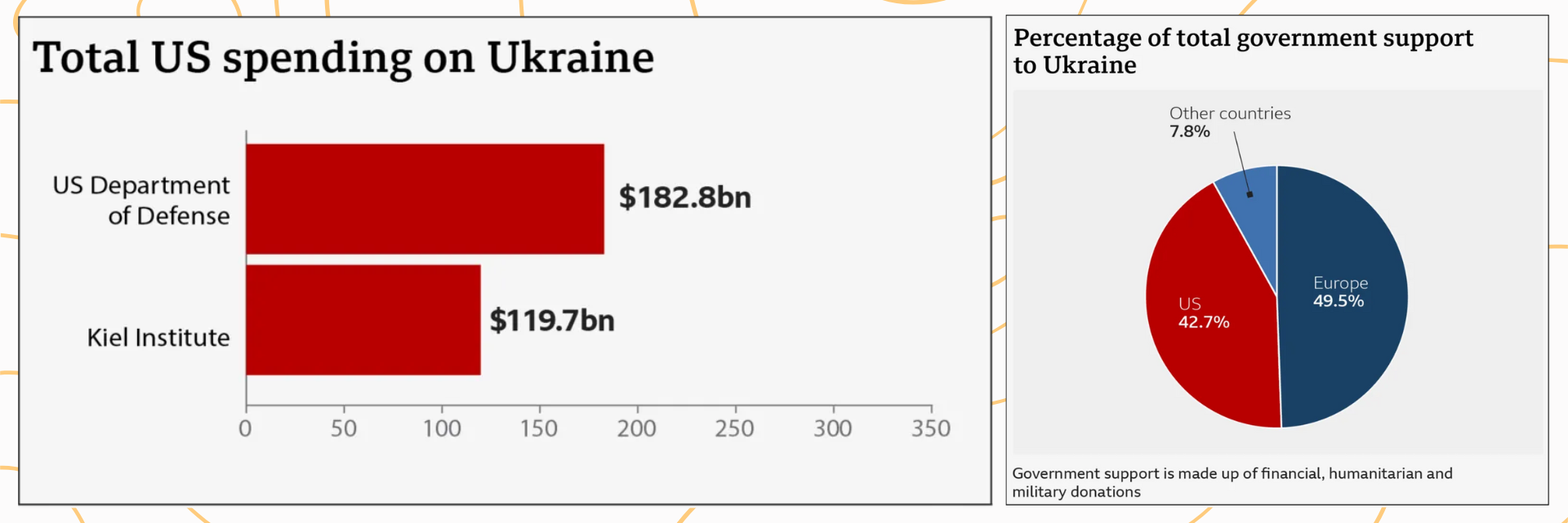
Moreover, BBC publications highlight that such “large” sums arise primarily from combining domestic and external expenses. In other words, the U.S. may spend money on weapons that remain in American arsenals, yet those purchases still appear in official documents under “aid to Ukraine.”
Analysis by Economists for Ukraine: Where Fact and Myth Diverge
The most high-profile work to date has come from the analytical group Economists for Ukraine, which states that the real economic value of U.S. support is significantly lower than what even the Kiel Institute or government agencies have calculated. According to representatives of this international initiative — comprising around 400 economists worldwide — most of the current figures are “highly inflated” due to the way they are tallied, including loans, logistics, and other internal U.S. costs as part of “aid to Ukraine.”
In a statement from Economists for Ukraine, it’s noted that a team of 19 researchers spent several months meticulously examining every item of U.S. assistance deliveries from 2022 to 2025. This included:
- Determining the exact cost of weapons and equipment, factoring in depreciation and the “age” of military hardware.
- Distinguishing between non-repayable grants, versus loans, lend-lease, or guarantees used to underwrite significantly larger lines of credit.
- Separating out internal U.S. expenditures (for example, modernizing its own weaponry or logistics that remain in the United States) from the material support that actually reaches Ukraine.

“The total amounts to approximately $50.9 billion in aid over three years of full-scale war, of which $18.3 billion is genuinely military in nature,” the authors reveal. The specialists explain that the officially quoted figure for military aid sometimes reaches $60 billion or more, but this includes “the purchase price of new weapons rather than the actual ‘book’ value of older equipment transferred.”
Economists for Ukraine compiled a classification of eight different forms of support often grouped under the general term “aid”:
- Direct financing through international institutions (the World Bank) to cover social expenditures (teachers’ and medical workers’ salaries).
- Loansthat Ukraine must repay.
- Collateral for obtaining larger credit lines: “If the U.S. provides $1.6 billion, under which $25 billion in loans becomes available, the real risk to the U.S. budget is only $1.6 billion, not the entire $25 billion.”
- Treasury Account Grants — targeted defense funds often used to purchase equipment from U.S. defense companies (some of it is sent to Ukraine, while the remainder stays in reserve).
- Direct equipment transfer (Presidential Drawdown Authority) — the United States transfers older or surplus weapons from its stockpiles, which in Pentagon accounting are no longer recorded “at full purchase value.”
- Indirect equipment transfer — the U.S. reimburses other countries that send their weapons to Ukraine.
- Lend-Lease — a mechanism dating back to World War II, formally approved for Ukraine, but in practice not used.
- Foreign Military Financing (FMF) — programs that finance or provide loans to foreign governments (including Ukraine) for purchasing U.S. military hardware.
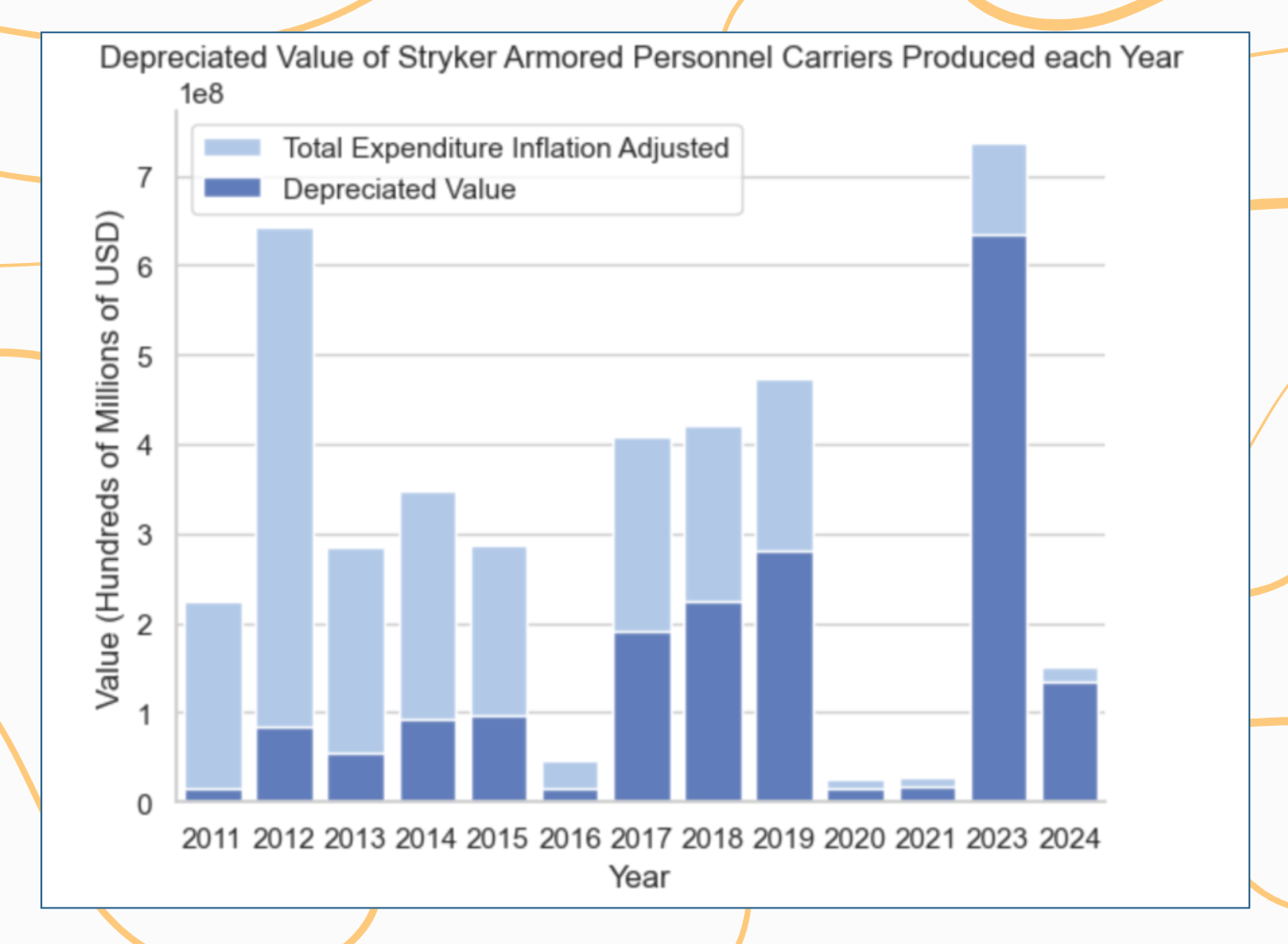
According to their analysis, the biggest discrepancies with official figures occur where “aid” includes U.S. military contracts (replacing its own stockpiles) and any loans that Kyiv is obliged to repay.
“We’ve calculated that out of the $50.9 billion in real aid, only $18.3 billion is genuine weaponry and military equipment actually delivered to Ukraine, rather than just purchased for U.S. needs,” the Economists for Ukraine document states. “Part of the funds is allocated for loans that Ukraine must repay, so calling them ‘financial gifts’ is not entirely accurate,” the authors add, emphasizing that from the perspective of the U.S. government, it’s far from the colossal outlays official appropriations reports might suggest.
For the most part, the discrepancy between the officially announced sums and what the Ukrainian Armed Forces actually receive arises from failing to account for depreciation — for instance, when decommissioned 1980s-era APCs are listed in reports at the price of modern models. It was also important to differentiate between “loans” and “grants,” since these are often lumped together in public statements, making the total seem larger. But if it is debt, it will have to be repaid.
While this aid remains symbolically and practically significant, the numbers could be drastically lower than what’s announced on the political stage. This is crucial for both the Ukrainian side and U.S. taxpayers, to avoid manipulations surrounding supposedly “fantastic sums.”
The Key Issue Isn’t the Figures, but Saving Lives
Amid Russia’s full-scale war, what matters most to Ukraine is not whether the sum is “300 or 500 billion,” but whether it can directly defend itself and protect its citizens’ lives. According to President Volodymyr Zelensky, soldiers and civilians die every day at the front, and any delay or debate about “excessive sums” can create the illusion that Ukraine is receiving unlimited resources.
“I think we need to sort out the issue of aid. We have completely different figures, unfortunately. The war has cost us 320 billion dollars. 120 billion is from us — the people of Ukraine, the taxpayers; 200 billion is from the U.S. and the European Union,” Zelensky said at a press conference on February 19, 2025.
He also clarified that Ukraine has received about $67 billion in military support from the United States and another $31.5 billion in financial aid for budgetary expenditures. However, the President rejects claims that the total sum of aid amounts to “500 billion” and considers it absurd to demand its “repayment” in the form of natural resources or rare-earth metals.
In comments to the media, he added that Ukraine does not recognize this “500 billion” as debt because a significant portion of these funds are provided as grants, and under previous agreements, such amounts do not need to be repaid. If new loan or credit program proposals arise, then, in his words, “that’s another agreement with different conditions,” and Kyiv is ready to negotiate if it aligns with Ukraine’s interests and security needs.
“We are not just a raw-material-exporting country — it’s vital for us that agreements involve not only access to resources but also investments and security guarantees. We can’t just reduce everything to ‘Repay the debt,’” Zelensky explained during a meeting with journalists.
Precisely because Ukrainian citizens are dying every day in this war, the Ukrainian government calls on international partners to gauge support not by formal billion-dollar tallies but by the genuine contribution to saving human lives. For Ukraine, the key issue remains ensuring the armed forces have stable access to weapons, equipment, and resources so as to prevent further casualties among civilians and military personnel; after all, the state’s very survival is at stake.
Author: Lukian Selskyi