


On the sidelines of the 70th session of the UN Commission on the Status of Women in New York, the Ukrainian delegation, state institutions, and public organizations held a series of high-level events dedicated to a just peace, women’s access to justice, rehabilitation of victims of captivity and war-related sexual violence, and international responsibility for the Russian Federation’s war crimes. The focus of the discussions was the thesis that sustainable peace is impossible without justice, and justice is impossible without the full participation of women.
This was reported by the Association of Women Lawyers of Ukraine “YurFem”, the Government Commissioner for Gender Policy, and the NGO “La Strada-Ukraine”.
One of the key events was the high-level side event “Achieving a Just Peace: Justice as an Integral Element and Women’s Participation in Peacebuilding”. The event was organized by JurFem together with the Permanent Mission of Ukraine to the UN and the Government Commissioner for Gender Policy Kateryna Levchenko. The event was also supported by the Ukrainian Women’s Fund, the World Federation of Ukrainian Women’s Organizations, the Georgetown Institute for Women, Peace and Security, the Global Survivors Fund, the International Center for Transitional Justice and Legal Action Worldwide.
The event brought together representatives of state delegations to the CSW, permanent missions to the UN, international organizations, the expert community and civil society. The main goal of the discussion was to develop recommendations on how to achieve justice for Ukraine and victims of war crimes committed by Russia, as well as how to ensure the real participation of women in peace-building processes.
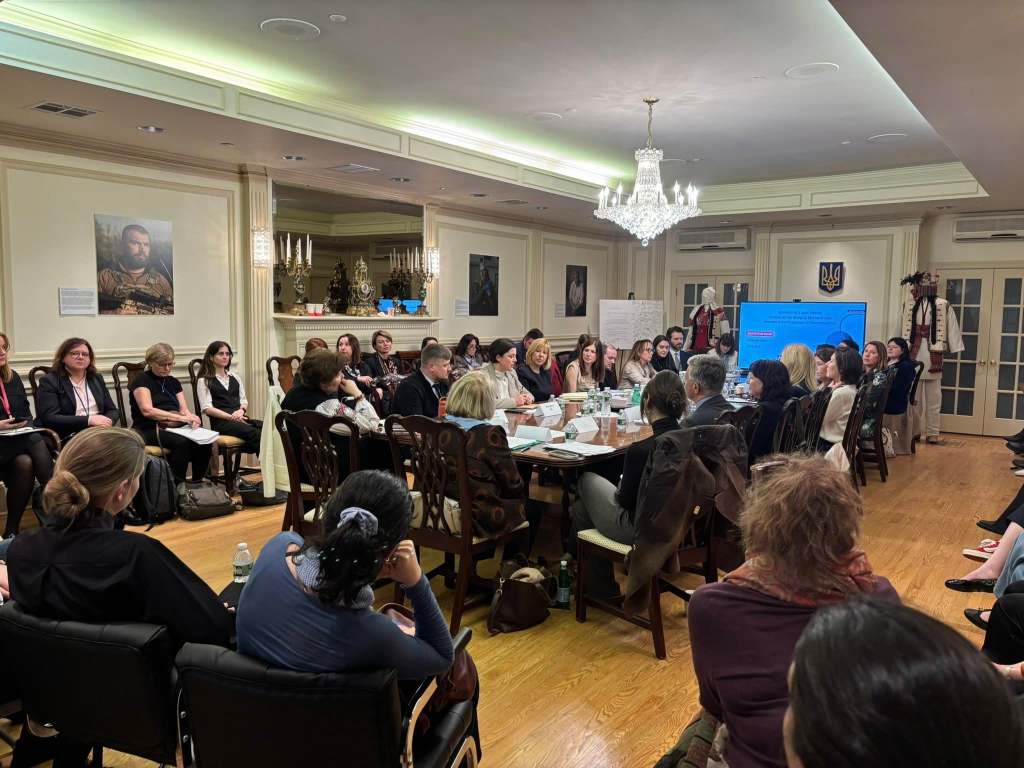
Participants emphasizedthat a just and lasting peace cannot be reduced to the cessation of hostilities alone. It must include accountability for international crimes, the restoration of the rights of victims, gender-sensitive approaches to justice, and the participation of women in negotiations and peacebuilding at all levels.
The event was moderated by Melan Verveer, Executive Director of the Georgetown Institute for Women, Peace, and Security. The Deputy Minister of Foreign Affairs of Ukraine, Mariana Betsa, delivered a welcoming speech.
The first block of the discussion was devoted to what a just peace means in the context of Ukraine, as well as the Ukrainian experience, challenges in ensuring justice, and the role of women in peacebuilding. This block also presented an analytical brief prepared by JurFem and partners on the participation of women in the processes of achieving a just peace.
The second block focused on how states understand a just peace in foreign and security policy, as well as what specific steps governments and international organizations can take to strengthen justice and ensure women’s participation in peace processes. The third part of the event was devoted to global approaches to accountability and justice as integral elements of a just peace, as well as how the Ukrainian experience influences international approaches to transitional justice.
“The recommendations voiced during the event concern not only Ukraine, but also the international community as a whole, as these requirements are directly related to issues of security architecture in the world,” emphasized the head of JurFem, Khrystyna Kit.
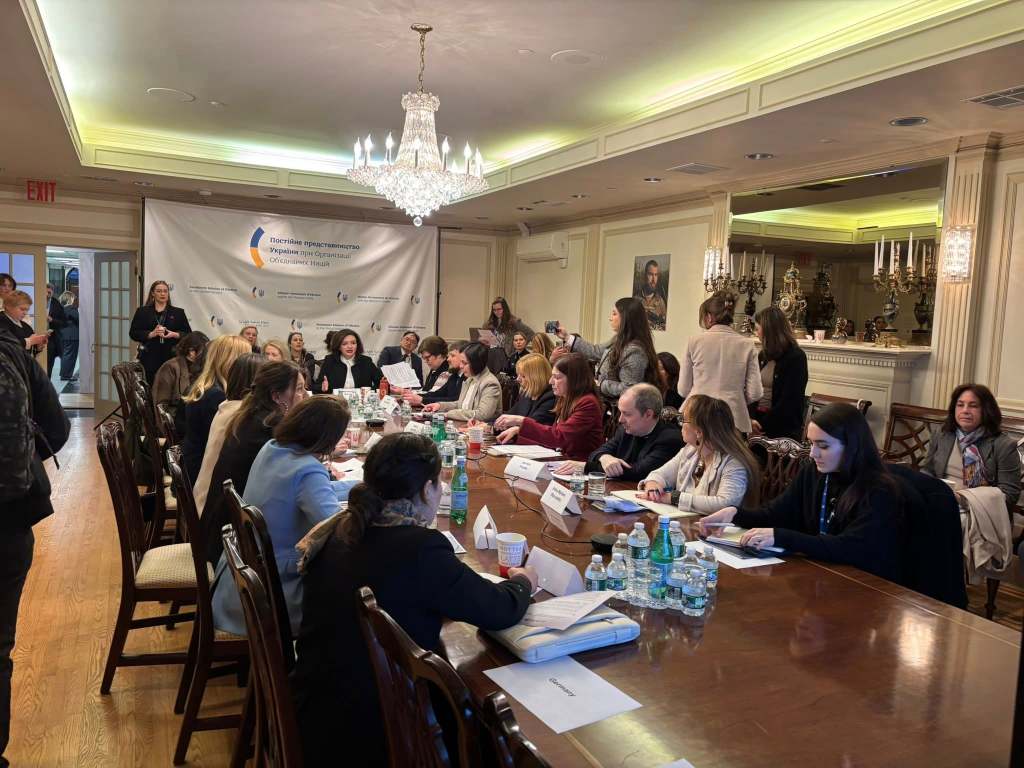
Special attention in New York was paid to the topic of the return of women from captivity. Thus, on March 12, the Government Commissioner for Gender Policy Kateryna Levchenko took part in the event “Beyond Liberation: Justice and Recovery for Women Returning from Captivity”, organized by the ICF “Ukrainian Foundation for Public Health” in cooperation with state institutions and public organizations, in particular “JurFem” and the NGO “Numo, Sisters!”.
The event was attended by representatives of diplomatic missions, international organizations, mental health and social protection sectors, as well as experts on justice and gender policy. The aim of the event was to form a holistic vision of access to justice for women who have survived captivity - as a long-term process that encompasses not only legal responsibility, but also psychosocial recovery, rehabilitation, restoration of dignity and subjectivity.
During the discussion, Kateryna Levchenko emphasized the need to combine legal and social mechanisms to support victims, including women who have survived conflict-related sexual violence.
“Justice after captivity is not a moment, it is a process that includes restoring trust, institutional reforms, international solidarity and accountability for war crimes,” emphasized Kateryna Levchenko.

Another important area of Ukrainian advocacy was the high-level side event “Advancing Women’s Access to Justice: Building justice systems that deliver for all, including in fragile contexts”, organized by UNDP in collaboration with UN Women, Brazil, the Kingdom of the Netherlands and Ukraine. During the discussion, participants focused on how justice systems can more effectively respond to the needs of women and girls, especially in situations of crisis, instability and armed conflict.
UN Women Executive Director Sima Sami Bachus focused on systemic inequality in access to justice.
“We must ensure that justice is accessible to half of the population,” she emphasized.
Kateryna Levchenko, speaking during the panel discussion, presented the Ukrainian experience of promoting gender-sensitive justice in the context of full-scale Russian aggression.
“Gender-sensitive justice cannot wait for the end of the war, it must be provided now. Part of these efforts is to hold the Russian Federation accountable for international crimes, including including it in the so-called “list of shame” for committing conflict-related sexual violence,” she said.
A separate area of work for the Ukrainian delegation at the 70th session of the UN Commission on the Status of Women was the presentation of the Implementation Plan for the Implementation of the Framework for Cooperation between the Government of Ukraine and the UN on Preventing and Responding to Conflict-Related Sexual Violence for 2026-2027. The event “Strengthening Commitments, Advancing Protection and Accountability: Presenting Ukraine’s Implementation Plan on CRSV 2026-2027” was held on March 9. The Special Representative of the UN Secretary-General on Sexual Violence in Conflict, Pramila Patten, and the Deputy Permanent Representative of Canada to the UN, Michael Gort, delivered welcoming remarks.

During the discussion, participants focused on strengthening accountability mechanisms for crimes of sexual violence, developing a system of support and rehabilitation for victims, interagency coordination, international partnerships, as well as the role of civil society and initiatives led by victims themselves.
The event concluded with speeches by Deputy Prosecutor General of Ukraine Andriy Leshchenko and Deputy Minister of Foreign Affairs of Ukraine Maryana Betsa, who emphasized the critical importance of international solidarity in ensuring justice, accountability, and dignity for victims.
Olga Dunebabina, Strategic Communications Manager of the NGO La Strada-Ukraine, spoke in the “Frontline Responders” panel discussion, and spoke about the role of civil society organizations in supporting victims and training law enforcement professionals and judges.
“Training Ukrainian law enforcement officers and judges is important. But I want to remind you that this alone will not help bring all Russian perpetrators and criminals to justice. Only international tribunals and courts, organized by the joint efforts of Ukraine and the world, are capable of ensuring justice and accountability for crimes,” emphasized Olga Dunebabina.
The voices of victims were also heard at the event. In particular, the representative of SEMA Ukraine, director of the documentary “Traces” Alisa Kovalenko spoke about the importance of victims not only being included in international discussions, but also being heard as full participants in the formation of memory, recovery and justice policies.
In the end, the main message that was heard at all venues of the 70th session of the UN Commission on the Status of Women boils down to the common position of the Ukrainian state and international partners: a just peace for Ukraine is impossible without punishment for war crimes, without support for victims and without women at the decision-making table.
Photo: Association of Women Lawyers of Ukraine “YurFem”, La Strada-Ukraine
Author: Inna Mikhno