In 2024, new tennis courts were opened in Zolochiv, Ukraine. The initiator of this wonderful gift for Ukrainians was Yaroslav Lisevych from the United States. The Department of Youth and Sports described this unique event as follows: “From now on, two new clay tennis courts will operate in Zolochiv. The project was implemented thanks to a patron from the Ukrainian diaspora in the U.S.—Mr. Yaroslav. In this way, he fulfills the wish of his mother, Olha Lisevych, who directed her savings toward supporting Ukrainian children and their future.” This is truly a kind and meaningful act of support for children in Ukraine from Ukrainians in the United States. This unique interaction is a direct result of the strong, long-standing connection between the diaspora and their homeland. For example, in nearly every interview with American athletes of Ukrainian descent, one hears a shared dream—a strong desire to visit Ukraine at least once or to help in some charitable way. It is therefore no surprise that such projects are being implemented today.
Tennis is extremely popular among the Ukrainian diaspora in the United States. Thousands of Ukrainian Americans are engaged in this sport, whether at the amateur level or even professionally. Moreover, Ukrainians often play tennis as entire families—there are even tennis dynasties within the Ukrainian community in the U.S. At the same time, Ukrainian Americans achieve significant individual success in the sport.
The Matkivsky Family
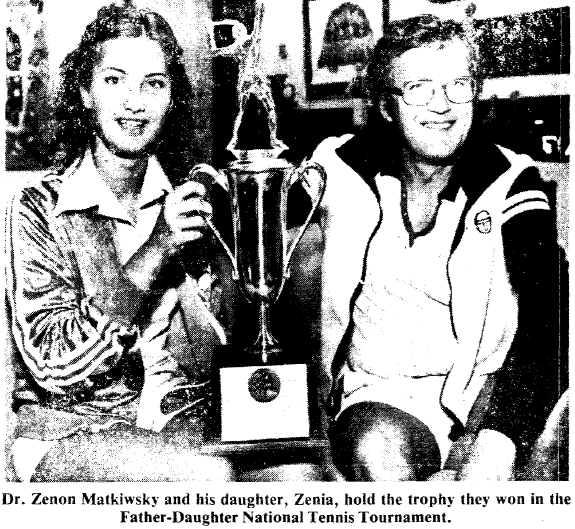
In 1978, the U.S. National Parent–Daughter Tennis Championship took place as part of the Equitable (Life Assurance) Family Tennis Challenge. The winners of the tournament were Zenon Matkivsky and Zenia Matkivska. This remarkable event for the Ukrainian community in the United States was covered by both American and Ukrainian-language media (The Star-Ledger, Svoboda). The winning father began his story as follows: “I essentially play only on weekends. I play when I’m not in the office… and I practice with my children.” Thus, Mr. Zenon was not a professional athlete—he played tennis only when he had free time. However, this amateur approach did not hinder his growing skill. As he himself noted: “I am a club tennis player, not a professional. I only recently became interested in the game.” At the time, Zenon was forty-five years old and worked as a physician, serving as head of surgery at a general hospital in Union. Before discovering tennis, he had been involved in other sports: “Tennis was not available where I grew up (in Ukraine)—at that time I was interested in soccer, volleyball, and ping-pong. I was also quite a skilled skier in my time, but not anymore… I became interested in tennis around 1964, when I started watching professionals on television. I took it quite seriously as a form of physical exercise.”

His sixteen-year-old daughter Zenia shared how they prepared for the competition: “My dad told me that we would go out and do our best, and I said, ‘Yes, yes, of course.’ But I was a little nervous. All I could think about was that all those players from California must be incredibly strong, and all these thoughts were spinning in my head.”
Speaking about their performance, Zenon said: “In our section, we defeated all opponents in three sets. The toughest match was the final against a pair from Atlanta, Georgia. The final score was 6–3, 7–5 in our favor.” Considering that thousands of participants from across the country took part in the tournament, the path to the final was far from easy: “The sectional competition in Philadelphia was quite strong, and we won it—that qualified us for Flushing Meadows. Two hundred thousand players registered for the tournament, and only 64 qualified.” An extraordinary achievement—out of 200,000 participants, the winners were Ukrainians.
Zenia Matkivska’s memories were deeply emotional: “When we won, I couldn’t believe it. It was incredible and at the same time the funniest feeling—I felt like a professional. And then, when the trophy was presented on the center court in front of such a large audience, I realized how important this victory was for me, for my dad, and for our whole family.”
After the victory, Zenon remarked: “It’s good to keep your body in shape—I would encourage everyone to do it. For my age, I feel quite strong and in good shape now. I can keep up with younger people. I even started jogging after hearing the slogan ‘Run for your life.’” This is truly a great example not only for young people but for everyone. Even after forty, one can maintain good physical shape and stay active in sports.
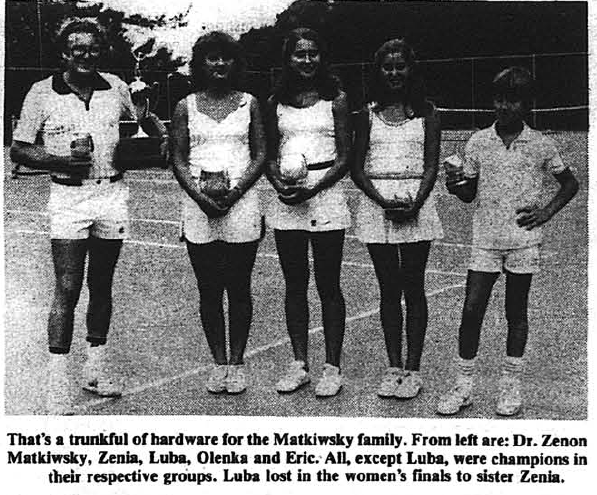
Zenon added: “Now I play tennis three to four times a week, about an hour and a half a day. At the club where our family takes lessons, there were many good players, so we thought we had a chance to qualify for the national championship.” He also noted that the entire Matkivsky family—including his wife Nadia, his nine-year-old son Eric, and Zenia’s sisters Liuba (14) and Olenka (12)—took lessons weekly. These are truly wonderful family tennis traditions. Looking ahead, Zenon said: “I’m already too old to become a professional, but I wouldn’t mind playing against professionals like Connors, Vilas, and Borg.”
Zenia later trained under the renowned tennis champion Althea Gibson. Speaking about her early interest in tennis, she said: “I really became interested in it thanks to my father. Every day we went to the courts and hit a few balls. Now I just want to work hard, play, and try to improve so that I can compete with professionals—and win.” As of 1978, Zenia Matkivska had already achieved significant success in tennis: she was the number one player on the Millburn High School tennis team; the winner of the national tournament at Soyuzivka (where she won the women’s division), earning 40–50 trophies in singles and doubles over the years; and the champion of the Princeton Open and the Big Flats Open in New York.
Interestingly, most of Zenia’s friends did not even know she played tennis—until she and her father won the prestigious national family tournament. She also shared that their bond extended beyond the court: “We jog together, play tennis, and we’re alike. We also discuss problems together, and we can go anywhere and have a good time—we even mow the lawn together.”
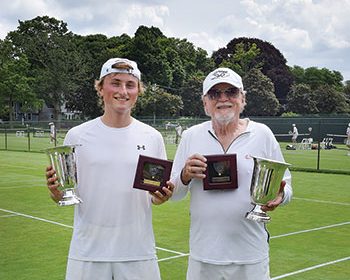
In 2015, a truly sensational event took place, reported by the press: “Zenon Matkivsky and Greg Olesnytsky won the Grandfather–Grandson Tennis Championship.” Yes, this is not a mistake—it is a real family legacy. Ukrainian media in the United States described the event as follows: “Florham Park, New Jersey—the grandfather and grandson duo of Zenon Matkivsky and Greg (Hryts) Olesnytsky won the USTA Grandfather–Grandson National Grass Court Championship in July 2015. Dr. Matkivsky, 83, and Mr. Olesnytsky, 21, won the 94th annual championship, held at one of the oldest and most prestigious tennis clubs in the country—the Longwood Cricket Club in Chestnut Hill, Massachusetts—with an undefeated record, winning several very challenging matches. They were awarded the USTA Gold Ball and a trophy. The championship was a round-robin tournament, in which each duo played against all others on a challenging grass surface over several days, from July 13 to 15.” Thus, many athletes from across the country took part in the competition. It is especially gratifying that Ukrainians emerged as winners of such a prestigious tournament.
Zenia Olesnytska, one of Zenon Matkivsky’s daughters and Greg’s mother, commented on this unique victory: “It was incredibly moving to see history repeat itself after 37 years. In 1978, my father and I won the USTA national father–daughter championship at Flushing Meadows during the U.S. Open. My father is now a two-time champion—once with his daughter, and now with his grandson.”
Phenomenal. Unique. Truly remarkable.

Tennis as a Family Sport
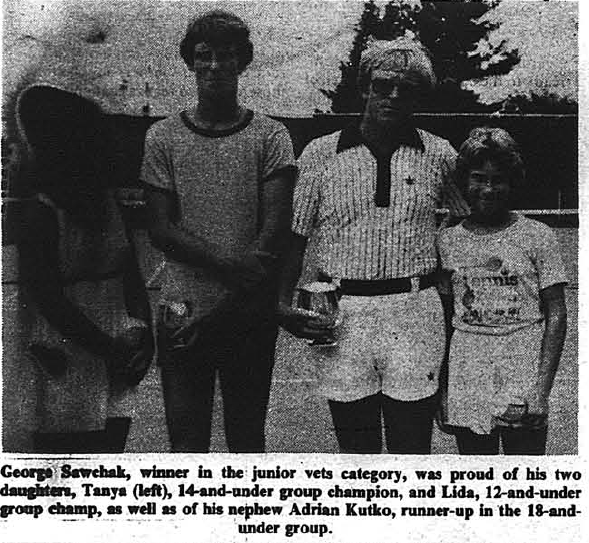
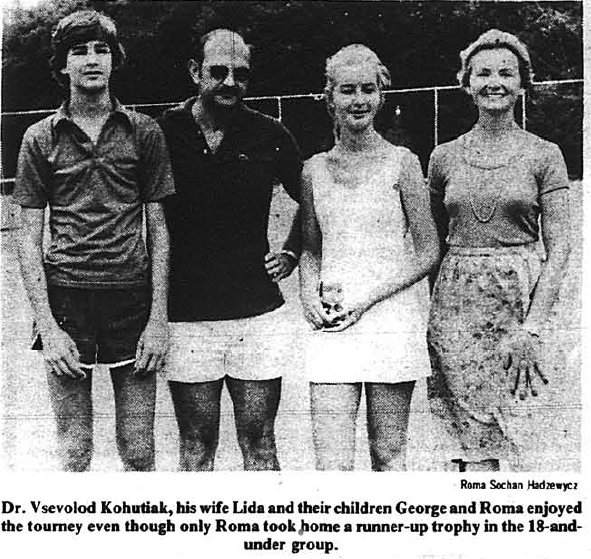
It is worth noting that among Ukrainian Americans, tennis is truly a family sport. As early as 1980, the Ukrainian newspaper Svoboda in the United States wrote about several families who played tennis: the Matkivskys, Savchaks, Shyyans, Sydoraks, and Kohutiaks.
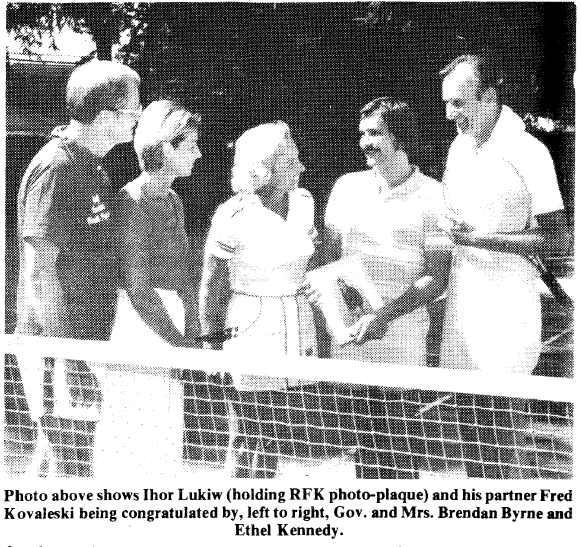
It is also important to emphasize that Ukrainians have integrated into and contributed to American family tennis traditions. A vivid example of such interaction and integration is the participation of Ihor Lukiv in the Kennedy Tennis Tournament—the RFK Tennis Tournament. This is an extremely popular event named after Robert F. Kennedy. Over the years, its participants and guests have included politicians, professional athletes, and stars of entertainment, film, and music (Pelé, Clint Eastwood, Dustin Hoffman, Arnold Schwarzenegger, Diana Ross, Muhammad Ali, Michael Jackson, and others). Ukrainian Americans have their own representative in this prestigious competition—a participant and winner, Ihor Lukiv.
Briefly about Ihor Lukiv’s achievements in tennis: September 1976, Soyuzivka (Ukrainian National Association estate): Lukiv lost in the second round to Ted Laskowski; August 1977, same venue, 25th anniversary tournament: in the men’s doubles semifinal, Lukiv and Stepan Fedorovskyi lost to the strong pair Zenon Snylyk and Yurii Savchak; September 1977, same venue, 22nd tournament of the Ukrainian Sports Federation of America and Canada: Lukiv took first place in his group (representing the Ukrainian Sports and Educational Society “Chornomorska Sich”), defeating Andrii Lenets in the final; August 1978, same venue: he repeated his success in the men’s division; in mixed doubles, Lukiv and Natalka Pytliar lost in the final to Areta Rakocha and Myron Shenkiryk. Of course, Lukiv has many more tournaments “behind him”—that is a separate story in itself.
Returning to the RFK Tennis Tournament, special attention should be given to this distinguished Ukrainian. Ihor Lukiv qualified for this prestigious event by winning the annual Governor’s Cup doubles tournament held in July 1977 in Morven. In addition, only 16 top corporations in New Jersey were selected to participate in the tournament, each delegating two players. Among those chosen were Ihor Lukiv—a chemist and research scientist at Schering-Plough Corporation—and his partner Fred Kovaleski, a senior vice president of the same company. The corporation’s choice of Lukiv was no coincidence. While studying at Pembroke University in North Carolina, he was ranked the number one tennis player. Notably, in 1978, the Lukiv–Kovaleski pair won the corporate competition at the RFK Tennis Tournament and also repeated their success in the Governor’s Cup.
Thus, Ukrainian Americans have strong and long-standing tennis traditions. Ukrainians achieve success both as families and as individuals—even in the most prestigious tournaments featuring stars of sports, film, politics, entertainment, and public life. In this way, Ukrainians continue to affirm their reputation as champions.
Author: Oleksii Lyakh-Porodko