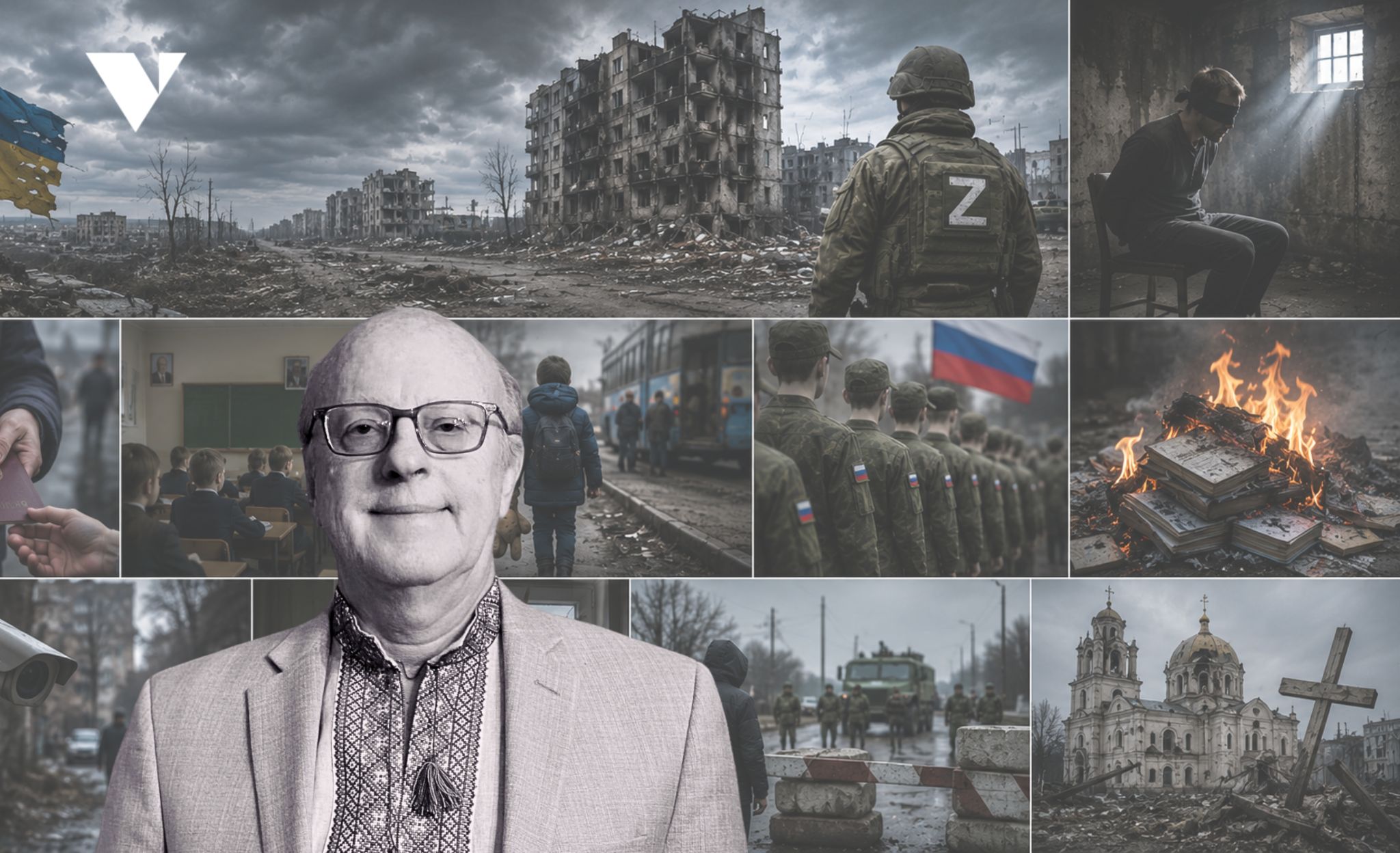
The plight of Ukrainians living under Russian occupation does not get nearly the attention it deserves. But it should, because conditions for the estimated 3-4.5 million Ukrainians living there are dreadful, and, in some respects, they are deteriorating.
It has become a given that the currently occupied territories will remain under Russian control for some time to come. This is considered an unpleasant truth, a fait accompli, for Ukraine and its allies. In turn, this perhaps results in a hesitancy for us to fully confront the suffering endured by millions of Ukrainians.
Any stop to the war, should one take place at all, would likely involve a ceasefire with the front lines frozen in their current state, which would lead to an acknowledgement of the reality that Russia exercises control over the territory it occupies. What this would mean is some sort of de facto recognition of Russian-occupied territory. And while Ukraine is more than holding its own these days, we probably won’t see a Ukrainian victory with a complete Russian withdrawal from Ukraine in the near-term (as desirable as that would be).
This brings up the question of de-jure recognition – the formal, legal acknowledgement that a territory belongs to a particular state. You might recall that last year U.S. President Donald Trump toyed with the idea of formally recognizing Russia’s annexation of Crimea, which was met with strong opposition from Ukraine, Europe, the U.S. Congress and foreign affairs policy experts. I doubt that the international community would ever go so far as to legally recognize Russia’s control over the territories that it currently occupies, even in the event of a durable ceasefire.
It is incumbent upon the international community to uphold the policy of non-recognition and never, ever, legally accept Russia’s occupation of Ukrainian lands. Western countries must follow the model of the Welles declaration of 1940, when the United States refused to diplomatically recognize the annexation of the three Baltic states by the Soviet Union. They should do so not only for the sake of international principles but for the sake of keeping the faith of the Ukrainian people who suffer daily under Russia’s brutal occupation.
One cannot overstate the level of repression in the occupied territories or the brutality of the level of suppression of any manifestation of dissent. With the passage of time, one might think it has let up. Not so. Just one telling example illustrates the point. According to an April 22 account by the Ukrainian human rights organization Truth Hounds, there are at least seven torture chambers in Enerhodar holding no less than 78 staff of the occupied Zaporizhzhia nuclear power plant, Europe’s largest.
The human rights picture continues to be deeply distressing. Russian abuses abound. According to a Freedom House 2026 report, the Russian occupied territories of Ukraine (the report covers conditions in Crimea and the occupied parts of Donetsk, Luhansk, Kherson and Zaporizhzhia oblasts) are currently ranked as the least free place in the entire world with a -1 rating. Think about that for one minute. They are rated even lower than major human rights violators, such as North Korea, or China’s occupied Tibet and Uyghur regions. By way of comparison, even highly repressive Russia gets a score of 12 out of 100, putting it in the “not free” category. Wartime Ukraine gets a 51 out of 100 and is listed as “partly free.”
Human rights abuses in the occupied territories include (but are not limited to) arbitrary and unlawful killings, enforced disappearances, abductions, torture, violence (including sexual violence) and forced displacement and deportation. It will surprise no one that those perceived to be disloyal to the Russian occupiers are particularly vulnerable.
Ukrainians in the occupied territories are demonstrably deprived of any rights and freedoms. Political rights? Zero. Political pluralism and representation? Zero. Freedoms of speech, expression, assembly and association, and the press? Zero. Religious liberties? Well, close to zero, unless you belong to the loyal Russian Orthodox Church (ROC). Evangelical Christians, Ukrainian Greek-Catholics, Ukrainian Orthodox, and other non-ROC affiliated religious groups are persecuted. Nearly 70 clergy have been killed in Ukraine since 2022.
And, as all of us are aware, there are tens of thousands of children who have been forcibly removed from their homes in the occupied territories.
Russia’s repression and abuses are not arbitrary. The violations are systematic, and they are the result of deliberate policies that affect every aspect of civilian life. These policies are abetted by various systems of control, including pervasive physical and digital surveillance. Moreover, Russia has imposed an information blackout to cut the occupied regions off from the rest of Ukraine.
There is also the issue of passportization, in which Russian authorities compel Ukrainians to obtain Russian citizenship or be denied medical care and other social services and face various restrictions, making their daily lives more difficult.
Then there is Russification – the attempt to erase all manifestations of Ukrainian identity, which arguably constitutes genocide, or at a minimum genocidal intent. Ukrainian schoolchildren, of which there are more than 580,000 in the occupied territories, are indoctrinated with pro-Russian education promoting the “Russian world” narrative and are consistently fed lies about Ukraine.
To add insult to injury, military-patriotic camps and state-sponsored youth organizations prepare these Ukrainian youngsters for conscription, in effect turning them into Russian soldiers who will fight against their fellow Ukrainians. Indeed, just this year alone the conscription of youth has intensified as part of a systematic and coercive process. Keep in mind that the 4th Geneva Convention proscribes occupying authorities from compelling residents of occupied territories to serve in its armed forces.
Among other manifestations of Russification are the burning of Ukrainian books taken from schools and libraries, the looting of museums, the destruction of Ukrainian symbols and the renaming of streets.
Russia expands its control and integration of the occupied territories through other means – including outright colonization. To replace the millions of Ukrainians who have fled, Moscow brings in Russian settlers. Russian authorities reportedly plan to resettle more than 115,000 Russians in occupied Ukraine by 2045.
The occupying powers target local Ukrainians through property seizures, giving homes to Russians moving to the territories. Mariupol, where 90 percent of the city’s residential buildings were damaged or destroyed during Russia’s brutal siege in 2022, is a case in point. Moscow has essentially been stealing the homes of Ukrainians who fled or whose homes were damaged during the siege. Onerous new rules have been imposed on Ukrainians that are designed to make the required Russian title deed extremely difficult to obtain, if not impossible to obtain, and incoming Russians are encouraged to buy these homes at ridiculously low interest rates.
Given the current geopolitical situation, Ukraine’s growing strength and determination, and increasing Russian vulnerabilities, it will not take anywhere near the 50 years it took the Baltic States to break free of Russian occupation, or, for that matter, the 41 years that it took for East and West Germany to be reunified. For the sake of Ukrainians suffering under Russian domination, let’s hope and pray that their day of liberation arrives sooner rather than later. In the meantime, let’s ensure that, at a minimum, they are not forgotten.
Author: Orest Deychakiwsky