


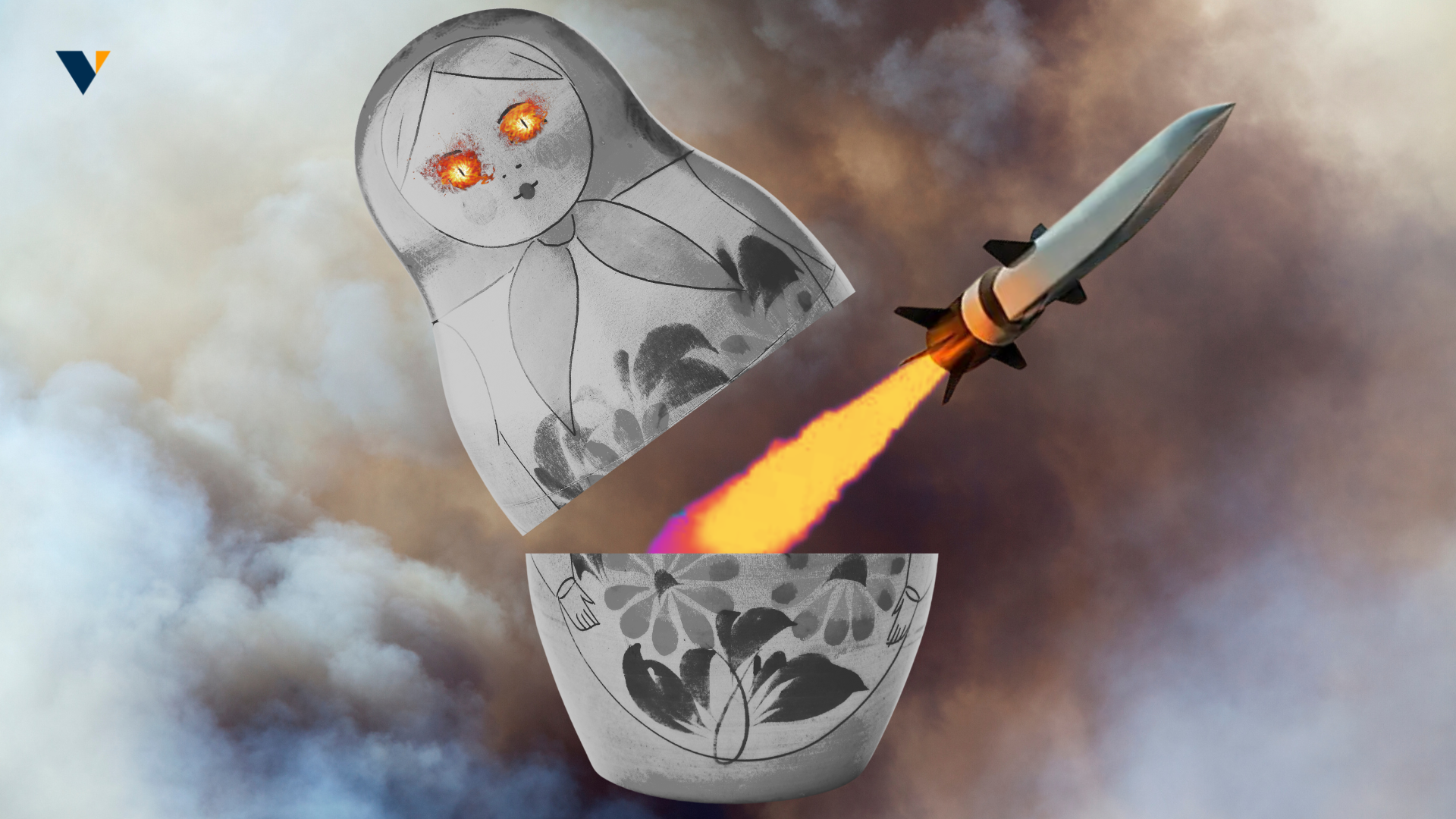
What place should russian culture hold in a Ukrainian’s life? In the midst of a brutal invasion, the answer may seem obvious. And yet, Ukrainians living in America are split - some categorically reject everything russian, while others remain entwined with our abusive “big brother.”
My adopted hometown of Washington DC is home to a large and vibrant Ukrainian diaspora. Unfortunately, it is also home to a large russian emigrant community. For a long time, the two remained close. Many of us maintained friendships with each other - in the US, russians, Belarusians, Moldovans, all seemed like nashi - our people. We spoke russian - our common language. We went to the russian grocery stores and attended russian cultural events.
Over time, russia thoroughly lodged itself in Ukrainians’ memories, recipes, and friendships. And then, February 24th came and our world exploded.
The Ties that Bind
When faced with something (or someone) russian, we essentially have four options. There’s nonchalant acceptance (“What’s the big deal?”). There’s resigned tolerance (“I don’t like it but I can’t stop”). There’s rejection (“russian things and people are now dead to me.”) And finally, there’s explicit protest.
Before the full-scale invasion, I practiced nonchalant acceptance. Raised bilingual russian & Ukrainian in a post-Soviet cultural soup, I had War and Peace and Master and Margarita on my shelves and Salad Olivier, shuba, and pelmeni in my kitchen. My friends were a mix of Ukrainian-speaking Ukrainians, russian-speaking Ukrainians, russians, Belarusians, Americans married to russians, Russian Jews, half-russians/half Ukrainians…it was hard to keep track. Війна і мир and Майстер і Маргарита, а в холодильнику були салат «Олів’є», «шуба» і пельмені. Мої друзі були різні: україномовні українці, російськомовні українці, росіяни, білоруси, американці, одружені з росіянами, російські євреї, напівросіяни/напівукраїнці… за всім цим було важко простежити.
The full-scale invasion pushed me to loosen my russian ties, but total purity proved impossible. I put away the books, but the recipes I’d grown up with remained. I stopped going to russian cultural events, but still occasionally put on my favorite Tchaikovsky pieces. Some friendships naturally faded, but others remained.
Oh, and perhaps my greatest moral conflict: my preschooler attends a russian-owned daycare. The owner supports Ukraine; the teachers are Ukrainian. The children are an ethnic mix representing the post-Soviet spectrum. It’s basically a pint-size version of “we are all brotherly nations.” I don’t love it, but after weighing a dozen factors, it’s the least bad option we’ve got.
So I reject what I can - not without an occasional wave of nostalgia for my childhood - and I hold my nose as I wade through the rest.
Most Ukrainians I know share this muddled reality, navigating complicated relationships with all things russian. So I was excited to stumble upon a team of activists who seem to have transcended these complexities - who not only cut russian culture out of their own lives, but actively fight it whenever it pops up.
I spoke to the organizer of this informal group, Maryna Lvovska, to learn more about her success in extricating herself from the long tentacles of russian imperialism.
Fighting russian Culture
Maryna is a force of nature. Originally from Kharkiv, for most of her life, she spoke russian. She joined the russian Facebook groups and sent her son to russian Saturday school. Most of her friends were russian. That is to say, she was in deeper than I had ever been.
February 2022 was an awakening. Maryna told me that she began to feel physical discomfort attending russian events, so she stopped going. At the time, she sang in a pan-Eastern-European chorus whose members were outwardly supportive of Ukraine. And yet, something still didn’t feel right.
“It began to cause cognitive dissonance for me,” Maryna told me. “So we go to perform and they sing a russian song, a Ukrainian song, a Belarusian song, and I tried to explain to them why it’s not good to do this - that it carries the wrong narrative to Americans, that this carries the narrative of ‘brotherly nations’, that you are mixing cultures. That this is a question of identity and the war is fundamentally about Ukrainian identity. And they didn’t hear me. So I realized I would not get anywhere with them.”
Maryna took Ukrainian lessons for a year, switched her son to the Ukrainian Saturday school, and started her own Facebook group for Ukrainian women. She also organized a new chorus, U-Generation, which sang Ukrainian songs (russian members were welcome - but attempts to mix cultures were not).
The problem with even “good” russians, Maryna realized, is that they struggled to recognize the problematic nature of their culture - an imperialist culture built on domination and oppression. They refer to the “tragedy” in Ukraine without identifying the aggressor; they perpetuate imperialism by appropriating elements of Ukrainian culture and sincerely see no issue with it because “we are all brothers”.
Maryna’s activism began with Facebook posts - polite, inconvenient questions which were met with annoyance and eventual bans. So, she began showing up in person, with posters and a speaker, playing air siren sounds and Ukrainian songs.
Most russian event organizers, Maryna told me, didn’t explicitly attack Ukraine - rather, they didn’t mention it at all, celebrating russian culture while ignoring the elephant in the room. Others mentioned supporting Ukraine, but presented russian and Ukrainian cultures as two branches of the same tree. She came to make sure they couldn’t conveniently forget the war, and to protest the brotherly nations trope.
At many events, Maryna and her fellow activists were met with aggressive and even cruel treatment. For instance, at the russian Bazaar at St John the Baptist Russian Orthodox Church in Washington DC, a man attempted to steal the group’s speaker, multiple people insulted the activists, and, in a decidedly unholy gesture, a priest spilled water on her speaker to damage it and then crudely taunted her with insults reminiscent of an elementary-school bully (“That wasn’t me spilling water, that was you peeing your pants!”)
To cope, Maryna tries to put psychological distance between herself and those attacking her. “I mentally separate myself, Maryna the person, from Maryna the activist,” she told me. She feels her work is important and worth the hassle. First, she makes it impossible for russians at the events to forget the war. Second, her activism targets American attendees, who often haven’t thought about how russian culture - not just Big Bad Putin - is complicit in the war.
Ukrainians vs. Ukrainians
My conversations with Maryna left me awed by her strength and determination, but confused by the wide gulf that existed between her views and others in our community. At just this time, our daycare announced a New Years’ celebration with Ded Moroz and Snehurochka as guests of honor. I was torn about whether to let my daughter attend, but other Ukrainian parents and teachers didn’t seem to see a problem with it. Meanwhile, Maryna was organizing a picket of a similar celebration in a nearby town.
What happens when some Ukrainians are actively battling russian imperialism while others take a more flexible approach? When do we judge or confront each other? When do we live and let live? What happens when these philosophies collide?
Recently, Maryna organized a small rally at a performance by the so-called State Ballet Theatre of Ukraine. This troupe is run by russian-Americans out of Brooklyn, NY, who organize Ukrainian ballet dancers to go on tour across North America each year. Formed in 2018, the group chose its name because many performers are alumni of the actual State Ballet Theatre troupe in Ukraine. When the full-scale invasion started, the ballet organizers wrote about supporting Ukrainians during a difficult time - helping some leave for safety, raising funds, and, of course, continuing to put on their annual tours to give the dancers work.
This year, the “State Ballet Theatre” decided to put on Swan Lake by Tchaikovsky. Not a wise or sensitive decision given the war (though it’s unlikely the russian organizers understood this given russians’ aforementioned difficulty seeing the problem with imperialism and mixing cultures).
Maryna was concerned. First, this russian-expat-owned group was using a Ukrainian name, cashing in on Americans’ support for Ukraine. Second, they gave American audiences the impression that an official Ukrainian ballet theater would dance to Tchaikovsky during a war with russia. Лебедине озеро під час війни з росією.
But the thing is, the dancers were Ukrainian… and they had no problem dancing Swan Lake for a russian-American owned company under the State Ballet Theater misnomer. I looked several of them up on social media. Beautiful young people posting glamour shots from Savannah, GA, and Universal Studios, Miami, in a mixture of russian, Ukrainian, and English, with no trace of moral angst. Given the dancers’ blase attitude, how could anyone hope to convince russian organizers or the American audience that this faux-ballet was wrong?
To me, russian culture feels like a cancerous tumor that entwines itself around vital organs, impossible to remove. As in cancer treatment, perhaps the key lies in nuance, evaluating each specific situation, and choosing a response as best you can?
As for my own Ded Moroz dilemma, I decided to skip the New Year’s celebration. I kept my daughter out of daycare that morning and brought her in once the party had come to a close. When I walked into the classroom, I stopped in my tracks. There, pulling off her Snehurochka costume, was our Ukrainian teacher.
Author: Katerina Manoff